







Question: A study reported on the effect of lap band surgery on diabetes. In this study, 49 obese patients with type 2 diabetes were randomly
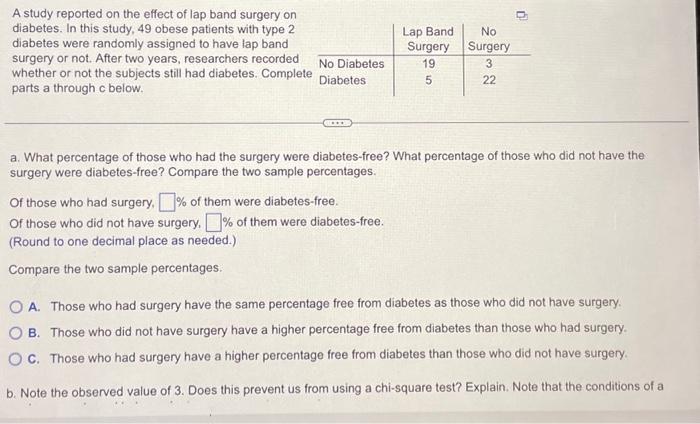
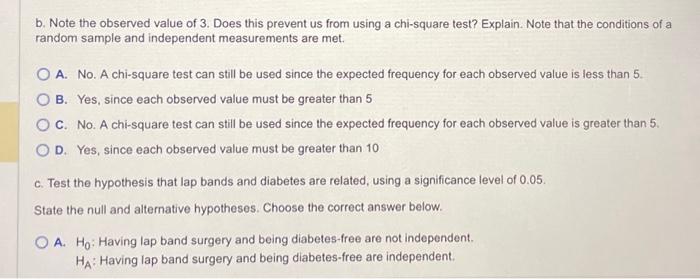
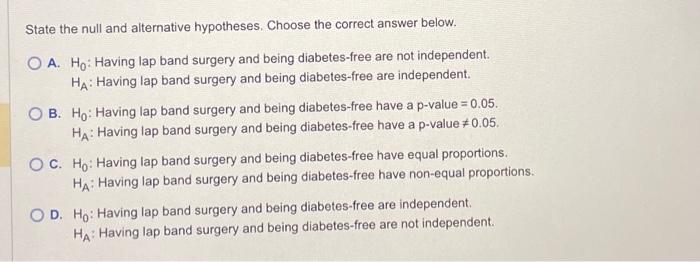
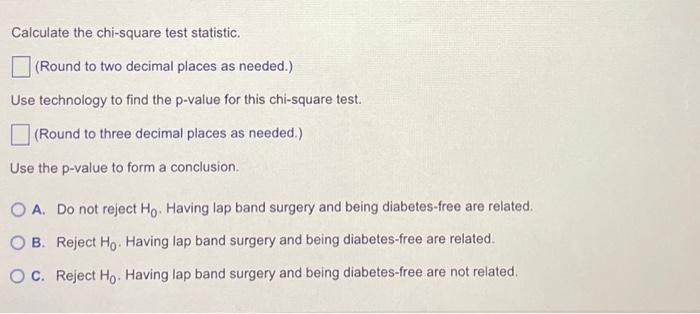
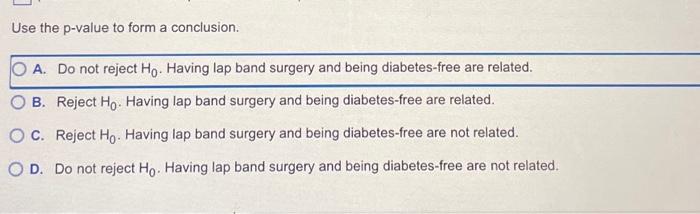
A study reported on the effect of lap band surgery on diabetes. In this study, 49 obese patients with type 2 diabetes were randomly assigned to have lap band surgery or not. After two years, researchers recorded whether or not the subjects still had diabetes. Complete parts a through c below. Lap Band Surgery No Surgery No Diabetes Diabetes 19 3 5 22 a. What percentage of those who had the surgery were diabetes-free? What percentage of those who did not have the surgery were diabetes-free? Compare the two sample percentages. Of those who had surgery. % of them were diabetes-free. Of those who did not have surgery. % of them were diabetes-free. (Round to one decimal place as needed.) Compare the two sample percentages. OA. Those who had surgery have the same percentage free from diabetes as those who did not have surgery. OB. Those who did not have surgery have a higher percentage free from diabetes than those who had surgery. OC. Those who had surgery have a higher percentage free from diabetes than those who did not have surgery. b. Note the observed value of 3. Does this prevent us from using a chi-square test? Explain. Note that the conditions of a b. Note the observed value of 3. Does this prevent us from using a chi-square test? Explain. Note that the conditions of a random sample and independent measurements are met. OA. No. A chi-square test can still be used since the expected frequency for each observed value is less than 5. B. Yes, since each observed value must be greater than 5 OC. No. A chi-square test can still be used since the expected frequency for each observed value is greater than 5. OD. Yes, since each observed value must be greater than 10 c. Test the hypothesis that lap bands and diabetes are related, using a significance level of 0.05. State the null and alternative hypotheses. Choose the correct answer below. OA. Ho: Having lap band surgery and being diabetes-free are not independent. HA: Having lap band surgery and being diabetes-free are independent. State the null and alternative hypotheses. Choose the correct answer below. OA. Ho: Having lap band surgery and being diabetes-free are not independent. HA: Having lap band surgery and being diabetes-free are independent. OB. Ho: Having lap band surgery and being diabetes-free have a p-value = 0.05. HA: Having lap band surgery and being diabetes-free have a p-value #0.05. OC. Ho: Having lap band surgery and being diabetes-free have equal proportions. HA: Having lap band surgery and being diabetes-free have non-equal proportions. O D. Ho: Having lap band surgery and being diabetes-free are independent. HA: Having lap band surgery and being diabetes-free are not independent. Calculate the chi-square test statistic. (Round to two decimal places as needed.) Use technology to find the p-value for this chi-square test. (Round to three decimal places as needed.) Use the p-value to form a conclusion. OA. Do not reject Ho. Having lap band surgery and being diabetes-free are related. OB. Reject Ho. Having lap band surgery and being diabetes-free are related. OC. Reject Ho. Having lap band surgery and being diabetes-free are not related. Use the p-value to form a conclusion. OA. Do not reject Ho. Having lap band surgery and being diabetes-free are related. B. Reject Ho. Having lap band surgery and being diabetes-free are related. OC. Reject Ho. Having lap band surgery and being diabetes-free are not related. OD. Do not reject Ho. Having lap band surgery and being diabetes-free are not related.
Step by Step Solution
There are 3 Steps involved in it

Get step-by-step solutions from verified subject matter experts
 Study Help