







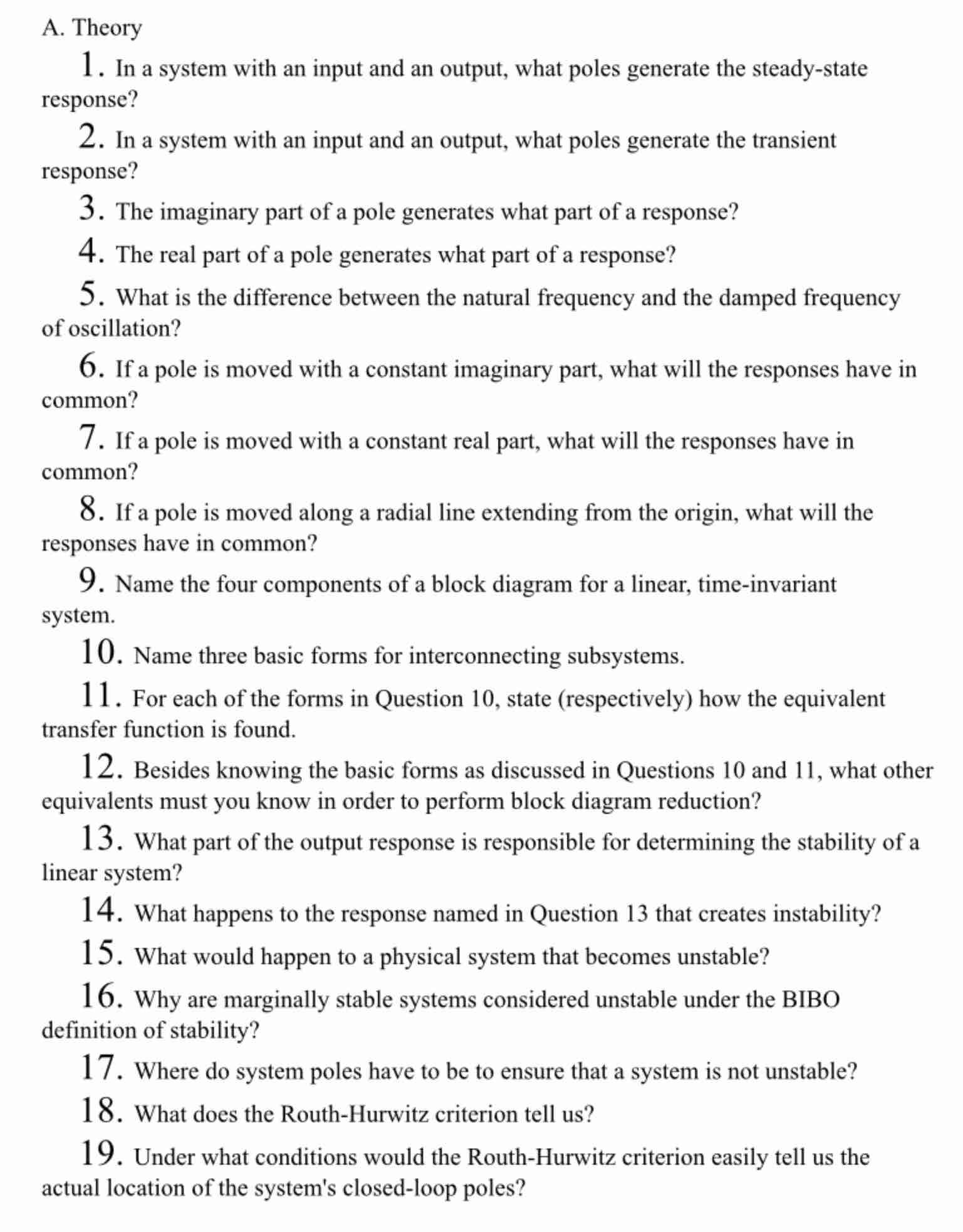
Question: A . Theory 1 . In a system with an input and an output, what poles generate the steady - state response? 2 . In
A Theory
In a system with an input and an output, what poles generate the steadystate response?
In a system with an input and an output, what poles generate the transient response?
The imaginary part of a pole generates what part of a response?
The real part of a pole generates what part of a response?
What is the difference between the natural frequency and the damped frequency of oscillation?
If a pole is moved with a constant imaginary part, what will the responses have in common?
If a pole is moved with a constant real part, what will the responses have in common?
If a pole is moved along a radial line extending from the origin, what will the responses have in common?
Name the four components of a block diagram for a linear, timeinvariant system.
Name three basic forms for interconnecting subsystems.
For each of the forms in Question state respectively how the equivalent transfer function is found.
Besides knowing the basic forms as discussed in Questions and what other equivalents must you know in order to perform block diagram reduction?
What part of the output response is responsible for determining the stability of a linear system?
What happens to the response named in Question that creates instability?
What would happen to a physical system that becomes unstable?
Why are marginally stable systems considered unstable under the BIBO definition of stability?
Where do system poles have to be to ensure that a system is not unstable?
What does the RouthHurwitz criterion tell us
Under what conditions would the RouthHurwitz criterion easily tell us the actual location of the system's closedloop poles?
Step by Step Solution
There are 3 Steps involved in it
1 Expert Approved Answer
Step: 1 Unlock

Question Has Been Solved by an Expert!
Get step-by-step solutions from verified subject matter experts
Step: 2 Unlock
Step: 3 Unlock
 Study Help