







Question: A vendor is recommending a program to make supervisors better at 'dealing with difficult conversations' at work. How would you apply the concepts of optimisation
A vendor is recommending a program to make supervisors better at 'dealing with difficult conversations' at work. How would you apply the concepts of optimisation and the Kirkpa- trick model to set up an analytical approach to determine if it would be a good investment?
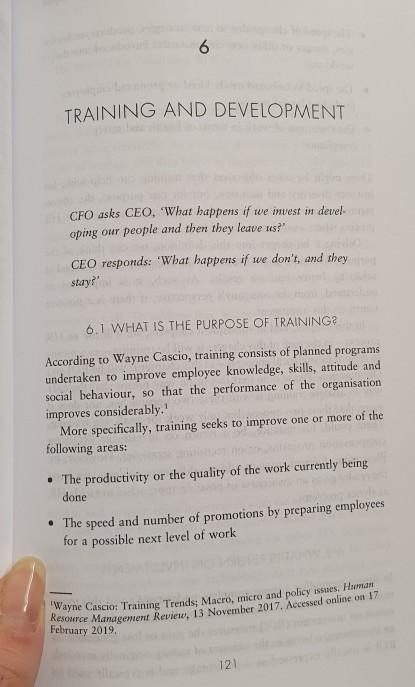
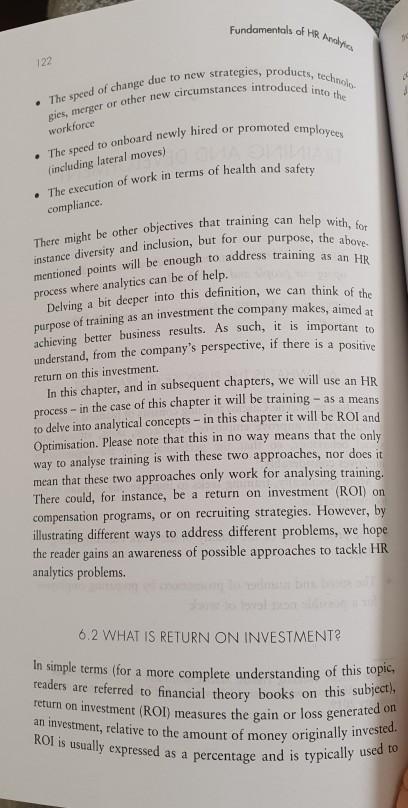
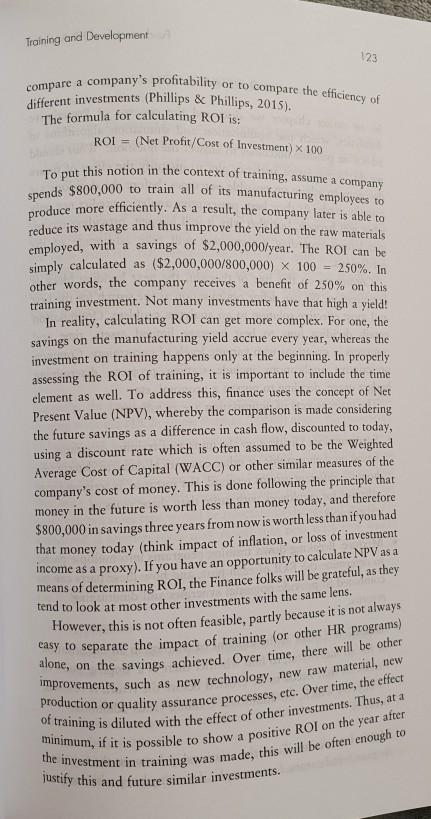
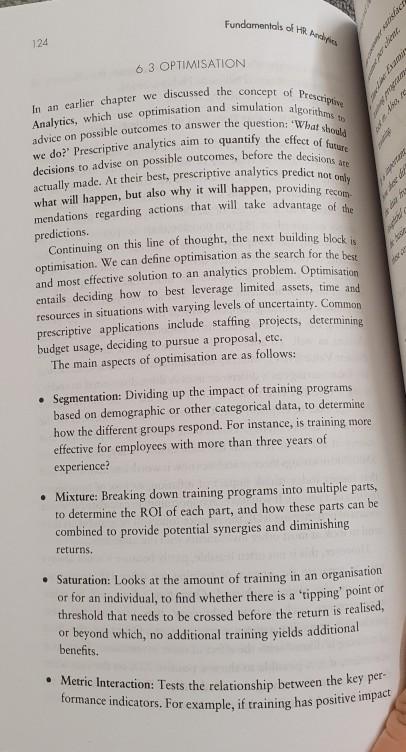
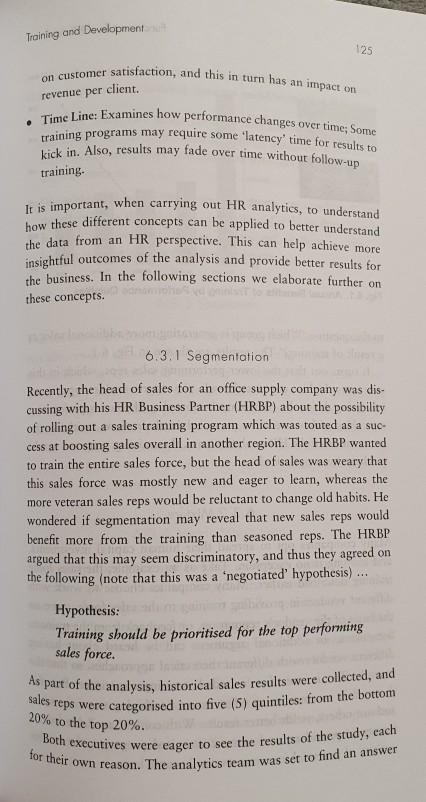
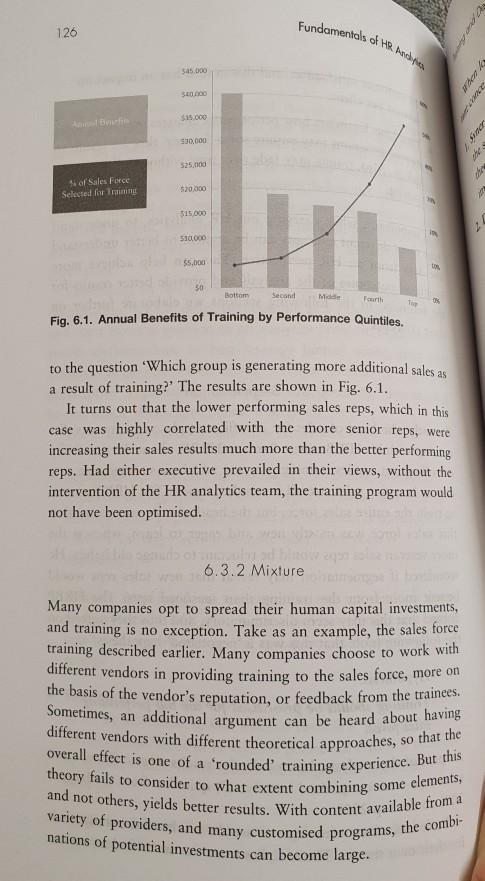
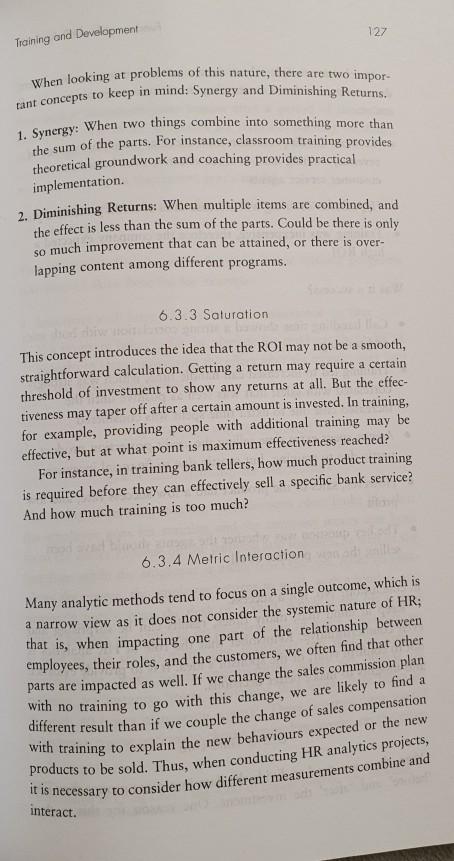
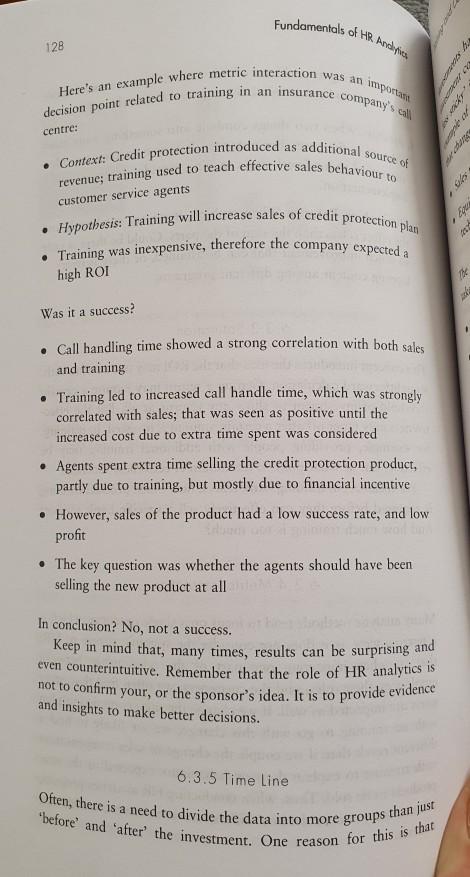
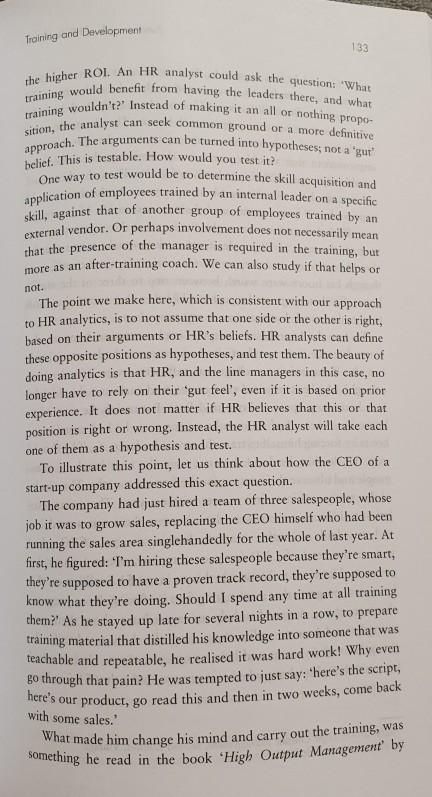
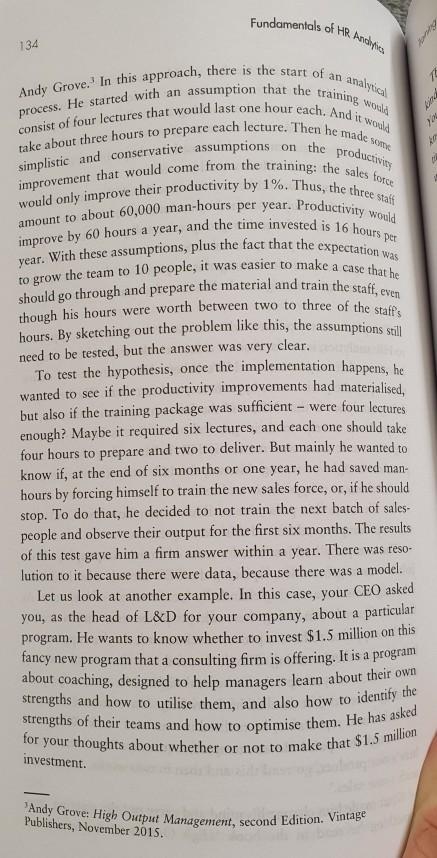
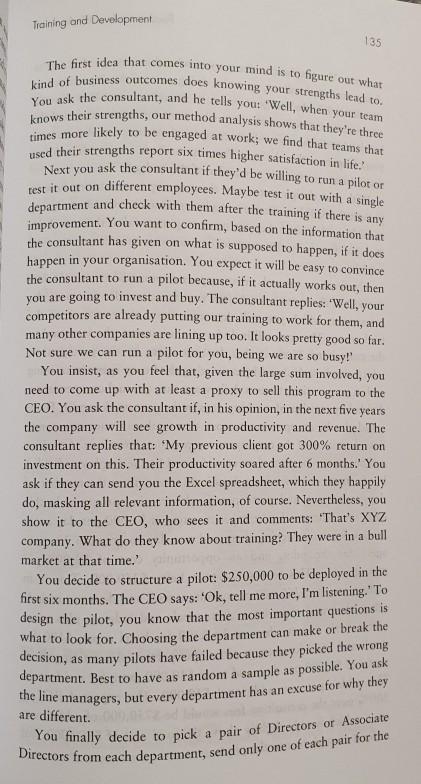
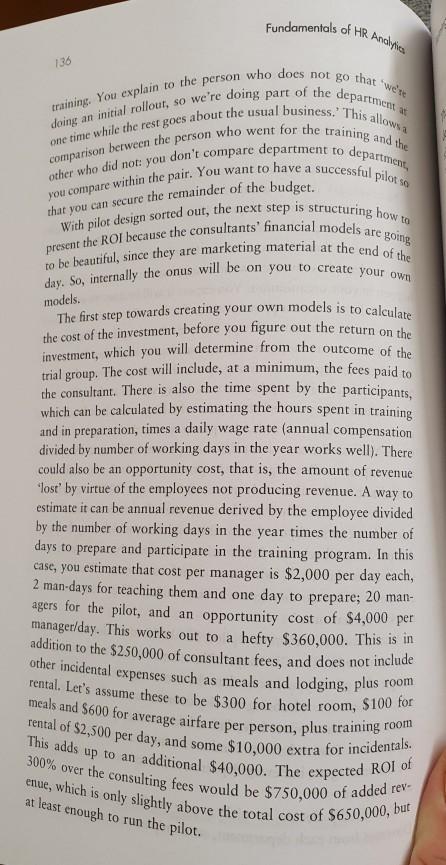
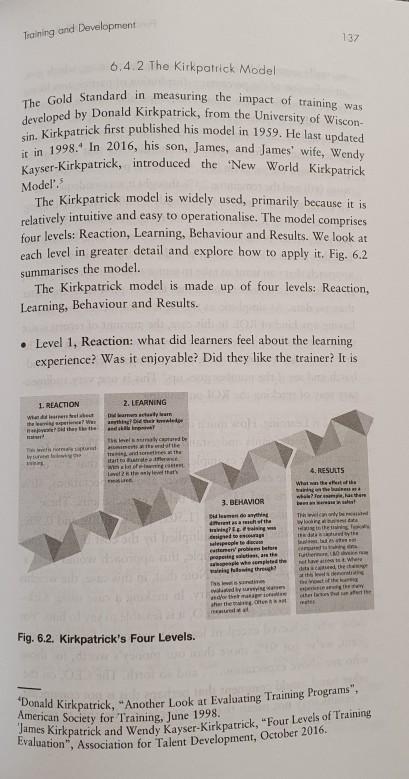
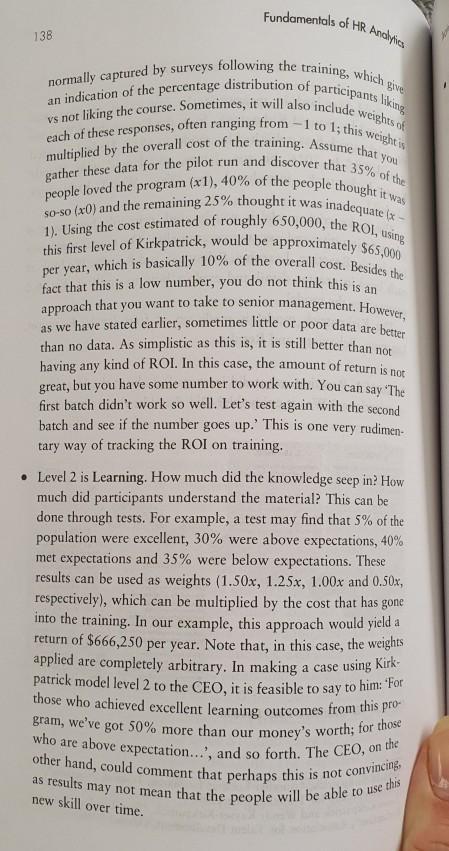
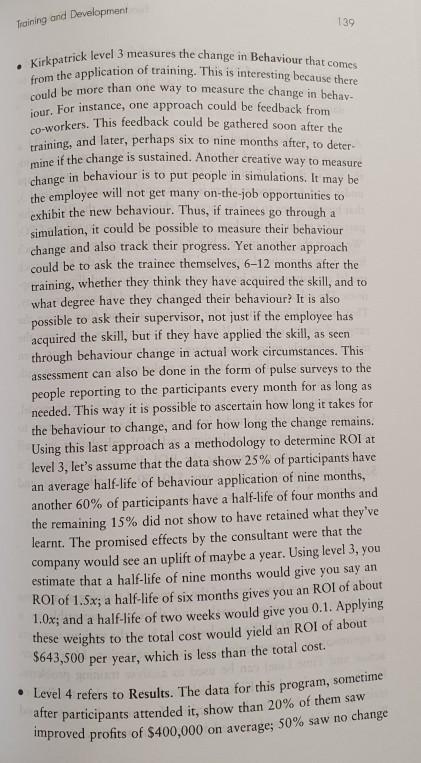
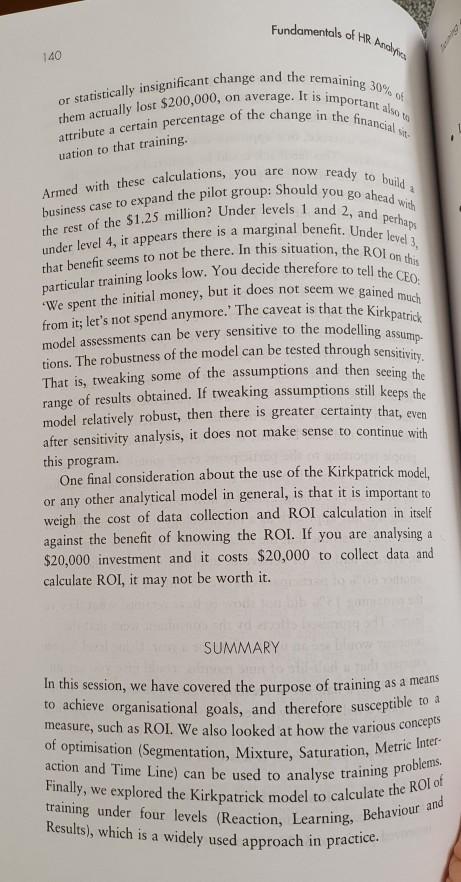
6 TRAINING AND DEVELOPMENT CFO asks CEO, 'What happens if we invest in devel oping our people and then they leave us? CEO responds: 'What happens if we don't, and they stay? 6.1 WHAT IS THE PURPOSE OF TRAINING According to Wayne Cascio, training consists of planned programs undertaken to improve employee knowledge, skills, attitude and social behaviour, so that the performance of the organisation improves considerably. More specifically, training seeks to improve one or more of the following areas: The productivity or the quality of the work currently being done The speed and number of promotions by preparing employees for a possible next level of work Wayne Cascio: Training Trends; Macro, micro and policy issues, Human Resource Management Review, 13 November 2017. Accessed online on 17 February 2019, 12 readers are referred to financial theory books on this subject), 122 The speed of change due to new workforce . The speed to onboard newly hired or (including lateral moves) compliance Fundamentals of HR Adica strategies, products, technolo The execution of work in terms of health and safety There might be other objectives that training can help with, fot instance diversity and inclusion, but for our purpose, the above mentioned points will be enough to address training as an HR Delving a bit deeper into this definition, we can think of the purpose of training as an investment the company makes, aimed at achieving better business results. As such, it is important to an investment, relative to the amount of money originally invested. ROI is usually expressed as a percentage and is typically used to promoted employees understand, from the company's perspective, if there is a positive In this chapter, and in subsequent chapters, we will use an HR process - in the case of this chapter it will be training - as a means to delve into analytical concepts - in this chapter it will be ROI and Optimisation. Please note that this in no way means that the only way to analyse training is with these two approaches, nor does it mean that these two approaches only work for analysing training. There could, for instance, be a return on investment (ROI) on compensation programs, or on recruiting strategies. However, by illustrating different ways to address different problems, we hope the reader gains an awareness of possible approaches to tackle HR analytics problems. process where analytics can be of help. return on this investment. 6.2 WHAT IS RETURN ON INVESTMENT In simple terms (for a more complete understanding of this topic, return on investment (ROI) measures the gain or loss generated on alone, on the savings achieved. Over time, there will be other justify this and future similar investments. 123 250%. In compare a company's profitability or to compare the efficiency of different investments (Phillips & Phillips, 2015). spends $800,000 to train all of its manufacturing employees to production or quality assurance processes, etc. Over time, the effect of training is diluted with the effect of other investments. Thus, at a minimum, if it is possible to show a positive ROI on the year after the investment in training was made, this will be often enough to Training and Development The formula for calculating ROI is. ROL = (Net Profit/Cost of Investment) X 100 To put this notion in the context of training, assume a company produce more efficiently. As a result, the company later is able to reduce its wastage and thus improve the yield on the raw materials employed, with a savings of $2,000,000/year. The ROI can be simply calculated as ($2,000,000/800,000) x 100 = other words, the company receives a benefit of 250% on this training investment. Not many investments have that high a yield! In reality, calculating ROI can get more complex. For the savings on the manufacturing yield accrue every year, whereas the investment on training happens only at the beginning. In properly assessing the ROI of training, it is important to include the time clement as well. To address this, finance uses the concept of Net Present Value (NPV), whereby the comparison is made considering the future savings as a difference in cash flow, discounted to today, using a discount rate which is often assumed to be the Weighted Average Cost of Capital (WACC) or other similar measures of the company's cost of money. This is done following the principle that money in the future is worth less than money today, and therefore $800,000 in savings three years from now is worth less than if you had that money today (think impact of inflation, or loss of investment income as a proxy). If you have an opportunity to calculate NPV as a means of determining ROI, the Finance folks will be grateful, as they tend to look at most other investments with the same lens. However, this is not often feasible, partly because it is not always one, casy to separate the impact of training (or other HR programs) improvements, such as new technology, new raw material , new formance indicators. For example, if training has positive impact 1.24 of Prescriptive In an earlier chapter we discussed the Fundamentals of HR Medics Analytics, which use optimisation and simulation algorithms 15 we do?' Prescriptive analytics aim to quantify the effect of future decisions to advise on possible outcomes, before the decisions at actually made. At their best, prescriptive analytics predict not only what will happen, but also why it will happen, providing recom mendations regarding actions that will take advantage of the 6.3 OPTIMISATION concept predictions Continuing on this line of thought, the next building block is optimisation. We can define optimisation as the search for the best and most effective solution to an analytics problem. Optimisation entails deciding how to best leverage limited assets, time and resources in situations with varying levels of uncertainty. Common prescriptive applications include staffing projects, determining budget usage, deciding to pursue a proposal, etc. The main aspects of optimisation are as follows: Segmentation: Dividing up the impact of training programs based on demographic or other categorical data, to determine how the different groups respond. For instance, is training more effective for employees with more than three years of experience? Mixture: Breaking down training programs into multiple parts, to determine the ROI of each part, and how these parts can be combined to provide potential synergies and diminishing returns. Saturation: Looks at the amount of training in an organisation or for an individual, to find whether there is a 'tipping point or threshold that needs to be crossed before the return is realised, or beyond which, no additional training yields additional benefits. Metric Interaction: Tests the relationship between the key per Both executives were eager to see the results of the study, each Training and Development 125 revenue per client. training. Time Line: Examines how performance changes over time; Some training programs may require some 'latency' time for results to kick in. Also, results may fade over time without follow-up sales reps were categorised into five (5) quintiles: from the bottom on customer satisfaction, and this in turn has an impact on It is important, when carrying out HR analytics, to understand how these different concepts can be applied to better understand the data from an HR perspective. This can help achieve more insightful outcomes of the analysis and provide better results for the business. In the following sections we elaborate further on these concepts. 6.3.1 Segmentation Recently, the head of sales for an office supply company was dis- cussing with his HR Business Partner (HRBP) about the possibility of rolling out a sales training program which was touted as a suc cess at boosting sales overall in another region. The HRBP wanted to train the entire sales force, but the head of sales was weary that this sales force was mostly new and eager to learn, whereas the more veteran sales reps would be reluctant to change old habits. He wondered if segmentation may reveal that new sales would reps benefit more from the training than seasoned reps. The HRBP argued that this may seem discriminatory, and thus they agreed on the following (note that this was a 'negotiated' hypothesis) Hypothesis: Training should be prioritised for the top performing As part of the analysis, historical sales results were collected, and sales force. 20% to the top 20%. $35.000 $15.000 530,000 4 of Sales Force Selected for mining $15.000 510.000 HIDE 55,000 50 Bottom Second Mid Fourth as Fundamentals of Rhodes the basis of the vendor's reputation, or feedback from the trainees. overall effect is one of a 'rounded' training experience. But this and not others, yields better results. With content available from a variety of providers, and many customised programs, the combi- 126 Fig. 6.1. Annual Benefits of Training by Performance Quintiles. to the question 'Which group is generating more additional sales a a result of training?' The results are shown in Fig. 6.1. It turns out that the lower performing sales reps, which in this case was highly correlated with the more senior reps, were increasing their sales results much more than the better performing reps. Had either executive prevailed in their views, without the intervention of the HR analytics team, the training program would not have been optimised. 6.3.2 Mixture Many companies opt to spread their human capital investments, and training is no exception. Take as an example, the sales force training described earlier. Many companies choose to work with different vendors in providing training to the sales force, more on Sometimes , an additional argument can be heard about having different vendors with different theoretical approaches, so that the theory fails to consider to what extent combining some elements, nations of potential investments can become large. When looking at problems of this nature, there are two impor- tant concepts to keep in mind: Synergy and Diminishing Returns. products to be sold. Thus, when conducting HR analytics projects, it is necessary to consider how different measurements combine and different result than if we couple the change of sales compensation 127 Training and Development 1. Synergy: When two things combine into something more than the sum of the parts. For instance, classroom training provides theoretical groundwork and coaching provides practical implementation 2. Diminishing Returns: When multiple items are combined, and the effect is less than the sum of the parts. Could be there is only so much improvement that can be attained, or there is over- lapping content among different programs. 6.3.3 Saturation This concept introduces the idea that the ROI may not be a smooth, straightforward calculation. Getting a return may require a certain threshold of investment to show any returns at all. But the effec- tiveness may taper off after a certain amount is invested. In training, for example, providing people with additional training may be effective, but at what point is maximum effectiveness reached? For instance, in training bank tellers, how much product training is required before they can effectively sell a specific bank service? And how much training is too much? 6.3.4 Metric Interaction Many analytic methods tend to focus on a single outcome, which is a narrow view as it does not consider the systemic nature of HR; that is, when impacting one part of the relationship between employees, their roles, and the customers, we often find that other parts are impacted as well. If we change the sales commission plan with no training to go with this change, we are likely to find a with training to explain the new behaviours expected or the new interact. 'before and after the investment. One reason for this is that 128 centre: customer service agents high ROI Was it a success? Fundamentals of HR Andifits Here's an example where metric interaction was an po decision point related to training in an insurance company's call Context: Credit protection introduced as additional source of revenue; training used to teach effective sales behaviour to Hypothesis: Training will increase sales of credit protection plan Training was inexpensive, therefore the company expected a not to confirm your, or the sponsor's idea. It is to provide evidence Often, there is a need to divide the data into more groups than just Call handling time showed a strong correlation with both sales and training Training led to increased call handle time, which was strongly correlated with sales; that was seen as positive until the increased cost due to extra time spent was considered Agents spent extra time selling the credit protection product, partly due to training, but mostly due to financial incentive However, sales of the product had a low success rate, and low profit The key question was whether the agents should have been selling the new product at all In conclusion? No, not a success. Keep in mind that, many times, results can be surprising and even counterintuitive. Remember that the role of HR analytics is 6.3.5 Time Line and insights to make better decisions. investments have varying degrees of 'Stickiness': A highly sticky investment continues to offer benefits for a long time, whereas a *less sticky investment loses impact after a period of time. One example of 'less sticky' programs are technical training on things With thanks to Leong Chee Tung, CEO of Engage Rocker, who provided valuable input to this section. 129 through 40 hours of training a year'. These organisations would Training and Development that change over time, such as: Sales training on the current year's model . Equipment that fade as clients move to a new level of technology The other side of 'stickiness is lag time. Some training programs take time to show benefits, for example: Industries with long sales cycles often experience lag time If a program helps to fill the pipeline for products that take 18 months to close, measuring the effect after six months lead to the wrong conclusion 6.4 THE ROI OF TRAINING? 6.4.1 Can Training Be Measureda The reality of training in many organisations often looks like this: the employee goes for training and the company incurs cost both from the direct expense on the training and logistics, as well as the lost time while the employee is away from the job. After he com- pletes the course, the employee returns to work with a binder, and promptly puts it onto the desk or a shelf, where it sits for a long time. This lack of emphasis on post-training in many organisations is part of the reason many line managers feel that training is unproductive. Some larger organisations might set quotas on training, for instance: 'every individual that works here must go may 130 bonus that they look good as resume Fundamentals of R. Adics hand, may consider these trainings as benefits, with the add No surprise then, that senior management is often tempted to slash the training budget: 'Let's remove 20% next year mot rash decisions like that without a thorough understanding of some of the real changes that training can do within the organisation. To address all sides in this scenario, HR analytics can support the HR function in figuring out how to deal with the reality of training, and how to deal with it intelligently. The aim is to answer the questions but the opportunity costs as well, there should be an expectation that the training will generate tangible, monetary results. The response from the business should be: 'Ok, tell me what I am getting out of it?' HR must articulate clearly why this is useful for the business, not just appealing to the emotional sense of 'we need to develop our people', but also explaining that the money they are putting into training will generate a return for the business. "why are people too busy working to go for training', or better stills 'why should people go to training in the first place? Let us consider a typical example, where HR asks the business heads to send some of their employees to training. A typical reply would be: 'Is it really necessary? Why are we spending money on this?" HR would then normally answer something like there's a gap here, so we need to fill it up' (unless we are talking about regulatory trainings, which are mandatory). The HR team would try to reason with the business heads, and generally the arguments centre about engagement or attrition, adducing that some people leave because they feel they are not being skilled enough, or not valued enough. These data come from exit interviews and from observations on the ground. If HR succeeds with this line of reasoning, the line will respond along the lines of: 'Ok, we try training. We give it a go then we see how it works. Eventually, therefore, success of training is measured as a reduction of turnover or an increase of engagement. And this is as numerical as this discussion usually gets. However, training is a business decision. If the business is going to allocate scarce resources into training, not just the money value, Training and Development training; term horizon. addressing this question, we will compare two of the types of training, as described in Section 6.1 previously. Functional training, broadly speaking, is role specific. For example, a software engineer will have specific software engineer processes or marketing strategies. General training would be concerned with things that are common to all jobs, such as lead- payback period to training. In other words, the question can be asked differently: 'If the business puts in a dollar and expects to get back $4.50, how long does it take for that $4.50 to come back? If it 131 What exactly does it mean to have an ROI on training In a salesperson, will have specific training around sales ership management, ethics, or regulations that have to be met. In general , it will be easier to calculate ROI on functional training than on general training, as one deals more with skills and com- petencies to perform the current role, whereas general training often is used to help in career development and thus has a longer- When we speak about Return on Investment for training, therefore, it not only has to focus on how much is spent on training and how much the business gets back in returns. In addition, to really measure return on investment, there is a need to measure transfer of training. If the employee learnt from the training, that is a necessary condition, but not sufficient. The skill or competency learnt must be transferred to what the employee does or achieves, and how he or she does it, in order for there to be a return. This is an interesting perspective that adds depth, but also complications, to the job of the HR analyst. Results have to do with the application of the knowledge, not just the acquisition of knowledge. How to articulate that transfer into an equation: If we follow the analytical process described in Chapter 1, one of our first tasks is to properly define the problem. Perhaps, before going through training, be clear about current level of knowledge of staff on the topic to be taught. Also, what is the change desired? This initial set-up will later allow for easier measurement of improvement and transfer to their work, either for functional or general training. From strictly a financial perspective, this is very clean, as long as the time element is expressly considered, because there is a certain executional level, what is going on, why are the data going this 132 a dollar today?' On their own greater Fundamentals of HR. And foes is expected to come back in 5-10 years, does it make sense to put Another interesting question to address with regards to training is that HR not only has to convince leaders to send dient people to the training programs, but also needs to convince the leaders to train their own staff. Typically, they would claim. No time. Too busy!' But what if HR analytics could show that when the line trains their own staff, the ROI is higher? On the KPIs, and that training can be outsourced to at least equally, it not more, capable trainers, at least skills-wise. And yet, on the other hand, it can be argued that, if it is the manager themselves understanding of the issues, and that employees (and the boss! adequately deliver this task for this client, and passes on the cli- Perceptive readers will realise that these are competing hypoth- eses, subject to testing, to determine which approach would have hand, it is true that line managers are busy working on doing the training, there will also be a tendency to have will follow the process as taught. It might also make managers act more like coaches, and could save money in the delivery of the program. Of course, there may be naysayers that disagree with this premise, arguing that it would be best to contextualise the training in a format where the leader is not involved in the sense that employees already go to their boss with some frequency. If they are also the trainer, there would be no fresh context. And battle lines are drawn, both sides wanting to impose their opinion. Another argument could ensue, that perhaps in terms of technical skills, the manager needs to do the training. That way, the manager would be able to communicate with his team as to what the new product or system is all about. For instance, a manager goes to meet a key client, who makes a request: 'I need this done.' If the manager has already trained the team, he would know how difficult (or easy!) it would be to deliver for the client, and what it will take to deliver successfully, and profitably. Or he could also know that the team does not have the necessary skill to ent's request. The manager and the employees can understand, at least at an way? the higher ROI. An HR analyst could ask the question: What training would benefit from having the leaders there, and what training wouldn't?' Instead of making it an all or nothing propo- approach. The arguments can be turned into hypotheses: not a 'gut' belief. This is testable. How would you test it? something he read in the book 'High Output Management by Training and Development 133 not. application of employees trained by an internal leader on a specific What made him change his mind and carry out the training, was One way to test would be to determine the skill acquisition and skill, against that of another group of employees trained by an external vendor. Or perhaps involvement does not necessarily mean that the presence of the manager is required in the training, but more as an after-training coach. We can also study if that helps or The point we make here, which is consistent with our approach to HR analytics, is to not assume that one side or the other is right, based on their arguments or HR's beliefs. HR analysts can define these opposite positions as hypotheses, and test them. The beauty of doing analytics is that HR, and the line managers in this case, no longer have to rely on their 'gut feel', even if it is based on prior experience. It does not matter if HR believes that this or that position is right or wrong. Instead, the HR analyst will take each one of them as a hypothesis and test. To illustrate this point, let us think about how the CEO of a start-up company addressed this exact question. The company had just hired a team of three salespeople, whose job it was to grow sales, replacing the CEO himself who had been running the sales area singlehandedly for the whole of last year. At first, he figured: 'I'm hiring these salespeople because they're smart, they're supposed to have a proven track record, they're supposed to know what they're doing. Should I spend any time at all training them?" As he stayed up late for several nights in a row, to prepare training material that distilled his knowledge into someone that was teachable and repeatable, he realised it was hard work! Why even go through that pain? He was tempted to just say: 'here's the script, here's our product, go read this and then in two weeks, come back with some sales. Andy Grove: High Output Management, second Edition. Vintage 134 14 1 Fundamentals of HR Audit Andy Grove. In this approach, there is the start of an analytical process. He started with an assumption that the training would consist of four lectures that would last one hour each. And it was take about three hours to prepare each lecture. Then he made improvement that would come from the training the sales torce simplistic and conservative assumptions on the productivity would only improve their productivity by 1%. Thus, the three staff improve by 60 hours a year, and the time invested is 16 hours per amount to about 60,000 man-hours per year. Productivity would year. With these assumptions, plus the fact that the expectation was should go through and prepare the material and train the staff, even though his hours were worth between two to three of the staff's strengths and how to utilise them, and also how to identify the strengths of their teams and how to optimise them. He has asked for your thoughts about whether or not to make that $1.5 million hours. By sketching out the problem like this, the assumptions still need to be tested, but the answer was very clear. To test the hypothesis, once the implementation happens, he wanted to see if the productivity improvements had materialised, but also if the training package was sufficient were four lectures enough? Maybe it required six lectures, and each one should take four hours to prepare and two to deliver. But mainly he wanted to know if, at the end of six months or one year, he had saved man- hours by forcing himself to train the new sales force, or, if he should stop. To do that, he decided to not train the next batch of sales- people and observe their output for the first six months. The results of this test gave him a firm answer within a year. There was reso- lution to it because there were data, because there was a model. Let us look at another example. In this case, your CEO asked you, as the head of L&D for your company, about a particular program. He wants to know whether to invest $1.5 million on this fancy new program that a consulting firm is offering. It is a program about coaching, designed to help managers learn about their own investment. Publishers, November 2015. Directors from each department, send only one of each pair for the Training and Development 135 The first idea that comes into your mind is to figure out what kind of business outcomes does knowing your strengths lead to. You ask the consultant, and he tells you: "Well, when your team knows their strengths, our method analysis shows that they're three You finally decide to pick a pair of Directors or Associate are different. times more likely to be engaged at work; we find that teams that used their strengths report six times higher satisfaction in life. Next you ask the consultant if they'd be willing to run a pilot or test it out on different employees. Maybe test it out with a single department and check with them after the training if there is any improvement. You want to confirm, based on the information that the consultant has given on what is supposed to happen, if it does happen in your organisation. You expect it will be easy to convince the consultant to run a pilot because, if it actually works out, then you are going to invest and buy. The consultant replies: "Well, your competitors are already putting our training to work for them, and many other companies are lining up too. It looks pretty good so far. Not sure we can run a pilot for you, being we are so busy!' You insist, as you feel that, given the large sum involved, you need to come up with at least a proxy to sell this program to the CEO. You ask the consultant if, in his opinion, in the next five years the company will see growth in productivity and revenue. The consultant replies that: 'My previous client got 300% return on investment on this. Their productivity soared after 6 months.' You ask if they can send you the Excel spreadsheet, which they happily do, masking all relevant information, of course. Nevertheless, you show it to the CEO, who sees it and comments: 'That's XYZ company. What do they know about training? They were in a bull market at that time.' You decide to structure a pilot: $250,000 to be deployed in the first six months. The CEO says: 'Ok, tell me more, I'm listening." To design the pilot, you know that the most important questions is what to look for. Choosing the department can make or break the decision, as many pilots have failed because they picked the wrong department. Best to have as random a sample as possible. You ask the line managers, but every department has an excuse for why they 136 department, that you can secure the remainder of the budget. models. Fundamentals of HR Anoia training. You explain to the person who does not go that we'te one time while the rest goes about the usual business. This allows doing an initial rollout, so we're doing part of the departevent comparison between the person who went for the training and the other who did not: you don't compare department to you compare within the pair. You want to have a successful pilot so With pilot design sorted our, the next step is structuring how to to be beautiful, since they are marketing material at the end of the present the ROI because the consultants' financial models are going The first step towards creating your own models is to calculate other incidental expenses such as meals and lodging, plus room rental. Let's assume these to be $300 for hotel room, $100 for meals and $600 for average airfare per person, plus training room rental of $2,500 per day, and some $10,000 extra for incidentals. This adds up to an additional $40,000. The expected ROI of 300% over the consulting fees would be $750,000 of added rev- enue, which is only slightly above the total cost of $650,000, but day. So, internally the onus will be on you to create your own the cost of the investment, before you figure out the return on the investment, which you will determine from the outcome of the trial group. The cost will include, at a minimum, the fees paid to the consultant. There is also the time spent by the participants, which can be calculated by estimating the hours spent in training and in preparation, times a daily wage rate (annual compensation divided by number of working days in the year works well). There could also be an opportunity cost, that is, the amount of revenue "Lost' by virtue of the employees not producing revenue. A way to estimate it can be annual revenue derived by the employee divided by the number of working days in the year times the number of days to prepare and participate in the training program. In this case, you estimate that cost per manager is $2,000 per day each, 2 man-days for teaching them and one day to prepare; 20 man- agers for the pilot, and an opportunity cost of $4,000 per manager/day. This works out to a hefty $360,000. This is in addition to the $250,000 of consultant fees, and does not include at least enough to run the pilot. Evaluation", Association for Talent Development, October 2016. Training and Development Model'. summarises the model. The Gold Standard in measuring the impact of training was developed by Donald Kirkpatrick, from the University of Wiscon- sin. Kirkpatrick first published his model in 1959. He last updated it in 1998. In 2016, his son, James, and James' wife, Wendy Kayser-Kirkpatrick, introduced the 'New World Kirkpatrick "Donald Kirkpatrick, "Another Look at Evaluating Training Programs James Kirkpatrick and Wendy Kayser-Kirkpatrick, "Four Levels of Training 137 6,42 The Kirkpatrick Model The Kirkpatrick model is widely used, primarily because it is relatively intuitive and easy to operationalise. The model comprises four levels: Reaction, Learning, Behaviour and Results. We look at each level in greater detail and explore how to apply it. Fig. 6.2 The Kirkpatrick model is made up of four levels: Reaction, Learning, Behaviour and Results. Level 1, Reaction: what did learners feel about the learning experience? Was it enjoyable? Did they like the trainer? It is 2. LEARNING w aale brid Fig. 6.2. Kirkpatrick's Four Levels. American Society for Training, June 1998 1. REACTION Wiener the new Ti Tudor Live sylwethat's 4. RESULTS Whether with a which 3. BEHAVIOR Dimen det interest as a richstha TH wa toto 1 cremer probleme we completed the Puth haven We diselt dywane um 138 inadequateix Fundamentals of HR Analys normally captured by surveys following the training, which give an indication of the percentage distribution of participants like vs not liking the course. Sometimes, it will also include weiglves of each of these responses, often ranging from 1 to 1; this weight is multiplied by the overall cost of the training. Assume that you gather these data for the pilot run and discover that 35% of the people loved the program (x1), 40% of the people thought it was 1). Using the cost estimated of roughly 650,000, the ROI, USLIVE this first level of Kirkpatrick, would be approximately $65,000 per year, which is basically 10% of the overall cost. Besides the fact that this is a low number, you do not think this is an approach that you want to take to senior management. However, as we have stated earlier, sometimes little or poor data are better gram, we've got 50% more than our money's worth: for those who are above expectation...', and so forth. The CEO, on the other hand, could comment that perhaps this is not convincing, as results may not mean that the people will be able to use this (x0) and the remaining 25% thought it was than no data. As simplistic as this is, it is still better than not having any kind of ROI. In this case, the amount of return is not great, but you have some number to work with. You can say "The first batch didn't work so well. Let's test again with the second batch and see if the number goes up.' This is one very rudimen- tary way of tracking the ROI on training, Level 2 is Learning. How much did the knowledge seep in? How much did participants understand the material? This can be done through tests. For example, a test may find that 5% of the population were excellent, 30% were above expectations, 40% met expectations and 35% were below expectations. These results can be used as weights (1.50x, 1.25x, 1.00x and 0.50x, respectively), which can be multiplied by the cost that has gone into the training. In our example, this approach would yield a return of $666,250 per year. Note that, in this case, the weights applied are completely arbitrary. In making a case using Kirk- patrick model level 2 to the CEO, it is feasible to say to him: For those who achieved excellent learning outcomes from this pro- new skill over time. from the application of training. This is interesting because there could be more than one way to measure the change in behav- jour. For instance, one approach could be feedback from co-workers. This feedback could be gathered soon after the Level 4 refers to Results. The data for this program, sometime Training and Development 139 Kirkpatrick level 3 measures the change in Behaviour that comes training, and later, perhaps six to nine months after, to deter- mine if the change is sustained. Another creative way to measure change in behaviour is to put people in simulations. It may be the employee will not get many on-the-job opportunities to exhibit the new behaviour. Thus, if trainees go through a simulation, it could be possible to measure their behaviour change and also track their progress. Yet another approach could be to ask the trainee themselves, 6-12 months after the training, whether they think they have acquired the skill, and to what degree have they changed their behaviour? It is also possible to ask their supervisor, not just if the employee has acquired the skill, but if they have applied the skill, as seen through behaviour change in actual work circumstances. This assessment can also be done in the form of pulse surveys to the people reporting to the participants every month for as long as needed. This way it is possible to ascertain how long it takes for the behaviour to change, and for how long the change remains. Using this last approach as a methodology to determine ROI at level 3, let's assume that the data show 25% of participants have an average half-life of behaviour application of nine months, another 60% of participants have a half-life of four months and the remaining 15% did not show to have retained what they've learnt. The promised effects by the consultant were that the company would see an uplift of maybe a year. Using level 3, you estimate that a half-life of nine months would give you say an ROI of 1.5x; a half-life of six months gives you an ROI of about 1.0x; and a half-life of two weeks would give you 0.1. Applying these weights to the total cost would yield an ROI of about $643,500 per year, which is less than the total cost. after participants attended it, show than 20% of them saw improved profits of $400,000 on average; 50% saw no change 140 them actually lost $200,000, uation to that training ahead with Fundamentals of HR. Ancora or statistically insignificant change and the remaining 30% on average. It is important also attribute a certain percentage of the change in the financial site Armed with these calculations, you are now ready to build a business case to expand the pilot group: Should you go the rest of the $1.25 million? Under levels 1 and 2, and perhaps under level 4, it appears there is a marginal benefit. Under level 3, that benefit seems to not be there. In this situation, the ROI on this particular training looks low. You decide therefore to tell the CEO: "We spent the initial money, but it does not seem we gained much from it; let's not spend anymore. The caveat is that the Kirkpatrick tions. The robustness of the model can be tested through sensitivity, measure, such as ROI. We also looked at how the various concepts of optimisation (Segmentation, Mixture, Saturation, Metric Inter action and Time Line) can be used to analyse training problems. Finally, we explored the Kirkpatrick model to calculate the ROI of training under four levels (Reaction, Learning, Behaviour and Results), which is a widely used approach in practice. That is, tweaking some of the assumptions and then seeing the range of results obtained. If tweaking assumptions still keeps the model relatively robust, then there is greater certainty that, even after sensitivity analysis, it does not make sense to continue with this program. One final consideration about the use of the Kirkpatrick model, or any other analytical model in general, is that it is important to weigh the cost of data collection and ROI calculation in itself against the benefit of knowing the ROI. If you are analysing a $20,000 investment and it costs $20,000 to collect data and calculate ROI, it may not be worth it. SUMMARY In this session, we have covered the purpose of training as a means to achieve organisational goals, and therefore susceptible to a 6 TRAINING AND DEVELOPMENT CFO asks CEO, 'What happens if we invest in devel oping our people and then they leave us? CEO responds: 'What happens if we don't, and they stay? 6.1 WHAT IS THE PURPOSE OF TRAINING According to Wayne Cascio, training consists of planned programs undertaken to improve employee knowledge, skills, attitude and social behaviour, so that the performance of the organisation improves considerably. More specifically, training seeks to improve one or more of the following areas: The productivity or the quality of the work currently being done The speed and number of promotions by preparing employees for a possible next level of work Wayne Cascio: Training Trends; Macro, micro and policy issues, Human Resource Management Review, 13 November 2017. Accessed online on 17 February 2019, 12 readers are referred to financial theory books on this subject), 122 The speed of change due to new workforce . The speed to onboard newly hired or (including lateral moves) compliance Fundamentals of HR Adica strategies, products, technolo The execution of work in terms of health and safety There might be other objectives that training can help with, fot instance diversity and inclusion, but for our purpose, the above mentioned points will be enough to address training as an HR Delving a bit deeper into this definition, we can think of the purpose of training as an investment the company makes, aimed at achieving better business results. As such, it is important to an investment, relative to the amount of money originally invested. ROI is usually expressed as a percentage and is typically used to promoted employees understand, from the company's perspective, if there is a positive In this chapter, and in subsequent chapters, we will use an HR process - in the case of this chapter it will be training - as a means to delve into analytical concepts - in this chapter it will be ROI and Optimisation. Please note that this in no way means that the only way to analyse training is with these two approaches, nor does it mean that these two approaches only work for analysing training. There could, for instance, be a return on investment (ROI) on compensation programs, or on recruiting strategies. However, by illustrating different ways to address different problems, we hope the reader gains an awareness of possible approaches to tackle HR analytics problems. process where analytics can be of help. return on this investment. 6.2 WHAT IS RETURN ON INVESTMENT In simple terms (for a more complete understanding of this topic, return on investment (ROI) measures the gain or loss generated on alone, on the savings achieved. Over time, there will be other justify this and future similar investments. 123 250%. In compare a company's profitability or to compare the efficiency of different investments (Phillips & Phillips, 2015). spends $800,000 to train all of its manufacturing employees to production or quality assurance processes, etc. Over time, the effect of training is diluted with the effect of other investments. Thus, at a minimum, if it is possible to show a positive ROI on the year after the investment in training was made, this will be often enough to Training and Development The formula for calculating ROI is. ROL = (Net Profit/Cost of Investment) X 100 To put this notion in the context of training, assume a company produce more efficiently. As a result, the company later is able to reduce its wastage and thus improve the yield on the raw materials employed, with a savings of $2,000,000/year. The ROI can be simply calculated as ($2,000,000/800,000) x 100 = other words, the company receives a benefit of 250% on this training investment. Not many investments have that high a yield! In reality, calculating ROI can get more complex. For the savings on the manufacturing yield accrue every year, whereas the investment on training happens only at the beginning. In properly assessing the ROI of training, it is important to include the time clement as well. To address this, finance uses the concept of Net Present Value (NPV), whereby the comparison is made considering the future savings as a difference in cash flow, discounted to today, using a discount rate which is often assumed to be the Weighted Average Cost of Capital (WACC) or other similar measures of the company's cost of money. This is done following the principle that money in the future is worth less than money today, and therefore $800,000 in savings three years from now is worth less than if you had that money today (think impact of inflation, or loss of investment income as a proxy). If you have an opportunity to calculate NPV as a means of determining ROI, the Finance folks will be grateful, as they tend to look at most other investments with the same lens. However, this is not often feasible, partly because it is not always one, casy to separate the impact of training (or other HR programs) improvements, such as new technology, new raw material , new formance indicators. For example, if training has positive impact 1.24 of Prescriptive In an earlier chapter we discussed the Fundamentals of HR Medics Analytics, which use optimisation and simulation algorithms 15 we do?' Prescriptive analytics aim to quantify the effect of future decisions to advise on possible outcomes, before the decisions at actually made. At their best, prescriptive analytics predict not only what will happen, but also why it will happen, providing recom mendations regarding actions that will take advantage of the 6.3 OPTIMISATION concept predictions Continuing on this line of thought, the next building block is optimisation. We can define optimisation as the search for the best and most effective solution to an analytics problem. Optimisation entails deciding how to best leverage limited assets, time and resources in situations with varying levels of uncertainty. Common prescriptive applications include staffing projects, determining budget usage, deciding to pursue a proposal, etc. The main aspects of optimisation are as follows: Segmentation: Dividing up the impact of training programs based on demographic or other categorical data, to determine how the different groups respond. For instance, is training more effective for employees with more than three years of experience? Mixture: Breaking down training programs into multiple parts, to determine the ROI of each part, and how these parts can be combined to provide potential synergies and diminishing returns. Saturation: Looks at the amount of training in an organisation or for an individual, to find whether there is a 'tipping point or threshold that needs to be crossed before the return is realised, or beyond which, no additional training yields additional benefits. Metric Interaction: Tests the relationship between the key per Both executives were eager to see the results of the study, each Training and Development 125 revenue per client. training. Time Line: Examines how performance changes over time; Some training programs may require some 'latency' time for results to kick in. Also, results may fade over time without follow-up sales reps were categorised into five (5) quintiles: from the bottom on customer satisfaction, and this in turn has an impact on It is important, when carrying out HR analytics, to understand how these different concepts can be applied to better understand the data from an HR perspective. This can help achieve more insightful outcomes of the analysis and provide better results for the business. In the following sections we elaborate further on these concepts. 6.3.1 Segmentation Recently, the head of sales for an office supply company was dis- cussing with his HR Business Partner (HRBP) about the possibility of rolling out a sales training program which was touted as a suc cess at boosting sales overall in another region. The HRBP wanted to train the entire sales force, but the head of sales was weary that this sales force was mostly new and eager to learn, whereas the more veteran sales reps would be reluctant to change old habits. He wondered if segmentation may reveal that new sales would reps benefit more from the training than seasoned reps. The HRBP argued that this may seem discriminatory, and thus they agreed on the following (note that this was a 'negotiated' hypothesis) Hypothesis: Training should be prioritised for the top performing As part of the analysis, historical sales results were collected, and sales force. 20% to the top 20%. $35.000 $15.000 530,000 4 of Sales Force Selected for mining $15.000 510.000 HIDE 55,000 50 Bottom Second Mid Fourth as Fundamentals of Rhodes the basis of the vendor's reputation, or feedback from the trainees. overall effect is one of a 'rounded' training experience. But this and not others, yields better results. With content available from a variety of providers, and many customised programs, the combi- 126 Fig. 6.1. Annual Benefits of Training by Performance Quintiles. to the question 'Which group is generating more additional sales a a result of training?' The results are shown in Fig. 6.1. It turns out that the lower performing sales reps, which in this case was highly correlated with the more senior reps, were increasing their sales results much more than the better performing reps. Had either executive prevailed in their views, without the intervention of the HR analytics team, the training program would not have been optimised. 6.3.2 Mixture Many companies opt to spread their human capital investments, and training is no exception. Take as an example, the sales force training described earlier. Many companies choose to work with different vendors in providing training to the sales force, more on Sometimes , an additional argument can be heard about having different vendors with different theoretical approaches, so that the theory fails to consider to what extent combining some elements, nations of potential investments can become large. When looking at problems of this nature, there are two impor- tant concepts to keep in mind: Synergy and Diminishing Returns. products to be sold. Thus, when conducting HR analytics projects, it is necessary to consider how different measurements combine and different result than if we couple the change of sales compensation 127 Training and Development 1. Synergy: When two things combine into something more than the sum of the parts. For instance, classroom training provides theoretical groundwork and coaching provides practical implementation 2. Diminishing Returns: When multiple items are combined, and the effect is less than the sum of the parts. Could be there is only so much improvement that can be attained, or there is over- lapping content among different programs. 6.3.3 Saturation This concept introduces the idea that the ROI may not be a smooth, straightforward calculation. Getting a return may require a certain threshold of investment to show any returns at all. But the effec- tiveness may taper off after a certain amount is invested. In training, for example, providing people with additional training may be effective, but at what point is maximum effectiveness reached? For instance, in training bank tellers, how much product training is required before they can effectively sell a specific bank service? And how much training is too much? 6.3.4 Metric Interaction Many analytic methods tend to focus on a single outcome, which is a narrow view as it does not consider the systemic nature of HR; that is, when impacting one part of the relationship between employees, their roles, and the customers, we often find that other parts are impacted as well. If we change the sales commission plan with no training to go with this change, we are likely to find a with training to explain the new behaviours expected or the new interact. 'before and after the investment. One reason for this is that 128 centre: customer service agents high ROI Was it a success? Fundamentals of HR Andifits Here's an example where metric interaction was an po decision point related to training in an insurance company's call Context: Credit protection introduced as additional source of revenue; training used to teach effective sales behaviour to Hypothesis: Training will increase sales of credit protection plan Training was inexpensive, therefore the company expected a not to confirm your, or the sponsor's idea. It is to provide evidence Often, there is a need to divide the data into more groups than just Call handling time showed a strong correlation with both sales and training Training led to increased call handle time, which was strongly correlated with sales; that was seen as positive until the increased cost due to extra time spent was considered Agents spent extra time selling the credit protection product, partly due to training, but mostly due to financial incentive However, sales of the product had a low success rate, and low profit The key question was whether the agents should have been selling the new product at all In conclusion? No, not a success. Keep in mind that, many times, results can be surprising and even counterintuitive. Remember that the role of HR analytics is 6.3.5 Time Line and insights to make better decisions. investments have varying degrees of 'Stickiness': A highly sticky investment continues to offer benefits for a long time, whereas a *less sticky investment loses impact after a period of time. One example of 'less sticky' programs are technical training on things With thanks to Leong Chee Tung, CEO of Engage Rocker, who provided valuable input to this section. 129 through 40 hours of training a year'. These organisations would Training and Development that change over time, such as: Sales training on the current year's model . Equipment that fade as clients move to a new level of technology The other side of 'stickiness is lag time. Some training programs take time to show benefits, for example: Industries with long sales cycles often experience lag time If a program helps to fill the pipeline for products that take 18 months to close, measuring the effect after six months lead to the wrong conclusion 6.4 THE ROI OF TRAINING? 6.4.1 Can Training Be Measureda The reality of training in many organisations often looks like this: the employee goes for training and the company incurs cost both from the direct expense on the training and logistics, as well as the lost time while the employee is away from the job. After he com- pletes the course, the employee returns to work with a binder, and promptly puts it onto the desk or a shelf, where it sits for a long time. This lack of emphasis on post-training in many organisations is part of the reason many line managers feel that training is unproductive. Some larger organisations might set quotas on training, for instance: 'every individual that works here must go may 130 bonus that they look good as resume Fundamentals of R. Adics hand, may consider these trainings as benefits, with the add No surprise then, that senior management is often tempted to slash the training budget: 'Let's remove 20% next year mot rash decisions like that without a thorough understanding of some of the real changes that training can do within the organisation. To address all sides in this scenario, HR analytics can support the HR function in figuring out how to deal with the reality of training, and how to deal with it intelligently. The aim is to answer the questions but the opportunity costs as well, there should be an expectation that the training will generate tangible, monetary results. The response from the business should be: 'Ok, tell me what I am getting out of it?' HR must articulate clearly why this is useful for the business, not just appealing to the emotional sense of 'we need to develop our people', but also explaining that the money they are putting into training will generate a return for the business. "why are people too busy working to go for training', or better stills 'why should people go to training in the first place? Let us consider a typical example, where HR asks the business heads to send some of their employees to training. A typical reply would be: 'Is it really necessary? Why are we spending money on this?" HR would then normally answer something like there's a gap here, so we need to fill it up' (unless we are talking about regulatory trainings, which are mandatory). The HR team would try to reason with the business heads, and generally the arguments centre about engagement or attrition, adducing that some people leave because they feel they are not being skilled enough, or not valued enough. These data come from exit interviews and from observations on the ground. If HR succeeds with this line of reasoning, the line will respond along the lines of: 'Ok, we try training. We give it a go then we see how it works. Eventually, therefore, success of training is measured as a reduction of turnover or an increase of engagement. And this is as numerical as this discussion usually gets. However, training is a business decision. If the business is going to allocate scarce resources into training, not just the money value, Training and Development training; term horizon. addressing this question, we will compare two of the types of training, as described in Section 6.1 previously. Functional training, broadly speaking, is role specific. For example, a software engineer will have specific software engineer processes or marketing strategies. General training would be concerned with things that are common to all jobs, such as lead- payback period to training. In other words, the question can be asked differently: 'If the business puts in a dollar and expects to get back $4.50, how long does it take for that $4.50 to come back? If it 131 What exactly does it mean to have an ROI on training In a salesperson, will have specific training around sales ership management, ethics, or regulations that have to be met. In general , it will be easier to calculate ROI on functional training than on general training, as one deals more with skills and com- petencies to perform the current role, whereas general training often is used to help in career development and thus has a longer- When we speak about Return on Investment for training, therefore, it not only has to focus on how much is spent on training and how much the business gets back in returns. In addition, to really measure return on investment, there is a need to measure transfer of training. If the employee learnt from the training, that is a necessary condition, but not sufficient. The skill or competency learnt must be transferred to what the employee does or achieves, and how he or she does it, in order for there to be a return. This is an interesting perspective that adds depth, but also complications, to the job of the HR analyst. Results have to do with the application of the knowledge, not just the acquisition of knowledge. How to articulate that transfer into an equation: If we follow the analytical process described in Chapter 1, one of our first tasks is to properly define the problem. Perhaps, before going through training, be clear about current level of knowledge of staff on the topic to be taught. Also, what is the change desired? This initial set-up will later allow for easier measurement of improvement and transfer to their work, either for functional or general training. From strictly a financial perspective, this is very clean, as long as the time element is expressly considered, because there is a certain executional level, what is going on, why are the data going this 132 a dollar today?' On their own greater Fundamentals of HR. And foes is expected to come back in 5-10 years, does it make sense to put Another interesting question to address with regards to training is that HR not only has to convince leaders to send dient people to the training programs, but also needs to convince the leaders to train their own staff. Typically, they would claim. No time. Too busy!' But what if HR analytics could show that when the line trains their own staff, the ROI is higher? On the KPIs, and that training can be outsourced to at least equally, it not more, capable trainers, at least skills-wise. And yet, on the other hand, it can be argued that, if it is the manager themselves understanding of the issues, and that employees (and the boss! adequately deliver this task for this client, and passes on the cli- Perceptive readers will realise that these are competing hypoth- eses, subject to testing, to determine which approach would have hand, it is true that line managers are busy working on doing the training, there will also be a tendency to have will follow the process as taught. It might also make managers act more like coaches, and could save money in the delivery of the program. Of course, there may be naysayers that disagree with this premise, arguing that it would be best to contextualise the training in a format where the leader is not involved in the sense that employees already go to their boss with some frequency. If they are also the trainer, there would be no fresh context. And battle lines are drawn, both sides wanting to impose their opinion. Another argument could ensue, that perhaps in terms of technical skills, the manager needs to do the training. That way, the manager would be able to communicate with his team as to what the new product or system is all about. For instance, a manager goes to meet a key client, who makes a request: 'I need this done.' If the manager has already trained the team, he would know how difficult (or easy!) it would be to deliver for the client, and what it will take to deliver successfully, and profitably. Or he could also know that the team does not have the necessary skill to ent's request. The manager and the employees can understand, at least at an way? the higher ROI. An HR analyst could ask the question: What training would benefit from having the leaders there, and what training wouldn't?' Instead of making it an all or nothing propo- approach. The arguments can be turned into hypotheses: not a 'gut' belief. This is testable. How would you test it? something he read in the book 'High Output Management by Training and Development 133 not. application of employees trained by an internal leader on a specific What made him change his mind and carry out the training, was One way to test would be to determine the
Step by Step Solution
There are 3 Steps involved in it
1 Expert Approved Answer
Step: 1 Unlock

To assess the investment in a program for enhancing supervisors skills in handling difficult conversations we can apply the concepts of optimization and the Kirkpatrick Model as follows Step 1 Define ... View full answer
Question Has Been Solved by an Expert!
Get step-by-step solutions from verified subject matter experts
Step: 2 Unlock
Step: 3 Unlock
 Study Help