Question: About a disease from a reputed website. ( ending with .edu) sample is below NOVEMBER 2022 BIOMEDICAL SCIENCE How did organoids help scientists JOURNAL understand
About a disease from a reputed website. ( ending with .edu)
sample is below
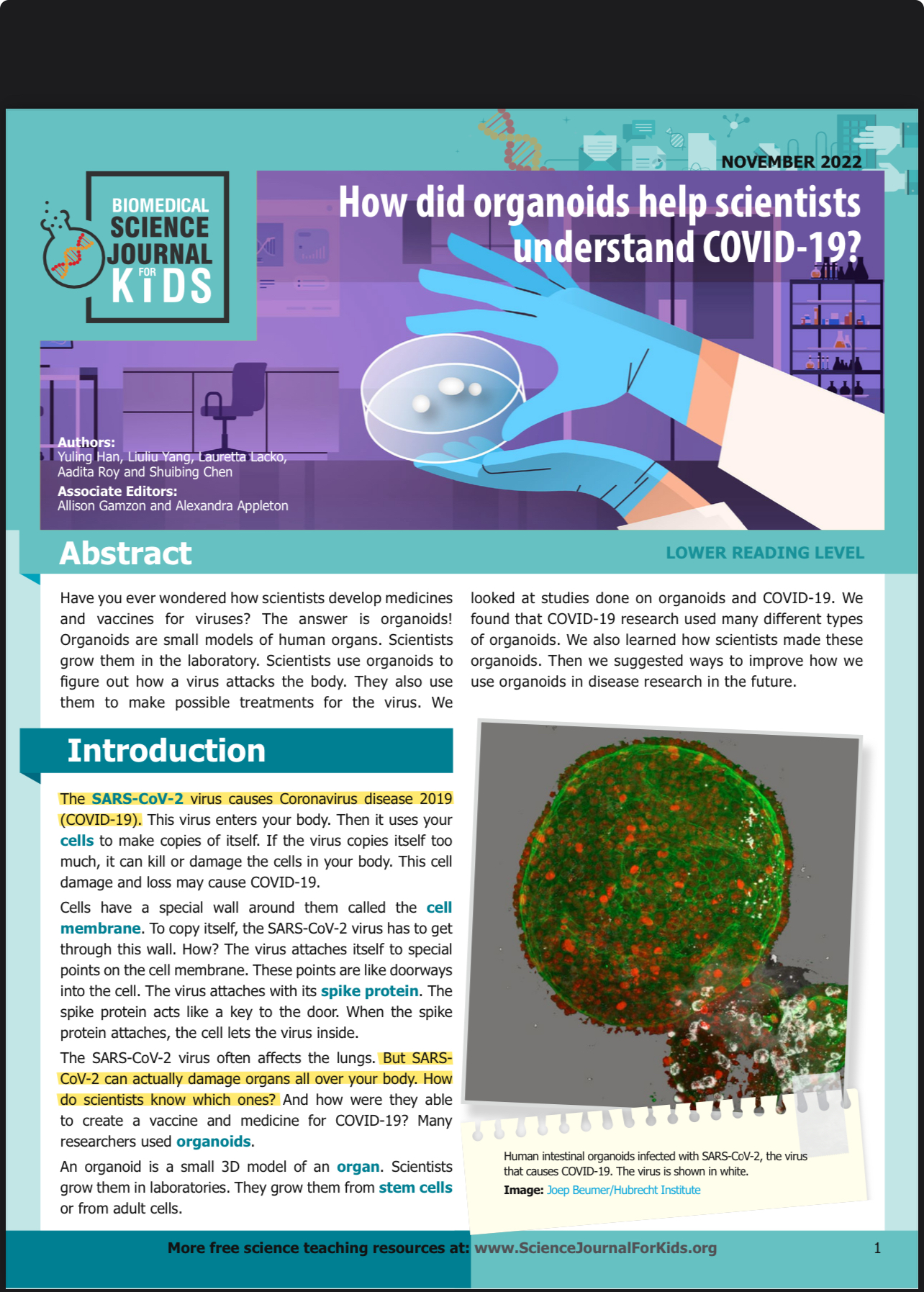
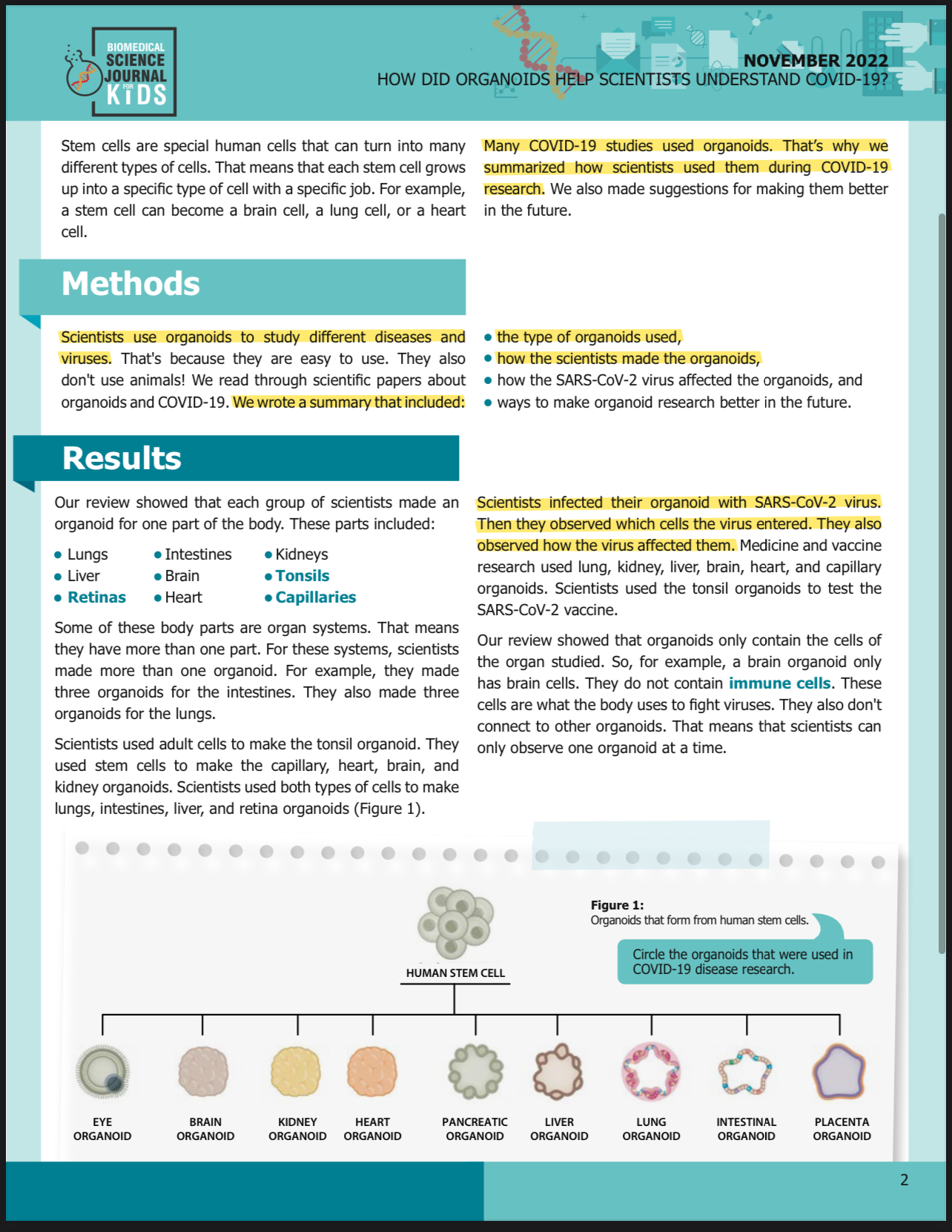
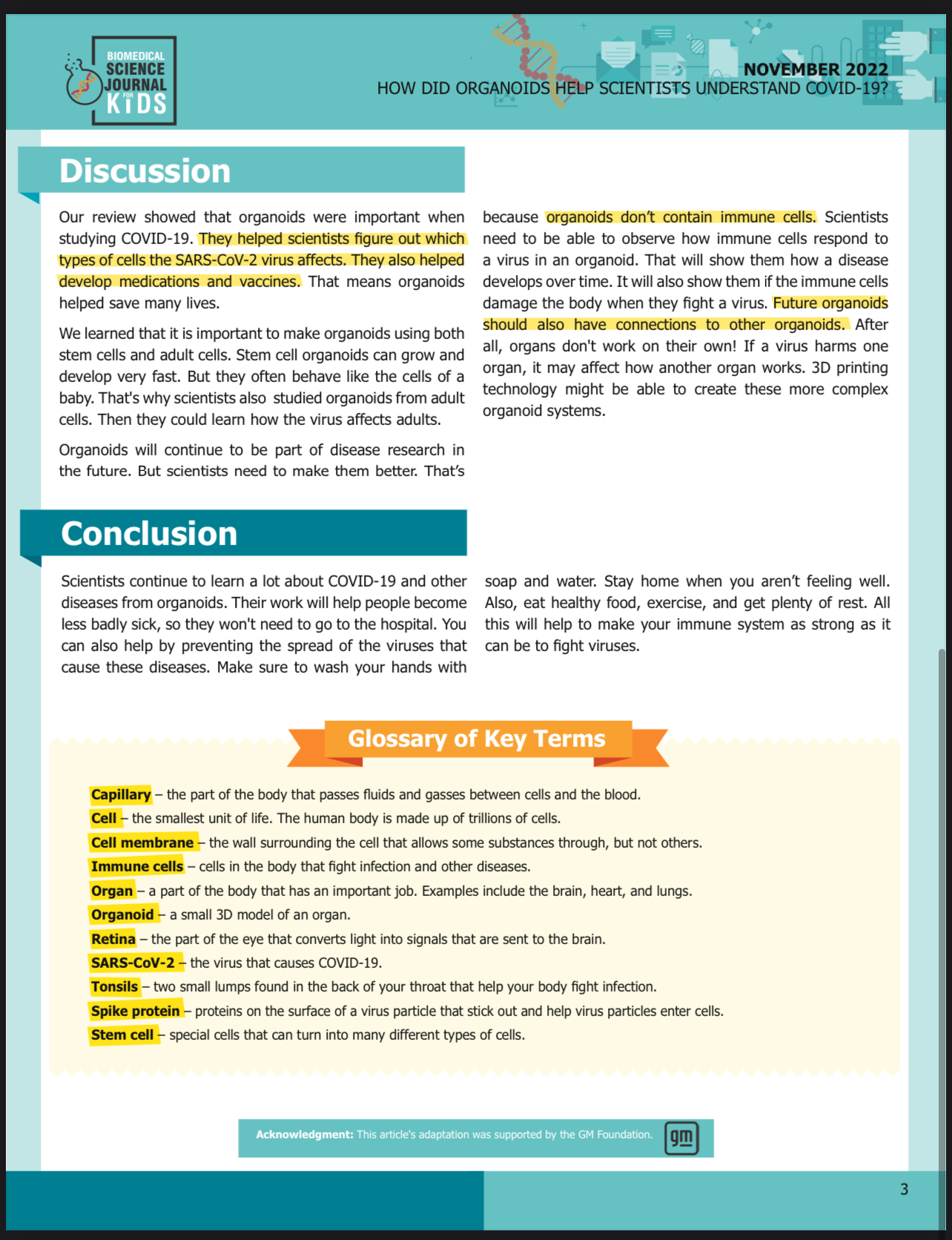
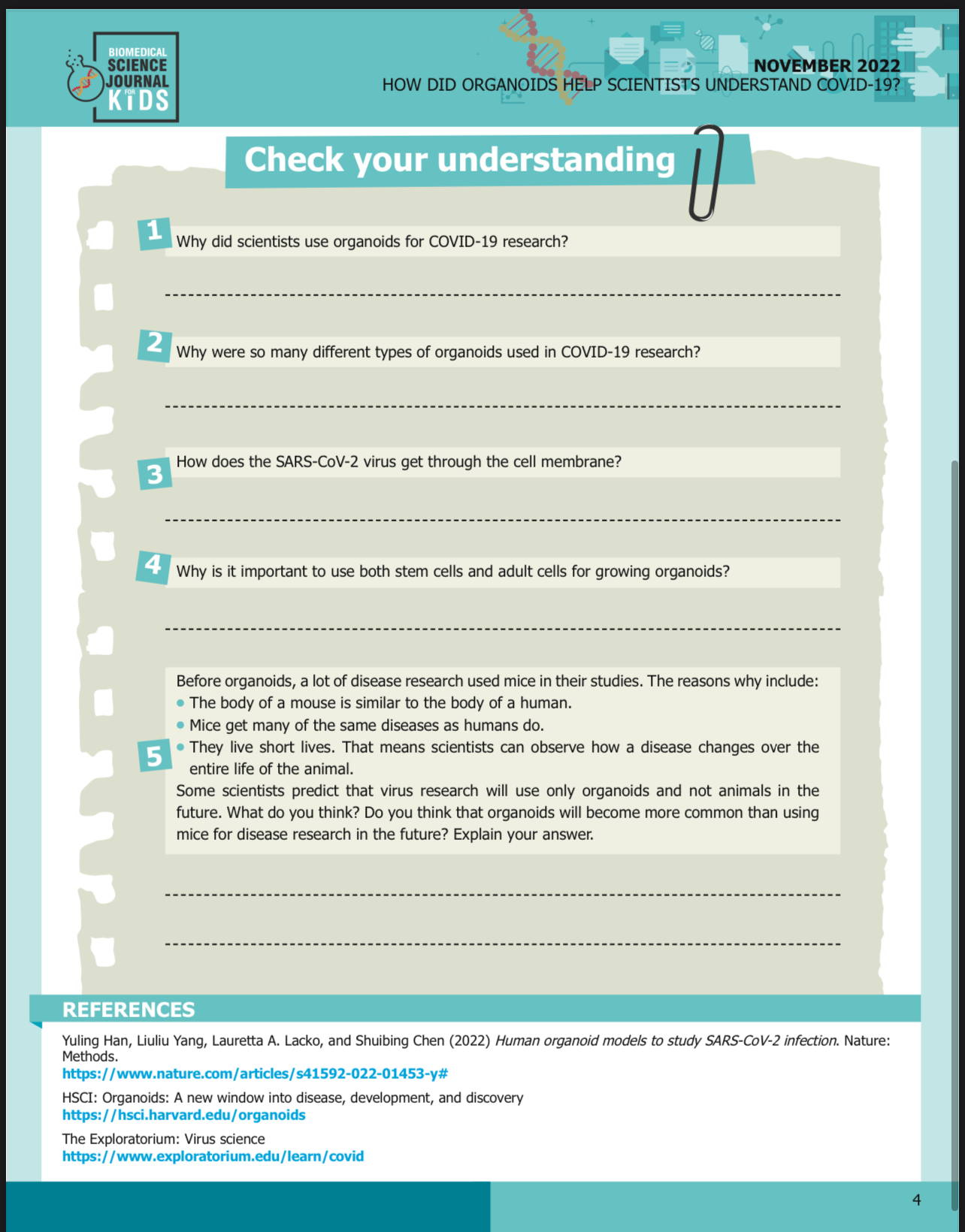
NOVEMBER 2022 BIOMEDICAL SCIENCE How did organoids help scientists JOURNAL understand COVID-19? KIDS Authors: Yuling Han, Liuliu Yang, Lauretta Lacko, Aadita Roy and Shuibing Chen Associate Editors: Allison Gamzon and Alexandra Appleton Abstract LOWER READING LEVEL Have you ever wondered how scientists develop medicines looked at studies done on organoids and COVID-19. We and vaccines for viruses? The answer is organoids! found that COVID-19 research used many different types Organoids are small models of human organs. Scientists of organoids. We also learned how scientists made these grow them in the laboratory. Scientists use organoids to organoids. Then we suggested ways to improve how we figure out how a virus attacks the body. They also use use organoids in disease research in the future. them to make possible treatments for the virus. We Introduction The SARS-CoV-2 virus causes Coronavirus disease 2019 (COVID-19). This virus enters your body. Then it uses your cells to make copies of itself. If the virus copies itself too much, it can kill or damage the cells in your body. This cell damage and loss may cause COVID-19. Cells have a special wall around them called the cell membrane. To copy itself, the SARS-CoV-2 virus has to get through this wall. How? The virus attaches itself to special points on the cell membrane. These points are like doorways into the cell. The virus attaches with its spike protein. The spike protein acts like a key to the door. When the spike protein attaches, the cell lets the virus inside. The SARS-CoV-2 virus often affects the lungs. But SARS- CoV-2 can actually damage organs all over your body. How do scientists know which ones? And how were they able to create a vaccine and medicine for COVID-19? Many researchers used organoids. An organoid is a small 3D model of an organ. Scientists Human intestinal organoids infected with SARS-CoV-2, the virus that causes COVID-19. The virus is shown in white. grow them in laboratories. They grow them from stem cells Image: Joep Beumer/Hubrecht Institute or from adult cells. More free science teaching resources at: www.ScienceJournalForKids.org 1Stem cells are special human cells that can turn into many different types of cells. That means that each stem cell grows up into a specific type of cell with a specific job. For example, a stem cell can become a brain cell, a lung cell, or a heart cell. Scientists use organoids to study different diseases and viruses. That's because they are easy to use. They also don't use animals! We read through scientific papers about organoids and COVID-19. We wrote a summary that included: Our review showed that each group of scientists made an organoid for one part of the body. These parts included: o Intestines e Brain e Heart e Lungs e Liver e Retinas o Kidneys e Tonsils e Capillaries Some of these body parts are organ systems. That means they have more than one part. For these systems, scientists made more than one organoid. For example, they made three organoids for the intestines. They also made three organoids for the lungs. Scientists used adult cells to make the tonsil organoid. They used stem cells to make the capillary, heart, brain, and kidney organoids. Scientists used both types of cells to make lungs, intestines, liver, and retina organoids (Figure 1). Many COVID-19 studies used organoids. That's why we summarized how scientists used them during COVID-19 research. We also made suggestions for making them better in the future. e the type of organoids used, how the scientists made the organoids, e how the SARS-CoV-2 virus affected the organoids, and e ways to make organoid research better in the future. Scientists infected their organoid with SARS-CoV-2 virus. Then they observed which cells the virus entered. They also observed how the virus affected them. Medicine and vaccine research used lung, kidney, liver, brain, heart, and capillary organoids. Scientists used the tonsil organoids to test the SARS-CoV-2 vaccine. Our review showed that organoids only contain the cells of the organ studied. So, for example, a brain organoid only has brain cells. They do not contain immune cells. These cells are what the body uses to fight viruses. They also don't connect to other organoids. That means that scientists can only observe one organoid at a time. Figure 1: Organoids that form from human stem cells. HUMAN STEM CELL @ 8 S0 OV O EYE ORGANOID BRAIN ORGANOQID KIDNEY HEART ORGANOID ORGANOID PANCREATIC ORGANOID LIVER ORGANOID LUNG ORGANOQID INTESTINAL ORGANOID PLACENTA ORGANOID Our review showed that organoids were important when studying COVID-19. They helped scientists figure out which types of cells the SARS-CoV-2 virus affects. They also helped develop medications and vaccines. That means organoids helped save many lives. We learned that it is important to make organoids using both stem cells and adult cells. Stem cell organoids can grow and develop very fast. But they often behave like the cells of a baby. That's why scientists also studied organoids from adult cells. Then they could learn how the virus affects adults. Organoids will continue to be part of disease research in the future. But scientists need to make them better. That's Scientists continue to learn a lot about COVID-19 and other diseases from organoids. Their work will help people become less badly sick, so they won't need to go to the hospital. You can also help by preventing the spread of the viruses that cause these diseases. Make sure to wash your hands with because organoids don't contain immune cells. Scientists need to be able to observe how immune cells respond to a virus in an organoid. That will show them how a disease develops over time. It will also show them if the immune cells damage the body when they fight a virus. Future organoids should also have connections to other organoids. After all, organs don't work on their own! If a virus harms one organ, it may affect how another organ works. 3D printing technology might be able to create these more complex organoid systems. soap and water. Stay home when you aren't feeling well. Also, eat healthy food, exercise, and get plenty of rest. All this will help to make your immune system as strong as it can be to fight viruses. Glossary of Key Terms Capillary - the part of the body that passes fluids and gasses between cells and the blood. Cell - the smallest unit of life. The human body is made up of trillions of cells. Cell membrane - the wall surrounding the cell that allows some substances through, but not others. Immune cells - cells in the body that fight infection and other diseases. Organ - a part of the body that has an important job. Examples include the brain, heart, and lungs. Organoid - a small 3D model of an organ. Retina - the part of the eye that converts light into signals that are sent to the brain. SARS-CoV-2 - the virus that causes COVID-19. Tonsils two small lumps found in the back of your throat that help your body fight infection. Spike protein proteins on the surface of a virus particle that stick out and help virus particles enter cells. Stem cell - special cells that can turn into many different types of cells. Acknowledgment: This article's adaptation was supported by the GM Foundation. BIOMEDICAL SCIENCE NOVEMBER 2022 JOURNAL HOW DID ORGANOIDS HELP SCIENTISTS UNDERSTAND COVID-19? KIDS Check your understanding 1 Why did scientists use organoids for COVID-19 research? 2 Why were so many different types of organoids used in COVID-19 research? 3 How does the SARS-CoV-2 virus get through the cell membrane? 4 Why is it important to use both stem cells and adult cells for growing organoids? Before organoids, a lot of disease research used mice in their studies. The reasons why include: . The body of a mouse is similar to the body of a human. . Mice get many of the same diseases as humans do. 5 . They live short lives. That means scientists can observe how a disease changes over the entire life of the animal. Some scientists predict that virus research will use only organoids and not animals in the future. What do you think? Do you think that organoids will become more common than using mice for disease research in the future? Explain your answer. REFERENCES Yuling Han, Liuliu Yang, Lauretta A. Lacko, and Shuibing Chen (2022) Human organoid models to study SARS-CoV-2 infection. Nature: Methods. https://www.nature.com/articles/s41592-022-01453-y# HSCI: Organoids: A new window into disease, development, and discovery https://hsci.harvard.edu/organoids The Exploratorium: Virus science https://www.exploratorium.edu/learn/covid
Step by Step Solution
There are 3 Steps involved in it
1 Expert Approved Answer
Step: 1 Unlock
Question Has Been Solved by an Expert!
Get step-by-step solutions from verified subject matter experts
Step: 2 Unlock
Step: 3 Unlock
Students Have Also Explored These Related Law Questions!









 Study Help