







Question: Alan Turing was an English mathematician and computer scientist (among many other things). During World War II, Turing and his team at Bletchley Park
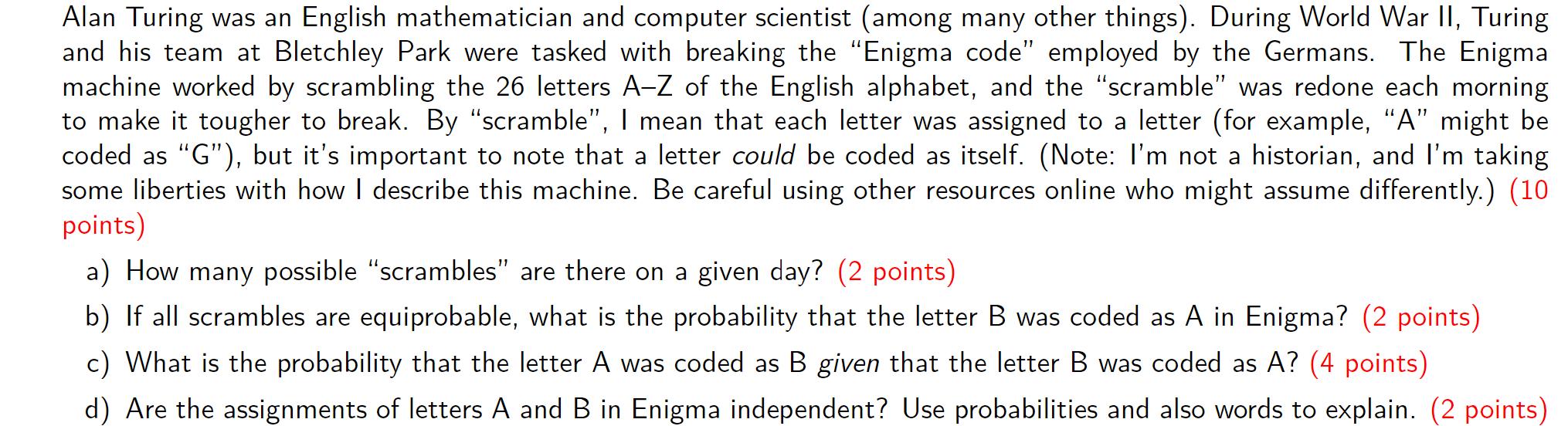
Alan Turing was an English mathematician and computer scientist (among many other things). During World War II, Turing and his team at Bletchley Park were tasked with breaking the "Enigma code" employed by the Germans. The Enigma machine worked by scrambling the 26 letters A-Z of the English alphabet, and the "scramble" was redone each morning to make it tougher to break. By "scramble", I mean that each letter was assigned to a letter (for example, "A" might be coded as "G"), but it's important to note that a letter could be coded as itself. (Note: I'm not a historian, and I'm taking some liberties with how I describe this machine. Be careful using other resources online who might assume differently.) (10 points) a) How many possible "scrambles" are there on a given day? (2 points) b) If all scrambles are equiprobable, what is the probability that the letter B was coded as A in Enigma? (2 points) c) What is the probability that the letter A was coded as B given that the letter B was coded as A? (4 points) d) Are the assignments of letters A and B in Enigma independent? Use probabilities and also words to explain. (2 points)
Step by Step Solution
3.62 Rating (145 Votes )
There are 3 Steps involved in it
a There are 26 possible scram bles on a given day one for each ... View full answer

Get step-by-step solutions from verified subject matter experts
 Study Help