







Question: Analyze the situation the case describe What happened,Why,How does this related to what you are being asked to do,Who are the key players in the
- Analyze the situation the case describe
- What happened,Why,How does this related to what you are being asked to do,Who are the key players in the case and what are their positions?
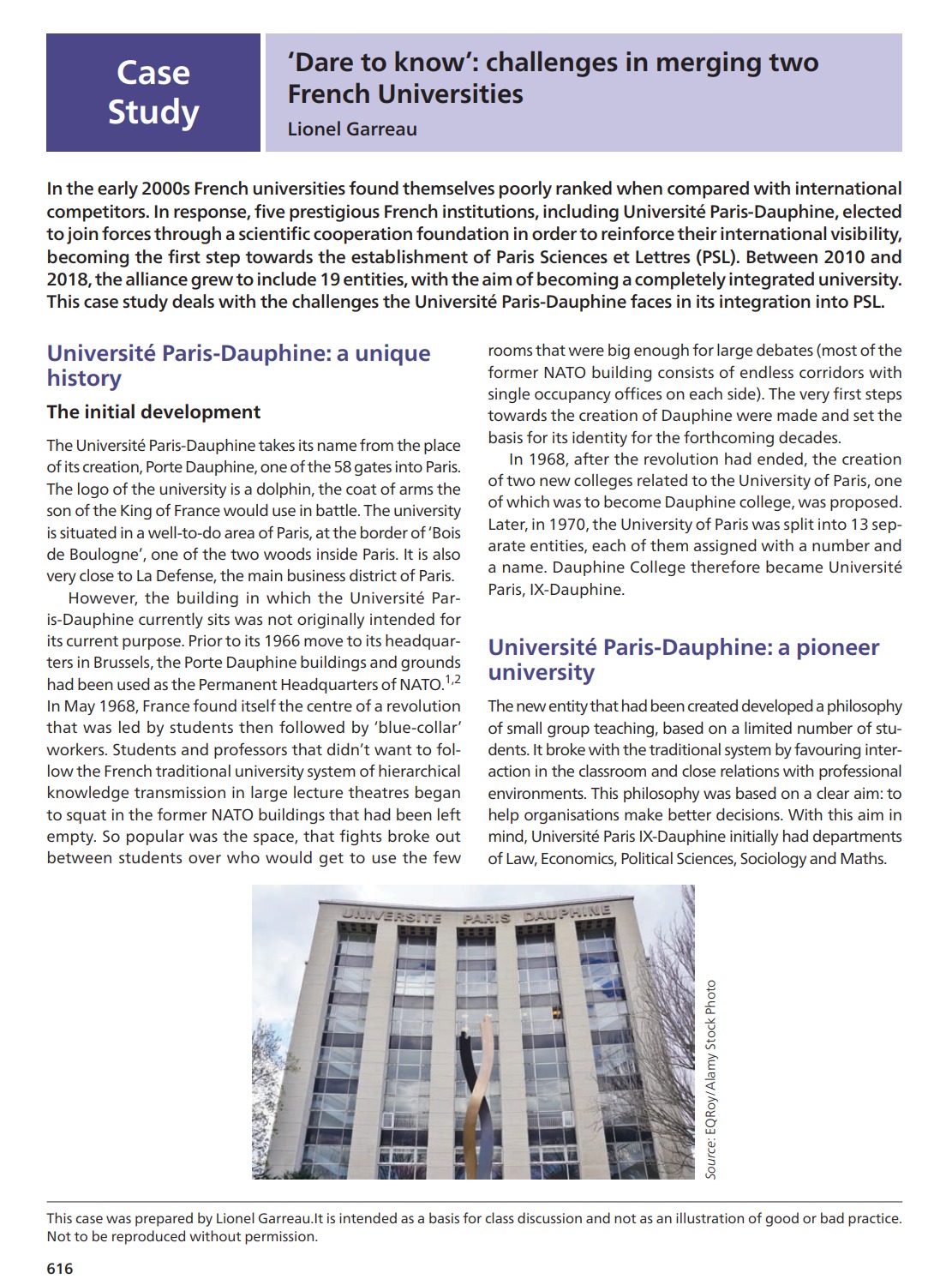
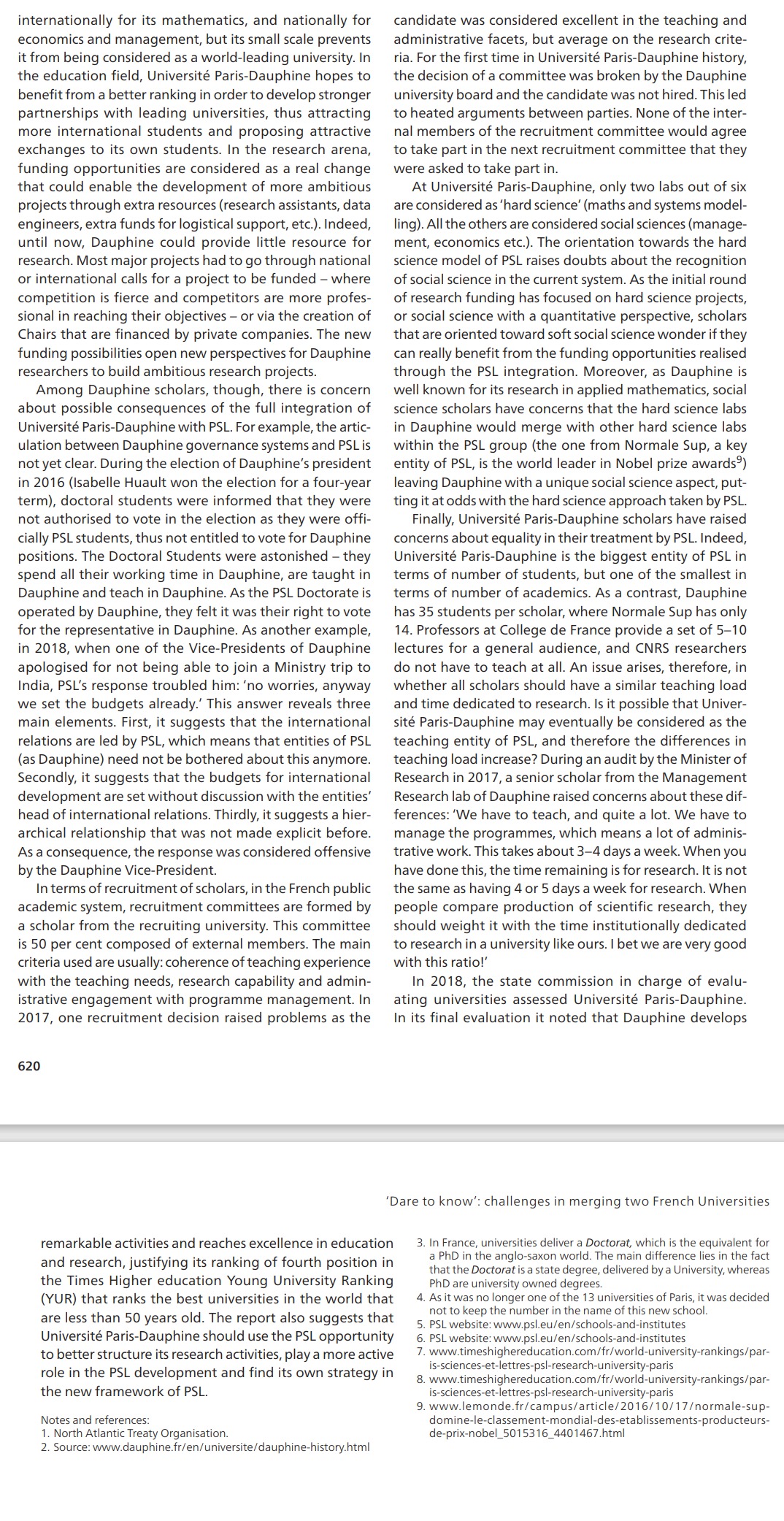
Case 'Dare to know': challenges in merging two Study French Universities Lionel Garreau In the early 2000s French universities found themselves poorly ranked when compared with international competitors. In response, five prestigious French institutions, including Universite Paris-Dauphine, elected to join forces through a scientific cooperation foundation in order to reinforce their international visibility, becoming the first step towards the establishment of Paris Sciences et Lettres (PSL). Between 2010 and 2018, the alliance grew to include 19 entities, with the aim of becoming a completely integrated university. This case study deals with the challenges the Universite Paris-Dauphine faces in its integration into PSL. Universite Paris-Dauphine: a unique rooms that were big enough for large debates (most of the history former NATO building consists of endless corridors with single occupancy offices on each side). The very first steps The initial development towards the creation of Dauphine were made and set the The Universite Paris-Dauphine takes its name from the place basis for its identity for the forthcoming decades. of its creation, Porte Dauphine, one of the 58 gates into Paris. In 1968, after the revolution had ended, the creation The logo of the university is a dolphin, the coat of arms the of two new colleges related to the University of Paris, one son of the King of France would use in battle. The university of which was to become Dauphine college, was proposed. is situated in a well-to-do area of Paris, at the border of 'Bois Later, in 1970, the University of Paris was split into 13 sep- de Boulogne', one of the two woods inside Paris. It is also arate entities, each of them assigned with a number and very close to La Defense, the main business district of Paris. a name. Dauphine College therefore became Universite However, the building in which the Universite Par- Paris, IX-Dauphine. is-Dauphine currently sits was not originally intended for its current purpose. Prior to its 1966 move to its headquar ters in Brussels, the Porte Dauphine buildings and grounds Universite Paris-Dauphine: a pioneer had been used as the Permanent Headquarters of NATO. 1,2 university n May 1968, France found itself the centre of a revolution The new entity that had been created developed a philosophy that was led by students then followed by 'blue-collar' of small group teaching, based on a limited number of stu- workers. Students and professors that didn't want to fol- dents. It broke with the traditional system by favouring inter- ow the French traditional university system of hierarchical action in the classroom and close relations with professional knowledge transmission in large lecture theatres began environments. This philosophy was based on a clear aim: to to squat in the former NATO buildings that had been left help organisations make better decisions. With this aim in empty. So popular was the space, that fights broke out mind, Universite Paris IX-Dauphine initially had departments between students over who would get to use the few of Law, Economics, Political Sciences, Sociology and Maths. UNIVERSITE PARIS DAUPHINE Source: EQRoy/Alamy Stock Photo This case was prepared by Lionel Garreau.It is intended as a basis for class discussion and not as an illustration of good or bad practice. Not to be reproduced without permission. 616Dare to know': challenges in merging two French Universities Historically, business schools developed in France out- . MSO - Master in Organisation Sciences. Oversees side of universities. They relied on Chambers of Commerce Master's degrees in Business, Economics, Law and and were focused on undergraduate and continuous edu- Social Sciences. cation but did not develop any research activities. In 1972 . MIDO - Mathematics and Informatics for Decision in Universite Paris IX-Dauphine was the first university to Organisations. Oversees licence and Master's degrees develop a business department. Following a long tradi- in mathematics and informatics. tion in universities, Universite Paris IX-Dauphine espoused research and teaching. Thanks to its small group educa- EDD - Ecole Doctorale de Dauphine. Oversees the tion system, and through experienced scholars Universite Doctorat level Paris IX-Dauphine rapidly developed a strong reputation . DEP - Departement d'Education Permanente. Oversees for business education and research. It developed the first continuous education programs. research Master's degree in the General Policy of Organ- Central services are composed of human resources, izations in France, which led to numerous other Master's finance, international relations, IT and technical services degrees in which research was closely related to teach- departments, as well as a research promotion service. ing. Later, Universite Paris IX-Dauphine developed the first In 2018, Universite Paris-Dauphine was composed Doctorat' in business management in France. of 13,000 students and 376 scholars undertaking the Universite Paris IX-Dauphine was one of the first to uti- research and teaching activities of the university as well lise a stringent selection process for students, yet in France, as hundreds of external part-time teachers that provide selection to university following completion of baccalaur the required teaching force. eate was forbidden until 2018. Instead, all French high school graduates were traditionally guaranteed a univer- ity place, irrespective of grades attained. Universite Paris Autonomy and project-based organisation IX-Dauphine, though, had decided from the very first years One of the main traits of Universite Paris-Dauphine is of its creation that students would be selected based on its decentralized organization. Indeed, the 88 Master's their educational performance. As a result, in the late degrees reflect the intensity of entrepreneurship in the 1990s, many students that wanted to enter Universite Paris University. Each is the result of a project to develop a new IX-Dauphine but were rejected due to insufficient grades, program in a field by a professor. The traditional process turned to the legal system to force acceptance. Dauphine's of programme development starts with a scholar who has selection method was deemed illegal, meaning that all an interesting idea that he/she discusses with colleagues. those who sought admittance through legal challenge Then, the programme structure is developed, and teach- were admitted. Consequently, in 2004, the president of ing resources sought, either from colleagues within the the University decided to change the status of the Uni- university or externally. At this stage the project is pre- versity, instead creating a 'Grand Etablissement' - a public sented to the department which provides an indicative excellence school that has the right to select. Although opinion. Then, official governance structures (Student Life Dauphine was no longer strictly a 'university' it was still Board, Scientific Board and Board of Directors - that are allowed to use the name Universite Paris-Dauphine. elected by students, academic and administrative staff members) vote to accept or refuse the proposal. Once the A decentralized organisation project is accepted, the director of the programme gener- ally has autonomy in programme management, the main Organisational structure constraints being budgetary. Whereas most universities operate through faculties that For decades, overseeing a Master's programme was articulate activities between research and education in considered a source of power and recognition within each field (for example, business, law, economics, etc.), Universite Paris-Dauphine. As such many projects were Universite Paris IX-Dauphine organises itself in a differ- developed, with little coordination by the governance ent way. It operates via a matrix organisational structure structures, resulting in two main outcomes. Firstly, Uni- with education departments and research departments. versite Paris-Dauphine developed a highly entrepreneur- Six research departments oversee the research activities ial system in which any new interesting project could in the areas of mathematics, business, law, social science, be launched. For example, eight MBAs were developed modelisation of decision making and economics. In addi- between 2000 and 2003 in French-speaking countries tion, five departments oversee the education elements of with local partners (Lebanon, Syria, Egypt, Morocco, the system: Algeria, Tunisia, Mauritius, Senegal). Secondly, many pro- grammes are considered by their developers as their own. LSO - Licence in Organisation Sciences. Oversees licence As they are able to realise large amounts of autonomy in (undergraduate) degrees in Business, Economics, Law programme management, they don't appreciate external and Social Sciences. constraints from central services. This trait is reinforced by 617the French university system. In this system, scholars are civil servants: they are selected by the National University Council and once employed, they remain in post until retirement. The only changes to this are when moving from an assistant professor position to associate or full professor or leaving the university. In addition, university scholars in France do not have a boss in the traditional sense: people in charge of the research or education departments are other scholars that are nominated or elected for a specific time period. They need to use their leadership in order to manage the teams they oversee but cannot rely on formal authority to do so. Testimonies of Dauphine academic staff members: - Female, 37 years old: \"What I like in our University is that it is very decentralized. Actually, every year, I adjust my teaching: I skip the courses that I like the less, or that I have taught for too long, and I look for new ones. Of course, this has disadvantages as you have to know where to find courses. you need to ask each program director if he needs someone like you. But when you're from inside, it\"s not a big problem.' - Male, 46 years old: \"When you have good ideas, it\"s easy to find support for them. Of course, you have to know people and to talk with them. One of the key places in the university is the corridors. Everything takes place in the corridors!\" - Male, 42 years old: \"What is striking when you arrive in Dauphine is the corridors. The buildings were made for NATO so that information could not move from one office to another without going through these huge corridors. We made a university out of it... And the least we can say is that the building does not favour communication.' - Male, 55 years old: \"Dauphine is a great place to work. You have ideas, you have support to implement them. And if you don't, nobody really asks you to have some!\" - Female, 2017 newcomer, 50 years old: \"I had been told that Dauphine was very entrepreneurial. It's true. But it's also a connection of networks that you have to navigate. They sometimes lack coordination. We can almost say it has a fractured state of small, sometimes mutually hostile, groups and you have to learn how to navigate them.\" PSL university: the creation of a lead- ing French university Birth and institutionalisation of PSL Research university In the early 20005, the French ministry of teaching and research acknowledged that, despite the overall good reputation of French schools and universities, global 618 university rankings indicated that that French universities were ranked below expectations. Five prestigious and well-established institutions Chimie ParisTech (Est. 1896), College de France (Est. 1530), Ecole normale suprieure Paris (Est. 1794), Ecole Suprieure de Physique et de Chimie Industrielles de la ville de Paris (Est. 1882), and the Observatoire de Paris (Est. 1671) agreed to develop a scientific alliance, leading to the eventual creation of the Paris Sciences et Lettres {PS L) foundation. This foundation was designed to provide a formal structure to hold ambitious research projects. In 201 1, the government launched a national programme in order to fund Initiatives for Excellence, for which PSL applied and was successful generating extra funding for research pro- jects. Once established as such an Initiative for Excellence, the PSL foundation attracted ten other institutions in 2011 and 2012, one of which was Universite' Paris-Dauphine. Finally, four other institutions joined PSL in 2014. In 2015, PSL organised itself into a university com- munity, a formal university format. The PSL foundation then became PSL Research University. Its motto is \"Dare to know\" as a reference to Horace and Kant\"s works, that reflects the objective of emancipating oneself through knowledge, and to provide its students enlightenment through education. PSL claims 26 Nobel prizes, 10 Field Medals, 3 Abel prizes, 75 Moliere awards (theatre) and, 44 Cesar awards (cinema), and more. Some of its internationally renowned figures (researchers or former students) include Pierre Curie (physics), Marie Curie (physics and chemistry), and Jean-Paul Sartre (literature). Governance of PSL Whereas the initial PSL project generated extra funding via large research projects that could aggregate resources from various entities, the expectations of the French min- istry of Research and the PSL board evolved towards a for- mal integration of the many components that composed PSL. In 2017, new statutes were passed that defined the main governance system components and the articulation between entities of PSL.5 These included the 'Members' central institutions at the heart of PSL with voting rights that develop a common strategy, the 'Associate Members\" more peripheral or lately integrated institutions with con- sultative rights that have an exclusive partnership with P5 L, and Associate Institutions national research entities that work in close relation with PSL. PSL is headquartered in a small building in the Latin Quarter of Paris, about 30 minutes from Dauphine by public transport. The location reflects the objective of cre- ating a university that aggregates and coordinates excel- lent institutions in the heart of Paris. At PSL headquarters. there are no classrooms or offices for scholars. Instead the building houses administrative staff and meeting rooms. 'Dare to know': challenges in merging two French Universities Universite PSL's member institutions collaborate to launched the PSL innovation fund, which aims to transfer develop a common strategy for research, teaching, and scientific knowledge to start-up projects, in the fields of technology transfer through a shared budget. They work digital technologies, artificial intelligence, hardware and together to implement a multi-year academic recruit- life sciences. ment plan and draw upon shared services. Further, these institutions agreed to confer all their degrees under the First rounds of operations PSL name. The very first degree to be integrated was the doctoral degree: from 2015 on, doctoral degrees from PSL competes with international institutions at the all institutions belonging to PSL became PSL doctoral highest levels. To do so, PSL focuses heavily on research degrees, operated by the various institutions. Follow- activities, either research-oriented programmes at the ing this, PSL developed 'excellence programs' that build Master and Doctorate levels, or formal research projects. on the resources from the various entities but that are Accordingly, PSL dedicates most of its funding to research directly operated by PSL in order to provide high value activities. PSL operates as a 'research framer' by proposing degrees. Students benefit from the best researchers in vari- frameworks for projects to be developed through calls for ous domains ensuring excellence in courses. Eventually, in proposals. PSL has clear guidelines for project applications 2017, all degrees were transferred to PSL, but continued and projects are usually selected by an international com- to be operated by the various institutions. mittee. Researchers can be granted anything between a PSL's associate institutions are affiliated with the univer- few thousand euros to several hundreds of thousands of sity through exclusive partnership agreements. They contrib euros for funding projects. ute to PSL's international rankings, have access to Universite PSL-conferred degrees and can contribute to a variety of Extract from a call for proposal research, teaching and technology transfer projects within a The Interdisciplinary and Strategic Research Initiative framework defined by the Council of Members. In 2018, PSL (IRIS) aims at federating teams that work on themes counted 17,000 students and 4,500 researchers. linked to global studies. This research is centred around three main axes: Implementation of a hard science model . policy in a globalised space; The PSL website describes PSL as, 'a world-class leader in . beyond Europe: connections, dependences and historic the hard sciences (College de France, ENS, Observatoire dynamics; de Paris, Institut Curie), first-rate schools of engineering . global perspectives on the long term through Asian (MINES ParisTech, ESPCI Paris, Chimie ParisTech), France's perspectives. leading hub for the humanities and social science (Ecole Through aggregation of the various entities and the des Chartes, EHESS, EPHE, EFEO), an institution of top development of new education programmes, as well as expertise in teaching and research in decision science (Paris Dauphine), and, something no other university in strong research projects, the initial rankings of PSL are encouraging. In 2017 the university was ranked: France can offer, five of the world's most prestigious fine arts schools (Conservatoire National d'Art Dramatique, 39th in the World Reputation Ranking' (Times higher Conservatoire National Superieur de Musique et de Danse Education) de Paris, Ecole Nationale Superieure des Arts Decoratifs, . 72nd in the World University Ranking (Times higher Beaux-Arts, and La Femis)', thus distinguishing the status Education) of excellence of each institution within the group. In 2017, Alain Fuchs was elected as President of PSL. 4th in the Young University Ranking (Times higher Alain Fuchs is a researcher in physiochemistry and the Education) former president of CNRS (National Centre for Scientific In all these rankings PSL is ranked as the top French Research), which is a public organisation whose main university, demonstrating that the strategy is working at mission is to 'evaluate and carry out all research capable a national level. However, it also demonstrates that all of advancing knowledge and bringing social, cultural, French institutions appear quite low in world rankings. and economic benefits for society'. The CNRS mission and the related headcount are mainly grounded in those Universite Paris-Dauphine in PSL elements of science considered 'hard' such as natural sciences (physics, chemistry, biology, etc.) and formal sci- university ence (mathematics, geometrics, etc.) as opposed to the The integration to PSL of Universite Paris-Dauphine is con- 'soft' sciences that focus more on social aspects (history, sidered as a great opportunity for most within the insti- sociology, language, etc.). Following this view, in 2018, PSL tution. Indeed, Universite Paris-Dauphine is well known 619internationally for its mathematics, and nationally for candidate was considered excellent in the teaching and economics and management, but its small scale prevents administrative facets, but average on the research crite- it from being considered as a world-leading university. In ria. For the first time in Universite Paris-Dauphine history, the education field, Universite Paris-Dauphine hopes to the decision of a committee was broken by the Dauphine benefit from a better ranking in order to develop stronger university board and the candidate was not hired. This led partnerships with leading universities, thus attracting to heated arguments between parties. None of the inter- more international students and proposing attractive nal members of the recruitment committee would agree exchanges to its own students. In the research arena, to take part in the next recruitment committee that they funding opportunities are considered as a real change were asked to take part in. that could enable the development of more ambitious At Universite Paris-Dauphine, only two labs out of six projects through extra resources (research assistants, data are considered as 'hard science' (maths and systems model- engineers, extra funds for logistical support, etc.). Indeed, ling). All the others are considered social sciences (manage- until now, Dauphine could provide little resource for ment, economics etc.). The orientation towards the hard research. Most major projects had to go through national science model of PSL raises doubts about the recognition or international calls for a project to be funded - where of social science in the current system. As the initial round competition is fierce and competitors are more profes- of research funding has focused on hard science projects, sional in reaching their objectives - or via the creation of or social science with a quantitative perspective, scholars Chairs that are financed by private companies. The new that are oriented toward soft social science wonder if they funding possibilities open new perspectives for Dauphine can really benefit from the funding opportunities realised researchers to build ambitious research projects. through the PSL integration. Moreover, as Dauphine is Among Dauphine scholars, though, there is concern well known for its research in applied mathematics, social about possible consequences of the full integration of science scholars have concerns that the hard science labs Universite Paris-Dauphine with PSL. For example, the artic- in Dauphine would merge with other hard science labs ulation between Dauphine governance systems and PSL is within the PSL group (the one from Normale Sup, a key not yet clear. During the election of Dauphine's president entity of PSL, is the world leader in Nobel prize awards") in 2016 (Isabelle Huault won the election for a four-year leaving Dauphine with a unique social science aspect, put- term), doctoral students were informed that they were ting it at odds with the hard science approach taken by PSL. not authorised to vote in the election as they were offi- Finally, Universite Paris-Dauphine scholars have raised cially PSL students, thus not entitled to vote for Dauphine concerns about equality in their treatment by PSL. Indeed, positions. The Doctoral Students were astonished - they Universite Paris-Dauphine is the biggest entity of PSL in spend all their working time in Dauphine, are taught in terms of number of students, but one of the smallest in Dauphine and teach in Dauphine. As the PSL Doctorate is terms of number of academics. As a contrast, Dauphine operated by Dauphine, they felt it was their right to vote has 35 students per scholar, where Normale Sup has only for the representative in Dauphine. As another example, 14. Professors at College de France provide a set of 5-10 in 2018, when one of the Vice-Presidents of Dauphine lectures for a general audience, and CNRS researchers apologised for not being able to join a Ministry trip to do not have to teach at all. An issue arises, therefore, in India, PSL's response troubled him: 'no worries, anyway whether all scholars should have a similar teaching load we set the budgets already.' This answer reveals three and time dedicated to research. Is it possible that Univer- main elements. First, it suggests that the international site Paris-Dauphine may eventually be considered as the relations are led by PSL, which means that entities of PSL teaching entity of PSL, and therefore the differences in (as Dauphine) need not be bothered about this anymore. teaching load increase? During an audit by the Minister of Secondly, it suggests that the budgets for international Research in 2017, a senior scholar from the Management development are set without discussion with the entities' Research lab of Dauphine raised concerns about these dif- head of international relations. Thirdly, it suggests a hier- ferences: "We have to teach, and quite a lot. We have to archical relationship that was not made explicit before. manage the programmes, which means a lot of adminis- As a consequence, the response was considered offensive trative work. This takes about 3-4 days a week. When you by the Dauphine Vice-President. have done this, the time remaining is for research. It is not In terms of recruitment of scholars, in the French public the same as having 4 or 5 days a week for research. When academic system, recruitment committees are formed by people compare production of scientific research, they a scholar from the recruiting university. This committee should weight it with the time institutionally dedicated is 50 per cent composed of external members. The main to research in a university like ours. I bet we are very good criteria used are usually: coherence of teaching experience with this ratio!' with the teaching needs, research capability and admin- In 2018, the state commission in charge of evalu- istrative engagement with programme management. In ating universities assessed Universite Paris-Dauphine. 2017, one recruitment decision raised problems as the In its final evaluation it noted that Dauphine develops 620 'Dare to know': challenges in merging two French Universities remarkable activities and reaches excellence in education 3. In France, universities deliver a Doctorat, which is the equivalent for and research, justifying its ranking of fourth position in a PhD in the anglo-saxon world. The main difference lies in the fact that the Doctorat is a state degree, delivered by a University, whereas the Times Higher education Young University Ranking PhD are university owned degrees. (YUR) that ranks the best universities in the world that 4. As it was no longer one of the 13 universities of Paris, it was decided are less than 50 years old. The report also suggests that not to keep the number in the name of this new school. 5. PSL website: www.psl.eu/en/schools-and-institutes Universite Paris-Dauphine should use the PSL opportunity 6. PSL website: www.psl.eu/en/schools-and-institutes to better structure its research activities, play a more active 7. www.timeshighereducation.com/fr/world-university-rankings/par- role in the PSL development and find its own strategy in is-sciences-et-lettres-psl-research-university-paris 8. www.timeshighereducation.com/fr/world-university-rankings/par- the new framework of PSL. is-sciences-et-lettres-psl-research-university-paris 9. www.lemonde.fr/campus/article/2016/10/17ormale-sup Notes and references: domine-le-classement-mondial-des-etablissements-producteurs- 1. North Atlantic Treaty Organisation. de-prix-nobel_5015316_4401467.html 2. Source: www.dauphine.fr/en/universite/dauphine-history.html
Step by Step Solution
There are 3 Steps involved in it

Get step-by-step solutions from verified subject matter experts
 Study Help