







Question: answer these MCQS i. i a training eveni inciudes learning iu be a beiier iisienter or learning is interaci effectively with team members and customers,
answer these MCQS
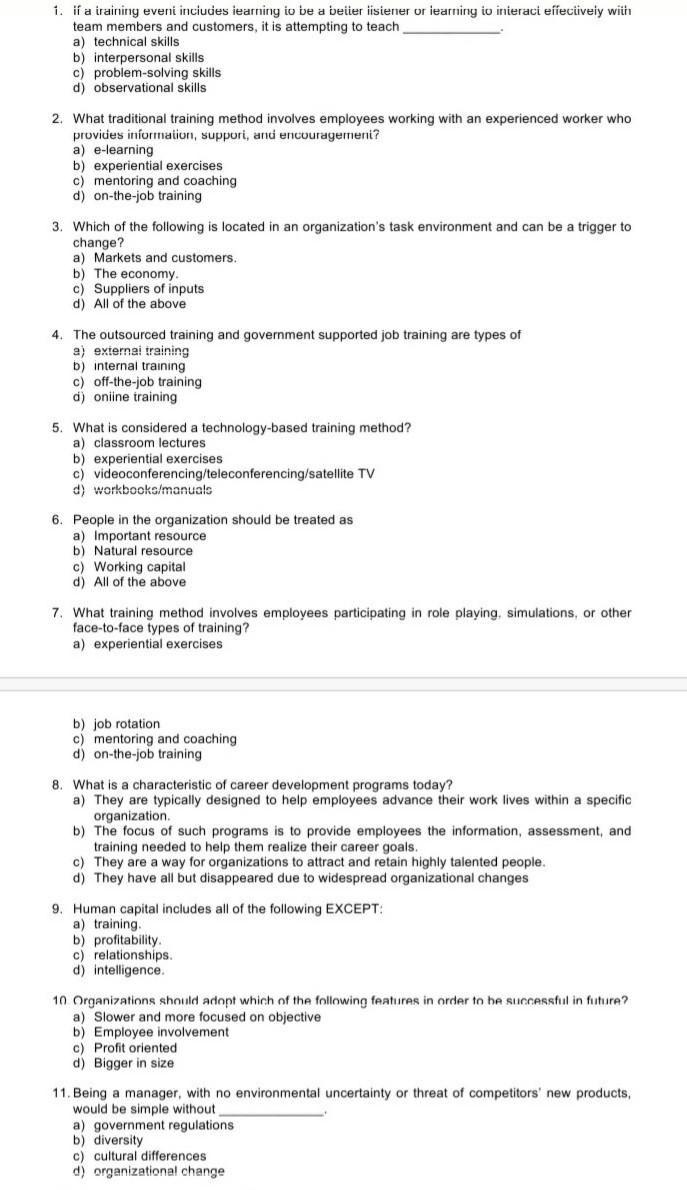
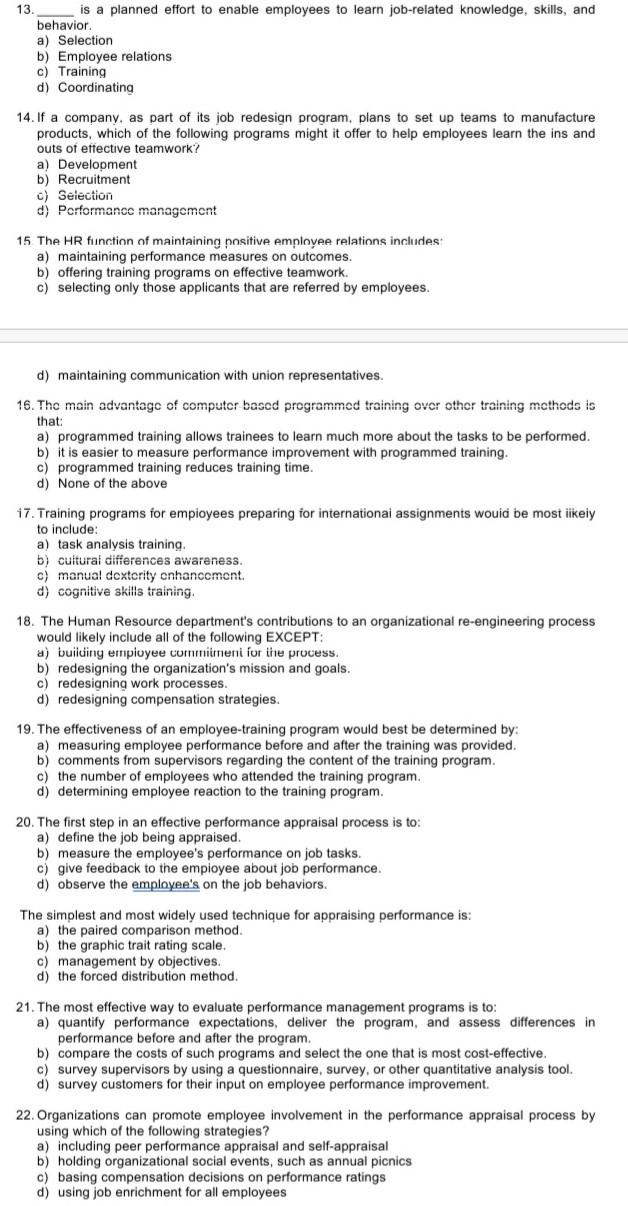
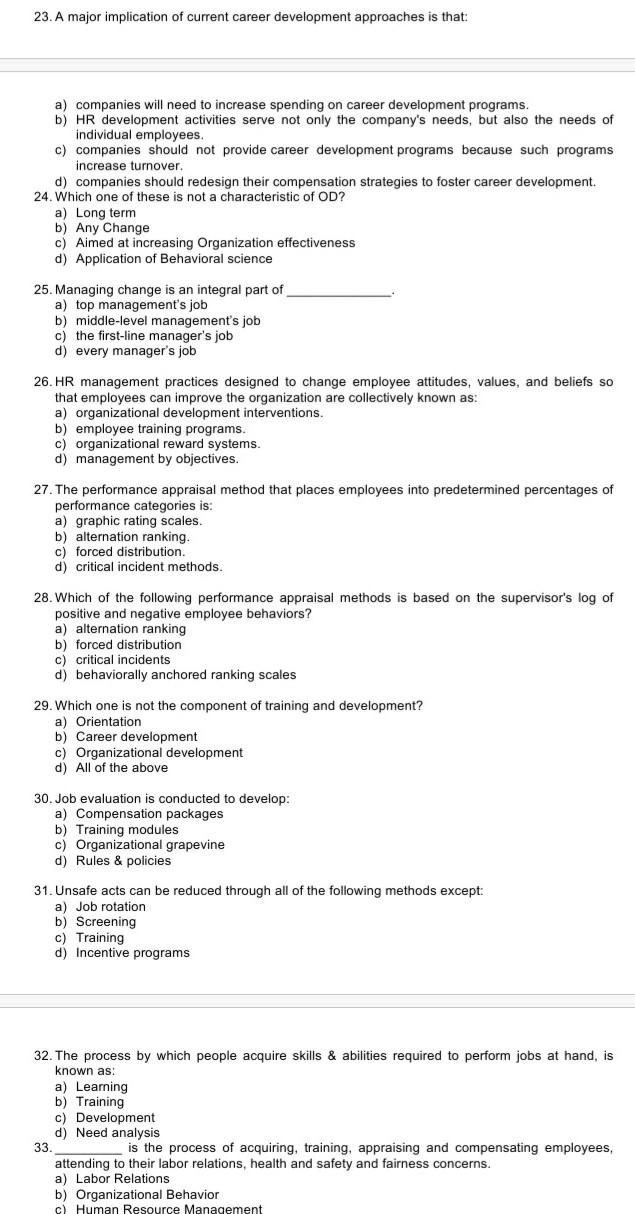
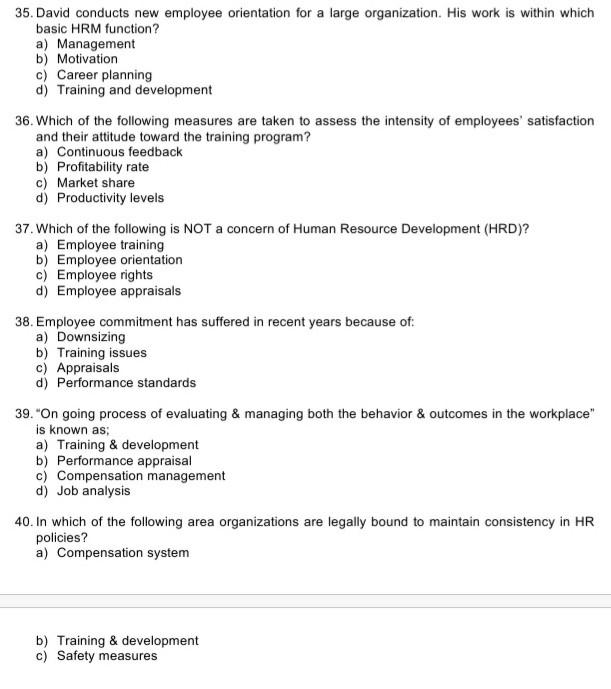
i. i a training eveni inciudes learning iu be a beiier iisienter or learning is interaci effectively with team members and customers, it is attempting to teach a) technical skills b) interpersonal skills c) problem-solving skills d) observational skills 2. What traditional training method involves employees working with an experienced worker who provides information, suppuri, and encouragemeni? a) e-learning b) experiential exercises c) mentoring and coaching d) on-the-job training 3. Which of the following is located in an organization's task environment and can be a trigger to change? a) Markets and customers. b) The economy. c) Suppliers of inputs d) All of the above 4. The outsourced training and government supported job training are types of a) external training b) internal training c) off-the-job training d) oniine training 5. What is considered a technology-based training method? a) classroom lectures b) experiential exercises c) videoconferencing/teleconferencing/satellite TV d) workbooks/manuals 6. People in the organization should be treated as a) Important resource b) Natural resource c) Working capital d) All of the above 7. What training method involves employees participating in role playing, simulations, or other face-to-face types of training? a) experiential exercises b) job rotation c) mentoring and coaching d) on-the-job training 8. What is a characteristic of career development programs today? a) They are typically designed to help employees advance their work lives within a specific organization b) The focus of such programs is to provide employees the information, assessment and training needed to help them realize their career goals. c) They are a way for organizations to attract and retain highly talented people. d) They have all but disappeared due to widespread organizational changes 9. Human capital includes all of the following EXCEPT a) training b) profitability c) relationships. d) intelligence 10 Organizations should adopt which of the following features in order to be successful in future? a) Slower and more focused on objective b) Employee involvement c) Profit oriented d) Bigger in size 11. Being a manager, with no environmental uncertainty or threat of competitors' new products, would be simple without a) government regulations b) diversity c) cultural differences d) organizational change 13 is a planned effort to enable employees to learn job-related knowledge, skills, and behavior a) Selection b) Employee relations c) Training d) Coordinating 14. If a company, as part of its job redesign program. plans to set up teams to manufacture products, which of the following programs might it offer to help employees learn the ins and outs of effective teamwork? a) Development b) Recruitment c) Selection d) Performance management 15 The HR function maintaining positive employee relations includes a) maintaining performance measures on outcomes. b) offering training programs on effective teamwork. c) selecting only those applicants that are referred by employees. d) maintaining communication with union representatives. 16. The main advantage of computer based programmed training over other training methods is that: a) programmed training allows trainees to learn much more about the tasks to be performed. b) it is easier to measure performance improvement with programmed training. c) programmed training reduces training time. d) None of the above 17. Training programs for employees preparing for international assignments would be most likely to include: a) task analysis training, b) cultural differences awareness c) manual dexterity enhancement d) cognitive skills training, 18. The Human Resource department's contributions to an organizational re-engineering process would likely include all of the following EXCEPT: a) building employee commitment for the process. b) redesigning the organization's mission and goals. c) redesigning work processes. d) redesigning compensation strategies. 19. The effectiveness of an employee-training program would best be determined by: a) measuring employee performance before and after the training was provided. b) comments from supervisors regarding the content of the training program. c) the number of employees who attended the training program. d) determining employee reaction to the training program. 20. The first step in an effective performance appraisal process is to: a) define the job being appraised. b) measure the employee's performance on job tasks. c) give feedback to the employee about job performance. d) observe the employee's on the job behaviors. The simplest and most widely used technique for appraising performance is: a) the paired comparison method. b) the graphic trait rating scale. c) management by objectives. d) the forced distribution method. 21. The most effective way to evaluate performance management programs is to: a) quantify performance expectations, deliver the program, and assess differences in performance before and after the program. b) compare the costs of such programs and select the one that is most cost-effective, c) survey supervisors by using a questionnaire, survey, or other quantitative analysis tool. d) survey customers for their input on employee performance improvement. 22. Organizations can promote employee involvement in the performance appraisal process by using which of the following strategies? a) including peer performance appraisal and self-appraisal b) holding organizational social events, such as annual picnics c) basing compensation decisions on performance ratings d) using job enrichment for all employees 23. A major implication of current career development approaches is that: a) companies will need to increase spending on career development programs. b) HR development activities serve not only the company's needs, but also the needs of individual employees. c) companies should not provide career development programs because such programs increase turnover, d) companies should redesign their compensation strategies to foster career development. 24. Which one of these is not a characteristic of OD? a) Long term b) Any Change c) Aimed at increasing Organization effectiveness d) Application of Behavioral science 25. Managing change is an integral part of a) top management's job b) middle-level management's job c) the first-line manager's job d) every manager's job 26. HR management practices designed to change employee attitudes, values, and beliefs so that employees can improve the organization are collectively known as: a) organizational development interventions. b) employee training programs. c) organizational reward systems. d) management by objectives. 27. The performance appraisal method that places employees into predetermined percentages of performance categories is: a) graphic rating scales. b) alternation ranking. C) forced distribution. d) critical incident methods. 28. Which of the following performance appraisal methods is based on the supervisor's log of positive and negative employee behaviors? a) alternation ranking b) forced distribution c) critical incidents d) behaviorally anchored ranking scales 29. Which one is not the component of training and development? a) Orientation b) Career development c) Organizational development d) All of the above 30. Job evaluation is conducted to develop: a) Compensation packages b) Training modules c) Organizational grapevine d) Rules & policies 31. Unsafe acts can be reduced through all of the following methods except: a) Job rotation b) Screening c) Training d) Incentive programs 32. The process by which people acquire skills & abilities required to perform jobs at hand, is known as: a) Learning b) Training c) Development d) Need analysis 33 is the process of acquiring, training, appraising and compensating employees, attending to their labor relations, health and safety and fairness concerns. a) Labor Relations b) Organizational Behavior C) Human Resource Management 35. David conducts new employee orientation for a large organization. His work is within which basic HRM function? a) Management b) Motivation c) Career planning d) Training and development 36. Which of the following measures are taken to assess the intensity of employees' satisfaction and their attitude toward the training program? a) Continuous feedback b) Profitability rate c) Market share d) Productivity levels 37. Which of the following is NOT a concern of Human Resource Development (HRD)? a) Employee training b) Employee orientation c) Employee rights d) Employee appraisals 38. Employee commitment has suffered in recent years because of: a) Downsizing b) Training issues c) Appraisals d) Performance standards 39. "On going process of evaluating & managing both the behavior & outcomes in the workplace" is known as: a) Training & development b) Performance appraisal c) Compensation management d) Job analysis 40. In which of the following area organizations are legally bound to maintain consistency in HR policies? a) Compensation system b) Training & development c) Safety measuresStep by Step Solution
There are 3 Steps involved in it
1 Expert Approved Answer
Step: 1 Unlock

Question Has Been Solved by an Expert!
Get step-by-step solutions from verified subject matter experts
Step: 2 Unlock
Step: 3 Unlock
 Study Help