







Question: Assume that the semi-discrete problem ; = f(ui-1, Ui, Ui+1) is instead discretised in time using a Runge-Kutta method with s > 1 stages. Which
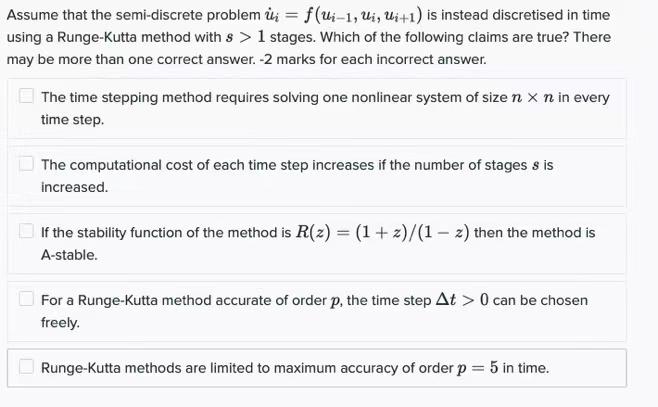
Assume that the semi-discrete problem ; = f(ui-1, Ui, Ui+1) is instead discretised in time using a Runge-Kutta method with s > 1 stages. Which of the following claims are true? There may be more than one correct answer. -2 marks for each incorrect answer. The time stepping method requires solving one nonlinear system of size n x n in every time step. The computational cost of each time step increases if the number of stages s is increased. If the stability function of the method is R(z) = (1+z)/(1 2) then the method is A-stable. For a Runge-Kutta method accurate of order p, the time step At > 0 can be chosen freely. Runge-Kutta methods are limited to maximum accuracy of order p = 5 in time
Step by Step Solution
There are 3 Steps involved in it

Get step-by-step solutions from verified subject matter experts
 Study Help