Question: atter? 7.8 AD-ROBIC EXERCISES A. Briefing for New Business Select a business in your town that is of interest to you. This can be a
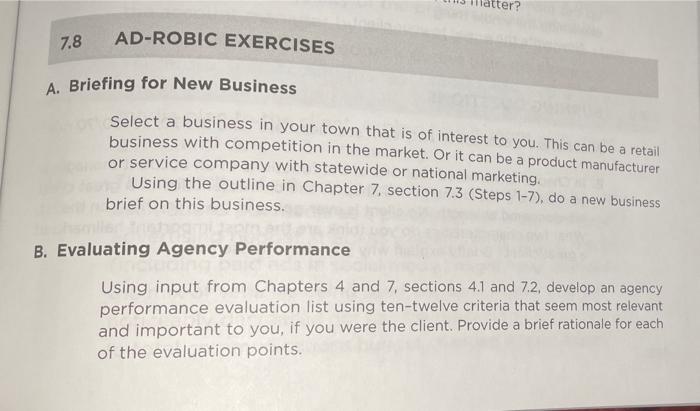
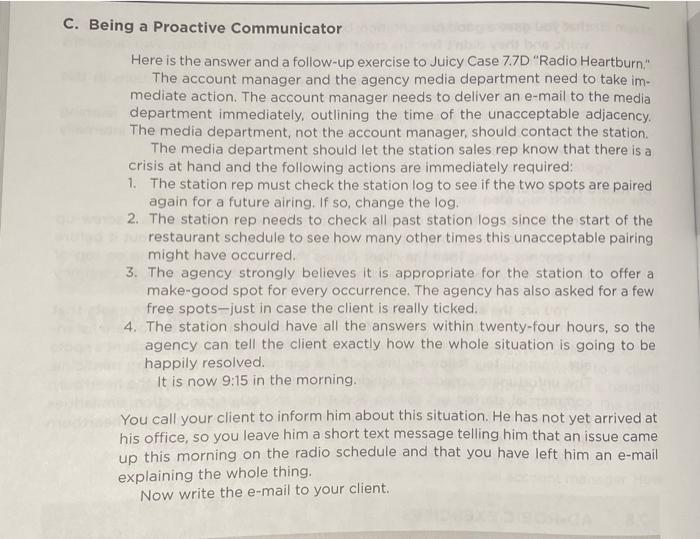
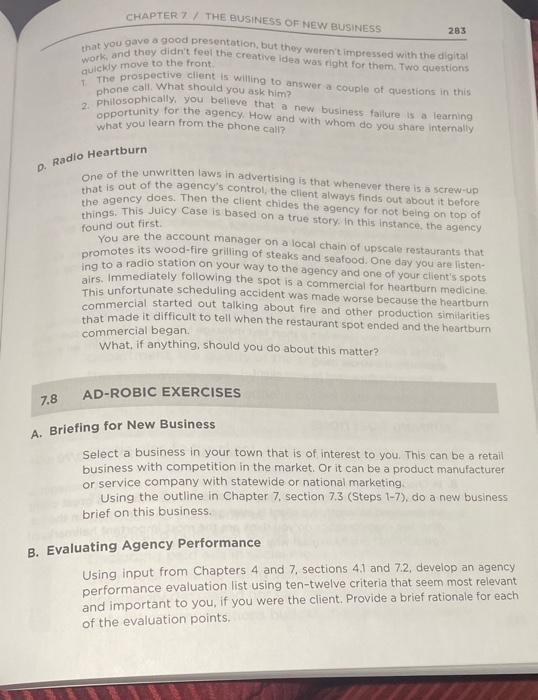
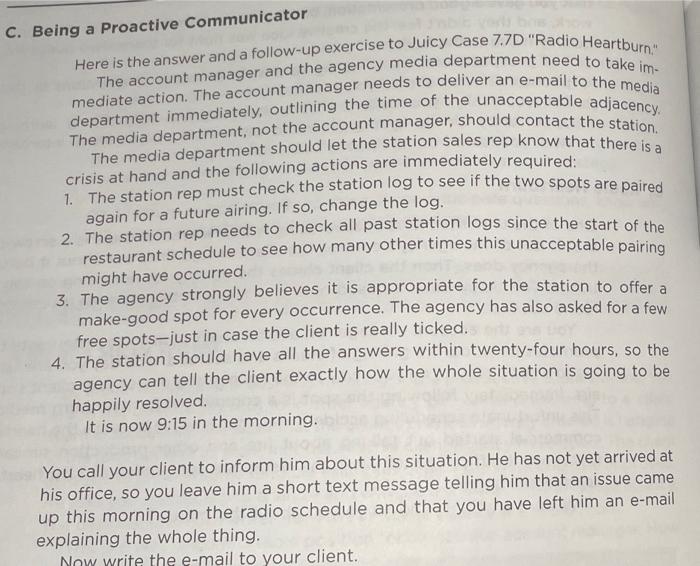
atter? 7.8 AD-ROBIC EXERCISES A. Briefing for New Business Select a business in your town that is of interest to you. This can be a retail business with competition in the market. Or it can be a product manufacturer or service company with statewide or national marketing Using the outline in Chapter 7, section 7.3 (Steps 1-7), do a new business brief on this business. B. Evaluating Agency Performance Using input from Chapters 4 and 7, sections 41 and 7.2, develop an agency performance evaluation list using ten-twelve criteria that seem most relevant and important to you, if you were the client. Provide a brief rationale for each of the evaluation points. C. Being a Proactive Communicator Here is the answer and a follow-up exercise to Juicy Case 7.7D "Radio Heartburn." The account manager and the agency media department need to take im- mediate action. The account manager needs to deliver an e-mail to the media department immediately, outlining the time of the unacceptable adjacency. The media department, not the account manager, should contact the station The media department should let the station sales rep know that there is a crisis at hand and the following actions are immediately required: 1. The station rep must check the station log to see if the two spots are paired again for a future airing. If so, change the log, 2. The station rep needs to check all past station logs since the start of the restaurant schedule to see how many other times this unacceptable pairing might have occurred. 3. The agency strongly believes it is appropriate for the station to offer a make-good spot for every occurrence. The agency has also asked for a few free spots-just in case the client is really ticked. 4. The station should have all the answers within twenty-four hours, so the agency can tell the client exactly how the whole situation is going to be happily resolved. It is now 9:15 in the morning. You call your client to inform him about this situation. He has not yet arrived at his office, so you leave him a short text message telling him that an issue came up this morning on the radio schedule and that you have left him an e-mail explaining the whole thing. Now write the e-mail to your client. C. Being a Proactive Communicator Here is the answer and a follow-up exercise to Juicy Case 7.7D "Radio Heartburn." The account manager and the agency media department need to take im- mediate action. The account manager needs to deliver an e-mail to the media department immediately, outlining the time of the unacceptable adjacency. The media department, not the account manager, should contact the stations, The media department should let the station sales rep know that there is a crisis at hand and the following actions are immediately required: 1. The station rep must check the station log to see if the two spots are paired again for a future airing. If so, change the log. 2. The station rep needs to check all past station logs since the start of the restaurant schedule to see how many other times this unacceptable pairing might have occurred. 3. The agency strongly believes it is appropriate for the station to offer a make-good spot for every occurrence. The agency has also asked for a few free spots-just in case the client is really ticked. 4. The station should have all the answers within twenty-four hours, so the agency can tell the client exactly how the whole situation is going to be happily resolved. It is now 9:15 in the morning. You call your client to inform him about this situation. He has not yet arrived at his office, so you leave him a short text message telling him that an issue came up this morning on the radio schedule and that you have left him an e-mail explaining the whole thing. Now write the e-mail to your client. 7.3 A SHORT COURSE IN NEW BUSINESS D The purpose of the new-business process is to show the prospective client that your agency can provide new customer insights, strategic thinking, creative solutions, and a high degree of integration across a diverse promotional mix that will help them grow their business and solve specific communication chal- lenges. Because of its importance, the new business function in an agency is normally managed by a very senior person who is an accomplished strategist, account manager, and presenter In a new business competition you basically develop a comprehensive advertising plan without much client input. The prospective client not only looks at the ideas you present, the questions you asked, and the process you went through to come up with your recommendations. So the method you use in the preparation of a new business pitch is important, not only CHAPTER 7 / THE BUSINESS OF NEW BUSINESS for the ideas it can produce but also for its ability to show you have a 9000 process for coming up with inspired thinking. The purpose of this section 15 to provide a short but proven road map in organizing a new business 263 presentation How to Write a New Business Brief and Develop a New-Business Pitch distillation of steps 1 through 5, Here is a straightforward new-business method. A new-business briet is a Step 1. State the Challenge This sounds simple enough if there is a specific communication challenge like a new product introduction. Or the communications challenge could be a vexing awareness issue, a fuzzy repositioning opportunity, or the need for some specific and immediate action from the marketplace. This challenge may not be what you end up with, but you need some place to start Step 2. Do a Streamlined Situation Analysis Many advertising textbooks call for situation analysis to be done at the beginning of any new-business effort. You can find an outline for a situation analysis in almost any advertising textbook. Most are very broad in scope, so you can streamline the activity by focusing on those things that are communications related Pay special attention to who the target audience is demographically and geographically, and their mind-set psychographically and behavioristically. (See Chapter 3, section 3.3 on the creative brief for more details on audience profiling.) Part of your new-business process should be to create a "brain food file." In the frenzy of energetic inquiry and analysis, ideas and valuable information should be flying Ideas and inspiration are precious. You can't lose them. Ad reprints, benchmarking samples, and research that seem to have little rele- vance now may be the source of wisdom, inspiration, and break-through ideas later. Create a repository for reference materials, and put someone in charge of keeping it in order Step 3. Do a Category Review Get advertising samples of all the prospective client's competitors and post them on a wall at the same time. Look at strategy, content, and execution See what you can learn from advertising being done by competitors. THE NEW ACCOUNT MA 264 Step 4. Do a SWOT Analysis: Strengths, Weaknesses, Opportunities, and Threats and the category review to a handful of key points: give the client its power. barriers that have to be overcome. The SWOT analysis is the outgrowth of what you learn about the client and the marketplace as you examine it through the lens of the stated problem and the target audience in the SWOT analysis you boll down your situation analysis they impact the marketplace. This can be product superiority. mar cet Share Strengths Here you explain the client's internal and external strengths as leadership Image dominance and a unique selling point those things that Weaknesses. These are internal and external weaknesses that have to be dealt with in the communication environment. They could be weaknesses in distribution, poor dealership control, pricing disadvantages essentially Opportunities "O" also stands for "open ground. Here is where you look of the target audience. Revisit what the category review is telling you about for a place that the client can "own" in the future. Review the state of mind where the competition is going with its ads. Review the strengths and weak Make this activity as visual as possible. Stick significant points on a big board or a wall and let it simmer. Let your subconscious work on it for a little while. This is an organic, intellectual process. The open ground is the ability to say something maps, word clouds, and other qualitative analytical tools are often helpful here new or to say something old in a way that no one has done before. Perceptual Threats: These are threats imposed externally, mostly by competitors. But offensive measures that might neutralize a competitor while you execute a you also need to consider the threats of not taking specific actions-counter- new campaign or the price to be paid for not boldly seizing the open ground Step 5. Restate the Challenge Confirm in your own mind that the problem is what the client says it is. Oftent is not. Steps 1-4 will often reveal a different problem along with a fresh strategy There is obvious risk in restating the challenge. But a redefined problem to address it. can often lead to a whole new way of looking at the issue. The fact that your analysis has led you to a different perspective on the issue is something their clients look for in agencies, as long as it is well justified and actionable. Step 6. Write the campaign and Creative Briefs Based on all the previous steps, here you outline the inspired communication 255 strategies you have developed to address the challenge as you see it How to deliver and to whom? Focus on creative strategy that will lead to strong are you going to solze the open ground? What basic message are you going distinctive themes and executions stop 7. Benchmark . . Before you start making ads, you need to revisit the mind-set of the target audience and the environment in which your campaign will run Examine the -best-in-class for these categories who is doing the best job advertising to your target audience, regardless of product category? What can you learn from them? who is doing the best job of overall promotion within the product category you are working with? What can we learn from them? who is currently doing the best job of using media vehicles you are going to use? What can we learn from them? who has recently executed a terrific sales promotion campaign? What can we learn from it? Who has the best-in-class website and interactive strategy? What can we learn from them? There may be other things relevant to your specific campaign that you want to benchmark in a similar way, Step 8. Make Ads Like Crazy By this time, ideas for ads should be covering the walls and littering the table. It's a natural outgrowth of the whole process that creative minds develop pos: sible ads as the new business process unfolds. Now is the time to bring out all those early ad ideas and let the creative juices really flow. Use the D'Arcy/Ogilvy/Bernbach model to evaluate early ad Ideas as well as the new ones. Pick the best three concepts that are noticeably different from one another but still on strategy. This will show the client how the overall strategy can be executed in a variety of ways. Try to come up with a total of three ad executions under each concept. This shows that each concept has "legs." Step 9: Wind Up and Pitch Present your concepts and defend them using the material in the presenta- tion template found in Chapter 3, section 3.5 (Should read: sections 3.3, 3,4, and 3.5) THE NEW ACCOUNT MANAGER 138 WHAT CLIENTS WANT FROM THEIR AGENCY AND EXPECT 4.1 OF THEIR ACCOUNT MANAGER stick against which to measure how you are doing. Since an important part of your job is to serve clients, you will spend them expectations. As you progress through your career, it is helpful to have a yard- jority of your time making sure you and your agency deliver on the following Clients hire agencies to solve problems-tough problems in need of crea pressures, biases, internal problems, and limitations that put a unique spin on tive solutions that only agencies can develop. Each client brings their own the account manager's job of managing the agency's efforts. The purpose of this chapter is to explain what clients want from their agency and therefore Short of a more formal assessment tool provided by agency management or your client, this list of client wants and expectations should serve you well expect their account manager to deliver Wanted: A Partner and Collaborator, Genuinely Interested in and Capable of Building Their Business The relationship between agency and client is unique in business culture. Some people like this relationship to that of a client and its law firm, its accounting firm, or its management consultants. But the agency is expected to be a more proactive partner, leading the client rather than simply responding. The agency-client relationship revolves around strategies and programs that will build image and generate revenue. Also, the agency-client partner ship is unique because it is usually a lot of fun. Honest! Smart clients know they need professional communications help and are willing to give you and your firm tremendous responsibility for their future success. This is why clients are called clients, not customers. When the rela- tionship between the agency and client is good, you will be entrusted with information few people see, Wanted: Collaboration, Objectivity, Candor Three characteristics are present in every strong agency-client relationship, collaboration, objectivity, and candor. The contemporary model for a strong relationship involves the client more in the agency process than in the past. The client review of the creative brief, the use of concept roughs, and even occasional client involvement in the creative process are indications that col- laboration is good business practice. Candor is another hallmark of a strong partnership. Clients expect to be told what they can and cannot expect their advertising to accomplish and CHAPTER 7 / THE BUSINESS OF NEW BUSINESS 7.2 253 IN THE HUNT: NEW BUSINESS 101 "New business is extremely important to an agency. Growing the bilings from current accounts is normally not enough to replace the clients every agency Toses over time for new agencies are attracted to hot shops. How advertising agencies set service ranks. plus, an agency that is landing new accounts is perceived as being a hot shop! new clients is an intriguing and often secretive process which is usually the responsibility of a senior agency manager who came up through the account while the young account manager will probably have little involvement in the new business process, it's important to know how new business works, Being tapped for involvement in agency new business is generally a good sign that management thinks you have a future at the agency and they're comfortable in presenting you to prospective clients. This section is designed to provide the young account manager with in- sights into this critical agency function. When the opportunity to get involved in new business finally presents itself, these insights can help you look at the agency pitch with a fresh and enlightened eye. This section will also help you make an important observation or key sug- gestion that makes the agency pitch more powerful. Developing a good feel for new business is serious job security and the quickest way to increase your compensation The New Business Process There are two basic ways that agencies get new accounts. First, the "scoop," where due to relationships and timing, the account moves to an agency without a formal review. Second, and more common, is the more formal agency review process. This is the one we'll focus on The Scoop Every once in a while, an account will simply switch from one agency to another. This normally doesn't happen on large national brand accounts, but smaller, less visible accounts will occasionally make this move. The scoop (aka "ay down") is often the result of some very adroit courting by the new agency behind the scenes. Through private talks over weeks, months, or years, management of the new agency has convinced the prospective client that the current agency needs to go and no review is needed. 7.3 A SHORT COURSE IN NEW BUSINESS The purpose of the new-business process is to show the prospective client that your agency can provide new customer insights, strategic thinking, creative solutions, and a high degree of integration across a diverse promotional mix that will help them grow their business and solve specific communication chal- lenges. Because of its importance, the new business function in an agency is normally managed by a very senior person who is an accomplished strategist, account manager, and presenter In a new business competition you basically develop a comprehensive advertising plan without much client input. The prospective client not only looks at the ideas you present, the questions you asked, and the process you went through to come up with your recommendations. So the method you use in the preparation of a new business pitch is important, not only 263 CHAPTER 7 / THE BUSINESS OF NEW BUSINESS for the ideas it can produce but also for its ability to show you have a good process for coming up with inspired thinking. The purpose of this section 15 to provide a short but proven road map in organizing a new-business How to Write a New Business Brief and Develop a New-Business Pitch Here is a straightforward new-business method. A new-business bries presentation distillation of steps through 5. stop 1. State the Challenge This sounds simple enough if there is a specific communication challenge Nke a new product introduction. Or the communications challenge could be a vexing awareness 155ue, a fuzzy repositioning opportunity, or the need for some specific and immediate action from the marketplace. This change may not be what you end up with, but you need some place to start related profiling.) Step 2. Do a Streamlined Situation Analysis Many advertising textbooks call for situation analysis to be done at the beginning of any new-business effort. You can find an outline for a situation analysis in almost any advertising textbook. Most are very broad in scope, so you can streamline the activity by focusing on those things that are communications Pay special attention to who the target audience is demographically and geographically, and their mind-set psychographically and behavioristically (See Chapter 3, section 3.3 on the creative brief for more details on audience Part of your new-business process should be to create a "brain food file." in the frenzy of energetic inquiry and analysis, ideas and valuable information should be flying Ideas and inspiration are precious. You can't lose them. Ad reprints, benchmarking samples, and research that seem to have little rele- vance now may be the source of wisdom inspiration, and break-through ideas later. Create a repository for reference materials, and put someone in charge of keeping it in order Step 3. Do a Category Review Get advertising samples of all the prospective client's competitors and post them on a wall at the same time. Look at strategy, content, and execution. See what you can learn from advertising being done by competitors. Step 4. Do a SWOT Analysis: Strengths, Weaknesses. Opportunities, and Threats The SWOT analysis is the outgrowth of what you learn about the client and the marketplace as you examine it through the lens of the stated problem and the target audience in the SWOT analysis you boil down your situation anal and the category review to a handful of key points Strengths! Here you explain the client's internal and external strengths leadership image dominance, and a unique selling point-those things that they impact the marketplace. This can be product superiority. marts give the client its power Weaknesses. These are internal and external weaknesses that have to be dealt within the communication environment. They could be weak in distribution, poor dealership control, pricing disadvantages-essen barriers that have to be overcome. Opportunities: "0" also stands for "open ground." Here is where you look for a place that the client can "ownin the future. Review the state of mind of the target audience. Revisit what the category review is telling you about where the competition is going with its ads. Review the strengths and we nesses. Review the communications problem given by the client. Make this activity as visual as possible. Stick significant points on a big boer or a wall and let it simmer. Let your subconscious work on it for a little while. This is an organic, intellectual process. The open ground is the ability to say something new or to say something old in a way that no one has done before. Perceptus Threats: These are threats imposed externally, mostly by competitors. But you also need to consider the threats of not taking specific actions-counter maps, word clouds , and other qualitative analytical tools are often helpful here offensive measures that might neutralize a competitor while you execute new campaign or the price to be paid for not boldly seizing the open ground Step 5. Restate the Challenge Confirm in your own mind that the problem is what the client says it is. Often, is not . Steps 7-4 will often reveal a different problem along with a fresh strategy There is obvious risk in restating the challenge. But a redefined probien can often lead to a whole new way of looking at the issue. The fact that you analysis has led you to a different perspective on the issue is something the clients look for in agencies, as long as it is well justified and actionable to address it. Step 6. Write the Campaign and Creative Briefs Based on all the previous steps, here you outline the inspired communications 265 CHAPTER 7 / THE BUSINESS OF NEW BUSINESS strategies you have developed to address the challenge your it How to deliver and to whom? Focus on creative strategy that we to strong are you going to the opon ground what basic more you gong distinctive themes and executions step 7. Benchmark Before you start making ads, you need to revisit the mind-set of the trout audience and the environment in which your campaign will run in the best-in-class" for these categories Who is doing the best job advertising to your target audience regardless of product category? What can you learn from them? Who is doing the best job of overall promotion within the product category you are working with? What can we learn from them? who is currently doing the best ob of using media vehicles you are going to use? What can we learn from them? .. who has recently executed a terrific sales promotion campaign? What can we learn from it? Who has the best-in-class website and interactive strategy? What can we learn from them? There may be other things relevant to your specific campaign that you want to benchmark in a similar way. Step 8. Make Ads Like Crazy By this time, Ideas for ads should be covering the walls and littering the table it's a natural outgrowth of the whole process that creative minds develop pos. sible ads as the new-business process unfolds. Now is the time to bring out all those early ad ideas and let the creative juices really flow. Use the D'Arcy/Ogilvy/Berbach model to evaluate early ad ideas as well as the new ones. Pick the best three concepts that are noticeably different from one another but still on strategy. This will show the client how the overall strategy can be executed in a variety of ways. Try to come up with a total of three ad executions under each concept. This shows that each concept has "legs." Step 9: Wind Up and Pitch Present your concepts and defend them using the material in the presenta tion template found in Chapter 3, section 3.5. (Should read: sections 3.3. 3.4, and 3.5) THE NEW ACCOUNT MANAGER 138 4.1 WHAT CLIENTS WANT FROM THEIR AGENCY AND EXPECT OF THEIR ACCOUNT MANAGER stick against which to measure how you are doing Since an important part of your job is to serve clients, you will spend the me jority of your time making sure you and your agency deliver on the following expectations. As you progress through your career, it is helpful to have yord Clients hire agencies to solve problems-tough problems in need of crea tive solutions that only agencies can develop. Each client brings their own the account manager's job of managing the agency's efforts. The purpose of pressures, biases, internal problems, and limitations that put a unique spin on this chapter is to explain what clients want from their agency and therefore Short of a more formal assessment tool provided by agency management expect their account manager to deliver or your client, this list of client wants and expectations should serve you want Wanted: A Partner and Collaborator, Genuinely Interested in and Capable of Building Their Business The relationship between agency and client is unique in business culture. Some people liken this relationship to that of a client and its law firm, its accounting firm or its management consultants. But the agency is expected to be a mons proactive partner, leading the client rather than simply responding that will build image and generate revenue. Also, the agency-client partner The agency-client relationship revolves around strategies and programs ship is unique because it is usually a lot of fun. Honest! Smart clients know they need professional communications help and are willing to give you and your firm tremendous responsibility for their future success. This is why clients are called clients, not customers. When the rela tionship between the agency and client is good, you will be entrusted with information few people see. Wanted: Collaboration, Objectivity, Candor Three characteristics are present in every strong agency-client relationship collaboration, objectivity, and candor. The contemporary model for a strong relationship involves the client more in the agency process than in the past. The client review of the creative brief, the use of concept roughs, and even occasional client involvement in the creative process are indications that col- laboration is good business practice. Candor is another hallmark of a strong partnership. Clients expect to be told what they can and cannot expect their advertising to accomplish and 139 are wrong CHAPTER 4 / WANTS, NEEDS, AND EXPECTATIONS should expect to be told when and why the agency thinks they (the clients) You are not just making ads. You are building brands, offecting sales and crafting the very voice your client uses to address its customers. This is no small deal. The posture and demeanor of the agency should be creative but still professional, sometimes leading sometimes equal, sometimes following but always collaborative and always candid The senior management of your agency has convinced your client that your account team is the partner they can count on for the creative messages into gration, and leadership that will drive their share of volce share of mind, and share of the market. It is a very heady responsibility one of the most important. Clients need to hear the truth as the agency sees it. The account manager is most often the messenger the advocate the take The account manager is the keeper of many flames, the candor flame being of unpopular agency positions. Nobody said leading a client was easy work One cautionary note, however. The term "partner" may not set well with the egos of many CEOs and top marketing executives. They know they need a partner, but they may not be able to admit it. So be sensitive to the use of this term and go with something else like "resource" e "advisor" but act no less professional To be a capable and deserving partner in the client's business, the agency requires a strong business sense to complement its creative prowess Becom ing a business partner is achieved through countless gestures and successes: for instance, going to client industry trade shows and participating in client industry associations. These are both seen as true demonstrations of a com mitment to the client Collaboration, in theory, is an attractive thing in practice, the level of client involvement in the creative process can pose great challenges The two driving forces that determine the level of client involvement in the creative process is how much the client wants to be involved and the agency creative director's tolerance for what is most likely to hinder the agency process The creative process, when executed correctly, should provide the client with adequate involvement in the objective setting and strategy review before the creative work starts. But some clients like to participate in the development of the ads themselves. This can be a very sensitive and problem-prone issue when the client is intimately involved in the creative work it hired the agency to do. Too much client involvement is bad for both the agency and the client. The agency's work needs to be just that the agency's work. And it needs to be work that the agency would proudly show a new business prospect. People fall in love with their own ideas even if there are better ones within reach. A heavily involved client quickly loses objectivity THE NEW ACCOUNT 140 Wanted: A Philosophy of Creating Change, Not Ads "They get it saying among clients who love their agency It means the stands the client's business, and knows what business the agency is really in agency has a good business sense. The agency understands marketing, under wareness attitude and behavior. It's normal for agency creatives to be in love Advertising is not an end in itself. It's a business tool to create change in with their ads. The account manager must be in love with the impact the ads wa have for the client in the marketplace Setting objectives is crucial to the account manager's role as change agent. The more specific the advertising objectives Wanted: Impactful Creative Work w Great communication is the most visible and tangible of the agency's products This comes in the form of advertising, websites, posters, special events, and so ate about delivering strong, high-quality creative work that is based on sound forth. Above all else, the account managers must be committed and passion strategy and realistic objectives. This, of course, requires that you know when Clients believe they need strong creative work, but they might need some education to know it when they see it. Evaluating the value of advertising is difficult and subjective. (Chapter 3. "Tools of the Craft," deals with the evalua tion of creative work) With the possible exception of direct-response cam- paigns, it is hard to isolate the exact impact of advertising. There are many factors that contribute to marketing success. Advertising is just one of them and why the creative work is the right work Don't assume your client fully understands or appreciates the strength ang brilliance of the work your agency does for them. For many clients, if the work gets done on time, doesn't exceed the budget, and looks halfway decent, it's good work Ultimately, the account manager is the keeper of the creative flame, en- suring consistently effective creative work. The client needs to trust the ac count manager to know strong work, to be able to explain and defend it. If the creative work doesn't meet your expectation, it's probably because it doesn't measure up to great work done in the past or it is not work you would proudly show a new business prospect. Whatever the reason, the agency can't expect a client to accept work about which the account manager is not genuinely enthusiastic Wanted: Team Members Who "Own the Customer Experience" Clients are often product-oriented, consumed by issues of product features, production, pricing and distribution. They hire an agency to stay in touch with CHAPTER 4 WANTS, NEEDS, AND EXPECTATIONS 141 the marketplace and add to the customer profile that is so critical to effective advertising While "owning the customer experience is not the sole domain collective understanding of the customer psyche of the agency, the client should expect the agency will add significantly to the As discussed elsewhere in this book account planning is a hybrid research represented in the creative process. So having everyone look at a campaign, or and creative technique designed to ensure that the customer's perspectives an ad, or a home page from the customer's standpoint is a good thing Think not include an account planner. When no account planner is there, the account ing like an account planner is especially important for agency teams that do manager is responsible for making sure the customer is well-represented in the creative and media strategy. The ability of an account manager to own the customer experience and understand the marketplace comes through getting out into the field, observ- ing, talking with customers with retail sales people and dealers, using the ci- ent's products, and testing the competitor's Wanted: Integrated Thinking Occasionally an account manager truly attuned to the client's customers and marketplace makes a significant contribution in the area of product design, packaging, marketing strategies, and the like Following closely behind strong creative work is the level of integration an agency should bring to a client's communications plan. The first thing a client will look at is the promotional mix-the choice of paid media. PR. sales promotion social media, digital and guerrilla media, and so on, being recommended by the agency it should be both creative and strategic in its makeup. The next thing clients will expect is that all the pieces of the plan will be well integrated. Integration ensures that those elements of the recommended promotional mix work to- gether well, follow a consistent strategy, and carry a consistent message. As explained in Chapter 1, section 1.1 the "Evolution of the Advertising Agency," agencies are trying to be truly full service to be able to deliver the services found in the promotional mix. One-stop shopping is a good thing for client relations and the agency bottom line. Briefing multiple resources can be a problem for communication manag- ers who have a lot on their plate. So an agency that provides a wide variety of communication services and is good at integration is a valuable partner. Even when the agency does not offer a certain service clike PR or events planning), it is best that the agency take the lead in finding the best provider and manag- ing that service for the client. Being good at managing the whole promotional mix and integrating those services well for the client does three other things, all positive. First, your client THE NEW ACCOUNT MANAGER 142 normally has many responsibilities beyond the ad program, so being able to from the customer's standpoint better coordinated and meaningful advertis rely upon one resource for everything is an officient use of their time Second the more services provided and controlled by the agency, the better the op ing can enhance the brand experience. Finally from the agency's standpoint portunity for effective integration and the more dependent the account the agency Wanted: Clear and consistent Communications Doing work for a client is one thing, tending to the business of account ser vice is another. The level of responsibility, confidentiality and money involved in servicing a client requires that the client know what is going on at all time with the projects entrusted to the agency As an account manager, you are the conduit for these communication, the gatekeeper, and the minder of the client's trust Communications must be timely , complete, and accurate, questions and concerns must be responded to quickly The tools used to achieve effective communications include conference reports, project status reports, reports of all kinds e-mail, texts, and simo phone calls. Don't be stingy with these tools. The client will tell you if you are over-communicating Two keys to communication success are: 1 Attention to detail (write it down), and 2. Providing what people need to know before they ask for it. In general, the more you communicate, the smoother things go. The smoother things go the more trust you earn, and the more the client will rely on the agency. The more trust and responsibility, the more space you get to do your job and the more important your growing account becomes to agency revenue War Think raise! Wanted: An Agency Team That's Open-Minded, Listens Well, and Takes Directions The most frequent reason for terminating an agency is "they don't listen This accusation is most often lodged at a creative team that consistently brings forth proposals that in the client's opinion) are off target or did not heed client input Developing good listening skills is well worth the time for account manag ers. Some people in the agency might listen selectively for what they want to hear and for what's wrong with what the client is saying. Agencies hurt their cause when they totally disregard a direction or suggestion made by the client. If not followed, client directions and suggestions still need to be responded to with well-considered explanations manager CHAPTER 4 WANTS, NEEDS, AND EXPECTATIONS 143 to make this happen. This is one of the most difficult fobs of the account for why they were not taken. It's the diplomatic job of the account manager Strong Hinded creatives are a fact of life in the agency business. But, as an was heard. Sometimes this is a difficult job because the role of the agency is to account manager, your job is to always make sure your clients know their input lead the client to advertising that will stand out in the marketplace Stand-out advertising often seems risky to clients An account manager's role is to provide input and feedback to the creative team that ensures that the client sees the agency was not only listening, but using this information in the client's best interest Clients who have read this book unanimously agree on the importance of this point and say they rely on their account manager to be their interpreter" to the agency. This occasionally includes filling in the blanks for what the client did not say At the same time, your role is to push the client to take reasonable risks to make their communications more effective. Being responsive and assertive is m art that becomes easier as you gain experience and trust. Demonstrating that your agency listens well is the first step. Wanted: Creative Thinkers in All Parts of the Team ideas are your stock and trade Clients hire agencies for ideas that will build share of voice, share of mind, and share of market Creativity can't stop with your creative department. Creativity must permeate the entire team (Except. perhaps, the accounting department. There, less creativity is better) Creative value-added should be everyone's goal media, interactive, public relations; it doesn't matter. The account manager's job is to challenge and mo- tivate every team member to do their best creative thinking on every project or campaign Creative depth is wonderful. It doesn't always happen. But wh tra creative solution is needed, you and your team really need to deliver Some creatives think that creative thinking is the exclusive responsibility of their department and they will resist ideas coming from others on the ac- count team This is old-school, arrogant, short-sighted thinking. Such creatives need to be smart enough to recognize a great idea when it drops in their lap, re- gardless of its origin, even the client. With their "superior creative skills, they should be able to take a good idea and make it even better, thereby extending ownership to themselves. When someone (other than the creative team, of course) comes up with a stunning creative idea that adds value to the campaign, make a big deal about it. There's nothing better than to be able to tell a client that the new idea that ex- THE NEW ACC 144 came from someone in the media department or an account coordinator someone in the traffic department whom they have never met Wanted: A Team That is Proactive Wa Red are the things that clients need and expect managers who sit around waiting for the next assignment from their clients are *Staying ahead of the client isn't the safe ground. It's the only ground Account doing their jobs. Thinking about ways to grow the client's business is part of partnership responsibility. Looking for new markets for their products, finding new media, finding a communications technique used in another industry and seeing how it might apply, and pushing the client in the right direction-thes You must constantly check the intellectual energy level of your account team With your intuitive talents and acquired skills, you need to keep your team, and Apathy and lethargy can set in after the account's "honeymoon period yourself pumped up-always proactive and always caring about the client's business Not every advertising and marketing idea you bring to a client is going to see the light of day. Enlightened clients don't expect to accept every agency ideas that are well thought out, aggressive, and on target. When one is ac proposal. That's not the point, anyway. You build trust and appreciation with cepted and executed, you and your client both look good. Wanted: A Team That Can Take Constructive Criticism and Deal Maturely with Disappointment No one has time for a creative team that gets defensive or starts to sulk when a client criticizes its work. There is something wrong with the relationship 1 this happens regularly, and it's up to the account manager to fix the problem Creative work should be "on target" when presented, there should be no unpleasant surprises if the agency has done its homework and has included the client in pivotal discussions along the way. Approval of the creative brief is one of these pivotal discussions. Additionally, clients should feel that they can be constructively critical in an attempt to get to the best execution of the best ideas, as they see it Sure, there are going to be disagreements, but everyone is on the same team. The agency should welcome client comments and participation, it fos- ters client buy-in of the agency's work. Dealing maturely with disappointment and set-back is also part of the business. Sometimes great ads and wonderful campaigns get killed regardless of their merits. Changes in the marketplace and budget cuts are realities that client and agency often face together. Even worse, whole campaigns have been killed because the chairman got one negative letter from a stockholder or the wife CHAPTER 4 / WANTS, NEEDS, AND EXPECTATIONS 145 of the CEO didn't like the new tagline it can happen. The agency.client relo tionship requires that the agency rebound quickly from disappointments and be ready to attack the next challenge with renewed energy Wanted: Genuine Respect and Appreciation for the Realities of the Client's Job The job of the client always looks easy. until you take a look behind the scenes Then you find that the client's job can be every bit as challenging as yours. Un derstanding the reality of the world your client contact lives in is often sobering and it is much appreciated when you understand what they have to deal with political battles for control. conflicting directives, production problems, turt battles, budget problems-you name it, they have it. The demands of their top management, dealers, employees, marketing, and production are often conflicting. Sometimes it simply is not easy being a client. So what can you do? Listen, empathize, understand their problems and look at everything you do for your clients from the standpoint of the challenges they face inside their organizations. You need to understand the environment in which your clients must do their jobs and respect their limitations, be they personal, organizar tional, budgetary, or otherwise. One of the jobs of the account manager is to make the client contact's job easier and to make them look good inside their organization. This is often done in small ways. The opportunities to ease their load and make them look good are hard to see if you don't understand their internal environment You might wonder how an agency could afford to be disrespectful to a cli- ent contact, but it happens all the time. In most cases, disrespect is the result of an agency working with a contact that has no power to fire the agency. In this case, the agency can turn arrogant and make this poor client contact's life miserable Beware. It happens. One day the person who is being dissed by the agency may be in a position of power. Who will be the first to go? The agency. Bad- mouthing a client among agency associates does nothing but lower morale and drain creative energy. A particular client can be a tough one and maybe not your favorite person, but if you want good work from your associates, showing respect and appreciation for the client is the best policy for you. The adage in the agency business is that every client should feel like they're the agency's only client. Idealistic, for sure. Realistic, not really. But that doesn't lessen the importance of the point. Clients are the life blood of the agency and should be appreciated as such. It doesn't take much to make a client feel important. Be responsive. Do good work. Spend their money as if it were your own. Trust and value their knowledge of their business. Treat them with respect. Say thanks. How difficult, is that? accou THE NEW ACCOUNT people 18 Wanted: Agens Wanted: Team Members (Especially the Account Manager) Who Are Presentable In add all mar Creatin proces or nee The staffe client be dd In cision know large the opin the agency's top management. The goal of an account managers to become a valued member of the management team to be recognized and respected within the organize as an outsider who is in the "inner circle" by advertising expertise, insig customer knowledge, and a thorough understanding of their business The degree to which an agency is allowed to be visible inside a client nization depends on a number of factors. These could include the importa of advertising to the client company the self-confidence of the client com nications manager, and how presentable the agency team is in most inside the client organization will be the account manager and a member the only members of the agency team who will have any significant viso One of the prime characteristics & client looks for in an account manage can make persuasive presentations to the client's upper management ar or agency top management is salesmanship. An agency representative who asset. Being dynamic, compelling authoritative and articulate is 9000 Bens able to blend in quickly with the clients culture is also one of the key to may be for others. Pay special attention to your client's internal culture and The "Chameleon Effect, as it is called, is easier for account people that adapt to it. This doesn't mean becoming something you are not. It does tural norms. When you do this, you are more likely to become an asset to you adopting protocols dress codes, language, work styles, and other client client contact and gain a position of importance within the organization There is something very special about being able to walk into a large et organization and assume a high level of acceptance because you've adapted to their culture. It's even better when you do the same thing in the afternoon the account manager a sp crea to tl 1. 2 4 5 6 with a different client and a totally different corporate culture. You've becom a true chameleon of others from your agency are involved with your client, everyone should be sensitive to this issue of presentability. Even though agency people ares pected to be a little different, they still are providing a professional service and should look and act like it. Some clients make arbitrary judgments about particular agency Status whose appearance or demeanor might impact how others in the client on ganization view the agency's work. This is a potential problem to which you need to be very alert. Why let good work get penalized because some agency people insist on a certain type of appearance or behavior? You shouldn't Account team stability is also an important subset of presentability ents take a risk by introducing agency players (other than the account mar ager and top management) into their organization. Frequent changes on the C c to ir CHAPTER 4 / WANTS, NEEDS, AND EXPECTATIONS 147 account team tend to decrease the client's willingness to give other agency people visibility, and frequent changes also impact the next issue anxiety Hote: Agency Service That Is "Seamless" and Anxiety-Free adation to great creative work, the agency must be reliable in completing manner of projects on deadline, on budget and error-free. No easy task Creating multifaceted campaigns from scratch can be a contentious, stressful process within the agency. But that's not the client's problem. They don't want or need to hear about all the problems you encounter The cantankerous copywriter, the error-prone media planner, the short staffed production department, the agency's lack of cost controls-not the client's concern. Anxiety-free means that when the agency says something will be done, it gets done on time on budget and error-free. In the process of creating ads and meeting deadlines, a lot of subjective de cisions have to be made and client approvals obtained. The client will want to know the account manager's "real opinion on all manner of subjective issues. Targe and small. It's the degree of trust in the account manager that compels the client to ask It's a delicate art the account manager learns--to have an opinion and also speak for the agency. It's part of being seamless it is normally acceptable for the account manager to have a preference for a specific approach among a number presented. But major disagreements on creative proposals need to be ironed out before anything ever gets presented to the client Seamless" has at least six meanings: 1. Agency departments and external resources work well together. Everyone on the team knows what is going on because the complex process of team communications in a highly dynamic environment is well managed 2. Regardless of who does the creative or media work. (agency or freelancer) it is always of the same excellent quality 3. The agency is united on its recommendations. 4. Agency performance standards are impervious to personnel changes. 5. Even when the account manager is gone, things run smoothly. (Good luck.) 6. The billings are accurate and timely Clients hire agencies to do work that they can't do themselves and to make their jobs easier, not to give them more worries and grief. The last thing you want to do is add to the client's stress level by causing anxiety about your agency's internal problems or your ability to perform effectively, Bottom line-make the agency's work one less thing the client has to worry about. On time, on budget, and error-free. No surprises. Keep your problems in the shop" and solve them quickly. Take total responsibility for results and make sure the client knows who to contact at the agency when you are gone CHAPTER 7 / THE BUSINESS OF NEW BUSINESS 253 IN THE HUNT: NEW BUSINESS 101 7.2 loses over time current accounts is normally not enough to replace the clients every agency "New business is extremely important to an agency. Growing the brings from shop Clients like to think that their agency is a hot shop Accounts looking Plus, an agency that is landing new accounts is erelvedes being hot for new agencies are attracted to hot shops. How advertising agencies get responsibility of a senior agency manager who came up through the account service ranks While the young account manager will probably have the involvement in the new business process. It's important to know how new business works Being tapped for involvement in agency new business is generally a good sign that management thinks you have a future at the agency and they're comfortable in presenting you to prospective clients. This section is designed to provide the young account manager with sights into this critical agency function. When the opportunity to get involved in new business finally presents itself, these insights can help you look at the agency pitch with a fresh and enlightened eye This section will also help you make an important observation or key sus gestion that makes the agency pitch more powerful Developing a good feel for new business is serious job security and the quickest way to increase your compensation The New Business Process There are two basic ways that agencies get new accounts. First, the "scoop.' where due to relationships and timing, the account moves to an agency without a formal review. Second, and more common, is the more formal agency review process. This is the one we'll focus on The Scoop Every once in a while, an account will simply switch from one agency to another This normally doesn't happen on large national brand accounts, but smaller, less visible accounts will occasionally make this move. The scoop (aka "lay down") is often the result of some very adroit courting by the new agency behind the scenes. Through private talks over weeks, months, or years, management of the new agency has convinced the prospective client that the current agency needs to go and no review is needed. THE NEW ACCOUNT MANAGER 254 The Scoop is often the result of a long acquaintance between a members of the same golf club or service club or even being re management of the client and the courting agency. It could be years Agency management just keeps after the client until the old agency cides it's time for a change You know you need a new agency, and we are the The courting agency takes advantage of the situation, and the la ness suffers anymore. This would be a typical call to action by the per right agency for you. Make it official, and let's get to work before you courting agency big mistake or consistently does inferior work. Phase The Agency Review fis: The customary new business process in the advertising industry is the review. Agency reviews are triggered by client dissatisfaction with their cent agency. Client dissatisfaction is triggered by a feeling that they are not getting the respect or service they deserve from the agency. The review can take a variety of forms, but the end objective is the same building mutual respect. This is a competition of sorts which often includes the incumbent agency with some government accounts, a review might be mandatory when the contract is being renewed. But, in general, being a incumbent agency and having to go through a review with your own cient can be a depressing experience. Phase 1: Getting invited For the other competing agencies, getting invited to participate in the review happens in one of three ways: 1. Behind-the-scenes courting which finally led to a formal review. (Note: actly what the courting agency wanted, but at least the account is now Up for reviews 2. An excellent reputation and perhaps some experience in the client's indus- try. (More about this in the agency promotion part of this chapter) 3. The agency new business team hadits antennae out for rumors about accounts up for review and was successful in getting their agency added to the list In a growing number of instances, the invitation to participate in a review will come in the form of an RFP-request for proposal. The RFP is something the private sector has adopted from the way the public sector does agency selection The US Army account, the Nebraska Tourism account, and the Springfield County Public Utility District all use RFPs. The RFP essentially describes what the client is looking for in terms of services and how the selection process CHAPTER 7 / THE BUSINESS OF NEW BUSINESS 255 will unfold. This may sound very cut-and-dritt There's still a lot of subjectivity in the RFP selection process and a lot of opportunity for creativity in presenting your agency work Phase 2: The Credentials Presentation Once an agency has been invited to atticoate in the oven the next steps normaya credentials presentation. This is where each agency has an op- portunity to present in writing or in-person things that whopefully get the agency onto the short list for the creative pitch The credentials presentation normally covers things . Client list. Does the agency have respected clients that look like "good company to keep? Are there contieto do they work with cients who have similarly sized budgets? Agency creative style. This includes creative philosophy, problem finding solving technique, their creative point of view and, of course, the work Mary creatively-driven agencies have a strong style that results in much of their work having a certain look and feel Use of research. How they turn information into intelligence to do things such as "seeing inside a target audience Relevant work and expertise. This covers such things as case histories fo- cusing on creative work target audiences, relevant media use, and results Demonstrating how the work is relevant to this portion of the presentation is especially important when the agency does not have any direct experi- ence in the client's product category Strategic thinking and a business sense. Do they add value with no advertising ideas that expand brand equity? Agency work style, how they work. Do they demonstrate the ability to listen? Does the agency appear to be a weirun organization, built for speed? Integration capabilities. Ability to integrate a diverse promotional mix especially in the digital/interactive space Digs and gigs. Factors like the agency office environment and culture can also have an impact In addition to taking all of this information in the prospective client will ofton be looking at Energy and chemistry of the account team Role of the agency's top management in the agency-client relationship Internal agency processes that ensure quality and speed Agency organization and current size of agency staff (Many prospective clients are concerned with the number of new employees the agency must hire to properly service their account. Doubling the agency staff overnight THE NEW ACCOUNT MANAGER 256 for instanceskely to wreak havoc on the agency infrastructure and have Experience of the proposed account team (Many account teams look good a negative impact on the early days of the new agency chent relationship) The type and amount of work the 19ency hires out to freelancers and on paper when in fact they have never worke









 Study Help