



Question: Bob waits for buses 14 or 99 to take him home. Both independently arrive according to a Poisson process of rate 1 bus per
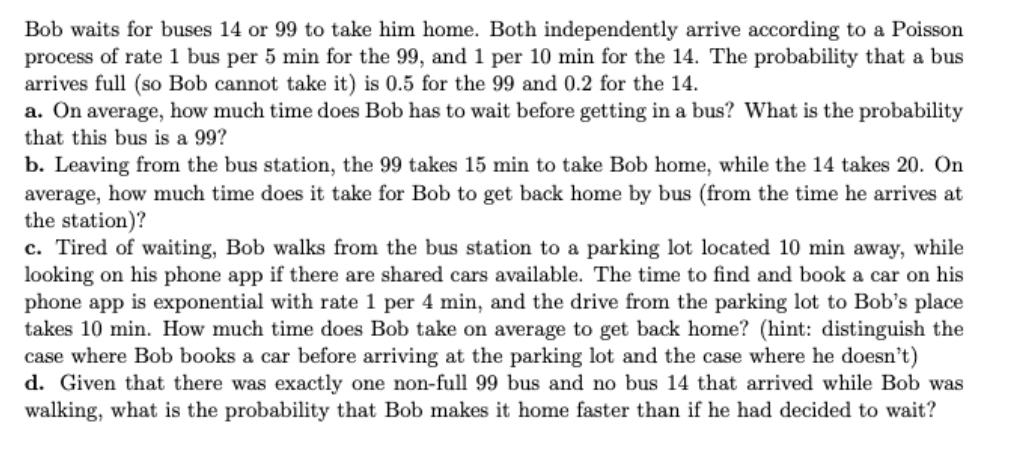
Bob waits for buses 14 or 99 to take him home. Both independently arrive according to a Poisson process of rate 1 bus per 5 min for the 99, and 1 per 10 min for the 14. The probability that a bus arrives full (so Bob cannot take it) is 0.5 for the 99 and 0.2 for the 14. a. On average, how much time does Bob has to wait before getting in a bus? What is the probability that this bus is a 99? b. Leaving from the bus station, the 99 takes 15 min to take Bob home, while the 14 takes 20. On average, how much time does it take for Bob to get back home by bus (from the time he arrives at the station)? c. Tired of waiting, Bob walks from the bus station to a parking lot located 10 min away, while looking on his phone app if there are shared cars available. The time to find and book a car on his phone app is exponential with rate 1 per 4 min, and the drive from the parking lot to Bob's place takes 10 min. How much time does Bob take on average to get back home? (hint: distinguish the case where Bob books a car before arriving at the parking lot and the case where he doesn't) d. Given that there was exactly one non-full 99 bus and no bus 14 that arrived while Bob was walking, what is the probability that Bob makes it home faster than if he had decided to wait?
Step by Step Solution
There are 3 Steps involved in it

Get step-by-step solutions from verified subject matter experts