Question: briefly state the main argument presented in article Google Charges Over Twice Its Rivals in Ad Fees, Suit Shows Keach Hagey, Mickle, Tripp. Wall Street
briefly state the main argument presented in article
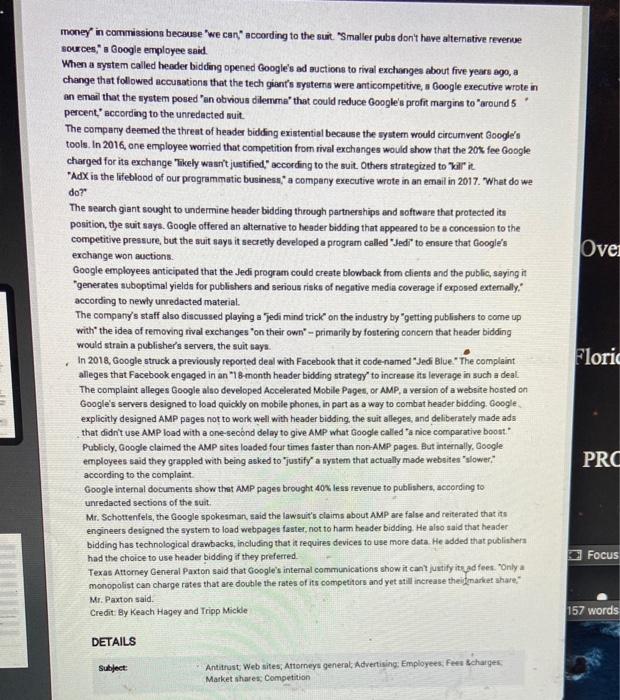
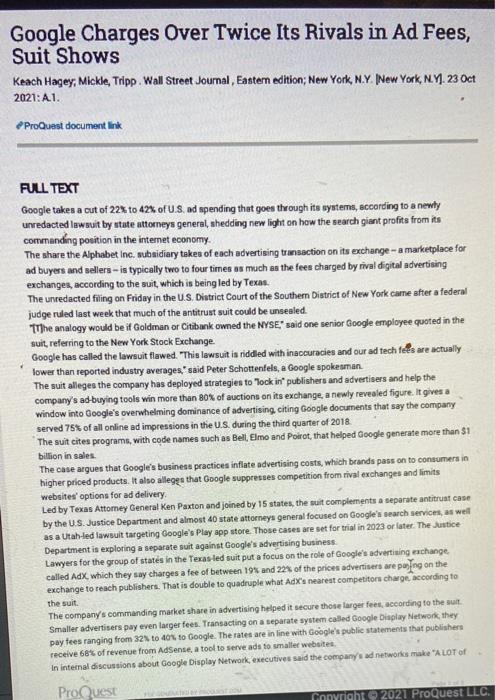
Google Charges Over Twice Its Rivals in Ad Fees, Suit Shows Keach Hagey, Mickle, Tripp. Wall Street Journal, Eastern edition: New York, N.Y. New York, NY. 23 Oct 2021:A1. ProQuest document link a FULL TEXT Google takes a cut of 22% to 42% of U.S. ad spending that goes through its uystems, according to a newly unredacted lawsuit by state attorneys general, shedding new light on how the search giant profits from its commanding position in the internet economy. The share the Alphabet Inc. subsidiary takes of each advertising transaction on its exchange - a marketplace for ad buyers and sellers -- is typically two to four times as much as the fees charged by rival digital advertising exchanges, according to the suit, which is being led by Texas. The unredacted filling on Friday in the US District Court of the Southern District of New York came after a federal judge ruled last week that much of the antitrust suit could be unsealed. The analogy would be if Goldman or Citibank owned the NYSE" said one senior Google employee quoted in the suit, referring to the New York Stock Exchange Google has called the lawsuit flawed. This lawsuit in riddled with inaccuracies and our ad tech tels are actually lower than reported industry averages," said Peter Schottenfels, a Google spokesman The suit alleges the company has deployed strategies to "ock in publishers and advertisers and help the company's ad buying tools win more than 80% of auctions on its exchange, a newly revealed figure. It gives a window into Google's overwhelming dominance of advertising citing Google documents that say the company served 75% of all online ad impressions in the U.S. during the third quarter of 2018 The suit cites programs, with code names such as Bell Elmo and Poirot, that helped Google generate more than $1 billion in sales The case argues that Google's business practices inflate advertising costs, which brands pass on to consumers in higher priced products. It also alleggs that Google suppresses competition from tival exchanges and limits websites' options for ad delivery Led by Texas Attomey General Ken Paxton and joined by 15 states, the suit complements a separate antitrust case by the U.S. Justice Department and almost 40 state attorneys general focused on Google's search services, as well as a Utah-led lawsuit targeting Google's Play app store. Those cases are set for trial in 2023 or later. The Justice Department is exploring a separate suit against Google's advertising business Lawyers for the group of states in the Texas led suit put a focus on the role of Google's advertising exchange called AdX, which they say charges a fee of between 19% and 22% of the prices advertisers are poing on the exchange to reach publishers. That is double to quadruple what AdX's nearest competitors charge, according to the suit. The company's commanding market share in advertising helped it secure those larger fees, according to the suit Smaller advertisers pay even larger fees. Transacting on a separate system called Google Display Network, they pay tees ranging from 324 to 40% 10 Google. The rates are in line with Google's public statements that publishers receive 68% of revenue from AdSense, a tool to serve ads to smaller websites In internal discussions about Google Display Network, executives said the company's ad networks make "A LOT OF ProQuest Conright2021 ProQuest LLC B Ovei money in commissions because we can according to the suit "Smaller pubs don't have alternative revenue sources, Google employee said. When a system called header bidding opened Google's ad suctions to rival exchanges about five years ago, a change that followed accusations that the tech giant's systems were anticompetitive, Google executive wrote in an email that the system posed "an obvious dilemma that could reduce Google's profit margins to around 5 percent" according to the unredected suit. The company deemed the threat of header bidding existential because the system would circumvent Google's tools. In 2016, one employee worried that competition from rival exchanges would show that the 20% fee Google charged for its exchange "likely wasn't justified according to the suit. Others strategized to War ir *AdX in the lifeblood of our programmatic business a company executive wrote in an email in 2017. What do we do? The search giant sought to undermine header bidding through partnerships and software that protected its position, the suit says. Google offered an alternative to header bidding that appeared to be a concession to the competitive pressure, but the suit says it secretly developed a program called "Jedi" to ensure that Google's exchange won auctions. Google employees anticipated that the Jedi program could create blowback from clients and the public, saying it *generates suboptimal yields for publishers and serious risks of negative media coverage if exposed externally, according to newly unredacted material The company's staff also discussed playing a "jedi mind trick on the industry by "getting publishers to come up with the idea of removing rival exchanges on their own" - primarily by fostering concern that header bidding would strain a publisher's servers, the suit saya. In 2018, Google struck a previously reported deal with Facebook that it code-named "Jedi Blue. The complaint alleges that Facebook engaged in an 18-month header bidding strategy to increase its leverage in such a deal The complaint alleges Google also developed Accelerated Mobile Pages, or AMP, a version of a website hosted on Google's servers designed to load quickly on mobile phones, in part as a way to combat header bidding. Google explicitly designed AMP pages not to work well with header bidding, the suit alleges, and deliberately made ads that didn't use AMP load with a one second delay to give AMP what Google called a nice comparative boost" Publicly. Google claimed the AMP sites loaded four times faster than non-AMP pages. But internally, Google employees said they grappled with being asked to "justify a nyutem that actually made websites "slower according to the complaint Google internal documents show that AMP pages brought 40% less revenue to publishers, according to unredacted sections of the suit. Mr. Schottenfels, the Google spokesman said the lawsuit's claims about AMP are false and reiterated that its engineers designed the system to load webpages faster, not to harm header bidding. He also said that header bidding has technological drawbacks, including that it requires devices to use more data. He added that publishers had the choice to use header bidding if they preferred Texas Attorney General Paxton said that Google's internal communications show it can't justify itsad fees. Only monopolist can change rates that are double the rates of its competitors and yet still increase theimarket share Mr. Paxton said. Credit: By Keach Hagey and Tripp Mickde Floric PRC Focus 157 words DETAILS Subject Antitrust Websites, Attorneys general Advertising: Employees, Fees charges Market shares Competition









 Study Help