







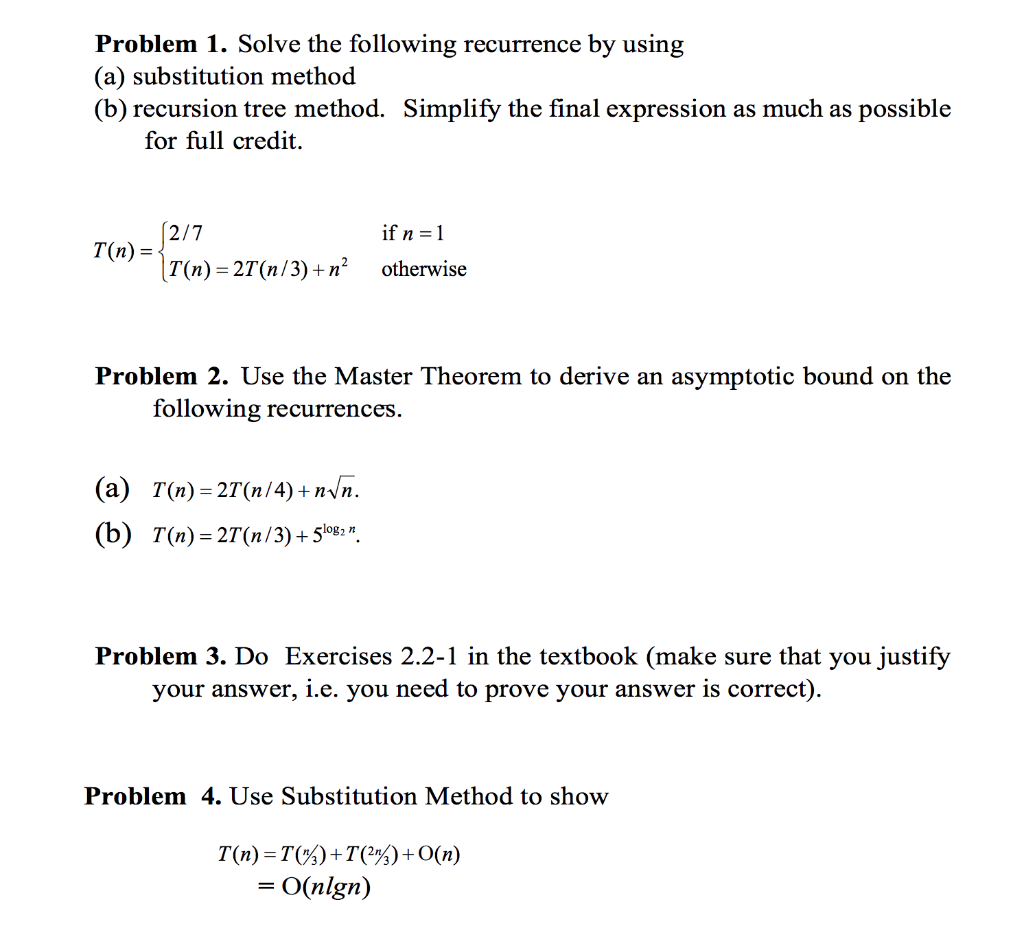
Question: Can any one help me (ignore 3rd question) Problem 1. Solve the following recurrence by using (a) substitution method (b) recursion tree method. Simplify the
 Can any one help me (ignore 3rd question)
Problem 1. Solve the following recurrence by using (a) substitution method (b) recursion tree method. Simplify the final expression as much as possible for full credit. 2/7 T(n) =3 T(n) = 2T(n/3) +n2 if n=1 otherwise Problem 2. Use the Master Theorem to derive an asymptotic bound on the following recurrences. (a) T(n)= 2T(n/4) + nn. (b) T(n) = 2T(n/3) + 5log2 r. Problem 3. Do Exercises 2.2-1 in the textbook (make sure that you justify your answer, i.e. you need to prove your answer is correct). Problem 4. Use Substitution Method to show T(n)=T(3)+T(23)+P(n) = O(nlgn) Problem 1. Solve the following recurrence by using (a) substitution method (b) recursion tree method. Simplify the final expression as much as possible for full credit. 2/7 T(n) =3 T(n) = 2T(n/3) +n2 if n=1 otherwise Problem 2. Use the Master Theorem to derive an asymptotic bound on the following recurrences. (a) T(n)= 2T(n/4) + nn. (b) T(n) = 2T(n/3) + 5log2 r. Problem 3. Do Exercises 2.2-1 in the textbook (make sure that you justify your answer, i.e. you need to prove your answer is correct). Problem 4. Use Substitution Method to show T(n)=T(3)+T(23)+P(n) = O(nlgn)
Step by Step Solution
There are 3 Steps involved in it

Get step-by-step solutions from verified subject matter experts
 Study Help