







Question: can I please get help on 2, 14, 8, 7, 11, and 13 please I will rate up Question 2 Question 7 part 1 of
can I please get help on 2, 14, 8, 7, 11, and 13 please I will rate up
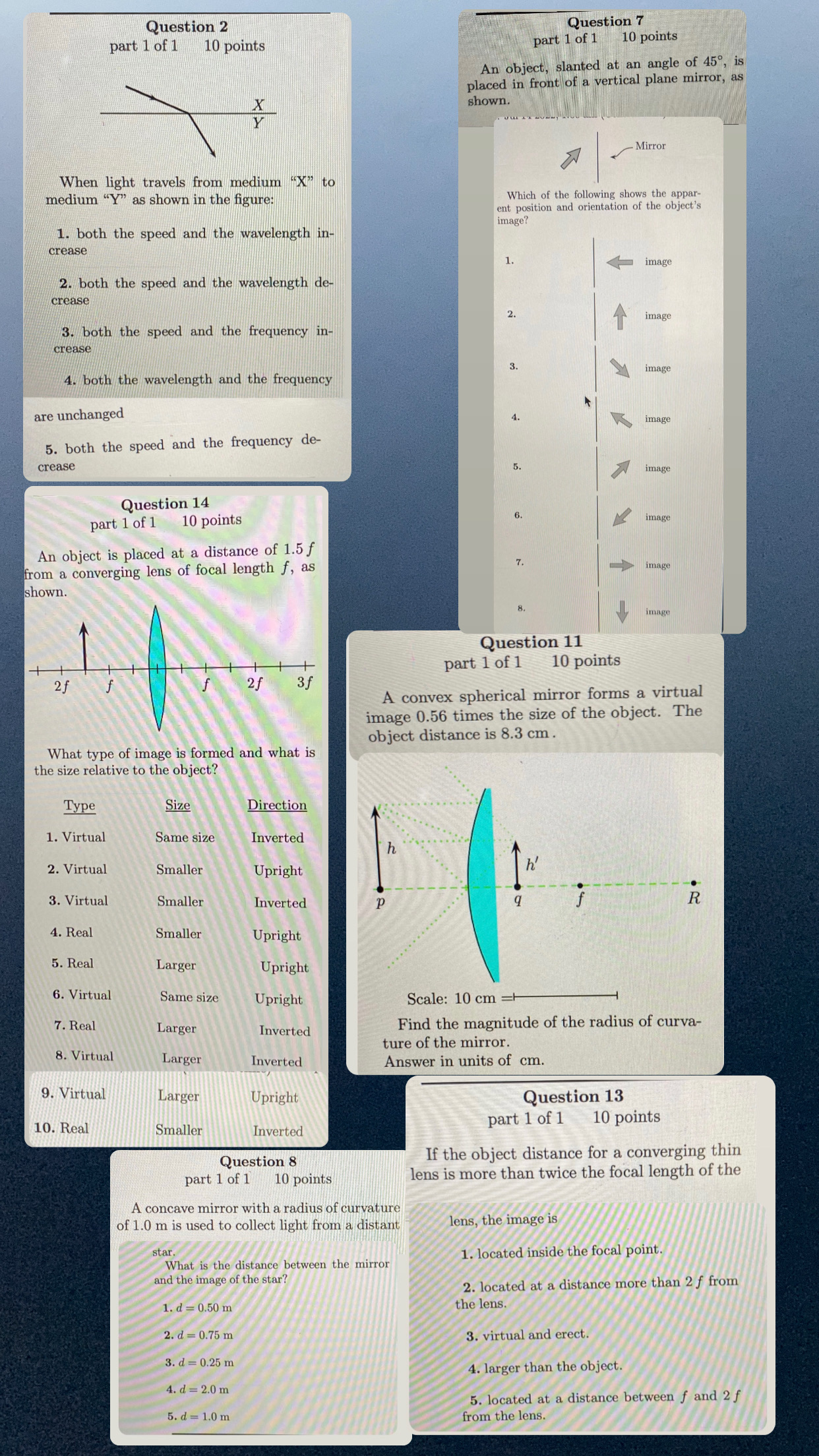
Question 2 Question 7 part 1 of 1 10 points part 1 of 1 10 points An object, slanted at an angle of 450, is placed in front of a vertical plane mirror, as shown. Mirror When light travels from medium "X" to medium "Y" as shown in the figure: Which of the following shows the appar- ent position and orientation of the object's image? 1. both the speed and the wavelength in- crease image 2. both the speed and the wavelength de- crease 2. image 3. both the speed and the frequency in- crease 3. image 4. both the wavelength and the frequency are unchanged 4. mage 5. both the speed and the frequency de- crease 5. image Question 14 part 1 of 1 10 points 6. image An object is placed at a distance of 1.5 f from a converging lens of focal length f, as 7 image shown. 8 image Question 11 part 1 of 1 10 points 2f 3f A convex spherical mirror forms a virtual image 0.56 times the size of the object. The object distance is 8.3 cm. What type of image is formed and what is the size relative to the object? Type Size Direction 1. Virtual Same size Inverted 2. Virtual Smaller Upright 3. Virtual Smaller Inverted R 4. Real Smaller Upright 5. Real Larger Upright 6. Virtual Same size Upright Scale: 10 cm = 7. Real Larger Inverted Find the magnitude of the radius of curva- ture of the mirror. 8. Virtual Larger Inverted Answer in units of cm. 9. Virtual Larger Upright Question 13 10. Real Smaller Inverted part 1 of 1 10 points Question 8 If the object distance for a converging thin part 1 of 1 10 points lens is more than twice the focal length of the A concave mirror with a radius of curvature of 1.0 m is used to collect light from a distant lens, the image is star. 1. located inside the focal point. What is the distance between the mirror and the image of the star? 2. located at a distance more than 2 f from 1. d = 0.50 m the lens. 2. d = 0.75 m 3. virtual and erect. 3. d = 0.25 m 4. larger than the object. 4. d = 2.0 m 5. located at a distance between f and 2 f 5. d = 1.0 m from the lens
Step by Step Solution
There are 3 Steps involved in it

Get step-by-step solutions from verified subject matter experts
 Study Help