Question: CASE: Mr Steven might be a somewhat odd name for a boat. But equally odd as its name is the boat itself. The boat is
CASE:
Mr Steven might be a somewhat odd name for a boat. But equally odd as its name is the boat itself. The boat is connected to a large net. Unlike the nets usually attached to boats, which are under the boat with the intent of catching fish, Mr Stevens net sits on top of the boat and somewhat resembles a large trampoline. The reason for this net location is that what Mr Steven is trying to catch does not reside in the water, but, instead, falls down from the sky. Mr Steven is built to catch rocket parts.
The boat belongs to SpaceX, the private space company built by Elon Musk. When SpaceX launches its Falcon 9 rocket into space, the nose piece, also known as the fairing, splits into two halves and the two pieces fall back to earth because of the force of gravity. Traditionally, space organizations have been willing to just let these rocket parts drop in the ocean and disappear, making no intent over ever recovering them. But, at $6 million per piece, this is an expensive strategy to pursue. And so Musk pushed his engineers to find a solution that would recover the fairings in order to use them for future flights.
The engineers responded by equipping the nose pieces with parachutes to slow down their fall and by adding small thrusters that allow for some control of the flight trajectory of a fairing hanging at the parachute. As parachute and fairing make their way down to Earths surface, Mr Steven attempts to position itself so that the nose pieces land right in its net without ever touching any corrosive salt water. This recovery allows for reuse and thereby drastically lowers the costs of a rocket launch.
The only problem with this approach is that nothing like this has ever been achieved before. But, at $6 million per catch, it is worth thinking a little bit about what drives the odds of success in this remarkable game.
Based on the concepts discussed in this chapter, in particular the concept of process capability, think about the key success variables for catching the fairings. What does this have to Page 295 do with quality management and statistical process control? Use the framework of Figure 9.1 to distinguish between input variables, output variables, and environmental variables.
QUESTIONS:
1. What is a defect in this case?
2. What, in the case of Mr. Stevens, drives the specification limits in the process capability formula?
3. And, what determines the variability that is in the denominator of the formula?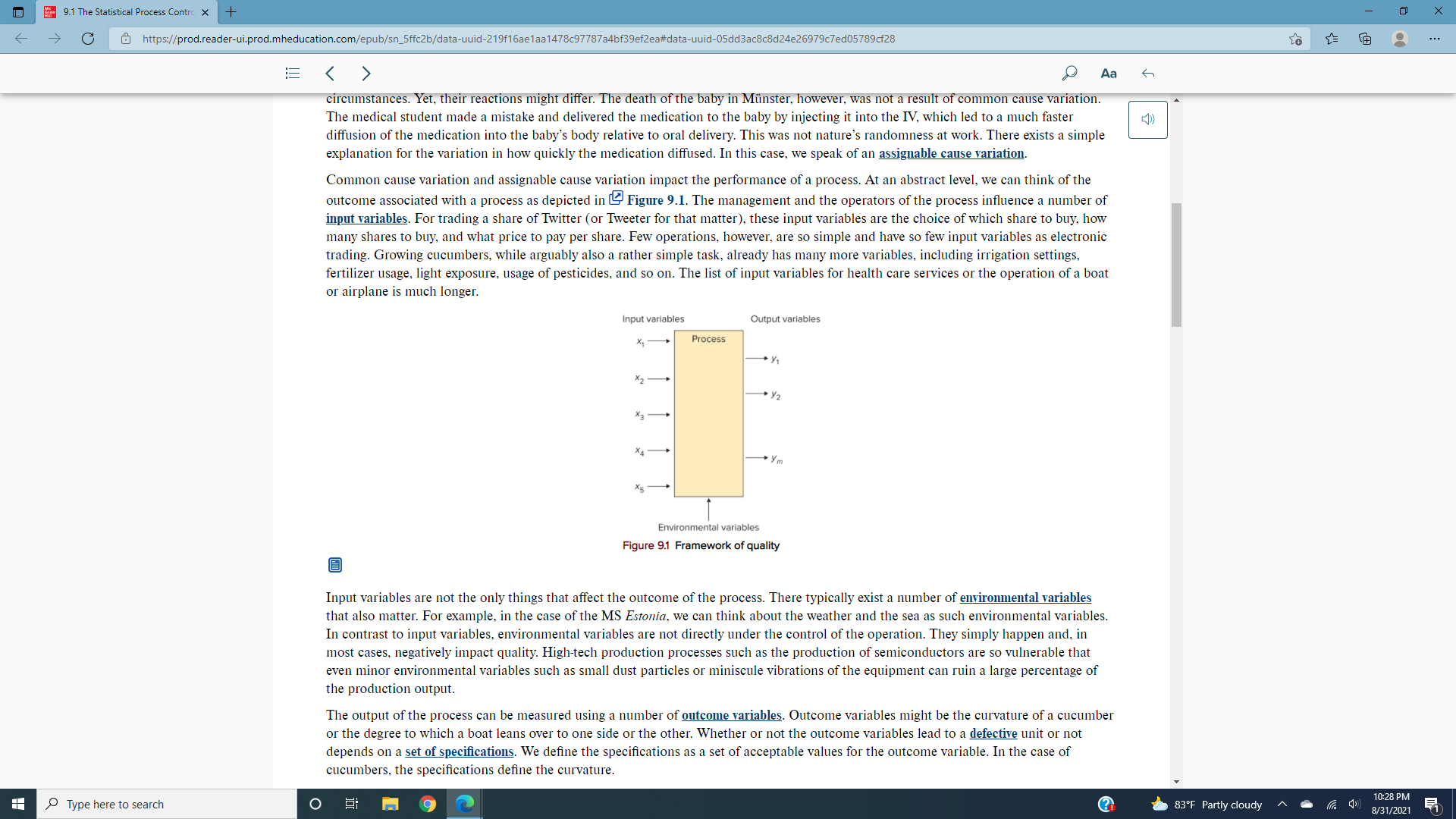
O 9.1 The Statistical Process Contrc x + 1 x @ https://prod.reader-ui.prod.mheducation.com/epub/sn_5ffc2b/data-uuid-219f16ae1aa1478c97787a4bf39ef2ea#data-uuid-05dd3ac8c8d24e26979c7ed05789cf28 o1 3" 3 circumstances. Yet, their reactions might differ. The death of the baby in Mnster, however, was not a result of common cause variation. The medical student made a mistake and delivered the medication to the baby by injecting it into the IV, which led to a much faster diffusion of the medication into the baby's body relative to oral delivery. This was not nature's randomness at work. There exists a simple explanation for the variation in how quickly the medication diffused. In this case, we speak of an assignable cause variation. Common cause variation and assignable cause variation impact the performance of a process. At an abstract level, we can think of the outcome associated with a process as depicted in Figure 9.1. The management and the operators of the process influence a number of input variables. For trading a share of Twitter (or Tweeter for that matter), these input variables are the choice of which share to buy, how many shares to buy, and what price to pay per share. Few operations, however, are so simple and have so few input variables as electronic trading. Growing cucumbers, while arguably also a rather simple task, already has many more variables, including irrigation settings, fertilizer usage, light exposure, usage of pesticides, and so on. The list of input variables for health care services or the operation of a boat or airplane is much longer. Input variables Output variables Process X- 1 X y2 X4 ym Environmental variables Figure 9.1 Framework of quality Input variables are not the only things that affect the outcome of the process. There typically exist a number of environmental variables that also matter. For example, in the case of the MS Estonia, we can think about the weather and the sea as such environmental variables. In contrast to input variables, environmental variables are not directly under the control of the operation. They simply happen and, in most cases, negatively impact quality. High-tech production processes such as the production of semiconductors are so vulnerable that even minor environmental variables such as small dust particles or miniscule vibrations of the equipment can ruin a large percentage of the production output. The output of the process can be measured using a number of outcome variables. Outcome variables might be the curvature of a cucumber or the degree to which a boat leans over to one side or the other. Whether or not the outcome variables lead to a defective unit or not depends on a set of specifications. We define the specifications as a set of acceptable values for the outcome variable. In the case of cucumbers, the specifications define the curvature. Type here to search (?? 83F Partly cloudy 10:28 PM 8/31/2021 O 9.1 The Statistical Process Contrc x + 1 x @ https://prod.reader-ui.prod.mheducation.com/epub/sn_5ffc2b/data-uuid-219f16ae1aa1478c97787a4bf39ef2ea#data-uuid-05dd3ac8c8d24e26979c7ed05789cf28 o1 3" 3 circumstances. Yet, their reactions might differ. The death of the baby in Mnster, however, was not a result of common cause variation. The medical student made a mistake and delivered the medication to the baby by injecting it into the IV, which led to a much faster diffusion of the medication into the baby's body relative to oral delivery. This was not nature's randomness at work. There exists a simple explanation for the variation in how quickly the medication diffused. In this case, we speak of an assignable cause variation. Common cause variation and assignable cause variation impact the performance of a process. At an abstract level, we can think of the outcome associated with a process as depicted in Figure 9.1. The management and the operators of the process influence a number of input variables. For trading a share of Twitter (or Tweeter for that matter), these input variables are the choice of which share to buy, how many shares to buy, and what price to pay per share. Few operations, however, are so simple and have so few input variables as electronic trading. Growing cucumbers, while arguably also a rather simple task, already has many more variables, including irrigation settings, fertilizer usage, light exposure, usage of pesticides, and so on. The list of input variables for health care services or the operation of a boat or airplane is much longer. Input variables Output variables Process X- 1 X y2 X4 ym Environmental variables Figure 9.1 Framework of quality Input variables are not the only things that affect the outcome of the process. There typically exist a number of environmental variables that also matter. For example, in the case of the MS Estonia, we can think about the weather and the sea as such environmental variables. In contrast to input variables, environmental variables are not directly under the control of the operation. They simply happen and, in most cases, negatively impact quality. High-tech production processes such as the production of semiconductors are so vulnerable that even minor environmental variables such as small dust particles or miniscule vibrations of the equipment can ruin a large percentage of the production output. The output of the process can be measured using a number of outcome variables. Outcome variables might be the curvature of a cucumber or the degree to which a boat leans over to one side or the other. Whether or not the outcome variables lead to a defective unit or not depends on a set of specifications. We define the specifications as a set of acceptable values for the outcome variable. In the case of cucumbers, the specifications define the curvature. Type here to search (?? 83F Partly cloudy 10:28 PM 8/31/2021









 Study Help