



Question: Chapter 8: Complete Empowering Ourselves (8.4.2.) // MANA-3319-004-CONTEMP MGMT CHALLENGES // Post #2 Changing the Portfolio You are head of a staff unit reporting to
Chapter 8: Complete Empowering Ourselves (8.4.2.) // MANA-3319-004-CONTEMP MGMT CHALLENGES // Post #2 Changing the Portfolio You are head of a staff unit reporting to the vice president of finance. He has asked you to provide a report on the firms current portfolio, including recommendations for changes in the current selection criteria. Doubts have been raised about the efficiency of the existing system given the current market conditions, and there is considerable dissatisfaction with prevailing rates of return.
You plan to write the report, but at the moment you are perplexed about what type of approach to take. Your own specialty is the bond market, and it is clear to you that detailed knowledge of the equity market, which you lack, would greatly enhance the value of the report. Fortunately, four members of your staff are specialists in different segments of the equity market. Together, they possess a vast amount of knowledge about the intricacies of investment. However, they seldom agree on the best way to achieve anything when it comes to investment philosophy and strategy.
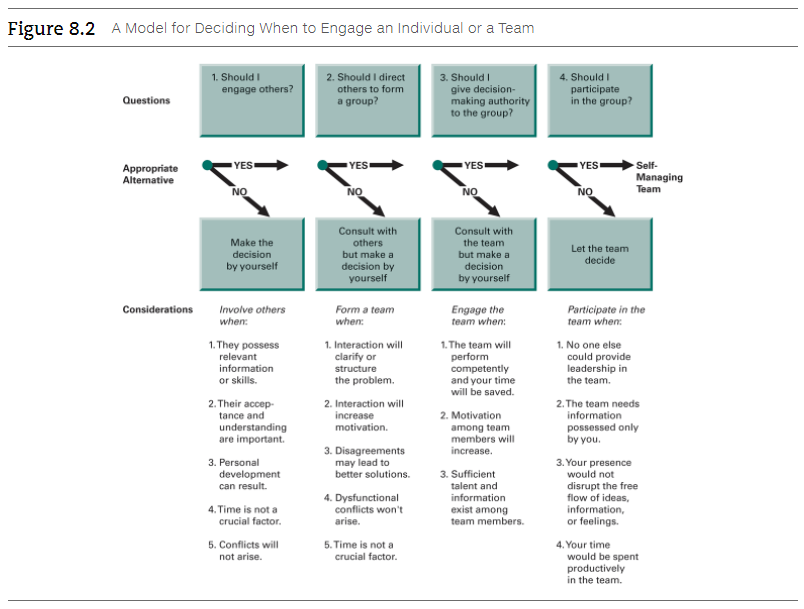
You have six weeks before the report is due. You have already begun to familiarize yourself with the firms current portfolio and have been provided by management with a specific set of constraints that any portfolio must satisfy. Your immediate problem is to come up with some alternatives to the firms present practices and to select the most promising for detailed analysis in your report. Figure 8.2
 Please answer questions based on analysis above:
(1) What is the problem statement(s) for this analysis?
(2) Should this decision be made by you alone? Why or why not? Justify.
(3) If your answer to the above question involved others, which alternative in Figure 8.2 should be used in making a decision? Be specific as to why.
(4) What are the most important considerations in deciding who to involve in this task? Justify.
(5) If others are to become involved, how much empowerment should they have? What would you do specifically to achieve the appropriate level of employment?
Figure 8.2 A Model for Deciding When to Engage an Individual or a Team 1. Should I engage others? 2. Should I direct others to form a group? 3. Should I give decision- making authority to the group? 4. Should participate in the group? Questions YES YES YES Appropriate Alternative YES NO Self- Managing Team NO NO NO Make the decision by yourself Consult with others but make a decision by yourself Consult with the team but make a decision by yourself Let the team decide Considerations Involve others when: 1. They possess relevant information or skills. Engage the team when: 1. The team will perform competently and your time will be saved. 2. Motivation among team members will increase Participate in the team when: 1. No one else could provide leadership in the team. Form a team when: 1. Interaction will clarify or structure the problem 2. Interaction will increase motivation. 3. Disagreements may lead to better solutions. 4. Dysfunctional conflicts won't arise. 5. Time is not a crucial factor 2. Their accep tance and understanding are important 3. Personal development can result 4. Time is not a crucial factor. 5. Conflicts will not arise. 2. The team needs information possessed only by you 3. Sufficient talent and information exist among team members. 3. Your presence would not disrupt the free flow of ideas, information, or feelings. 4. Your time would be spent productively in the team. Figure 8.2 A Model for Deciding When to Engage an Individual or a Team 1. Should I engage others? 2. Should I direct others to form a group? 3. Should I give decision- making authority to the group? 4. Should participate in the group? Questions YES YES YES Appropriate Alternative YES NO Self- Managing Team NO NO NO Make the decision by yourself Consult with others but make a decision by yourself Consult with the team but make a decision by yourself Let the team decide Considerations Involve others when: 1. They possess relevant information or skills. Engage the team when: 1. The team will perform competently and your time will be saved. 2. Motivation among team members will increase Participate in the team when: 1. No one else could provide leadership in the team. Form a team when: 1. Interaction will clarify or structure the problem 2. Interaction will increase motivation. 3. Disagreements may lead to better solutions. 4. Dysfunctional conflicts won't arise. 5. Time is not a crucial factor 2. Their accep tance and understanding are important 3. Personal development can result 4. Time is not a crucial factor. 5. Conflicts will not arise. 2. The team needs information possessed only by you 3. Sufficient talent and information exist among team members. 3. Your presence would not disrupt the free flow of ideas, information, or feelings. 4. Your time would be spent productively in the teamStep by Step Solution
There are 3 Steps involved in it

Get step-by-step solutions from verified subject matter experts