Question: Choose the correct answer Multiple Choice: Write the letter of correct answer on the space provided before each number. 1. A contract that can stand
Choose the correct answer
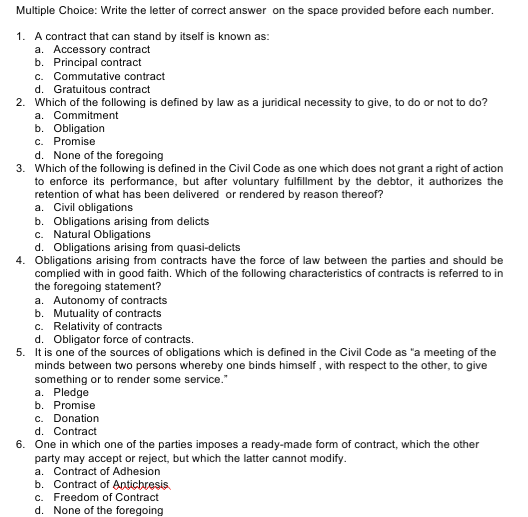
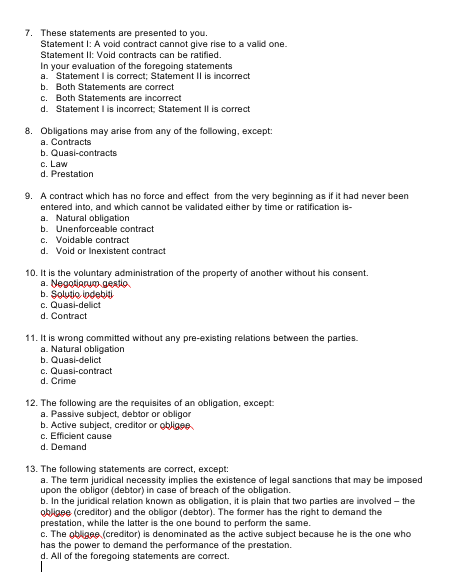
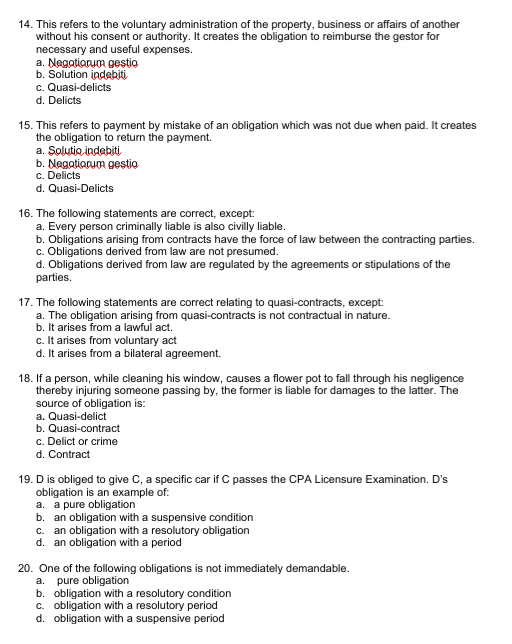
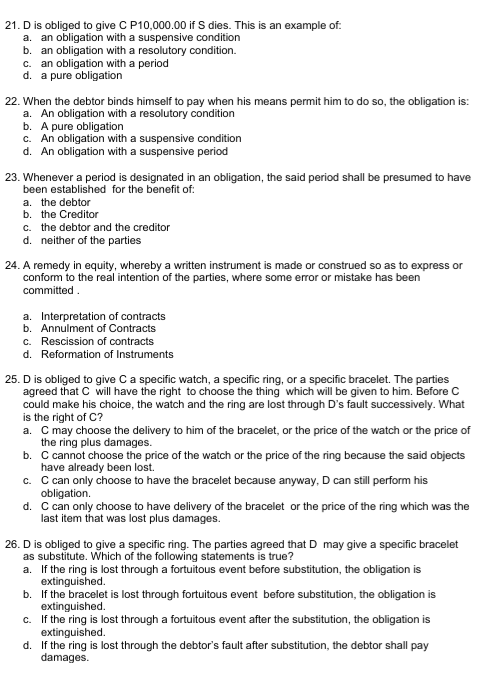
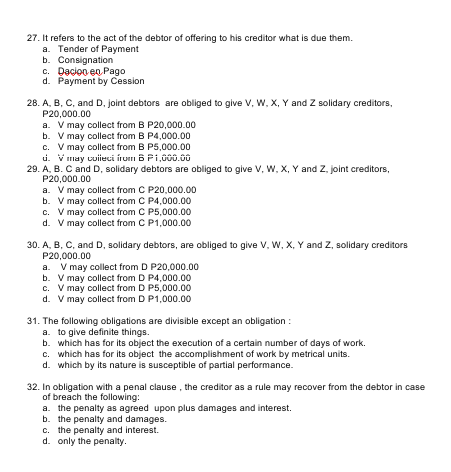
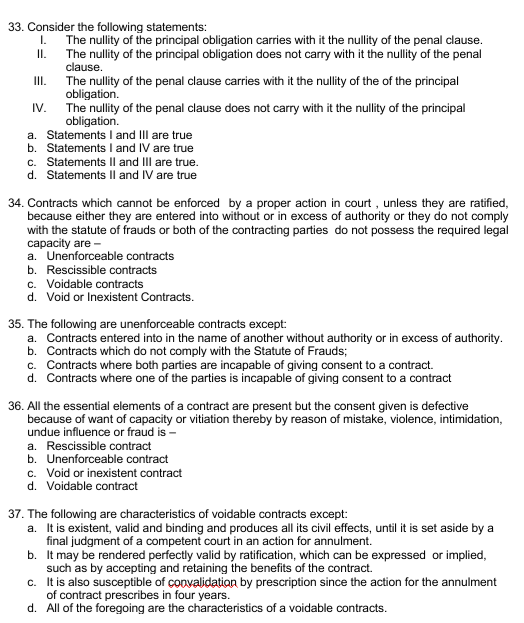
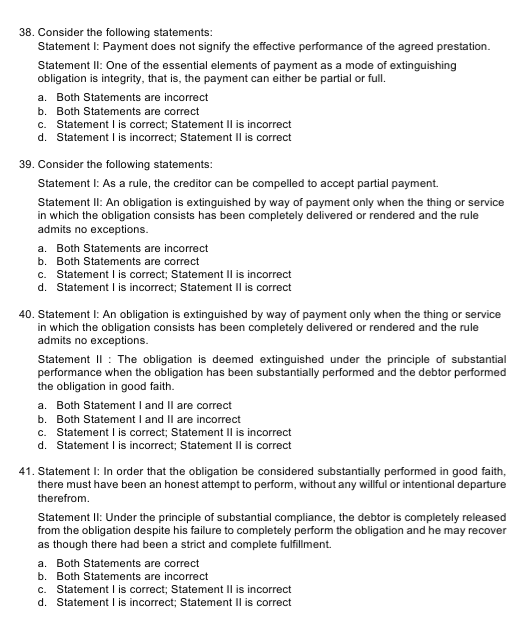
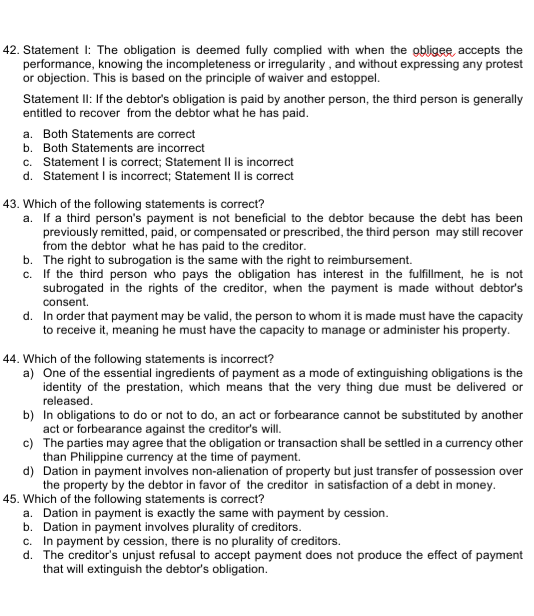
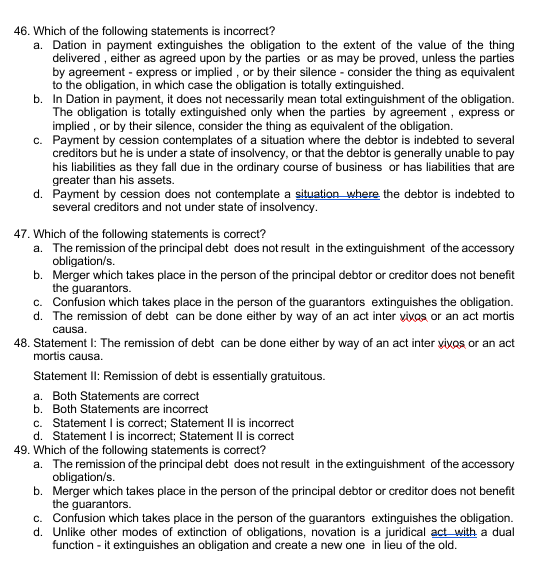
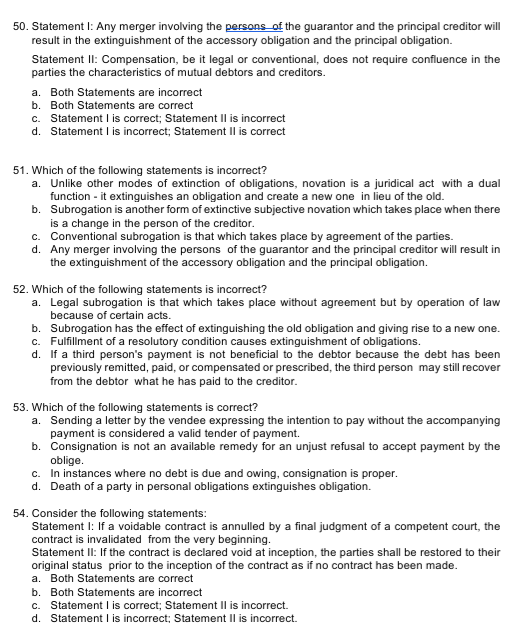
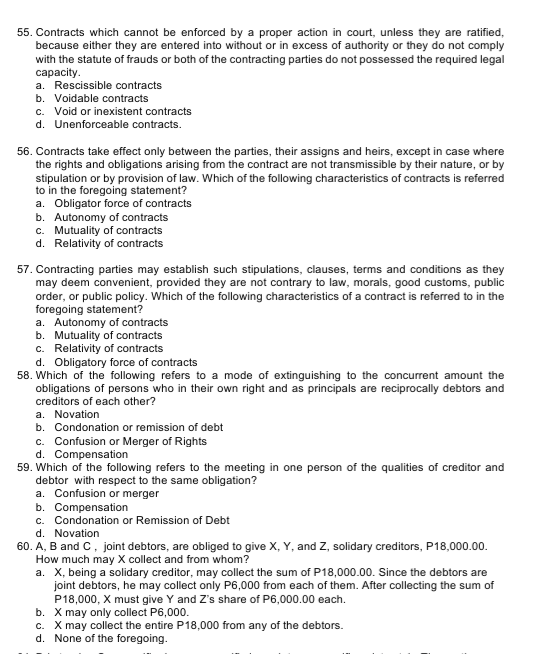
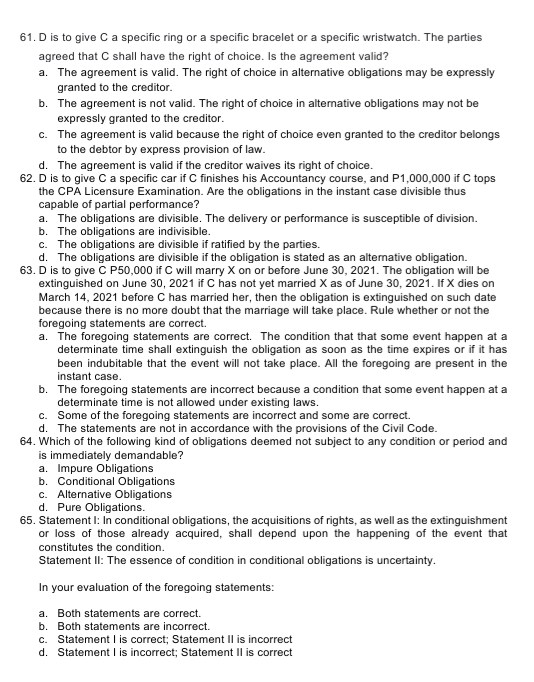
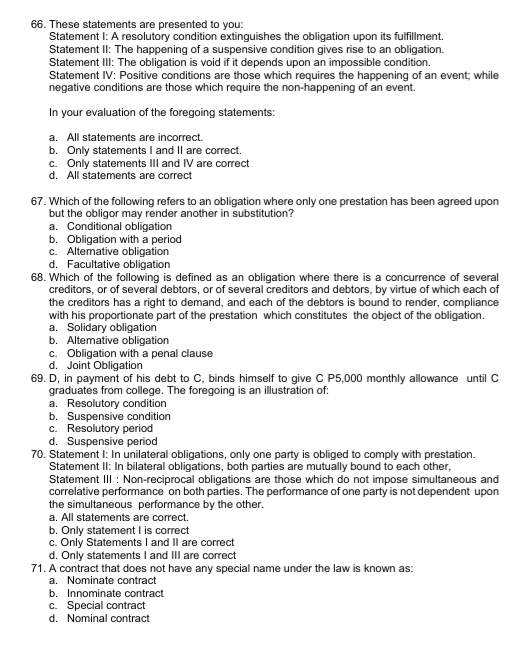
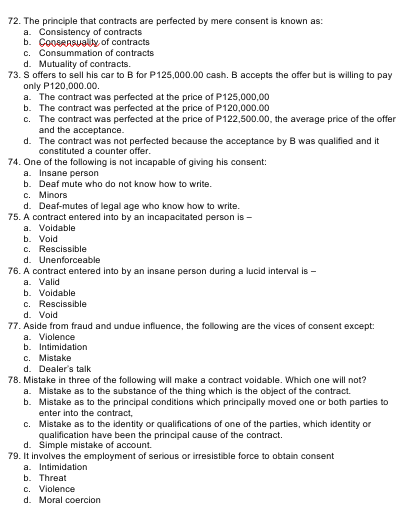
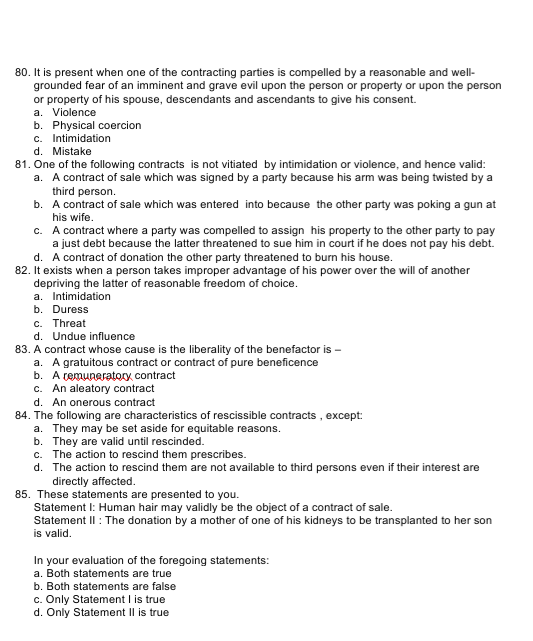
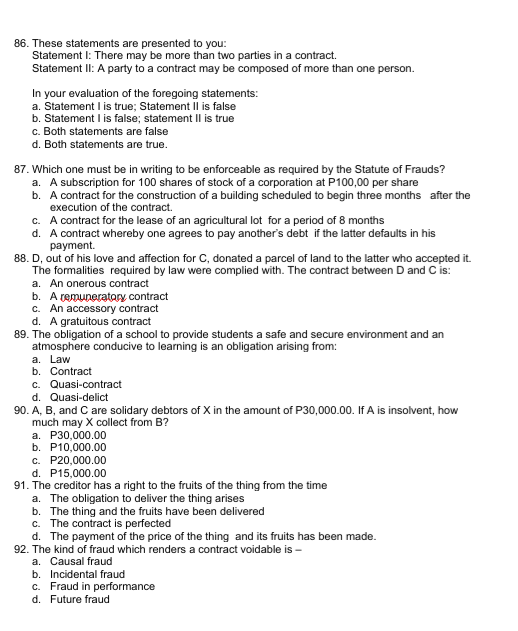
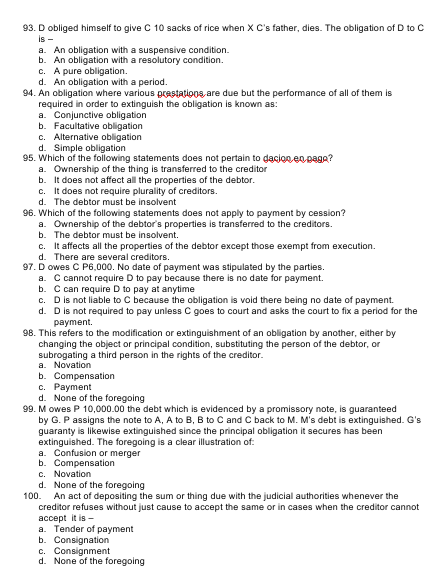
Multiple Choice: Write the letter of correct answer on the space provided before each number. 1. A contract that can stand by itself is known as: a. Accessory contract b. Principal contract c. Commutative contract d. Gratuitous contract 2. Which of the following is defined by law as a juridical necessity to give, to do or not to do? a. Commitment b. Obligation C. Promise d. None of the foregoing 3. Which of the following is defined in the Civil Code as one which does not grant a right of action to enforce its performance, but after voluntary fulfillment by the debtor, it authorizes the retention of what has been delivered or rendered by reason thereof? a. Civil obligations b. Obligations arising from delicts c. Natural Obligations d. Obligations arising from quasi-delicts 4. Obligations arising from contracts have the force of law between the parties and should be complied with in good faith. Which of the following characteristics of contracts is referred to in the foregoing statement? . Autonomy of contracts b. Mutuality of contracts C. Relativity of contracts d. Obligator force of contracts. 5. It is one of the sources of obligations which is defined in the Civil Code as "a meeting of the minds between two persons whereby one binds himself , with respect to the other, to give something or to render some service." a. Pledge b. Promise c. Donation d. Contract 6. One in which one of the parties imposes a ready-made form of contract, which the other party may accept or reject, but which the latter cannot modify. a. Contract of Adhesion b. Contract of Antichresis. C. Freedom of Contract d. None of the foregoing7. These statements are presented to you. Statement I: A void contract cannot give rise to a valid one. Statement II: Void contracts can be ratified. In your evaluation of the foregoing statements a. Statement I is correct; Statement II is incorrect Both Statements are correct C. Both Statements are incorrect d. Statement I Is incorrect Statement Il is correct 8. Obligations may arise from any of the following, except: a. Contracts b. Quasi-contracts C. Law d. Prestation 9. A contract which has no force and effect from the very beginning as if it had never been entered into, and which cannot be validated either by time or ratification is- a. Natural obligation b. Unenforceable contract C. Voldable contract d. Vold or Inexistent contract 10. It is the voluntary administration of the property of another without his consent. a. Negollano geation b. Solutiondebit c. Quasi-delict d. Contract 11. It is wrong committed without any pre-existing relations between the parties. a. Natural obligation b. Quasi-delict c. Quasi-contract d. Crime 12. The following are the requisites of an obligation, except: a. Passive subject, debtor or obligor b. Active subject, creditor or obliges. C. Efficient cause d. Demand 13. The following statements are correct, except: a. The term juridical necessity implies the existence of legal sanctions that may be imposed upon the obligor (debtor) in case of breach of the obligation. b. In the juridical relation known as obligation, it is plain that two parties are involved - the Qbigee (creditor) and the obligor (debtor). The former has the right to demand the prestation, while the latter is the one bound to perform the same. C. The obknee (creditor) is denominated as the active subject because he is the one who has the power to demand the performance of the prestation. d. All of the foregoing statements are correct.14. This refers to the voluntary administration of the property, business or affairs of another without his consent or authority. It creates the obligation to reimburse the gestor for necessary and useful expenses. a. Negationm gestio b. Solution indebiti c. Quasi-delicts d. Delicts 15. This refers to payment by mistake of an obligation which was not due when paid. It creates the obligation to return the payment. a. Solutioindebiti. b. Negationum gestio c. Delicts d. Quasi-Delicts 16. The following statements are correct, except: a. Every person criminally liable is also civilly liable. b. Obligations arising from contracts have the force of law between the contracting parties. c. Obligations derived from law are not presumed. d. Obligations derived from law are regulated by the agreements or stipulations of the parties. 17. The following statements are correct relating to quasi-contracts, except: a. The obligation arising from quasi-contracts is not contractual in nature. b. It arises from a lawful act. c. It arises from voluntary act d. It arises from a bilateral agreement. 18. If a person, while cleaning his window, causes a flower pot to fall through his negligence thereby injuring someone passing by, the former is liable for damages to the latter. The source of obligation is: a. Quasi-delict b. Quasi-contract c. Delict or crime d. Contract 19. D is obliged to give C, a specific car if C passes the CPA Licensure Examination. D's obligation is an example of: a. a pure obligation b. an obligation with a suspensiondition c. an obligation with a resolutory obligation d. an obligation with a period 20. One of the following obligations is not immediately demandable. a. pure obligation b. obligation with a resolutory condition c. obligation with a resolutory period d. obligation with a suspension period21. D is obliged to give C P10,000.00 if S dies. This is an example of: a. an obligation with a suspensiondition b. an obligation with a resolutory condition. c. an obligation with a period d. a pure obligation 22. When the debtor binds himself to pay when his means permit him to do so, the obligation is: a. An obligation with a resolutory condition b. A pure obligation c. An obligation with a suspensiondition d. An obligation with a suspensioniod 23. Whenever a period is designated in an obligation, the said period shall be presumed to have been established for the benefit of: a. the debtor b. the Creditor c. the debtor and the creditor d. neither of the parties 24. A remedy in equity, whereby a written instrument is made or construed so as to express or conform to the real intention of the parties, where some error or mistake has been committed . a. Interpretation of contracts b. Annulment of Contracts C. Rescission of contracts d. Reformation of Instruments 25. D is obliged to give C a specific watch, a specific ring, or a specific bracelet. The parties agreed that C will have the right to choose the thing which will be given to him. Before C could make his choice, the watch and the ring are lost through D's fault successively. What is the right of C? a. C may choose the delivery to him of the bracelet, or the price of the watch or the price of the ring plus damages. b. C cannot choose the price of the watch or the price of the ring because the said objects have already been lost. c. C can only choose to have the bracelet because anyway, D can still perform his obligation. d. C can only choose to have delivery of the bracelet or the price of the ring which was the last item that was lost plus damages. 26. D is obliged to give a specific ring. The parties agreed that D may give a specific bracelet as substitute. Which of the following statements is true? a. If the ring is lost through a fortuitous event before substitution, the obligation is extinguished. b. If the bracelet is lost through fortuitous event before substitution, the obligation is extinguished C. If the ring is lost through a fortuitous event after the substitution, the obligation is extinguished. d. If the ring is lost through the debtor's fault after substitution, the debtor shall pay damages.27. It refers to the act of the debtor of offering to his creditor what is due them. a. Tender of Payment b. Consignation c. Daclon en Pago d. Payment by Cession 28. A. B, C, and D, joint debtors are obliged to give V, W. X, Y and Z solidary creditors, P20,000.00 a. V may collect from B P20,000.00 b. V may collect from B P4,000.00 C. V may collect from B P5,000.00 . V may vullevi from 6 P1,000.00 29. A, B. C and D, solidary debtors are obliged to give V, W. X, Y and Z, joint creditors, P20,000.00 a. V may collect from C P20,000.00 b. V may collect from C P4,000.00 C. V may collect from C P5,000.00 d. V may collect from C P1,000.00 30. A, B. C, and D, solidary debtors, are obliged to give V. W, X, Y and Z, solidary creditors P20,000.00 a. V may collect from D P20,000.00 b. V may collect from D P4,000.00 c. V may collect from D P5,000.00 d. V may collect from D P1,000.00 31. The following obligations are divisible except an obligation : a. to give definite things. b. which has for its object the execution of a certain number of days of work. c. which has for its object the accomplishment of work by metrical units. d. which by its nature is susceptible of partial performance. 32. In obligation with a penal clause , the creditor as a rule may recover from the debtor in case of breach the following: a. the penalty as agreed upon plus damages and interest. b. the penalty and damages. C. the penalty and interest. d. only the penalty.33. Consider the following statements: The nullity of the principal obligation carries with it the nullity of the penal clause. The nullity of the principal obligation does not carry with it the nullity of the penal clause. The nullity of the penal clause carries with it the nullity of the of the principal obligation. IV. The nullity of the penal clause does not carry with it the nullity of the principal obligation. a. Statements I and Ill are true b. Statements I and IV are true c. Statements II and Ill are true. . Statements II and IV are true 34. Contracts which cannot be enforced by a proper action in court , unless they are ratified, because either they are entered into without or in excess of authority or they do not comply with the statute of frauds or both of the contracting parties do not possess the required legal capacity are - a. Unenforceable contracts b. Rescission contracts c. Voidable contracts d. Void or Inexistent Contracts. 35. The following are unenforceable contracts except: a. Contracts entered into in the name of another without authority or in excess of authority. b. Contracts which do not comply with the Statute of Frauds; c. Contracts where both parties are incapable of giving consent to a contract. d. Contracts where one of the parties is incapable of giving consent to a contract 36. All the essential elements of a contract are present but the consent given is defective because of want of capacity or vitiation thereby by reason of mistake, violence, intimidation, undue influence or fraud is - a. Rescission contract b. Unenforceable contract c. Void or inexistent contract d. Voidable contract 37. The following are characteristics of voidable contracts except: a. It is existent, valid and binding and produces all its civil effects, until it is set aside by a final judgment of a competent court in an action for annulment. b. It may be rendered perfectly valid by ratification, which can be expressed or implied, such as by accepting and retaining the benefits of the contract. c. It is also susceptible of convalidation by prescription since the action for the annulment of contract prescribes in four years. d. All of the foregoing are the characteristics of a voidable contracts.38. Consider the following statements: Statement I: Payment does not signify the effective performance of the agreed prestation. Statement II: One of the essential elements of payment as a mode of extinguishing obligation is integrity, that is, the payment can either be partial or full. . Both Statements are incorrect b. Both Statements are correct c. Statement I is correct; Statement II is incorrect d. Statement I is incorrect; Statement II is correct 39. Consider the following statements: Statement : As a rule, the creditor can be compelled to accept partial payment. Statement II: An obligation is extinguished by way of payment only when the thing or service in which the obligation consists has been completely delivered or rendered and the rule admits no exceptions. a. Both Statements are incorrect b. Both Statements are correct C. Statement I is correct; Statement Il is incorrect d. Statement I is incorrect; Statement Il is correct 40. Statement I: An obligation is extinguished by way of payment only when the thing or service in which the obligation consists has been completely delivered or rendered and the rule admits no exceptions. Statement II : The obligation is deemed extinguished under the principle of substantial performance when the obligation has been substantially performed and the debtor performed the obligation in good faith. a. Both Statement I and II are correct b. Both Statement I and II are incorrect C. Statement I is correct; Statement II is incorrect d. Statement I is incorrect; Statement II is correct 41. Statement I: In order that the obligation be considered substantially performed in good faith, there must have been an honest attempt to perform, without any willful or intentional departure therefrom. Statement II: Under the principle of substantial compliance, the debtor is completely released from the obligation despite his failure to completely perform the obligation and he may recover as though there had been a strict and complete fulfillment. a. Both Statements are correct . Both Statements are incorrect C. Statement I is correct; Statement Il is incorrect d. Statement I is incorrect; Statement Il is correct42. Statement I: The obligation is deemed fully complied with when the obligee accepts the performance, knowing the incompleteness or irregularity , and without expressing any protest or objection. This is based on the principle of waiver and estoppel. Statement II: If the debtor's obligation is paid by another person, the third person is generally entitled to recover from the debtor what he has paid. a. Both Statements are correct b. Both Statements are incorrect c. Statement I is correct; Statement II is incorrect d. Statement I is incorrect; Statement II is correct 43. Which of the following statements is correct? a. If a third person's payment is not beneficial to the debtor because the debt has been previously remitted, paid, or compensated or prescribed, the third person may still recover from the debtor what he has paid to the creditor. b. The right to subrogation is the same with the right to reimbursement. c. If the third person who pays the obligation has interest in the fulfillment, he is not subrogatin the rights of the creditor, when the payment is made without debtor's consent. d. In order that payment may be valid, the person to whom it is made must have the capacity to receive it, meaning he must have the capacity to manage or administer his property. 44. Which of the following statements is incorrect? a) One of the essential ingredients of payment as a mode of extinguishing obligations is the identity of the prestation, which means that the very thing due must be delivered or released. b) In obligations to do or not to do, an act or forbearance cannot be substituted by another act or forbearance against the creditor's will. c) The parties may agree that the obligation or transaction shall be settled in a currency other than Philippine currency at the time of payment. d) Dation in payment involves non-alienation of property but just transfer of possession over the property by the debtor in favor of the creditor in satisfaction of a debt in money. 45. Which of the following statements is correct? a. Dation in payment is exactly the same with payment by cession. b. Dation in payment involves plurality of creditors. c. In payment by cession, there is no plurality of creditors. d. The creditor's unjust refusal to accept payment does not produce the effect of payment that will extinguish the debtor's obligation.46. Which of the following statements is incorrect? a. Dation in payment extinguishes the obligation to the extent of the value of the thing delivered , either as agreed upon by the parties or as may be proved, unless the parties by agreement - express or implied , or by their silence - consider the thing as equivalent to the obligation, in which case the obligation is totally extinguished. b. In Dation in payment, it does not necessarily mean total extinguishment of the obligation. The obligation is totally extinguished only when the parties by agreement , express or implied , or by their silence, consider the thing as equivalent of the obligation. c. Payment by cession contemplates of a situation where the debtor is indebted to several creditors but he is under a state of insolvency, or that the debtor is generally unable to pay his liabilities as they fall due in the ordinary course of business or has liabilities that are greater than his assets. d. Payment by cession does not contemplate a situation where the debtor is indebted to several creditors and not under state of insolvency. 47. Which of the following statements is correct? a. The remission of the principal debt does not result in the extinguishment of the accessory obligation/s. b. Merger which takes place in the person of the principal debtor or creditor does not benefit the guarantors. c. Confusion which takes place in the person of the guarantors extinguishes the obligation. d. The remission of debt can be done either by way of an act inter viyos or an act mortis causa. 48. Statement I: The remission of debt can be done either by way of an act inter vivos or an act mortis causa. Statement Il: Remission of debt is essentially gratuitous. a. Both Statements are correct b. Both Statements are incorrect c. Statement I is correct; Statement II is incorrect d. Statement I is incorrect; Statement II is correct 49. Which of the following statements is correct? a. The remission of the principal debt does not result in the extinguishment of the accessory obligation/s b. Merger which takes place in the person of the principal debtor or creditor does not benefit the guarantors. c. Confusion which takes place in the person of the guarantors extinguishes the obligation. d. Unlike other modes of extinction of obligations, novation is a juridical act with a dual function - it extinguishes an obligation and create a new one in lieu of the old.50. Statement I: Any merger involving the persons of the guarantor and the principal creditor will result in the extinguishment of the accessory obligation and the principal obligation. Statement II: Compensation, be it legal or conventional, does not require confluence in the parties the characteristics of mutual debtors and creditors. a. Both Statements are incorrect b. Both Statements are correct C. Statement I is correct; Statement Il is incorrect d. Statement I is incorrect; Statement Il is correct 51. Which of the following statements is incorrect? a. Unlike other modes of extinction of obligations, novation is a juridical act with a dual function - it extinguishes an obligation and create a new one in lieu of the old. b. Subrogation is another form of extinctive subjective novation which takes place when there is a change in the person of the creditor. c. Conventional subrogation is that which takes place by agreement of the parties. d. Any merger involving the persons of the guarantor and the principal creditor will result in the extinguishment of the accessory obligation and the principal obligation. 52. Which of the following statements is incorrect? a. Legal subrogation is that which takes place without agreement but by operation of law because of certain acts. b. Subrogation has the effect of extinguishing the old obligation and giving rise to a new one. c. Fulfillment of a resolutory condition causes extinguishment of obligations. d. If a third person's payment is not beneficial to the debtor because the debt has been previously remitted, paid, or compensated or prescribed, the third person may still recover from the debtor what he has paid to the creditor. 53. Which of the following statements is correct? a. Sending a letter by the vendee expressing the intention to pay without the accompanying payment is considered a valid tender of payment. b. Consignation is not an available remedy for an unjust refusal to accept payment by the oblige. C. In instances where no debt is due and owing, consignation is proper. d. Death of a party in personal obligations extinguishes obligation. 54. Consider the following statements: Statement I: If a voidable contract is annulled by a final judgment of a competent court, the contract is invalidated from the very beginning. Statement II: If the contract is declared void at inception, the parties shall be restored to their original status prior to the inception of the contract as if no contract has been made. a. Both Statements are correct b. Both Statements are incorrect C. Statement I is correct; Statement Il is incorrect. Statement | is incorrect; Statement ll is incorrect.55. Contracts which cannot be enforced by a proper action in court, unless they are ratified, because either they are entered into without or in excess of authority or they do not comply with the statute of frauds or both of the contracting parties do not possessed the required legal capacity. a. Rescission contracts b. Voidable contracts . Void or inexistent contracts d. Unenforceable contracts. 56. Contracts take effect only between the parties, their assigns and heirs, except in case where the rights and obligations arising from the contract are not transmissible by their nature, or by stipulation or by provision of law. Which of the following characteristics of contracts is referred to in the foregoing statement? a. Obligator force of contracts b. Autonomy of contracts Mutuality of contracts d. Relativity of contracts 57. Contracting parties may establish such stipulations, clauses, terms and conditions as they may deem convenient, provided they are not contrary to law, morals, good customs, public order, or public policy. Which of the following characteristics of a contract is referred to in the foregoing statement? . Autonomy of contracts b. Mutuality of contracts C. Relativity of contracts d. Obligatory force of contracts 58. Which of the following refers to a mode of extinguishing to the concurrent amount the obligations of persons who in their own right and as principals are reciprocally debtors and creditors of each other? a. Novation b. Condonation or remission of debt c. Confusion or Merger of Rights d. Compensation 59. Which of the following refers to the meeting in one person of the qualities of creditor and debtor with respect to the same obligation? a. Confusion or merger b. Compensation c. Condonation or Remission of Debt d. Novation 60. A, B and C , joint debtors, are obliged to give X, Y, and Z, solidary creditors, P18,000.00. How much may X collect and from whom? a. X, being a solidary creditor, may collect the sum of P18,000.00. Since the debtors are joint debtors, he may collect only P6,000 from each of them. After collecting the sum of P18,000, X must give Y and Z's share of P6,000.00 each. b. X may only collect P6,000. c. X may collect the entire P18,000 from any of the debtors. d. None of the foregoing.61. D is to give C a specific ring or a specific bracelet or a specific wristwatch. The parties agreed that C shall have the right of choice. Is the agreement valid? a. The agreement is valid. The right of choice in alternative obligations may be expressly granted to the creditor. b. The agreement is not valid. The right of choice in alternative obligations may not be expressly granted to the creditor. The agreement is valid because the right of choice even granted to the creditor belongs to the debtor by express provision of law. d. The agreement is valid if the creditor waives its right of choice. 62. D is to give C a specific car if C finishes his Accountancy course, and P1,000,000 if C tops the CPA Licensure Examination. Are the obligations in the instant case divisible thus capable of partial performance? a. The obligations are divisible. The delivery or performance is susceptible of division. b. The obligations are indivisible. C. The obligations are divisible if ratified by the parties. d. The obligations are divisible if the obligation is stated as an alternative obligation. 63. D is to give C P50,000 if C will marry X on or before June 30, 2021. The obligation will be extinguished on June 30, 2021 if C has not yet married X as of June 30, 2021. If X dies on March 14, 2021 before C has married her, then the obligation is extinguished on such date because there is no more doubt that the marriage will take place. Rule whether or not the foregoing statements are correct. a. The foregoing statements are correct. The condition that that some event happen at a determinate time shall extinguish the obligation as soon as the time expires or if it has been indubitably that the event will not take place. All the foregoing are present in the instant case. b. The foregoing statements are incorrect because a condition that some event happen at a determinate time is not allowed under existing laws. c. Some of the foregoing statements are incorrect and some are correct. d. The statements are not in accordance with the provisions of the Civil Code. 64. Which of the following kind of obligations deemed not subject to any condition or period and is immediately demandable? a. Impure Obligations b. Conditional Obligations C. Alternative Obligations d. Pure Obligations. 65. Statement I: In conditional obligations, the acquisitions of rights, as well as the extinguishment or loss of those already acquired, shall depend upon the happening of the event that constitutes the condition. Statement II: The essence of condition in conditional obligations is uncertainty. In your evaluation of the foregoing statements: a. Both statements are correct. b. Both statements are incorrect. c. Statement I is correct; Statement Il is incorrect d. Statement I is incorrect; Statement II is correct66. These statements are presented to you: Statement I: A resolutory condition extinguishes the obligation upon its fulfillment. Statement II: The happening of a suspensiondition gives rise to an obligation. Statement Ill: The obligation is void if it depends upon an impossible condition. Statement IV: Positive conditions are those which requires the happening of an event; while negative conditions are those which require the non-happening of an event. In your evaluation of the foregoing statements: a. All statements are incorrect. Only statements I and Il are correct. C. Only statements Ill and IV are correct d. All statements are correct 67. Which of the following refers to an obligation where only one prestation has been agreed upon but the obligor may render another in substitution? a. Conditional obligation b. Obligation with a period c. Alternative obligation d. Facultative obligation 68. Which of the following is defined as an obligation where there is a concurrence of several creditors, or of several debtors, or of several creditors and debtors, by virtue of which each of the creditors has a right to demand, and each of the debtors is bound to render, compliance with his proportionate part of the prestation which constitutes the object of the obligation. a. Solidary obligation b. Alternative obligation c. Obligation with a penal clause 1. Joint Obligation 69. D, in payment of his debt to C, binds himself to give C P5,000 monthly allowance until C graduates from college. The foregoing is an illustration of: a. Resolutory condition b. Suspension condition C. Resolutory period d. Suspensioneriod 70. Statement I: In unilateral obligations, only one party is obliged to comply with prestation. Statement II: In bilateral obligations, both parties are mutually bound to each other, Statement III : Non-reciprocal obligations are those which do not impose simultaneous and correlative performance on both parties. The performance of one party is not dependent upon the simultaneous performance by the other. a. All statements are correct. b. Only statement I is correct c. Only Statements I and II are correct d. Only statements I and Ill are correct 71. A contract that does not have any special name under the law is known as: a. Nominate contract b. Innominate contract c. Special contract d. Nominal contract72. The principle that contracts are perfected by mere consent is known as: a. Consistency of contracts b. Goosensually of contracts c. Consummation of contracts d. Mutuality of contracts. 73. S offers to sell his car to B for P125,000.00 cash. B accepts the offer but is willing to pay only P120,000.00. a. The contract was perfected at the price of P125,000,00 b. The contract was perfected at the price of P120,000.00 C. The contract was perfected at the price of P122,500.00, the average price of the offer and the acceptance. d. The contract was not perfected because the acceptance by B was qualified and it constituted a counter offer. 74. One of the following is not incapable of giving his consent: a. Insane person b. Deaf mute who do not know how to write. c. Minors d. Deaf-mutes of legal age who know how to write. 75. A contract entered into by an incapacitated person is - a. Voldable b. Vold c. Rescission d. Unenforceable 76. A contract entered into by an insane person during a lucid interval is - a. Valid b. Voldable C. Rescission d. Vold 77. Aside from fraud and undue influence, the following are the vices of consent except: a. Violence b. Intimidation C. Mistake d. Dealer's talk 78. Mistake in three of the following will make a contract voidable. Which one will not? a. Mistake as to the substance of the thing which is the object of the contract. b. Mistake as to the principal conditions which principally moved one or both parties to enter into the contract, C. Mistake as to the identity or qualifications of one of the parties, which identity or qualification have been the principal cause of the contract. d. Simple mistake of account. 79. It involves the employment of serious or irresistible force to obtain consent a. Intimidation b. Threat c. Violence d. Moral coercion80. It is present when one of the contracting parties is compelled by a reasonable and well- grounded fear of an imminent and grave evil upon the person or property or upon the person or property of his spouse, descendants and ascendants to give his consent. a. Violence b. Physical coercion C. Intimidation d. Mistake 81. One of the following contracts is not vitiated by intimidation or violence, and hence valid: a. A contract of sale which was signed by a party because his arm was being twisted by a third person. b. A contract of sale which was entered into because the other party was poking a gun at his wife. C. A contract where a party was compelled to assign his property to the other party to pay a just debt because the latter threatened to sue him in court if he does not pay his debt. d. A contract of donation the other party threatened to burn his house. 82. It exists when a person takes improper advantage of his power over the will of another depriving the latter of reasonable freedom of choice. a. Intimidation b. Duress C. Threat d. Undue influence 83. A contract whose cause is the liberality of the benefactor is - A gratuitous contract or contract of pure beneficence b. A cemungratory contract C. An aleatory contract d. An onerous contract 84. The following are characteristics of rescissiontracts , except: a. They may be set aside for equitable reasons. b. They are valid until rescinded. c. The action to rescind them prescribes. . The action to rescind them are not available to third persons even if their interest are directly affected. 85. These statements are presented to you. Statement I: Human hair may validly be the object of a contract of sale. Statement II : The donation by a mother of one of his kidneys to be transplanted to her son is valid. In your evaluation of the foregoing statements: a. Both statements are true b. Both statements are false c. Only Statement I is true d. Only Statement II is true86. These statements are presented to you: Statement : There may be more than two parties in a contract. Statement II: A party to a contract may be composed of more than one person. In your evaluation of the foregoing statements: a. Statement I is true; Statement II is false b. Statement I is false; statement II is true c. Both statements are false d. Both statements are true. 87. Which one must be in writing to be enforceable as required by the Statute of Frauds? a. A subscription for 100 shares of stock of a corporation at P100,00 per share b. A contract for the construction of a building scheduled to begin three months after the execution of the contract. C. A contract for the lease of an agricultural lot for a period of 8 months d. A contract whereby one agrees to pay another's debt if the latter defaults in his payment. 88. D, out of his love and affection for C, donated a parcel of land to the latter who accepted it. The formalities required by law were complied with. The contract between D and C is: a. An onerous contract b. A remuneratery contract C. An accessory contract d. A gratuitous contract 89. The obligation of a school to provide students a safe and secure environment and an atmosphere conducive to learning is an obligation arising from: a. Law b. Contract c. Quasi-contract d. Quasi-delict 90. A, B, and C are solidary debtors of X in the amount of P30,000.00. If A is insolvent, how much may X collect from B? a. P30,000.00 b. P10,000.00 C. P20,000.00 d. P15,000.00 91. The creditor has a right to the fruits of the thing from the time a. The obligation to deliver the thing arises b. The thing and the fruits have been delivered C. The contract is perfected d. The payment of the price of the thing and its fruits has been made. 92. The kind of fraud which renders a contract voidable is - a. Causal fraud b. Incidental fraud C. Fraud in performance d. Future fraud93. D obliged himself to give C 10 sacks of rice when X C's father, dies. The obligation of D to C 18 - a. An obligation with a suspensiondition. b. An obligation with a resolutory condition. C. A pure obligation. d. An obligation with a period. 94. An obligation where various prestations are due but the performance of all of them is required in order to extinguish the obligation is known as: a. Conjunctive obligation b. Facultative obligation C. Alternative obligation d. Simple obligation 95. Which of the following statements does not pertain to daciqq en page? a. Ownership of the thing is transferred to the creditor b. It does not affect all the properties of the debtor. c. It does not require plurality of creditors. d. The debtor must be insolvent 96. Which of the following statements does not apply to payment by cession? a. Ownership of the debtor's properties is transferred to the creditors. b. The debtor must be insolvent. c. It affects all the properties of the debtor except those exempt from execution. d. There are several creditors. 97. D owes C P6,000. No date of payment was stipulated by the parties. a. C cannot require D to pay because there is no date for payment. b. C can require D to pay at anytime C. D is not liable to C because the obligation is void there being no date of payment. d. D is not required to pay unless C goes to court and asks the court to fix a period for the payment. 98. This refers to the modification or extinguishment of an obligation by another, either by changing the object or principal condition, substituting the person of the debtor, or subrogating a third person in the rights of the creditor. a. Novation b. Compensation C. Payment d. None of the foregoing 99. M owes P 10,000.00 the debt which is evidenced by a promissory note, is guaranteed by G. P assigns the note to A, A to B, B to C and C back to M. M's debt is extinguished. G's guaranty is likewise extinguished since the principal obligation it secures has been extinguished. The foregoing is a clear illustration of: a. Confusion or merger b. Compensation C. Novation d. None of the foregoing 100. An act of depositing the sum or thing due with the judicial authorities whenever the creditor refuses without just cause to accept the same or in cases when the creditor cannot accept it is - a. Tender of payment b. Consignation C. Consignment d. None of the foregoing









 Study Help