







Question: Computer Science Department 278 CCS-5 Concepts of Programming Languages Instructor: Dr. Mohamed Ghouse Subject Coordinator: Dr.Mohamed Ghouse 2. The Java character set is what? a)
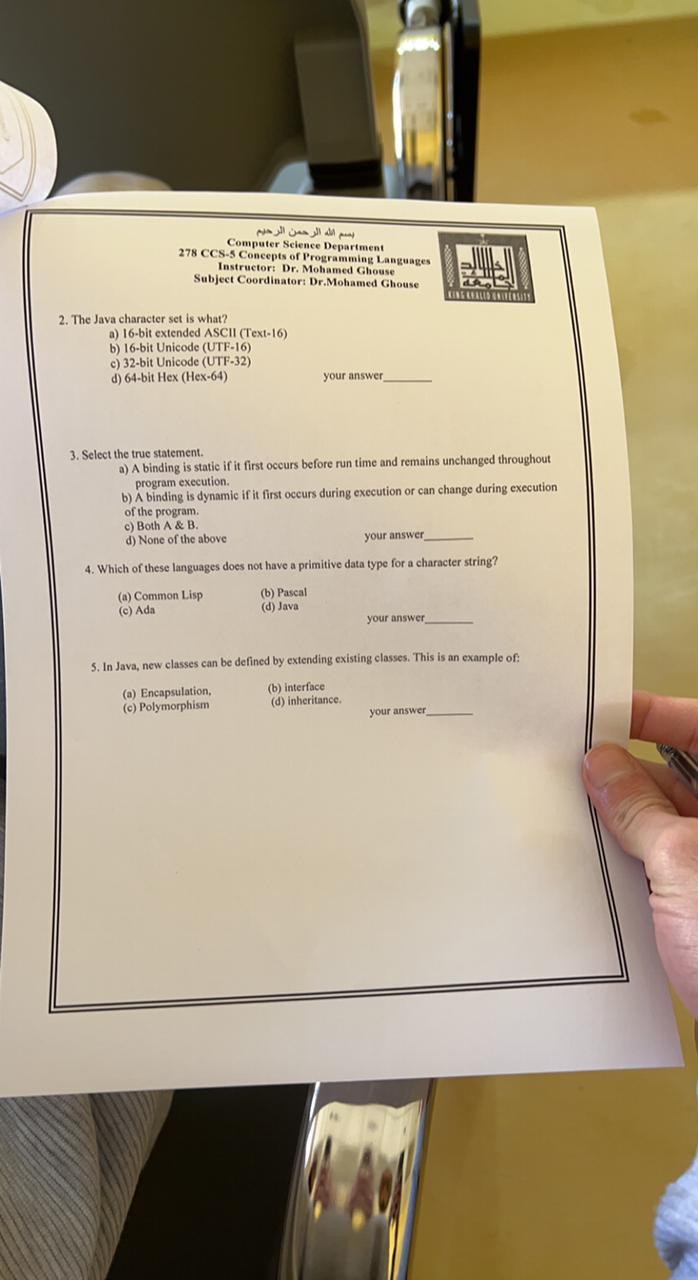
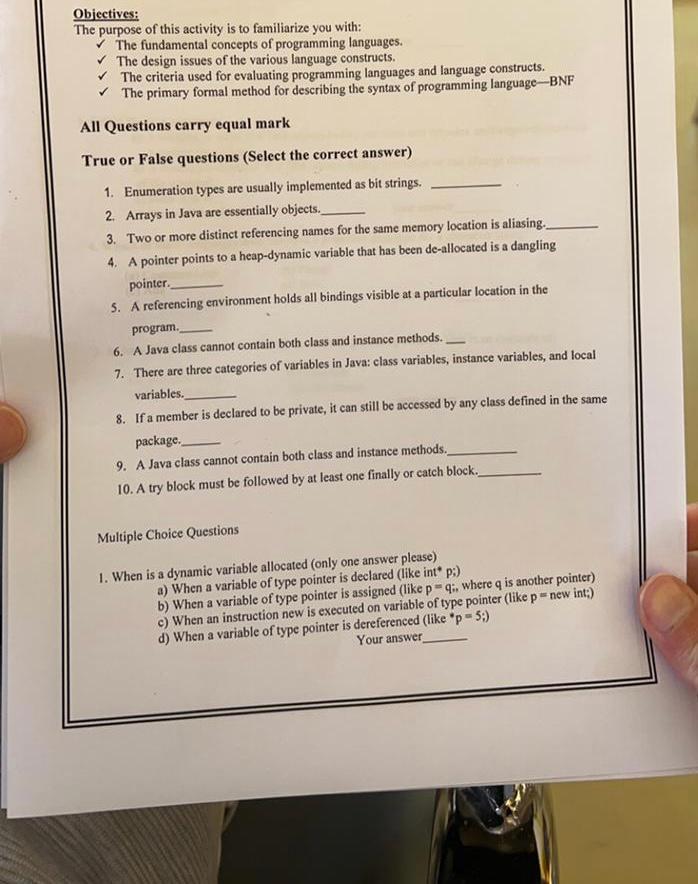
Computer Science Department 278 CCS-5 Concepts of Programming Languages Instructor: Dr. Mohamed Ghouse Subject Coordinator: Dr.Mohamed Ghouse 2. The Java character set is what? a) 16-bit extended ASCII (Text-16) b) 16-bit Unicode (UTF-16) c) 32-bit Unicode (UTF-32) d) 64-bit Hex (Hex-64) your answer. 3. Select the true statement. a) A binding is static if it first occurs before run time and remains unchanged throughout program execution. b) A binding is dynamic if it first occurs during execution or can change during execution of the program. c) Both A \& B. d) None of the above your answer 4. Which of these languages does not have a primitive data type for a character string? (a) Common Lisp (b) Pascal (c) Ada (d) Java your answer 5. In Java, new classes can be defined by extending existing classes. This is an example of: (a) Encapsulation, (b) interface (c) Polymorphism (d) inheritance. your answer Objectives: The purpose of this activity is to familiarize you with: The fundamental concepts of programming languages. The design issues of the various language constructs. The criteria used for evaluating programming languages and language constructs. The primary formal method for describing the syntax of programming language-BNF All Questions carry equal mark True or False questions (Select the correct answer) 1. Enumeration types are usually implemented as bit strings. 2. Arrays in Java are essentially objects. 3. Two or more distinct referencing names for the same memory location is aliasing. 4. A pointer points to a heap-dynamic variable that has been de-allocated is a dangling pointer. 5. A referencing environment holds all bindings visible at a particular location in the program. 6. A Java class cannot contain both class and instance methods. 7. There are three categories of variables in Java: class variables, instance variables, and local variables. 8. If a member is declared to be private, it can still be accessed by any class defined in the same package. 9. A Java class cannot contain both class and instance methods. 10. A try block must be followed by at least one finally or catch block. Multiple Choice Questions 1. When is a dynamic variable allocated (only one answer please) a) When a variable of type pointer is declared (like int p; ) b) When a variable of type pointer is assigned (like p=q;. where q is another pointer) c) When an instruction new is executed on variable of type pointer (like p= new inti) d) When a variable of type pointer is dereferenced (like * p=5: ) Your
Step by Step Solution
There are 3 Steps involved in it

Get step-by-step solutions from verified subject matter experts
 Study Help