







Question: Consider the combined Solow-Romer model: YAK Ly(1. Production Function for Output) AKt = 8Yt - d Kt (2. Capital Accumulation Equation) AAt = ZALA
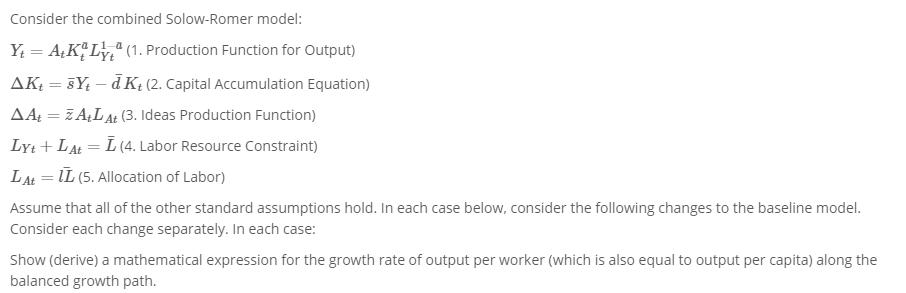

Consider the combined Solow-Romer model: YAK Ly(1. Production Function for Output) AKt = 8Yt - d Kt (2. Capital Accumulation Equation) AAt = ZALA (3. Ideas Production Function) At Lyt + LAt = L (4. Labor Resource Constraint) LAt = IL (5. Allocation of Labor) Assume that all of the other standard assumptions hold. In each case below, consider the following changes to the baseline model. Consider each change separately. In each case: Show (derive) a mathematical expression for the growth rate of output per worker (which is also equal to output per capita) along the balanced growth path. Graph output per capita with output per capita represented on the vertical axis and time on the horizontal axis, using a ratio scale. Intuitively explain how and why the results differ from the standard Solow-Romer model above. A. Suppose that 1-0 =0. B. Suppose that the Ideas Production function is replaced by the following: AAt+1= ZAPILAtAAt+1=z AtPLAt where 0 < p < 1. C. Suppose that a sixth equation is added to the model to allow for a constant, positive population growth rate: Lt=L0(1+gL)tLt=L_0(1+g L)t where LtLt is the labor force at time t and the growth rate of the labor force is positive (gL>0)(gL>0):
Step by Step Solution
3.40 Rating (153 Votes )
There are 3 Steps involved in it
A If A0 then there is no technological progress and the economy will converge to a steady state where the growth rate of output per worker is zero The mathematical expression for the growth rate of ou... View full answer

Get step-by-step solutions from verified subject matter experts
 Study Help