







Question: Could someone please explain how to work these out Sweeten Company had no jobs in progress at the beginning of the year and no beginning
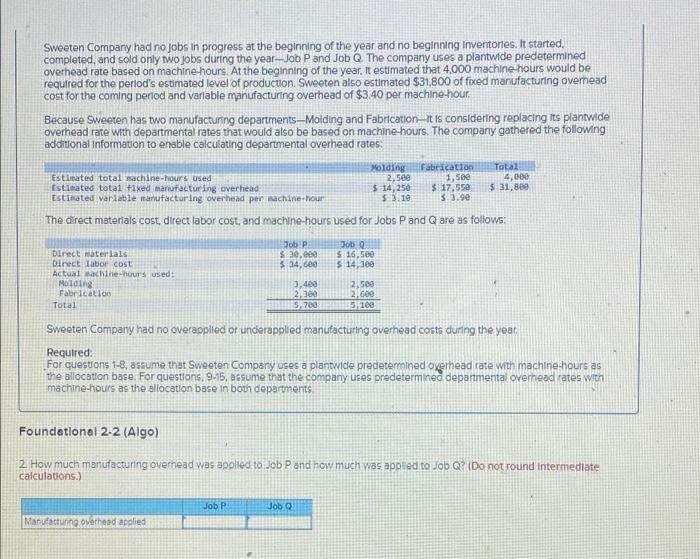
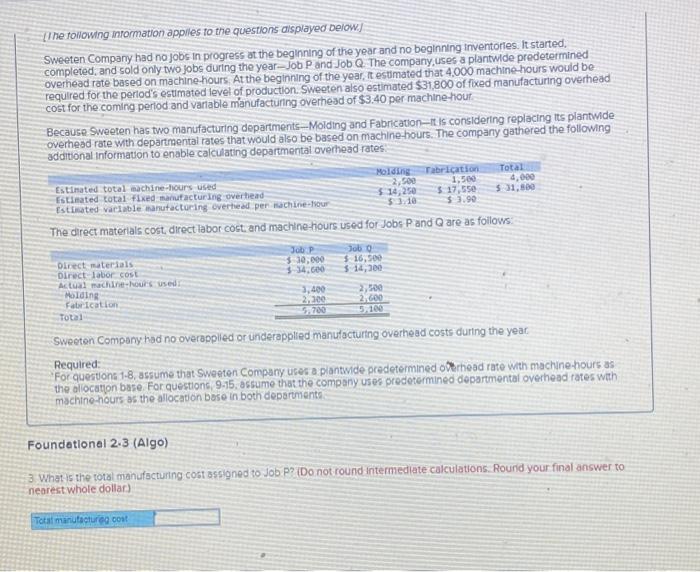
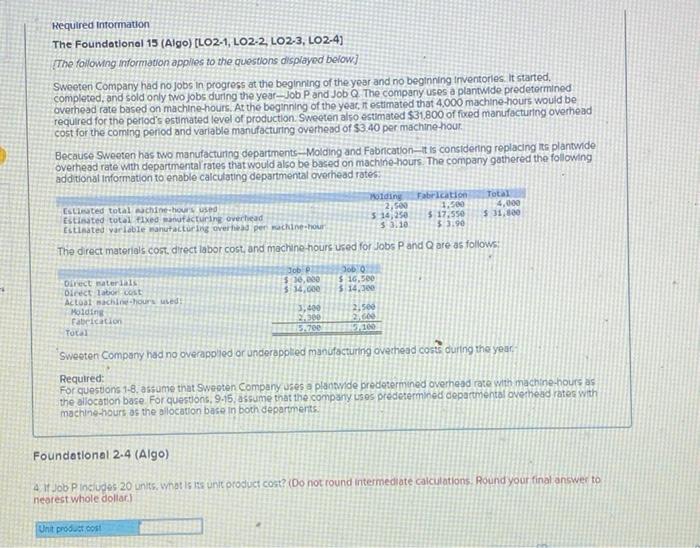
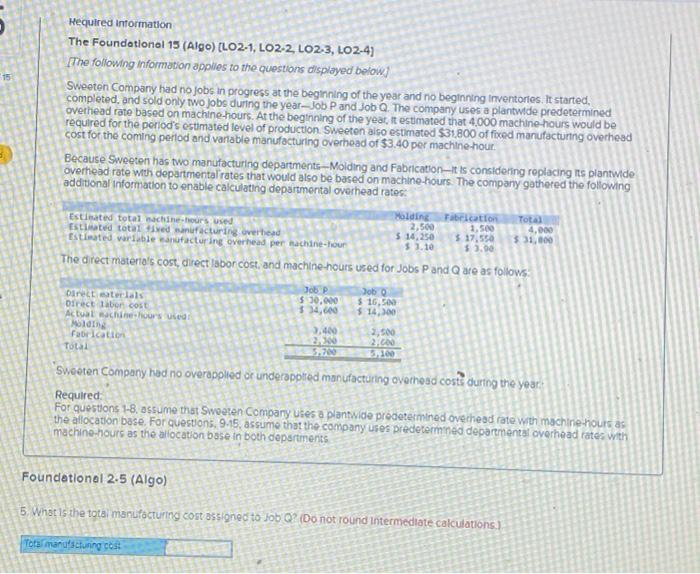
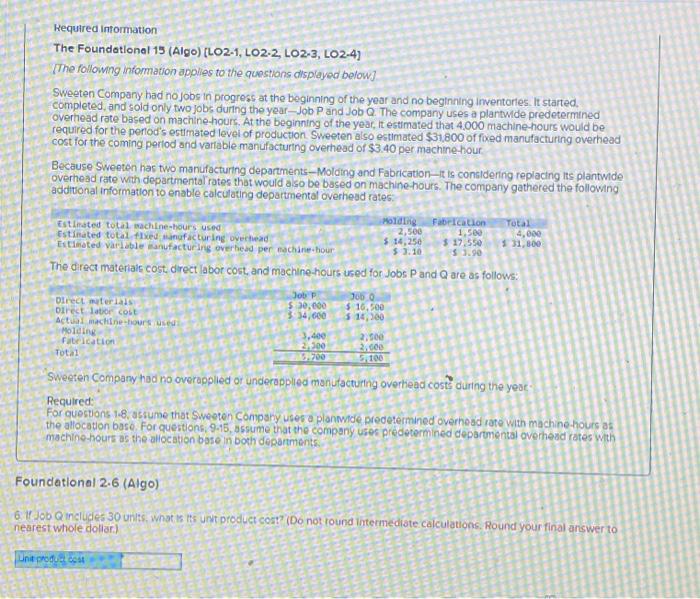
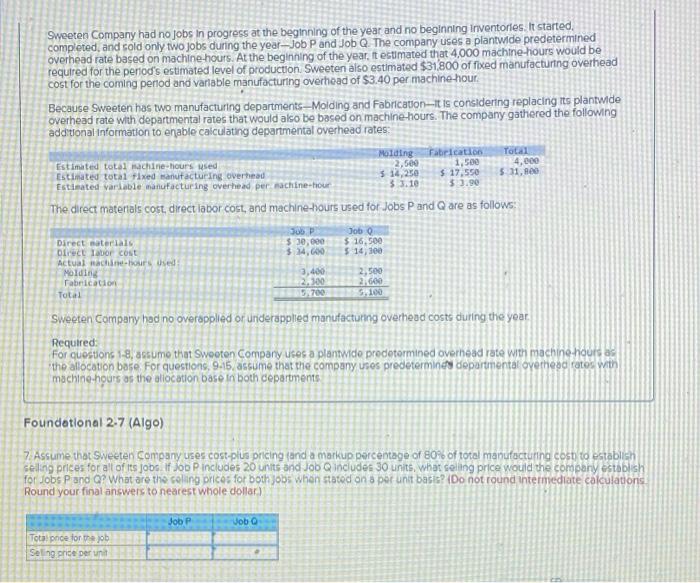
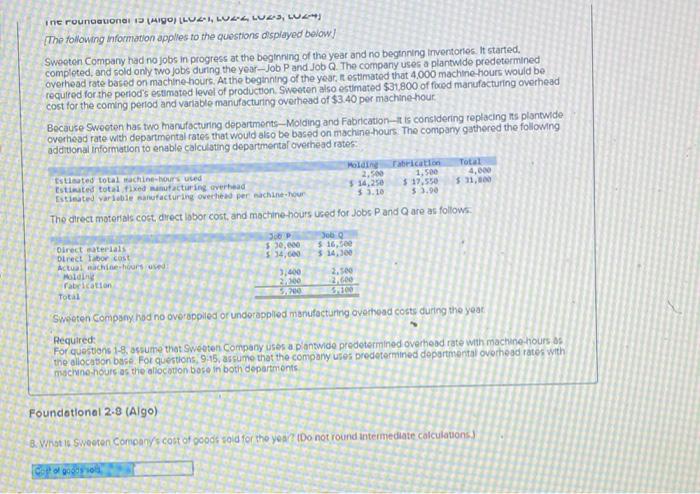
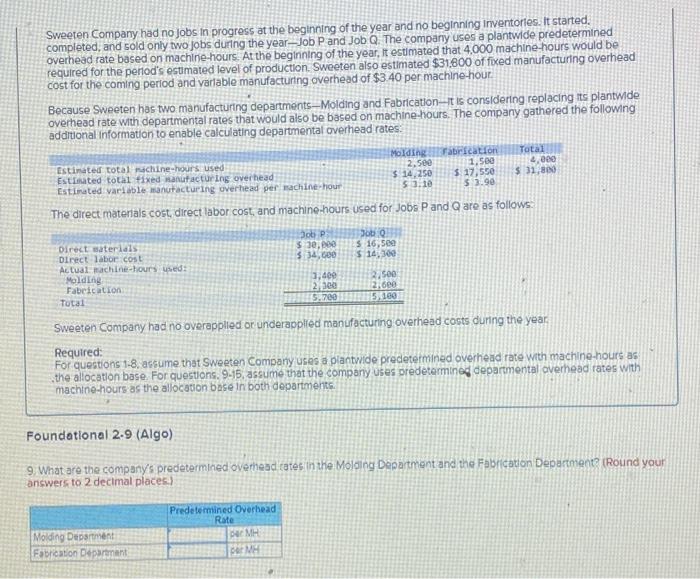
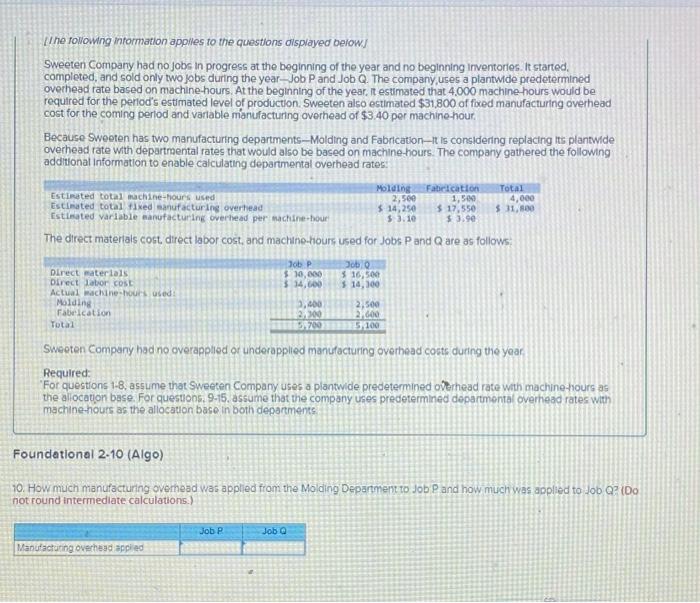
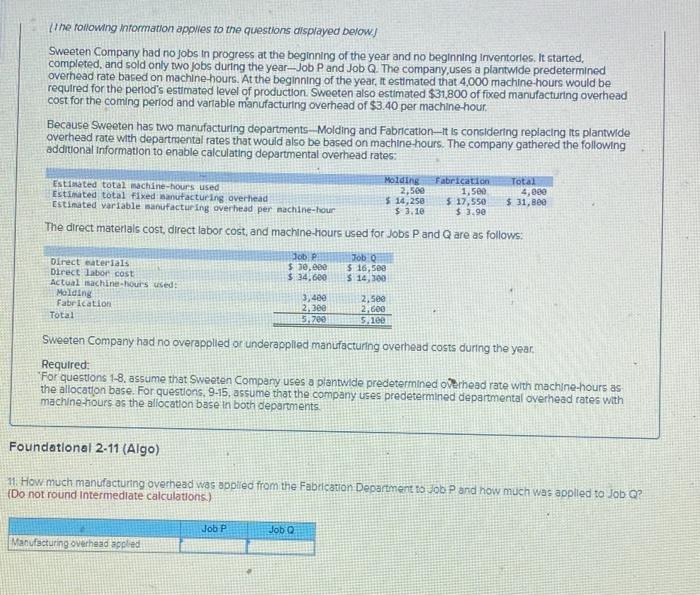
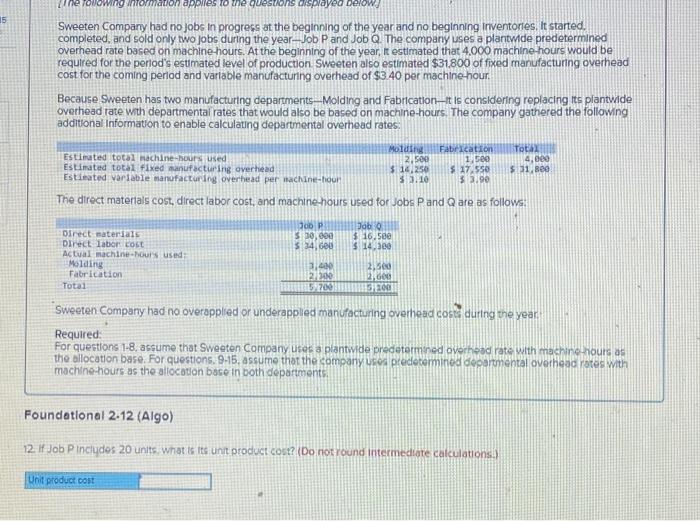
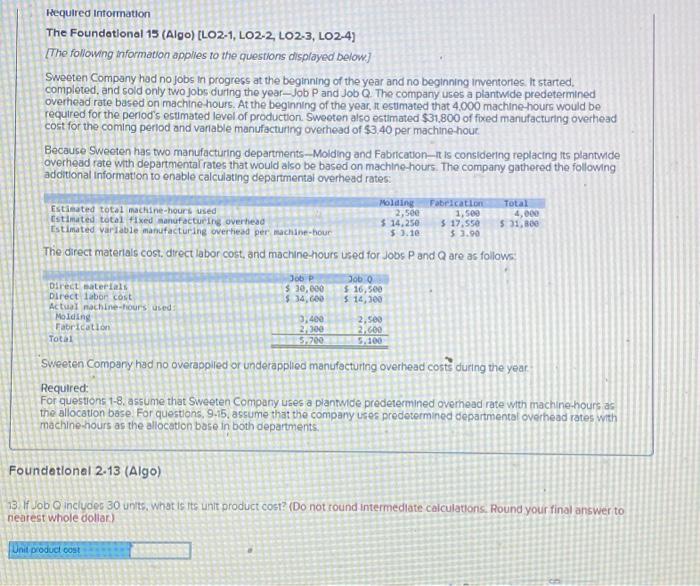
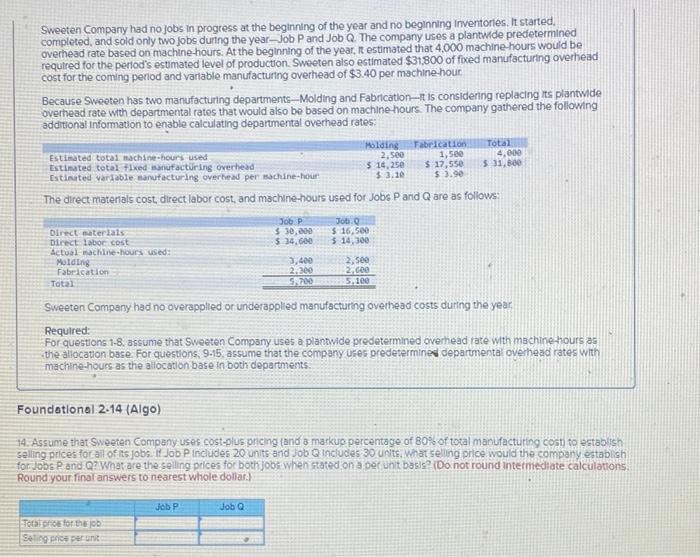
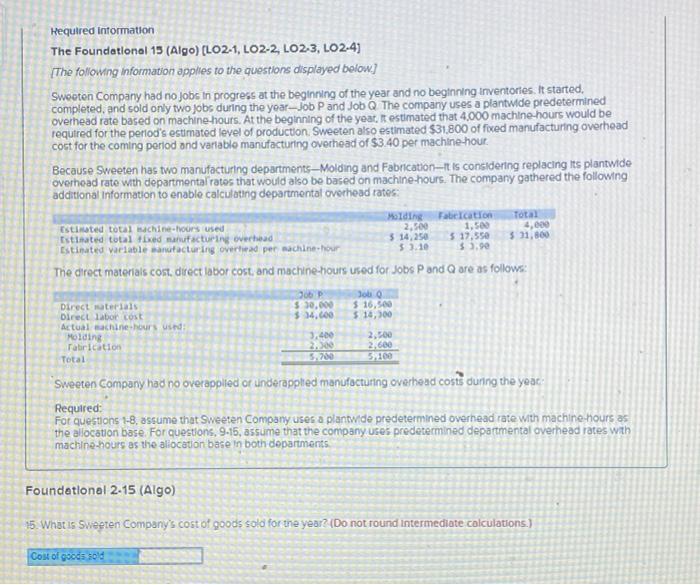
Sweeten Company had no jobs in progress at the beginning of the year and no beginning Inventones. It started. completed, and sold only two jobs during the year-Job P and Job Q. The company uses a plantwide predetermined overhead rate based on machine-hours. At the beginning of the year, It estimated that 4,000 machine-hours would be required for the period's estimated level of production. Sweeten also estimated $31,800 of fixed manufacturing overhead cost for the coming period and variable manufacturing overhead of $3.40 per machine-hour. Because Sweeten has two manufacturing departments-Molding and Fabrication-It is considering replacing its plantwide overhead rate with departmental rates that would also be based on machine-hours. The company gathered the following additional Information to enable calculating departmental overhead rates Total Estimated total machine-hours used Molding Fabrication 2,500 1,500 4,000 Estimated total fixed manufacturing overhead $ 31,800 $ 14,250 $ 3.10 $ 17,550 $ 3.90 Estimated variable manufacturing overhead per machine-hour The direct materials cost, direct labor cost, and machine-hours used for Jobs P and Q are as follows: Job P Job Q Direct materials $ 30,000 $ 16,500 Direct labor cost $ 34,600 $ 14,300 Actual machine-hours used: Molding 3,400 2,500 Fabrication 2.300 2,600 Total 5,700 5,100 Sweeten Company had no overapplied or underapplied manufacturing overhead costs during the year. Required: For questions 1-8, assume that Sweeten Company uses a plantwide predetermined overhead rate with machine-hours as the allocation base. For questions, 9-15, assume that the company uses predetermined departmental overhead rates with machine-hours as the allocation base in both departments. Foundational 2-2 (Algo) 2. How much manufacturing overhead was applied to Job P and how much was applied to Job Q? (Do not round Intermediate calculations.) Job P Job Q Manufacturing overhead applied [The following information appiles to the questions displayed below.) Sweeten Company had no jobs in progress at the beginning of the year and no beginning inventories. It started. completed, and sold only two jobs during the year-Job P and Job Q. The company,uses a plantwide predetermined overhead rate based on machine-hours. At the beginning of the year, it estimated that 4,000 machine-hours would be required for the period's estimated level of production. Sweeten also estimated $31,800 of fixed manufacturing overhead cost for the coming period and variable manufacturing overhead of $3.40 per machine-hour Because Sweeten has two manufacturing departments-Molding and Fabrication-It is considering replacing its plantwide overhead rate with departmental rates that would also be based on machine-hours. The company gathered the following additional information to enable calculating departmental overhead rates Total Tabrication 1,500 4,000 Estimated total machine-hours used Molding 2,500 $14,250 $3.10 $ 31,800 Estimated total fixed manufacturing overhead $ 17,550 $ 3.90 Estimated variable manufacturing overhead per machine-hour The direct materials cost, direct labor cost and machine-hours used for Jobs P and Q are as follows: Job Q Direct materials Job P $ 30,000 3-34.000 $ 16,500 Direct labor cost $ 14,300 Actual machine-hours used 3,400 2,500 Molding Fabrication. 2,300 2,600 5,100 Total Sweeten Company had no overappiled or underapplied manufacturing overhead costs during the year Required: For questions 1-8, assume that Sweeten Company uses a plantwide predetermined overhead rate with machine-hours as the allocation base For questions, 9-15, assume that the company uses predetermined departmental overhead rates with machine-hours as the allocation base in both departments Foundational 2-3 (Algo) 3 What is the total manufacturing cost assigned to Job P? (Do not round intermediate calculations. Round your final answer to nearest whole dollar) Total manufacturing cost Required Information. The Foundational 15 (Algo) [LO2-1, LO2-2, LO2-3, LO2-4) [The following information applies to the questions displayed below] Sweeten Company had no jobs in progress at the beginning of the year and no beginning inventories. It started. completed, and sold only two jobs during the year-Job P and Job Q. The company uses a plantwide predetermined overhead rate based on machine-hours. At the beginning of the year, it estimated that 4,000 machine-hours would be required for the period's estimated level of production. Sweeten also estimated $31,800 of fixed manufacturing overhead cost for the coming period and variable manufacturing overhead of $3.40 per machine-hour Because Sweeten has two manufacturing departments-Molding and Fabrication-t is considering replacing its plantwide overhead rate with departmental rates that would also be based on machine-hours. The company gathered the following additional Information to enable calculating departmental overhead rates: Total Estimated total aachine-hours used 4,000 Estimated total fixed manufacturing overhead Holding Fabrication 2,500 1,500 $ 17,550 $ 3.90 $ 31,000 S 14,250 $ 3.10 Estimated variable manufacturing overhead per machine-hour The direct materials cost, direct labor cost, and machine-hours used for Jobs P and Q are as follows: Job P Direct materials $ 30,000 $ 34,000 Job Q $16.500 $ 14,300 Direct labor cost Actual machine-hours used: Holding 3,400 2,500 2,000 Fabrication 2.300 Total 5.700 15.300 Sweeten Company had no overapplied or underapplied manufacturing overhead costs during the year. Required: For questions 1-8, assume that Sweeten Company uses a plantwide predetermined overhead rate with machine-hours as the allocation base. For questions, 9-15, assume that the company uses predetermined departmental overhead rates with machine-hours as the allocation base in both departments. Foundational 2-4 (Algo) 4. If Job P includes 20 units, what is its unit product cost? (Do not round intermediate calculations. Round your final answer to nearest whole dollar) Unit product cost 15 Hequired information The Foundational 15 (Algo) (LO2-1, LO2-2, LO2-3, LO2-4] [The following information applies to the questions displayed below] Sweeten Company had no jobs in progress at the beginning of the year and no beginning inventories. It started. completed, and sold only two jobs during the year-Job P and Job Q. The company uses a plantwide predetermined overhead rate based on machine-hours. At the beginning of the year, it estimated that 4,000 machine-hours would be required for the period's estimated level of production Sweeten also estimated $31,800 of fixed manufacturing overhead cost for the coming period and variable manufacturing overhead of $3.40 per machine-hour. Because Sweeten has two manufacturing departments-Molding and Fabrication-It is considering replacing its plantwide overhead rate with departmental rates that would also be based on machine-hours. The company gathered the following additional information to enable calculating departmental overhead rates: Total Estimated total eachine-hours used Molding Fabrication 2,500 1,500 4,000 Estimated total ived manufacturing overhead Estimated variable eanufacturing overhead per nachine-hour $ 14,250 $ 3.10 $ 31,000 $ 17,550 $ 3.00 The direct materials cost, direct labor cost, and machine-hours used for Jobs P and Q are as follows: Job P Direct materials Job Q $ 16,500 Direct labor cost Actual $ 30,000 $34,600 $ 14,300 chine-hours used 3,400 Molding Fabrication 2,500 2,300 2.000 Total 5,700 5,100 Sweeten Company had no overapplied or underapplied manufacturing overhead costs during the year: Required. For questions 1-8, assume that Sweeten Company uses a plantwide predetermined overhead rate with machine-hours as the allocation base. For questions, 9-15, assume that the company uses predetermined departmental overhead rates with machine-hours as the allocation base in both departments Foundational 2-5 (Algo) 5. What is the total manufacturing cost assigned to Job Q? (Do not round Intermediate calculations. Total manufacturing cost Required information The Foundational 15 (Algo) (LO2-1, LO2-2, LO2-3, LO2-4) [The following information applies to the questions displayed below] Sweeten Company had no jobs in progress at the beginning of the year and no beginning inventories. It started. completed, and sold only two jobs during the year-Job P and Job Q. The company uses a plantwide predetermined overhead rate based on machine-hours. At the beginning of the year, it estimated that 4.000 machine-hours would be required for the period's estimated level of production Sweeten also estimated $31,800 of fixed manufacturing overhead cost for the coming period and variable manufacturing overhead of $3.40 per machine-hour Because Sweeton has two manufacturing departments-Molding and Fabrication-it is considering replacing its plantwide overhead rate with departmental rates that would also be based on machine-hours. The company gathered the following additional information to enable calculating departmental overhead rates: Estimated total machine-hours used Estimated total fixed manufacturing overhead Molding 2,500 $14,250 $ 3.10 Fabrication Total 1,500 4,000 131,800 Estimated variable manufacturing overhead per nachine-hour $17.550 $ 3.90 The direct materials cost, direct labor cost, and machine-hours used for Jobs P and Q are as follows: Job 0 Direct materiais Job P $ 30,000 3:34,600 Direct labor cost $ 16,500 $ 14,300 Actual machine-hours used Molding- Fabrication 3,400 2,500 2.300 2,000 Total 5.700 5,100 Sweeten Company had no overapplied or underapplied manufacturing overhead costs during the year- Required: For questions 1-8, assume that Sweeten Company uses a planwide predetermined overhead rate with machine-hours as the allocation base. For questions, 9-15, assume that the company uses predetermined departmental overhead rates with machine-hours as the allocation base in both departments. Foundational 2-6 (Algo) 61 Job Q includes 30 units, what is its unit product cost? (Do not round Intermediate calculations. Round your final answer to nearest whole dollar) Unit product cost Sweeten Company had no jobs in progress at the beginning of the year and no beginning inventories. It started. completed, and sold only two jobs during the year-Job P and Job Q. The company uses a plantwide predetermined overhead rate based on machine-hours. At the beginning of the year, it estimated that 4,000 machine-hours would be required for the period's estimated level of production. Sweeten also estimated $31,800 of fixed manufacturing overhead cost for the coming period and variable manufacturing overhead of $3.40 per machine-hour. Because Sweeten has two manufacturing departments-Molding and Fabrication-It is considering replacing its plantwide overhead rate with departmental rates that would also be based on machine-hours. The company gathered the following additional Information to enable calculating departmental overhead rates: Total Estimated total machine-hours used 4,000 Molding 2,500 $ 14,250 $ 3.10 Fabrication 1,500 $ 17,550 $3.90 Estimated total fixed manufacturing overhead $ 11,900 Estimated variable manufacturing overhead per eachine-hour The direct materials cost, direct labor cost, and machine-hours used for Jobs P and Q are as follows: Jub P Job Q Direct eaterials. $30,000 $ 16,500 Direct labor cost $34,600 $ 14,300 Actual machine-bours Used: Molding 3,400 2,500 Fabrication 2.300 2,600 Total 115,700 5,100 Sweeten Company had no overapplied or underapplied manufacturing overhead costs during the year. Required: For questions 1-8, assume that Sweeten Company uses a plantwide predetermined overhead rate with machine-hours as the allocation base For questions, 9-15, assume that the company uses predetermine departmental overhead rates with machine-hours as the allocation base in both departments Foundational 2-7 (Algo) 7. Assume that Sweeten Company uses cost-plus pricing (and a markup percentage of 80% of total manufacturing cost to establish selling prices for all of its jobs. If Job P includes 20 units and Job Q includes 30 units, what selling price would the company establish for Jobs P and Q? What are the selling prices for both jobs when stated on a per unit basis? (Do not round intermediate calculations Round your final answers to nearest whole dollar) Job P Job Q Total price for the job Selling price per unit ine roundation () (LUGI, LUGL WAS, WA [The following information applies to the questions displayed below] Sweeten Company had no jobs in progress at the beginning of the year and no beginning inventories. It started. completed, and sold only two jobs during the year-Job P and Job Q. The company uses a plantwide predetermined overhead rate based on machine-hours. At the beginning of the year, it estimated that 4,000 machine-hours would be required for the period's estimated level of production. Sweeten also estimated $31,800 of foxed manufacturing overhead cost for the coming period and variable manufacturing overhead of $3.40 per machine-hour Because Sweeten has two manufacturing departments-Molding and Fabrication-t is considering replacing its plantwide overhead rate with departmental rates that would also be based on machine-hours. The company gathered the following additional Information to enable calculating departmental overhead rates: Total 4,000 Estimated total machine-hours used Molding Fabrication 2,500 1,500 $14,250 $ 17,550 $ 3.10 $3.90 Estimated total fixed manufacturing overhead $ 11,000 Estimated variable nanufacturing overhead per nachine-hour The direct materials cost direct labor cost, and machine-hours used for Jobs P and Q are as follows. Job Q Direct materials 300 P $30,000 $ 14,000 $ 16,500 Direct labor cost $ 14,300 Actual nachine-hours used: Molding 3,400 2.500 Fabrication 2.300 2,600 Total 5.200 5-100 Sweeten Company had no overappiled or underapplied manufacturing overhead costs during the year Required: For questions 1-8, assume that Sweeten Company uses a plantwide predetermined overhead rate with machine-hours as the allocation base For questions, 9-15, assume that the company uses predetermined departmental overhead rates with machine-hours as the allocation base in both departments Foundational 2-8 (Algo) 8. What is Sweeten Company's cost of goods sold for the year? (Do not found intermediate calculations Cost of goods sold Sweeten Company had no Jobs in progress at the beginning of the year and no beginning Inventories. It started. completed, and sold only two jobs during the year-Job P and Job Q. The company uses a plantwide predetermined overhead rate based on machine-hours. At the beginning of the year, it estimated that 4,000 machine-hours would be required for the period's estimated level of production. Sweeten also estimated $31,600 of fixed manufacturing overhead cost for the coming period and variable manufacturing overhead of $3.40 per machine-hour. Because Sweeten has two manufacturing departments-Molding and Fabrication-it is considering replacing its plantwide overhead rate with departmental rates that would also be based on machine-hours. The company gathered the following additional information to enable calculating departmental overhead rates: Total Estimated total machine-hours used Fabrication 1,500 4,000 Estimated total fixed manufacturing overhead Molding 2,500 $14,250 5 3.10 $ 31,800 $ 17,550 $ 3.90 Estimated variable manufacturing overhead per machine-hour The direct materials cost, direct labor cost, and machine-hours used for Jobs P and Q are as follows: Job P Direct materials $ 30,000 Job Q $ 16,500 Direct labor cost $ 34,000 $ 14,300 Actual machine-hours used: Molding 3,400 2,500 Fabrication 2,300 2,600 Total 5.700 15,100 Sweeten Company had no overapplied or underapplied manufacturing overhead costs during the year. Required: For questions 1-8, assume that Sweeten Company uses a plantwide predetermined overhead rate with machine-hours as the allocation base. For questions. 9-15, assume that the company uses predetermined departmental overhead rates with machine-hours as the allocation base in both departments. Foundational 2-9 (Algo) 9. What are the company's predetermined overhead rates in the Molding Department and the Fabrication Department? (Round your answers to 2 decimal places) Predetermined Overhead. Rate Molding Department par MH Fabrication Department par MH [The following information applies to the questions displayed below] Sweeten Company had no jobs in progress at the beginning of the year and no beginning inventories. It started. completed, and sold only two jobs during the year-Job P and Job Q. The company,uses a plantwide predetermined overhead rate based on machine-hours. At the beginning of the year, it estimated that 4,000 machine-hours would be required for the period's estimated level of production. Sweeten also estimated $31,800 of fixed manufacturing overhead cost for the coming period and variable manufacturing overhead of $3.40 per machine-hour. Because Sweeten has two manufacturing departments-Molding and Fabrication-It is considering replacing its plantwide overhead rate with departmental rates that would also be based on machine-hours. The company gathered the following additional Information to enable calculating departmental overhead rates: Total Estimated total machine-hours used 4,000 Estimated total fixed manufacturing overhead Molding Fabrication 2,500 1,500 $ 14,250 $17,550 $3.10 $ 3.90 $31,800 Estimated variable manufacturing overhead per eachine-hour The direct materials cost, direct labor cost, and machine-hours used for Jobs P and Q are as follows: Direct materials Job P $10,000 $ 14,600 Job Q $ 16,500 Direct labor cost $ 14,300 Actual machine-hours used: Molding 3,400 2,500 Fabrication 2.300 2,600 Total 5,700 111115,100 Sweeten Company had no overapplied or underapplied manufacturing overhead costs during the year. Required: For questions 1-8, assume that Sweeten Company uses a plantwide predetermined overhead rate with machine-hours as the allocation base. For questions, 9-15. assume that the company uses predetermined departmental overhead rates with machine-hours as the allocation base in both departments. Foundational 2-10 (Algo) 10. How much manufacturing overhead was applied from the Molding Department to Job P and how much was applied to Job Q? (Do not round intermediate calculations.) Job P Job Q Manufacturing overhead applied (the following information applies to the questions displayed below. Sweeten Company had no jobs in progress at the beginning of the year and no beginning inventories. It started. completed, and sold only two jobs during the year-Job P and Job Q. The company,uses a plantwide predetermined overhead rate based on machine-hours. At the beginning of the year, it estimated that 4,000 machine-hours would be required for the period's estimated level of production. Sweeten also estimated $31,800 of fixed manufacturing overhead cost for the coming period and variable manufacturing overhead of $3.40 per machine-hour. Because Sweeten has two manufacturing departments-Molding and Fabrication-it is considering replacing its plantwide overhead rate with departmental rates that would also be based on machine-hours. The company gathered the following additional Information to enable calculating departmental overhead rates: Estimated total machine-hours used 4,000 Molding 2,500 $14,250 $ 3.10 Total $ 31,800 Estimated total fixed manufacturing overhead Fabrication 1,500 $17,550 $ 3.90 Estimated variable manufacturing overhead per machine-hour The direct materials cost, direct labor cost, and machine-hours used for Jobs P and Q are as follows: Job P Job Q Direct eaterials $ 30,000 $ 16,500 Direct labor cost $ 34,600 $ 14,300 Actual machine-hours used: Molding Fabrication 3,400 2,500 2,300 2,600 Total 5,700 5,100 Sweeten Company had no overapplied or underapplied manufacturing overhead costs during the year. Required: For questions 1-8, assume that Sweeten Company uses a plantwide predetermined overhead rate with machine-hours as the allocation base. For questions, 9-15, assume that the company uses predetermined departmental overhead rates with machine-hours as the allocation base in both departments. Foundational 2-11 (Algo) 11. How much manufacturing overhead was applied from the Fabrication Department to Job P and how much was applied to Job Q? (Do not round Intermediate calculations.) Job P Job Q Manufacturing overhead applied Line following applies to the questions displayed below Sweeten Company had no jobs in progress at the beginning of the year and no beginning inventories. It started. completed, and sold only two jobs during the year-Job P and Job Q. The company uses a plantwide predetermined overhead rate based on machine-hours. At the beginning of the year, it estimated that 4.000 machine-hours would be required for the period's estimated level of production. Sweeten also estimated $31,800 of fixed manufacturing overhead cost for the coming period and variable manufacturing overhead of $3.40 per machine-hour. Because Sweeten has two manufacturing departments-Molding and Fabrication-it is considering replacing its plantwide overhead rate with departmental rates that would also be based on machine-hours. The company gathered the following additional Information to enable calculating departmental overhead rates: Total Estimated total machine-hours used. 4,000 Estimated total fixed manufacturing overhead Molding Fabrication 2,500 1,500 $14,250 $ 17,550 $ 3.10 $ 3.90 $31,800 Estimated variable manufacturing overhead per machine-hour The direct materials cost, direct labor cost, and machine-hours used for Jobs P and Q are as follows: 300 P Direct materials $ 30,000 Job Q $16.500 $ 14,300 Direct labor cost $ 34,600 Actual machine-hours used: Molding 3,400 2/300 2,500 2,600 Fabrication Total Hi5-700300 Sweeten Company had no overapplied or underapplied manufacturing overhead costs during the year. Required: For questions 1-8, assume that Sweeten Company uses a plantwide predetermined overhead rate with machine-hours as the allocation base. For questions. 9-15, assume that the company uses predetermined departmental overhead rates with machine-hours as the allocation base in both departments. Foundational 2-12 (Algo) 12. If Job P Includes 20 units, what is its unit product cost? (Do not round Intermediate calculations.) Unit product cost Required Information The Foundational 15 (Algo) (LO2-1, LO2-2, LO2-3, LO2-4) [The following information applies to the questions displayed below] Sweeten Company had no jobs in progress at the beginning of the year and no beginning inventones. It started. completed, and sold only two jobs during the year-Job P and Job Q. The company uses a plantwide predetermined overhead rate based on machine-hours. At the beginning of the year, it estimated that 4.000 machine-hours would be required for the period's estimated level of production. Sweeten also estimated $31,800 of fixed manufacturing overhead cost for the coming period and variable manufacturing overhead of $3.40 per machine-hour Because Sweeten has two manufacturing departments-Molding and Fabrication-It is considering replacing its plantwide overhead rate with departmental rates that would also be based on machine-hours. The company gathered the following additional information to enable calculating departmental overhead rates: Estimated total machine-hours used Molding Fabrication 2,500 Total $ 31,800 4,000 Estimated total fixed manufacturing overhead 1,500 $ 17,550 $ 3.90 $ 14,250 $ 3.10 Estimated variable manufacturing overhead per machine-hour The direct materials cost, direct labor cost, and machine-hours used for Jobs P and Q are as follows: Job P Job Q Direct materials $ 30,000 $ 16,500 Direct labor cost $ 34,600 $ 14,300 Actual machine-hours used: Molding 3,400 2,500 Fabrication 2,300 2,000 Total 5,700 5,100 Sweeten Company had no overapplied or underapplied manufacturing overhead costs during the year. Required: For questions 1-8. assume that Sweeten Company uses a plantwide predetermined overhead rate with machine-hours as the allocation base. For questions, 9-15, assume that the company uses predetermined departmental overhead rates with machine-hours as the allocation base in both departments. Foundational 2-13 (Algo) 13. If Job Q includes 30 units, what is its unit product cost? (Do not round intermediate calculations. Round your final answer to nearest whole dollar) Unit product cost Sweeten Company had no jobs in progress at the beginning of the year and no beginning inventories. It started. completed, and sold only two jobs during the year-Job P and Job Q. The company uses a plantwide predetermined overhead rate based on machine-hours. At the beginning of the year, it estimated that 4,000 machine-hours would be required for the period's estimated level of production. Sweeten also estimated $31,800 of fixed manufacturing overhead cost for the coming period and variable manufacturing overhead of $3.40 per machine-hour Because Sweeten has two manufacturing departments-Molding and Fabrication-It is considering replacing its plantwide overhead rate with departmental rates that would also be based on machine-hours. The company gathered the following additional Information to enable calculating departmental overhead rates: Total Estimated total machine-hours used 4,000 Molding 2,500 $14,250 $ 3.10 Fabrication 1,500 $ 17,550 $ 3.90 Estimated total fixed manufacturing overhead $ 31,800 Estimated variable manufacturing overhead per machine-hour The direct materials cost, direct labor cost, and machine-hours used for Jobs P and Q are as follows: Job P Job Q Direct materials: $ 30,000 $ 16,500 Direct labor cost $ 34,000 $ 14,300 Actual machine-hours used: Molding 3,400 2,500 Fabrication 2,300 2,600 Total 5,700 5.100 Sweeten Company had no overapplied or underapplied manufacturing overhead costs during the year. Required: For questions 1-8, assume that Sweeten Company uses a plantwide predetermined overhead rate with machine-hours as the allocation base For questions, 9-15, assume that the company uses predetermined departmental overhead rates with machine-hours as the allocation base in both departments. Foundational 2-14 (Algo) 14. Assume that Sweeten Company uses cost-plus pricing (and a markup percentage of 80% of total manufacturing cost) to establish selling prices for all of its jobs. If Job P Includes 20 units and Job Q Includes 30 units, what selling price would the company establish for Jobs P and Q? What are the selling prices for both jobs when stated on a per unit basis? (Do not round Intermediate calculations. Round your final answers to nearest whole dollar.) Job P Job Q Total price for the job Selling price per unit Hequired Information The Foundational 15 (Algo) (LO2-1, LO2-2, LO2-3, LO2-4) [The following information applies to the questions displayed below.] Sweeten Company had no jobs in progress at the beginning of the year and no beginning inventories. It started. completed, and sold only two jobs during the year-Job P and Job Q. The company uses a plantwide predetermined overhead rate based on machine-hours. At the beginning of the year, it estimated that 4,000 machine-hours would be required for the period's estimated level of production. Sweeten also estimated $31,800 of fixed manufacturing overhead cost for the coming period and variable manufacturing overhead of $3.40 per machine-hour. Because Sweeten has two manufacturing departments-Molding and Fabrication-It is considering replacing its plantwide overhead rate with departmental rates that would also be based on machine-hours. The company gathered the following additional information to enable calculating departmental overhead rates: Total Molding Fabrication 2,500 1,500 Estimated total machine-hours used 4,000 Estimated total fixed manufacturing overhead $ 31,800 $ 14,250 $ 3.10 $ 17,550 $ 3.90 Estimated variable manufacturing overhead per eachine-hour The direct materials cost, direct labor cost, and machine-hours used for Jobs P and Q are as follows: 306 P Job Q Direct materials $ 30,000 $ 34,600 $ 16,500 $ 14,300 Direct labor cost Actual machine-hours used: Molding 3,400 2,500 Fabrication 2.300 2,600 Total 5,700 5,100 Sweeten Company had no overapplied or underapplied manufacturing overhead costs during the year Required: For questions 1-8, assume that Sweeten Company uses a plantwide predetermined overhead rate with machine-hours as the allocation base. For questions, 9-15, assume that the company uses predetermined departmental overhead rates with machine-hours as the allocation base in both departments Foundational 2-15 (Algo) 15. What is Sweeten Company's cost of goods sold for the year? (Do not round Intermediate calculations.) Cost of goods sold Sweeten Company had no jobs in progress at the beginning of the year and no beginning Inventones. It started. completed, and sold only two jobs during the year-Job P and Job Q. The company uses a plantwide predetermined overhead rate based on machine-hours. At the beginning of the year, It estimated that 4,000 machine-hours would be required for the period's estimated level of production. Sweeten also estimated $31,800 of fixed manufacturing overhead cost for the coming period and variable manufacturing overhead of $3.40 per machine-hour. Because Sweeten has two manufacturing departments-Molding and Fabrication-It is considering replacing its plantwide overhead rate with departmental rates that would also be based on machine-hours. The company gathered the following additional Information to enable calculating departmental overhead rates Total Estimated total machine-hours used Molding Fabrication 2,500 1,500 4,000 Estimated total fixed manufacturing overhead $ 31,800 $ 14,250 $ 3.10 $ 17,550 $ 3.90 Estimated variable manufacturing overhead per machine-hour The direct materials cost, direct labor cost, and machine-hours used for Jobs P and Q are as follows: Job P Job Q Direct materials $ 30,000 $ 16,500 Direct labor cost $ 34,600 $ 14,300 Actual machine-hours used: Molding 3,400 2,500 Fabrication 2.300 2,600 Total 5,700 5,100 Sweeten Company had no overapplied or underapplied manufacturing overhead costs during the year. Required: For questions 1-8, assume that Sweeten Company uses a plantwide predetermined overhead rate with machine-hours as the allocation base. For questions, 9-15, assume that the company uses predetermined departmental overhead rates with machine-hours as the allocation base in both departments. Foundational 2-2 (Algo) 2. How much manufacturing overhead was applied to Job P and how much was applied to Job Q? (Do not round Intermediate calculations.) Job P Job Q Manufacturing overhead applied [The following information appiles to the questions displayed below.) Sweeten Company had no jobs in progress at the beginning of the year and no beginning inventories. It started. completed, and sold only two jobs during the year-Job P and Job Q. The company,uses a plantwide predetermined overhead rate based on machine-hours. At the beginning of the year, it estimated that 4,000 machine-hours would be required for the period's estimated level of production. Sweeten also estimated $31,800 of fixed manufacturing overhead cost for the coming period and variable manufacturing overhead of $3.40 per machine-hour Because Sweeten has two manufacturing departments-Molding and Fabrication-It is considering replacing its plantwide overhead rate with departmental rates that would also be based on machine-hours. The company gathered the following additional information to enable calculating departmental overhead rates Total Tabrication 1,500 4,000 Estimated total machine-hours used Molding 2,500 $14,250 $3.10 $ 31,800 Estimated total fixed manufacturing overhead $ 17,550 $ 3.90 Estimated variable manufacturing overhead per machine-hour The direct materials cost, direct labor cost and machine-hours used for Jobs P and Q are as follows: Job Q Direct materials Job P $ 30,000 3-34.000 $ 16,500 Direct labor cost $ 14,300 Actual machine-hours used 3,400 2,500 Molding Fabrication. 2,300 2,600 5,100 Total Sweeten Company had no overappiled or underapplied manufacturing overhead costs during the year Required: For questions 1-8, assume that Sweeten Company uses a plantwide predetermined overhead rate with machine-hours as the allocation base For questions, 9-15, assume that the company uses predetermined departmental overhead rates with machine-hours as the allocation base in both departments Foundational 2-3 (Algo) 3 What is the total manufacturing cost assigned to Job P? (Do not round intermediate calculations. Round your final answer to nearest whole dollar) Total manufacturing cost Required Information. The Foundational 15 (Algo) [LO2-1, LO2-2, LO2-3, LO2-4) [The following information applies to the questions displayed below] Sweeten Company had no jobs in progress at the beginning of the year and no beginning inventories. It started. completed, and sold only two jobs during the year-Job P and Job Q. The company uses a plantwide predetermined overhead rate based on machine-hours. At the beginning of the year, it estimated that 4,000 machine-hours would be required for the period's estimated level of production. Sweeten also estimated $31,800 of fixed manufacturing overhead cost for the coming period and variable manufacturing overhead of $3.40 per machine-hour Because Sweeten has two manufacturing departments-Molding and Fabrication-t is considering replacing its plantwide overhead rate with departmental rates that would also be based on machine-hours. The company gathered the following additional Information to enable calculating departmental overhead rates: Total Estimated total aachine-hours used 4,000 Estimated total fixed manufacturing overhead Holding Fabrication 2,500 1,500 $ 17,550 $ 3.90 $ 31,000 S 14,250 $ 3.10 Estimated variable manufacturing overhead per machine-hour The direct materials cost, direct labor cost, and machine-hours used for Jobs P and Q are as follows: Job P Direct materials $ 30,000 $ 34,000 Job Q $16.500 $ 14,300 Direct labor cost Actual machine-hours used: Holding 3,400 2,500 2,000 Fabrication 2.300 Total 5.700 15.300 Sweeten Company had no overapplied or underapplied manufacturing overhead costs during the year. Required: For questions 1-8, assume that Sweeten Company uses a plantwide predetermined overhead rate with machine-hours as the allocation base. For questions, 9-15, assume that the company uses predetermined departmental overhead rates with machine-hours as the allocation base in both departments. Foundational 2-4 (Algo) 4. If Job P includes 20 units, what is its unit product cost? (Do not round intermediate calculations. Round your final answer to nearest whole dollar) Unit product cost 15 Hequired information The Foundational 15 (Algo) (LO2-1, LO2-2, LO2-3, LO2-4] [The following information applies to the questions displayed below] Sweeten Company had no jobs in progress at the beginning of the year and no beginning inventories. It started. completed, and sold only two jobs during the year-Job P and Job Q. The company uses a plantwide predetermined overhead rate based on machine-hours. At the beginning of the year, it estimated that 4,000 machine-hours would be required for the period's estimated level of production Sweeten also estimated $31,800 of fixed manufacturing overhead cost for the coming period and variable manufacturing overhead of $3.40 per machine-hour. Because Sweeten has two manufacturing departments-Molding and Fabrication-It is considering replacing its plantwide overhead rate with departmental rates that would also be based on machine-hours. The company gathered the following additional information to enable calculating departmental overhead rates: Total Estimated total eachine-hours used Molding Fabrication 2,500 1,500 4,000 Estimated total ived manufacturing overhead Estimated variable eanufacturing overhead per nachine-hour $ 14,250 $ 3.10 $ 31,000 $ 17,550 $ 3.00 The direct materials cost, direct labor cost, and machine-hours used for Jobs P and Q are as follows: Job P Direct materials Job Q $ 16,500 Direct labor cost Actual $ 30,000 $34,600 $ 14,300 chine-hours used 3,400 Molding Fabrication 2,500 2,300 2.000 Total 5,700 5,100 Sweeten Company had no overapplied or underapplied manufacturing overhead costs during the year: Required. For questions 1-8, assume that Sweeten Company uses a plantwide predetermined overhead rate with machine-hours as the allocation base. For questions, 9-15, assume that the company uses predetermined departmental overhead rates with machine-hours as the allocation base in both departments Foundational 2-5 (Algo) 5. What is the total manufacturing cost assigned to Job Q? (Do not round Intermediate calculations. Total manufacturing cost Required information The Foundational 15 (Algo) (LO2-1, LO2-2, LO2-3, LO2-4) [The following information applies to the questions displayed below] Sweeten Company had no jobs in progress at the beginning of the year and no beginning inventories. It started. completed, and sold only two jobs during the year-Job P and Job Q. The company uses a plantwide predetermined overhead rate based on machine-hours. At the beginning of the year, it estimated that 4.000 machine-hours would be required for the period's estimated level of production Sweeten also estimated $31,800 of fixed manufacturing overhead cost for the coming period and variable manufacturing overhead of $3.40 per machine-hour Because Sweeton has two manufacturing departments-Molding and Fabrication-it is considering replacing its plantwide overhead rate with departmental rates that would also be based on machine-hours. The company gathered the following additional information to enable calculating departmental overhead rates: Estimated total machine-hours used Estimated total fixed manufacturing overhead Molding 2,500 $14,250 $ 3.10 Fabrication Total 1,500 4,000 131,800 Estimated variable manufacturing overhead per nachine-hour $17.550 $ 3.90 The direct materials cost, direct labor cost, and machine-hours used for Jobs P and Q are as follows: Job 0 Direct materiais Job P $ 30,000 3:34,600 Direct labor cost $ 16,500 $ 14,300 Actual machine-hours used Molding- Fabrication 3,400 2,500 2.300 2,000 Total 5.700 5,100 Sweeten Company had no overapplied or underapplied manufacturing overhead costs during the year- Required: For questions 1-8, assume that Sweeten Company uses a planwide predetermined overhead rate with machine-hours as the allocation base. For questions, 9-15, assume that the company uses predetermined departmental overhead rates with machine-hours as the allocation base in both departments. Foundational 2-6 (Algo) 61 Job Q includes 30 units, what is its unit product cost? (Do not round Intermediate calculations. Round your final answer to nearest whole dollar) Unit product cost Sweeten Company had no jobs in progress at the beginning of the year and no beginning inventories. It started. completed, and sold only two jobs during the year-Job P and Job Q. The company uses a plantwide predetermined overhead rate based on machine-hours. At the beginning of the year, it estimated that 4,000 machine-hours would be required for the period's estimated level of production. Sweeten also estimated $31,800 of fixed manufacturing overhead cost for the coming period and variable manufacturing overhead of $3.40 per machine-hour. Because Sweeten has two manufacturing departments-Molding and Fabrication-It is considering replacing its plantwide overhead rate with departmental rates that would also be based on machine-hours. The company gathered the following additional Information to enable calculating departmental overhead rates: Total Estimated total machine-hours used 4,000 Molding 2,500 $ 14,250 $ 3.10 Fabrication 1,500 $ 17,550 $3.90 Estimated total fixed manufacturing overhead $ 11,900 Estimated variable manufacturing overhead per eachine-hour The direct materials cost, direct labor cost, and machine-hours used for Jobs P and Q are as follows: Jub P Job Q Direct eaterials. $30,000 $ 16,500 Direct labor cost $34,600 $ 14,300 Actual machine-bours Used: Molding 3,400 2,500 Fabrication 2.300 2,600 Total 115,700 5,100 Sweeten Company had no overapplied or underapplied manufacturing overhead costs during the year. Required: For questions 1-8, assume that Sweeten Company uses a plantwide predetermined overhead rate with machine-hours as the allocation base For questions, 9-15, assume that the company uses predetermine departmental overhead rates with machine-hours as the allocation base in both departments Foundational 2-7 (Algo) 7. Assume that Sweeten Company uses cost-plus pricing (and a markup percentage of 80% of total manufacturing cost to establish selling prices for all of its jobs. If Job P includes 20 units and Job Q includes 30 units, what selling price would the company establish for Jobs P and Q? What are the selling prices for both jobs when stated on a per unit basis? (Do not round intermediate calculations Round your final answers to nearest whole dollar) Job P Job Q Total price for the job Selling price per unit ine roundation () (LUGI, LUGL WAS, WA [The following information applies to the questions displayed below] Sweeten Company had no jobs in progress at the beginning of the year and no beginning inventories. It started. completed, and sold only two jobs during the year-Job P and Job Q. The company uses a plantwide predetermined overhead rate based on machine-hours. At the beginning of the year, it estimated that 4,000 machine-hours would be required for the period's estimated level of production. Sweeten also estimated $31,800 of foxed manufacturing overhead cost for the coming period and variable manufacturing overhead of $3.40 per machine-hour Because Sweeten has two manufacturing departments-Molding and Fabrication-t is considering replacing its plantwide overhead rate with departmental rates that would also be based on machine-hours. The company gathered the following additional Information to enable calculating departmental overhead rates: Total 4,000 Estimated total machine-hours used Molding Fabrication 2,500 1,500 $14,250 $ 17,550 $ 3.10 $3.90 Estimated total fixed manufacturing overhead $ 11,000 Estimated variable nanufacturing overhead per nachine-hour The direct materials cost direct labor cost, and machine-hours used for Jobs P and Q are as follows. Job Q Direct materials 300 P $30,000 $ 14,000 $ 16,500 Direct labor cost $ 14,300 Actual nachine-hours used: Molding 3,400 2.500 Fabrication 2.300 2,600 Total 5.200 5-100 Sweeten Company had no overappiled or underapplied manufacturing overhead costs during the year Required: For questions 1-8, assume that Sweeten Company uses a plantwide predetermined overhead rate with machine-hours as the allocation base For questions, 9-15, assume that the company uses predetermined departmental overhead rates with machine-hours as the allocation base in both departments Foundational 2-8 (Algo) 8. What is Sweeten Company's cost of goods sold for the year? (Do not found intermediate calculations Cost of goods sold Sweeten Company had no Jobs in progress at the beginning of the year and no beginning Inventories. It started. completed, and sold only two jobs during the year-Job P and Job Q. The company uses a plantwide predetermined overhead rate based on machine-hours. At the beginning of the year, it estimated that 4,000 machine-hours would be required for the period's estimated level of production. Sweeten also estimated $31,600 of fixed manufacturing overhead cost for the coming period and variable manufacturing overhead of $3.40 per machine-hour. Because Sweeten has two manufacturing departments-Molding and Fabrication-it is considering replacing its plantwide overhead rate with departmental rates that would also be based on machine-hours. The company gathered the following additional information to enable calculating departmental overhead rates: Total Estimated total machine-hours used Fabrication 1,500 4,000 Estimated total fixed manufacturing overhead Molding 2,500 $14,250 5 3.10 $ 31,800 $ 17,550 $ 3.90 Estimated variable manufacturing overhead per machine-hour The direct materials cost, direct labor cost, and machine-hours used for Jobs P and Q are as follows: Job P Direct materials $ 30,000 Job Q $ 16,500 Direct labor cost $ 34,000 $ 14,300 Actual machine-hours used: Molding 3,400 2,500 Fabrication 2,300 2,600 Total 5.700 15,100 Sweeten Company had no overapplied or underapplied manufacturing overhead costs during the year. Required: For questions 1-8, assume that Sweeten Company uses a plantwide predetermined overhead rate with machine-hours as the allocation base. For questions. 9-15, assume that the company uses predetermined departmental overhead rates with machine-hours as the allocation base in both departments. Foundational 2-9 (Algo) 9. What are the company's predetermined overhead rates in the Molding Department and the Fabrication Department? (Round your answers to 2 decimal places) Predetermined Overhead. Rate Molding Department par MH Fabrication Department par MH [The following information applies to the questions displayed below] Sweeten Company had no jobs in progress at the beginning of the year and no beginning inventories. It started. completed, and sold only two jobs during the year-Job P and Job Q. The company,uses a plantwide predetermined overhead rate based on machine-hours. At the beginning of the year, it estimated that 4,000 machine-hours would be required for the period's estimated level of production. Sweeten also estimated $31,800 of fixed manufacturing overhead cost for the coming period and variable manufacturing overhead of $3.40 per machine-hour. Because Sweeten has two manufacturing departments-Molding and Fabrication-It is considering replacing its plantwide overhead rate with departmental rates that would also be based on machine-hours. The company gathered the following additional Information to enable calculating departmental overhead rates: Total Estimated total machine-hours used 4,000 Estimated total fixed manufacturing overhead Molding Fabrication 2,500 1,500 $ 14,250 $17,550 $3.10 $ 3.90 $31,800 Estimated variable manufacturing overhead per eachine-hour The direct materials cost, direct labor cost, and machine-hours used for Jobs P and Q are as follows: Direct materials Job P $10,000 $ 14,600 Job Q $ 16,500 Direct labor cost $ 14,300 Actual machine-hours used: Molding 3,400 2,500 Fabrication 2.300 2,600 Total 5,700 111115,100 Sweeten Company had no overapplied or underapplied manufacturing overhead costs during the year. Required: For questions 1-8, assume that Sweeten Company uses a plantwide predetermined overhead rate with machine-hours as the allocation base. For questions, 9-15. assume that the company uses predetermined departmental overhead rates with machine-hours as the allocation base in both departments. Foundational 2-10 (Algo) 10. How much manufacturing overhead was applied from the Molding Department to Job P and how much was applied to Job Q? (Do not round intermediate calculations.) Job P Job Q Manufacturing overhead applied (the following information applies to the questions displayed below. Sweeten Company had no jobs in progress at the beginning of the year and no beginning inventories. It started. completed, and sold only two jobs during the year-Job P and Job Q. The company,uses a plantwide predetermined overhead rate based on machine-hours. At the beginning of the year, it estimated that 4,000 machine-hours would be required for the period's estimated level of production. Sweeten also estimated $31,800 of fixed manufacturing overhead cost for the coming period and variable manufacturing overhead of $3.40 per machine-hour. Because Sweeten has two manufacturing departments-Molding and Fabrication-it is considering replacing its plantwide overhead rate with departmental rates that would also be based on machine-hours. The company gathered the following additional Information to enable calculating departmental overhead rates: Estimated total machine-hours used 4,000 Molding 2,500 $14,250 $ 3.10 Total $ 31,800 Estimated total fixed manufacturing overhead Fabrication 1,500 $17,550 $ 3.90 Estimated variable manufacturing overhead per machine-hour The direct materials cost, direct labor cost, and machine-hours used for Jobs P and Q are as follows: Job P Job Q Direct eaterials $ 30,000 $ 16,500 Direct labor cost $ 34,600 $ 14,300 Actual machine-hours used: Molding Fabrication 3,400 2,500 2,300 2,600 Total 5,700 5,100 Sweeten Company had no overapplied or underapplied manufacturing overhead costs during the year. Required: For questions 1-8, assume that Sweeten Company uses a plantwide predetermined overhead rate with machine-hours as the allocation base. For questions, 9-15, assume that the company uses predetermined departmental overhead rates with machine-hours as the allocation base in both departments. Foundational 2-11 (Algo) 11. How much manufacturing overhead was applied from the Fabrication Department to Job P and how much was applied to Job Q? (Do not round Intermediate calculations.) Job P Job Q Manufacturing overhead applied Line following applies to the questions displayed below Sweeten Company had no jobs in progress at the beginning of the year and no beginning inventories. It started. completed, and sold only two jobs during the year-Job P and Job Q. The company uses a plantwide predetermined overhead rate based on machine-hours. At the beginning of the year, it estimated that 4.000 machine-hours would be required for the period's estimated level of production. Sweeten also estimated $31,800 of fixed manufacturing overhead cost for the coming period and variable manufacturing overhead of $3.40 per machine-hour. Because Sweeten has two manufacturing departments-Molding and Fabrication-it is considering replacing its plantwide overhead rate with departmental rates that would also be based on machine-hours. The company gathered the following additional Information to enable calculating departmental overhead rates: Total Estimated total machine-hours used. 4,000 Estimated total fixed manufacturing overhead Molding Fabrication 2,500 1,500 $14,250 $ 17,550 $ 3.10 $ 3.90 $31,800 Estimated variable manufacturing overhead per machine-hour The direct materials cost, direct labor cost, and machine-hours used for Jobs P and Q are as follows: 300 P Direct materials $ 30,000 Job Q $16.500 $ 14,300 Direct labor cost $ 34,600 Actual machine-hours used: Molding 3,400 2/300 2,500 2,600 Fabrication Total Hi5-700300 Sweeten Company had no overapplied or underapplied manufacturing overhead costs during the year. Required: For questions 1-8, assume that Sweeten Company uses a plantwide predetermined overhead rate with machine-hours as the allocation base. For questions. 9-15, assume that the company uses predetermined departmental overhead rates with machine-hours as the allocation base in both departments. Foundational 2-12 (Algo) 12. If Job P Includes 20 units, what is its unit product cost? (Do not round Intermediate calculations.) Unit product cost Required Information The Foundational 15 (Algo) (LO2-1, LO2-2, LO2-3, LO2-4) [The following information applies to the questions displayed below] Sweeten Company had no jobs in progress at the beginning of the year and no beginning inventones. It started. completed, and sold only two jobs during the year-Job P and Job Q. The company uses a plantwide predetermined overhead rate based on machine-hours. At the beginning of the year, it estimated that 4.000 machine-hours would be required for the period's estimated level of production. Sweeten also estimated $31,800 of fixed manufacturing overhead cost for the coming period and variable manufacturing overhead of $3.40 per machine-hour Because Sweeten has two manufacturing departments-Molding and Fabrication-It is considering replacing its plantwide overhead rate with departmental rates that would also be based on machine-hours. The company gathered the following additional information to enable calculating departmental overhead rates: Estimated total machine-hours used Molding Fabrication 2,500 Total $ 31,800 4,000 Estimated total fixed manufacturing overhead 1,500 $ 17,550 $ 3.90 $ 14,250 $ 3.10 Estimated variable manufacturing overhead per machine-hour The direct materials cost, direct labor cost, and machine-hours used for Jobs P and Q are as follows: Job P Job Q Direct materials $ 30,000 $ 16,500 Direct labor cost $ 34,600 $ 14,300 Actual machine-hours used: Molding 3,400 2,500 Fabrication 2,300 2,000 Total 5,700 5,100 Sweeten Company had no overapplied or underapplied manufacturing overhead costs during the year. Required: For questions 1-8. assume that Sweeten Company uses a plantwide predetermined overhead rate with machine-hours as the allocation base. For questions, 9-15, assume that the company uses predetermined departmental overhead rates with machine-hours as the allocation base in both departments. Foundational 2-13 (Algo) 13. If Job Q includes 30 units, what is its unit product cost? (Do not round intermediate calculations. Round your final answer to nearest whole dollar) Unit product cost Sweeten Company had no jobs in progress at the beginning of the year and no beginning inventories. It started. completed, and sold only two jobs during the year-Job P and Job Q. The company uses a plantwide predetermined overhead rate based on machine-hours. At the beginning of the year, it estimated that 4,000 machine-hours would be required for the period's estimated level of production. Sweeten also estimated $31,800 of fixed manufacturing overhead cost for the coming period and variable manufacturing overhead of $3.40 per machine-hour Because Sweeten has two manufacturing departments-Molding and Fabrication-It is considering replacing its plantwide overhead rate with departmental rates that would also be based on machine-hours. The company gathered the following additional Information to enable calculating departmental overhead rates: Total Estimated total machine-hours used 4,000 Molding 2,500 $14,250 $ 3.10 Fabrication 1,500 $ 17,550 $ 3.90 Estimated total fixed manufacturing overhead $ 31,800 Estimated variable manufacturing overhead per machine-hour The direct materials cost, direct labor cost, and machine-hours used for Jobs P and Q are as follows: Job P Job Q Direct materials: $ 30,000 $ 16,500 Direct labor cost $ 34,000 $ 14,300 Actual machine-hours used: Molding 3,400 2,500 Fabrication 2,300 2,600 Total 5,700 5.100 Sweeten Company had no overapplied or underapplied manufacturing overhead costs during the year. Required: For questions 1-8, assume that Sweeten Company uses a plantwide predetermined overhead rate with machine-hours as the allocation base For questions, 9-15, assume that the company uses predetermined departmental overhead rates with machine-hours as the allocation base in both departments. Foundational 2-14 (Algo) 14. Assume that Sweeten Company uses cost-plus pricing (and a markup percentage of 80% of total manufacturing cost) to establish selling prices for all of its jobs. If Job P Includes 20 units and Job Q Includes 30 units, what selling price would the company establish for Jobs P and Q? What are the selling prices for both jobs when stated on a per unit basis? (Do not round Intermediate calculations. Round your final answers to nearest whole dollar.) Job P Job Q Total price for the job Selling price per unit Hequired Information The Foundational 15 (Algo) (LO2-1, LO2-2, LO2-3, LO2-4) [The following information applies to the questions displayed below.] Sweeten Company had no jobs in progress at the beginning of the year and no beginning inventories. It started. completed, and sold only two jobs during the year-Job P and Job Q. The company uses a plantwide predetermined overhead rate based on machine-hours. At the beginning of the year, it estimated that 4,000 machine-hours would be required for the period's estimated level of production. Sweeten also estimated $31,800 of fixed manufacturing overhead cost for the coming period and variable manufacturing overhead of $3.40 per machine-hour. Because Sweeten has two manufacturing departments-Molding and Fabrication-It is considering replacing its plantwide overhead rate with departmental rates that would also be based on machine-hours. The company gathered the following additional information to enable calculating departmental overhead rates: Total Molding Fabrication 2,500 1,500 Estimated total machine-hours used 4,000 Estimated total fixed manufacturing overhead $ 31,800 $ 14,250 $ 3.10 $ 17,550 $ 3.90 Estimated variable manufacturing overhead per eachine-hour The direct materials cost, direct labor cost, and machine-hours used for Jobs P and Q are as follows: 306 P Job Q Direct materials $ 30,000 $ 34,600 $ 16,500 $ 14,300 Direct labor cost Actual machine-hours used: Molding 3,400 2,500 Fabrication 2.300 2,600 Total 5,700 5,100 Sweeten Company had no overapplied or underapplied manufacturing overhead costs during the year Required: For questions 1-8, assume that Sweeten Company uses a plantwide predetermined overhead rate with machine-hours as the allocation base. For questions, 9-15, assume that the company uses predetermined departmental overhead rates with machine-hours as the allocation base in both departments Foundational 2-15 (Algo) 15. What is Sweeten Company's cost of goods sold for the year? (Do not round Intermediate calculations.) Cost of goods sold
Step by Step Solution
There are 3 Steps involved in it
Certainly Lets work through these questions step by step 2 Manufacturing Overhead Applied to Jobs P and Q Step 1 Calculate the Plantwide Predetermined ... View full answer

Get step-by-step solutions from verified subject matter experts
 Study Help