







Question: Discrete mathematics (entry-level). Please give a brief explanation for your answers and steps, and only answer if you're sure you figured it out. I'll give
Discrete mathematics (entry-level). Please give a brief explanation for your answers and steps, and only answer if you're sure you figured it out.
I'll give a thumbs up to the answer as soon as I read it :)
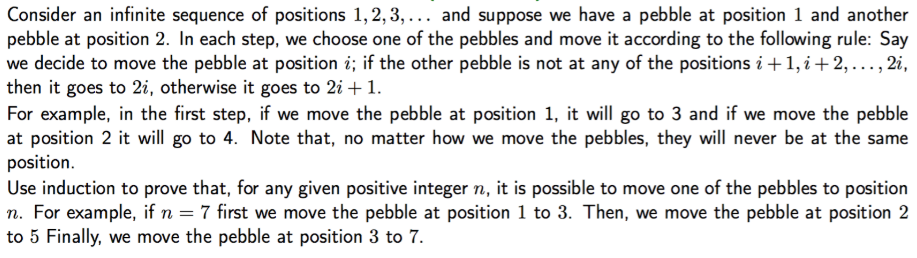
Consider an infinite sequence of positions 1,2,3,... and suppose we have a pebble at position 1 and another pebble at position 2. In each step, we choose one of the pebbles and move it according to the following rule: Say we decide to move the pebble at position i; if the other pebble is not at any of the positions i+1,i+ 2,..., 2i, then it goes to 2i, otherwise it goes to 2i +1 For example, in the first step, if we move the pebble at position 1, it will go to 3 and if we move the pebble at position 2 it will go to 4. Note that, no matter how we move the pebbles, they will never be at the same position Use induction to prove that, for any given positive integer n, it is possible to move one of the pebbles to position n. For example, if n 7 first we move the pebble at position 1 to 3, Then, we move the pebble at position 2 to 5 Finally, we move the pebble at position 3 to 7
Step by Step Solution
There are 3 Steps involved in it

Get step-by-step solutions from verified subject matter experts
 Study Help