







Question: drop down options are mostly percentages Consider the following information for Stocks A, B, and C. The returns on the three stocks, whlle positively correlated,
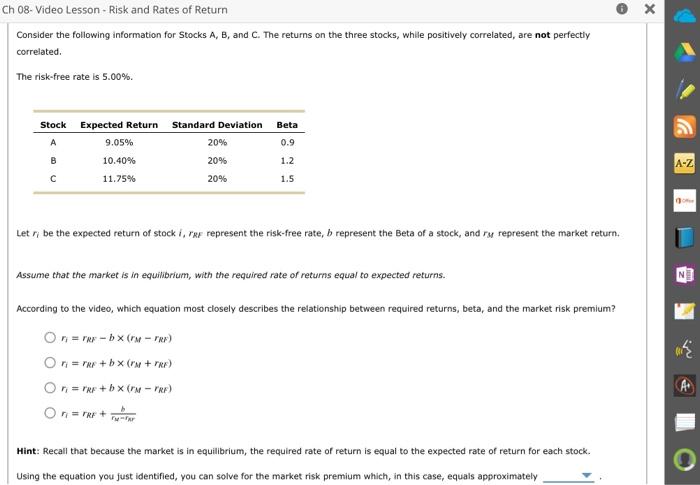
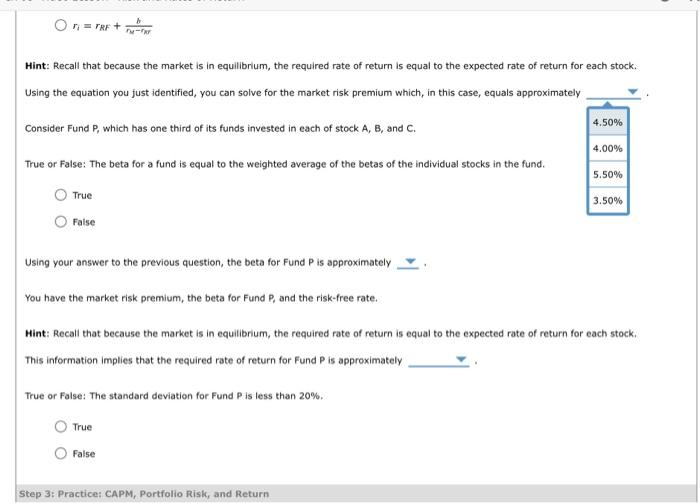
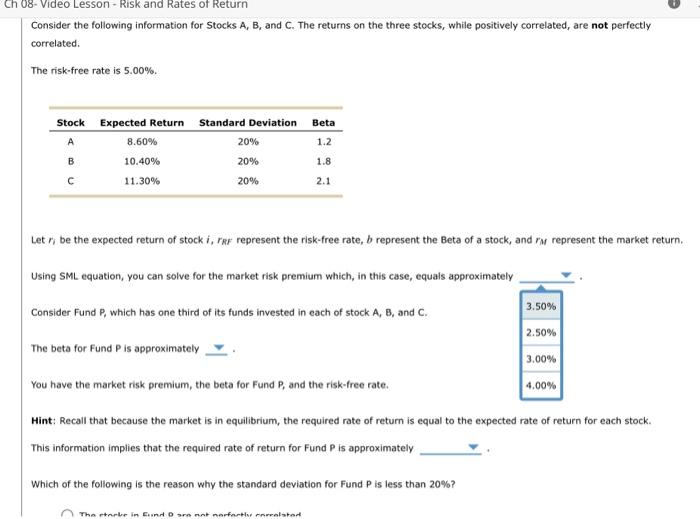
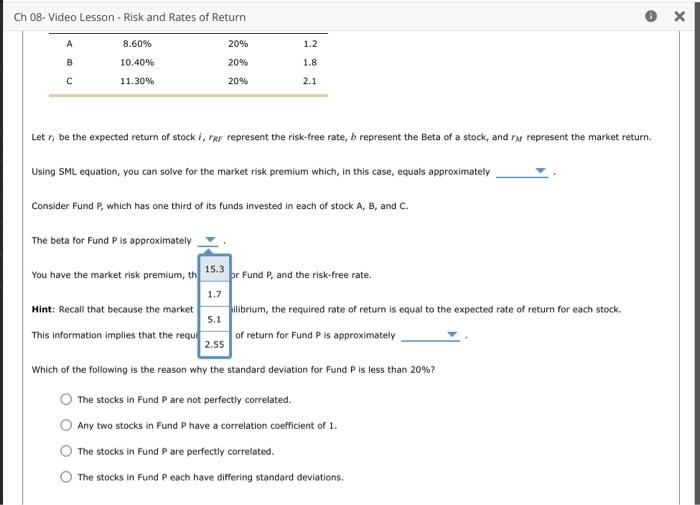
Consider the following information for Stocks A, B, and C. The returns on the three stocks, whlle positively correlated, are not perfectly correlated. The risk-free rate is 5.00%. Let ri be the expected return of stock i,rRF represent the risk-free rate, b represent the Beta of a stock, and rM represent the market return. Assume that the market is in equilibrium, with the required rate of returns equal to expected returns. According to the video, which equation most closely describes the relationship between required returns, beta, and the market risk premium? ri=rRFb(rMrRF)ri=rRF+b(rM+rRF)ri=rRF+b(rMrRF)rr=rRF+rMrMrb Hint: Recall that because the market is in equilibrium, the required rate of return is equal to the expected rate of return for each stock. Using the equation you just identified, you can solve for the market risk premium which, in this case, equals approximately ri=rRF+rMrRFb Hint: Recall that because the market is in equilibrium, the required rate of return is equal to the expected rate of return for each stock. Using the equation you just identified, you can solve for the market risk premium which, in this case, equals approximately Consider Fund P, which has one third of its funds invested in each of stock A,B, and C. True or False: The beta for a fund is equal to the weighted average of the betas of the individual stocks in the fund. True. \begin{tabular}{|l|} \hline 4.50% \\ \hline 4.00% \\ \hline 5.50% \\ \hline 3.50% \\ \hline \end{tabular} Faise Using your answer to the previous question, the beta for Fund P is approximately You have the market risk premium, the beta for Fund P, and the risk-free rate. Hint: Recall that because the market is in equilibrium, the required rate of return is equal to the expected rate of return for each stock. This information implies that the required rate of return for Fund P is approximately True or False: The standard deviation for Fund P is less than 20%. True False Step 3: Practice: CAPM, Portfolio Risk, and Return Consider the following information for Stocks A, B, and C. The returns on the three stocks, while positively correlated, are not perfectly correlated. The risk-free rate is 5.00%. Let ri be the expected return of stock i,rRF represent the risk-free rate, b represent the Beta of a stock, and rM represent the market return. Using SML equation, you can solve for the market risk premium which, in this case, equals approximately Consider Fund P, which has one third of its funds invested in each of stock A,B, and C. The beta for Fund P is approximately You have the market risk premium, the beta for Fund P, and the risk-free rate. Hint: Recall that because the market is in equilibrium, the required rate of return is equal to the expected rate of return for each stock. This information implies that the required rate of return for Fund P is approximately Which of the following is the reason why the standard deviation for Fund P is less than 20% ? Ch 08- Video Lesson - Risk and Rates of Return Let r1 be the expected return of stock i,rRF represent the risk-free rate, b represent the Beta of a stock, and rM represent the market return. Using SML equation, you can solve for the market risk premium which, in this case, equals approximately Consider Fund P, which has one third of its funds invested in each of stock A,B, and C. The beta for Fund P is approximately Which of the following is the reason why the standard deviation for Fund P is less than 20% ? The stocks in Fund P are not perfectly correlated. Any two stocks in Fund P have a correlation coefficient of 1 . The stocks in Fund P are perfectly correlated. The stocks in Fund P each have differing standard deviations. Consider the following information for Stocks A, B, and C. The returns on the three stocks, whlle positively correlated, are not perfectly correlated. The risk-free rate is 5.00%. Let ri be the expected return of stock i,rRF represent the risk-free rate, b represent the Beta of a stock, and rM represent the market return. Assume that the market is in equilibrium, with the required rate of returns equal to expected returns. According to the video, which equation most closely describes the relationship between required returns, beta, and the market risk premium? ri=rRFb(rMrRF)ri=rRF+b(rM+rRF)ri=rRF+b(rMrRF)rr=rRF+rMrMrb Hint: Recall that because the market is in equilibrium, the required rate of return is equal to the expected rate of return for each stock. Using the equation you just identified, you can solve for the market risk premium which, in this case, equals approximately ri=rRF+rMrRFb Hint: Recall that because the market is in equilibrium, the required rate of return is equal to the expected rate of return for each stock. Using the equation you just identified, you can solve for the market risk premium which, in this case, equals approximately Consider Fund P, which has one third of its funds invested in each of stock A,B, and C. True or False: The beta for a fund is equal to the weighted average of the betas of the individual stocks in the fund. True. \begin{tabular}{|l|} \hline 4.50% \\ \hline 4.00% \\ \hline 5.50% \\ \hline 3.50% \\ \hline \end{tabular} Faise Using your answer to the previous question, the beta for Fund P is approximately You have the market risk premium, the beta for Fund P, and the risk-free rate. Hint: Recall that because the market is in equilibrium, the required rate of return is equal to the expected rate of return for each stock. This information implies that the required rate of return for Fund P is approximately True or False: The standard deviation for Fund P is less than 20%. True False Step 3: Practice: CAPM, Portfolio Risk, and Return Consider the following information for Stocks A, B, and C. The returns on the three stocks, while positively correlated, are not perfectly correlated. The risk-free rate is 5.00%. Let ri be the expected return of stock i,rRF represent the risk-free rate, b represent the Beta of a stock, and rM represent the market return. Using SML equation, you can solve for the market risk premium which, in this case, equals approximately Consider Fund P, which has one third of its funds invested in each of stock A,B, and C. The beta for Fund P is approximately You have the market risk premium, the beta for Fund P, and the risk-free rate. Hint: Recall that because the market is in equilibrium, the required rate of return is equal to the expected rate of return for each stock. This information implies that the required rate of return for Fund P is approximately Which of the following is the reason why the standard deviation for Fund P is less than 20% ? Ch 08- Video Lesson - Risk and Rates of Return Let r1 be the expected return of stock i,rRF represent the risk-free rate, b represent the Beta of a stock, and rM represent the market return. Using SML equation, you can solve for the market risk premium which, in this case, equals approximately Consider Fund P, which has one third of its funds invested in each of stock A,B, and C. The beta for Fund P is approximately Which of the following is the reason why the standard deviation for Fund P is less than 20% ? The stocks in Fund P are not perfectly correlated. Any two stocks in Fund P have a correlation coefficient of 1 . The stocks in Fund P are perfectly correlated. The stocks in Fund P each have differing standard deviations
Step by Step Solution
There are 3 Steps involved in it

Get step-by-step solutions from verified subject matter experts
 Study Help