







Question: ECTION 1.3 11. Suppose there is exactly one packet switch between a sending host and a receiving host. The transmission rates between the sending host
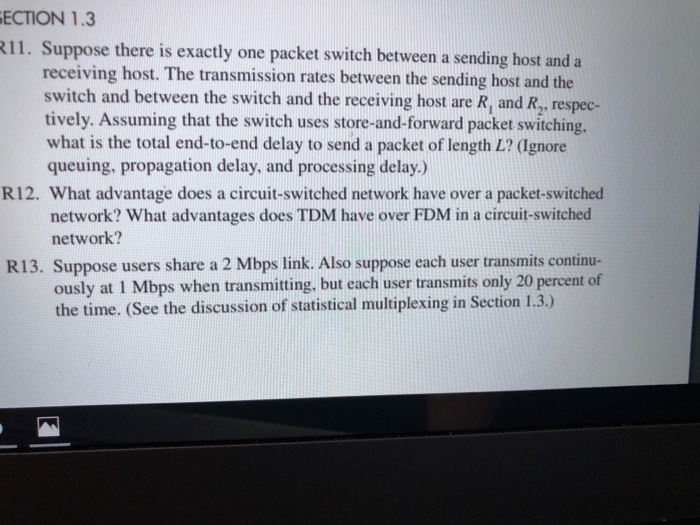
ECTION 1.3 11. Suppose there is exactly one packet switch between a sending host and a receiving host. The transmission rates between the sending host and the switch and between the switch and the receiving host are R, and R,, respec- tively. Assuming that the switch uses store-and-forward packet switching. what is the total end-to-end delay to send a packet of length L? (Ignore queuing, propagation delay, and processing delay.) R12. What advantage does a circuit-switched network have over a packet-switched network? What advantages does TDM have over FDM in a circuit-switched network? R13. Suppose users share a 2 Mbps link. Also suppose each user transmits continu- ously at 1 Mbps when transmitting, but each user transmits only 20 percent of the time. (See the discussion of statistical multiplexing in Section 1.3.)
Step by Step Solution
There are 3 Steps involved in it

Get step-by-step solutions from verified subject matter experts
 Study Help