







Question: For the larger midterm and final case study assignments, your submission should be done in a professional manner, and constructed as if you are a
For the larger midterm and final case study assignments, your submission should be done in a professional manner, and constructed as if you are a consultant providing a solution to the situation. The expected length of your submission is three to five pages, double spaced, using margins. This does not include a cover page or reference list if used
Your submission in these larger cases should follow this format:
Introduction
Present an overview of the key problems and issues in the case.
Provide a thesis statement that summarizes your analysis in one or two sentences.
Background, key facts, and issues
Provide background information, relevant facts, and the most important issues.
Tie to class materials.
Alternatives
Outline two to five possible alternatives certainly not all of them
Discuss the critical constraints.
Explain the strengths and weaknesses of the alternatives.
Proposed solution or Recommend one solution.
Explain why this solution was chosen.
Support this solution with facts and class materials.
Provide personal experiences, if applicable.
Recommendations
Determine and discuss the specific strategies needed to accomplish the proposed solution.
If applicable, define what further information is needed.
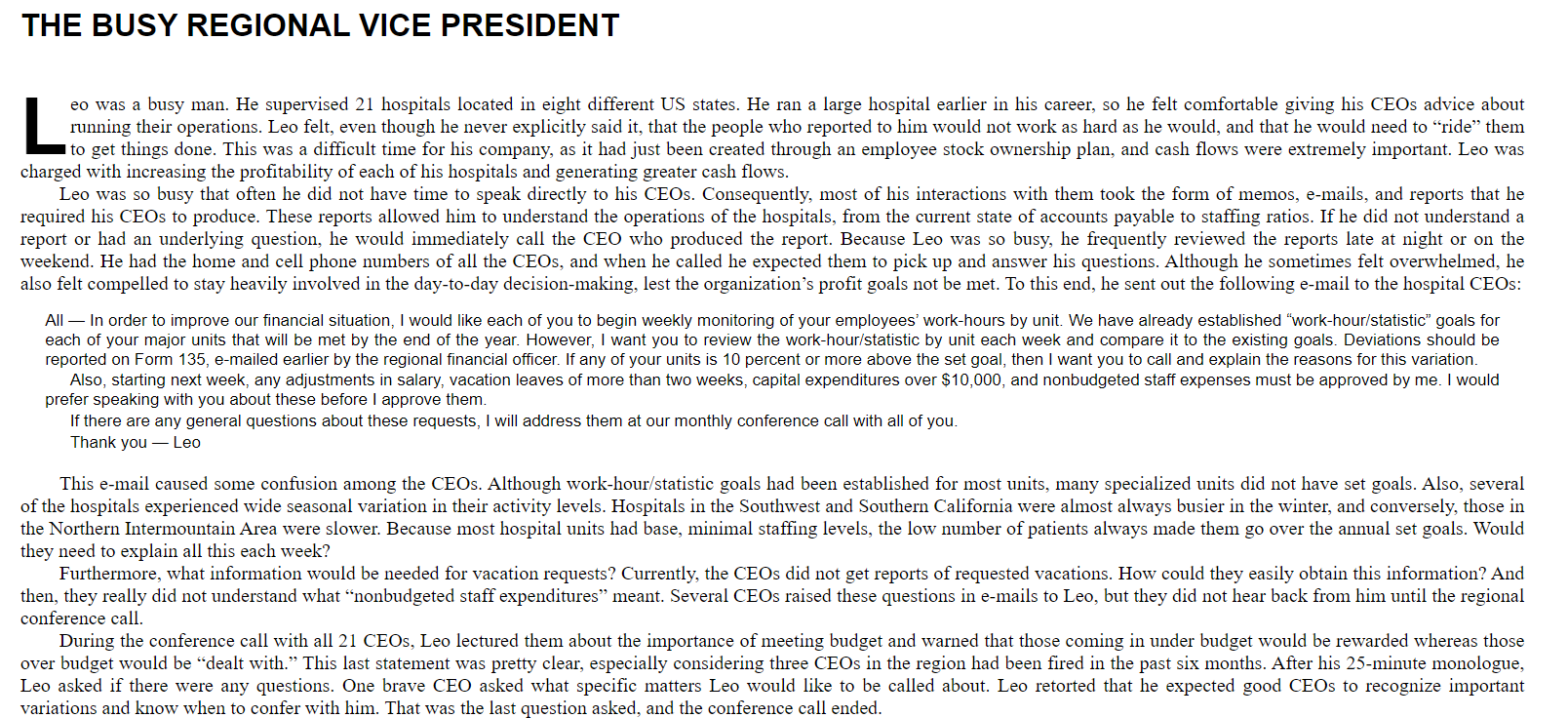
eo was a busy man. He supervised hospitals located in eight different US states. He ran a large hospital earlier in his career, so he felt comfortable giving his CEOs advice about running their operations. Leo felt, even though he never explicitly said it that the people who reported to him would not work as hard as he would, and that he would need to "ride" them to get things done. This was a difficult time for his company, as it had just been created through an employee stock ownership plan, and cash flows were extremely important. Leo was charged with increasing the profitability of each of his hospitals and generating greater cash flows.
Leo was so busy that often he did not have time to speak directly to his CEOs. Consequently, most of his interactions with them took the form of memos, emails, and reports that he required his CEOs to produce. These reports allowed him to understand the operations of the hospitals, from the current state of accounts payable to staffing ratios. If he did not understand a report or had an underlying question, he would immediately call the CEO who produced the report. Because Leo was so busy, he frequently reviewed the reports late at night or on the weekend. He had the home and cell phone numbers of all the CEOs, and when he called he expected them to pick up and answer his questions. Although he sometimes felt overwhelmed, he also felt compelled to stay heavily involved in the daytoday decisionmaking, lest the organization's profit goals not be met. To this end, he sent out the following email to the hospital CEOs:
All In order to improve our financial situation, I would like each of you to begin weekly monitoring of your employees' workhours by unit. We have already established "workhourstatistic goals for each of your major units that will be met by the end of the year. However, I want you to review the workhourstatistic by unit each week and compare it to the existing goals. Deviations should be reported on Form emailed earlier by the regional financial officer. If any of your units is percent or more above the set goal, then I want you to call and explain the reasons for this variation.
Also, starting next week, any adjustments in salary, vacation leaves of more than two weeks, capital expenditures over $ and nonbudgeted staff expenses must be approved by me I would prefer speaking with you about these before I approve them.
If there are any general questions about these requests, I will address them at our monthly conference call with all of you.
Thank you Leo
This email caused some confusion among the CEOs. Although workhourstatistic goals had been established for most units, many specialized units did not have set goals. Also, several of the hospitals experienced wide seasonal variation in their activity levels. Hospitals in the Southwest and Southern California were almost always busier in the winter, and conversely, those in the Northern Intermountain Area were slower. Because most hospital units had base, minimal staffing levels, the low number of patients always made them go over the annual set goals. Would they need to explain all this each week?
Furthermore, what information would be needed for vacation requests? Currently, the CEOs did not get reports of requested vacations. How could they easily obtain this information? And then, they really did not understand what "nonbudgeted staff expenditures" meant. Several CEOs raised these questions in emails to Leo, but they did not hear back from him until the regional conference call.
During the conference call with all CEOs, Leo lectured them about the importance of meeting budget and warned that those coming in under budget would be reward Leo was busy, but soon
Step by Step Solution
There are 3 Steps involved in it
1 Expert Approved Answer
Step: 1 Unlock

Question Has Been Solved by an Expert!
Get step-by-step solutions from verified subject matter experts
Step: 2 Unlock
Step: 3 Unlock
 Study Help