Question: HELP ME FINISH MY EA PROJECT! Im not sure if I covered everything since the assignment was updated. ASSIGNMENT: You are the new chief architect
HELP ME FINISH MY EA PROJECT! Im not sure if I covered everything since the assignment was updated.
ASSIGNMENT:
You are the new chief architect for WOU. You will use the EA3 framework and methodology (from the text). Do not be concerned (yet) with governance. Your first assignment is to define the framework for documenting our current architecture.
- Document the WOU mission statement and key objectives under the core themes for the university. Organize this in a way that will make it easy to reference these objectives - use a spreadsheet with unique IDs for each objective.
- Determine the primary lines of business for WOU. Determine which aspects of the University's mission apply to each LOB. Indicate which objective belongs in each LOB together with a description of the LOB on the spreadsheet.
Key resources describing WOU's strategic layer:
- Forward Together 2017-2023: WOUs Strategic Framework (Links to an external site.)
- WOU Organizational Chart (Links to an external site.)
Guidance on defining lines of business (LOBs) in your architectural framework:
- in the university's administrative structure, individuals with the title of Dean are typically in charge of a distinct LOB,
- not every individual responsible for an LOB will have the title of Dean, but they will appear at a similar level on the university's org chart,
- not everyone at the Dean level in the org chart will run their own LOB,
- it is possible for one individual to be responsible for more than one LOB at a time.
To define an LOB you need to:
- name it,
- define its function(s), products and services,
- provide that subset of the University's goals and objectives cataloged in part 1 that apply to or are fulfilled by the LOB.
When you are finished defining LOBs, you should have every goal or objective documented assigned to at least one LOB. It is okay for multiple LOBs to contribute to a single goal/objective.
This is a group assignment so it is important for everyone in each group to contribute to and concur to the final submission. If agreement within a group cannot be reached, an emailed explanation of the disagreement should be sent.
Submit you framework as a single spreadsheet.
MISSION STATEMENT:
MISSION STATEMENT IN QUESTION:
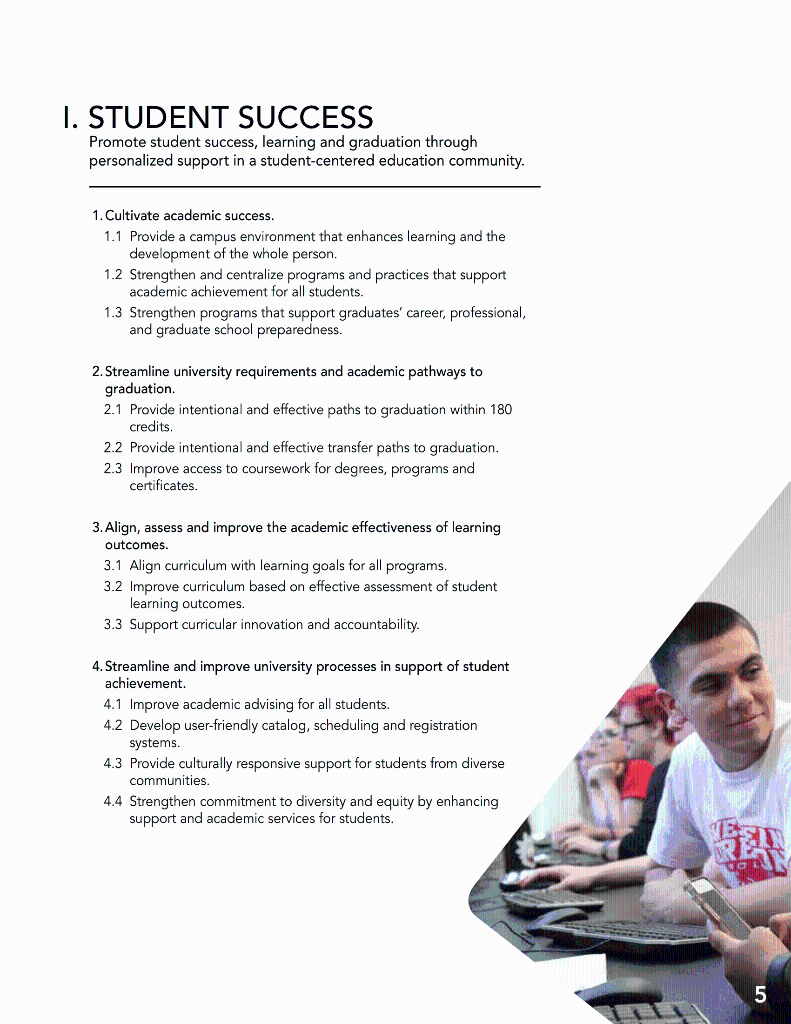
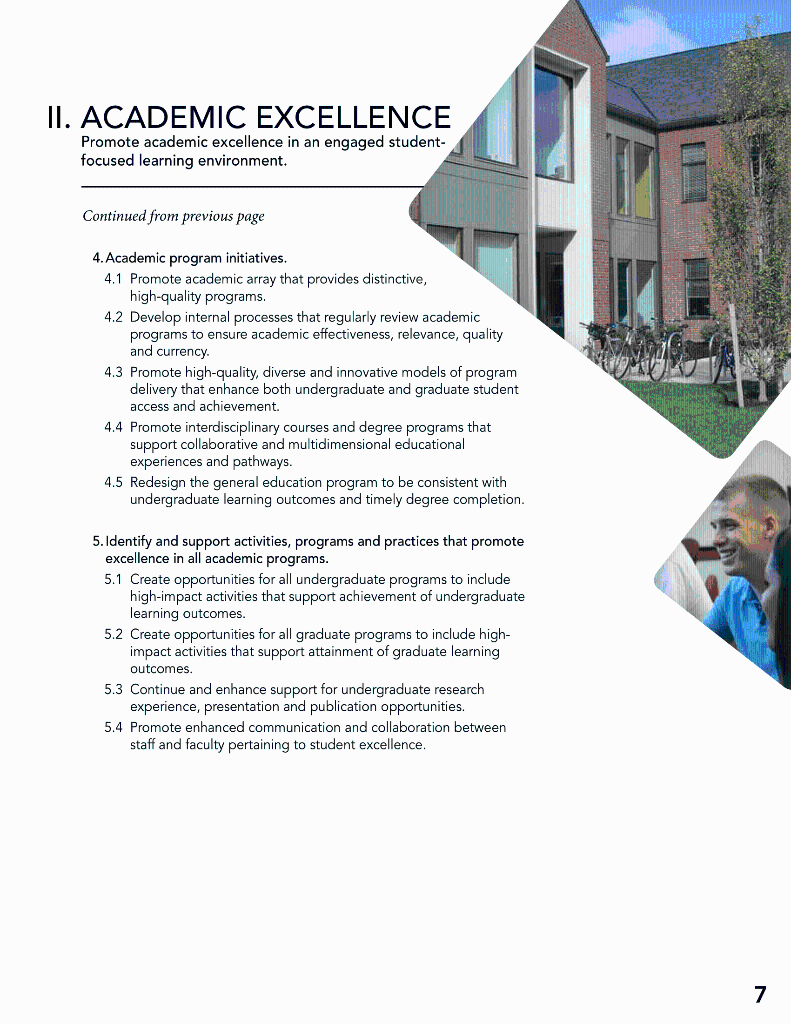
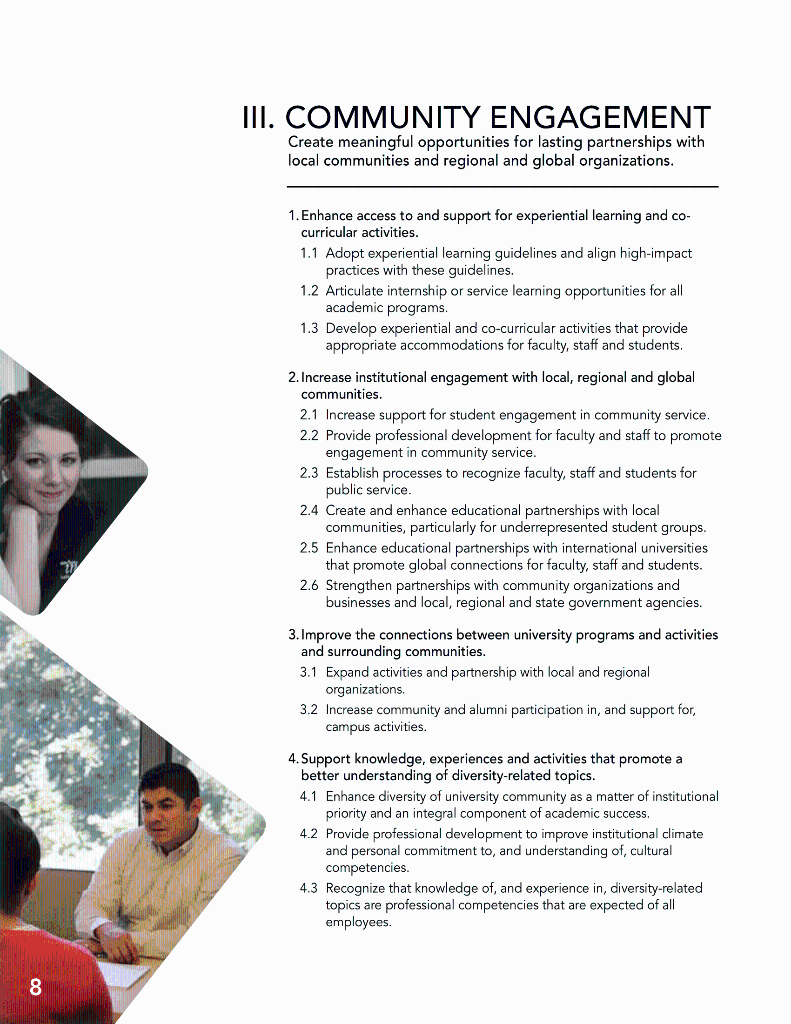
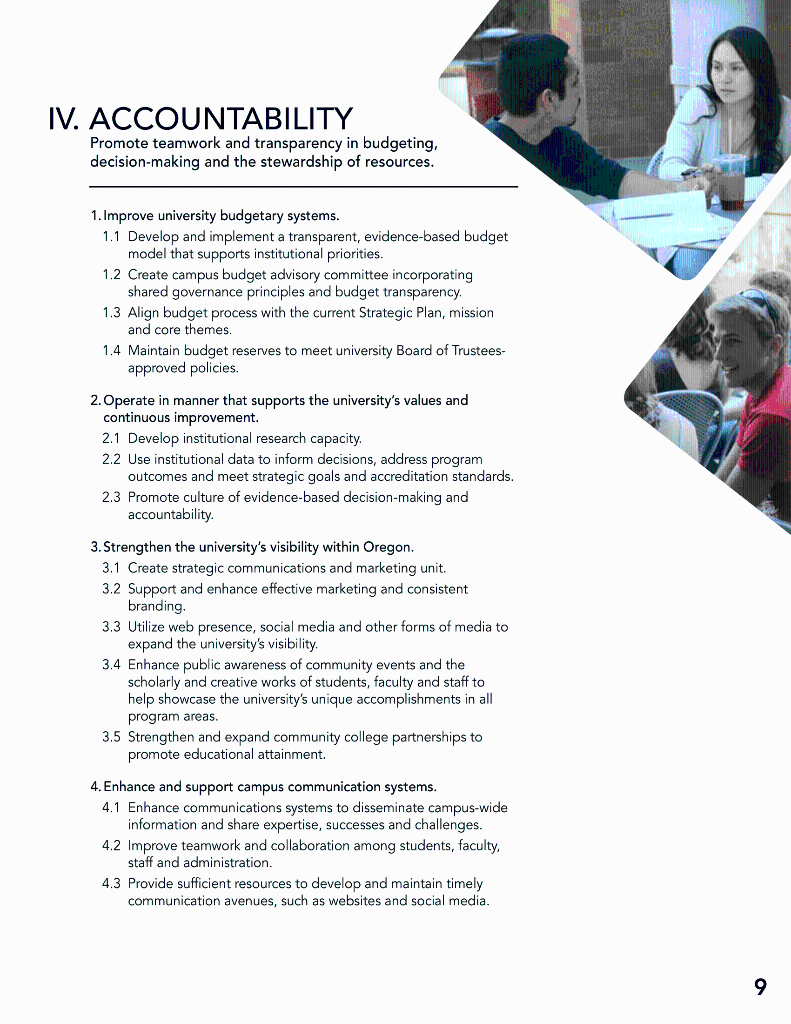
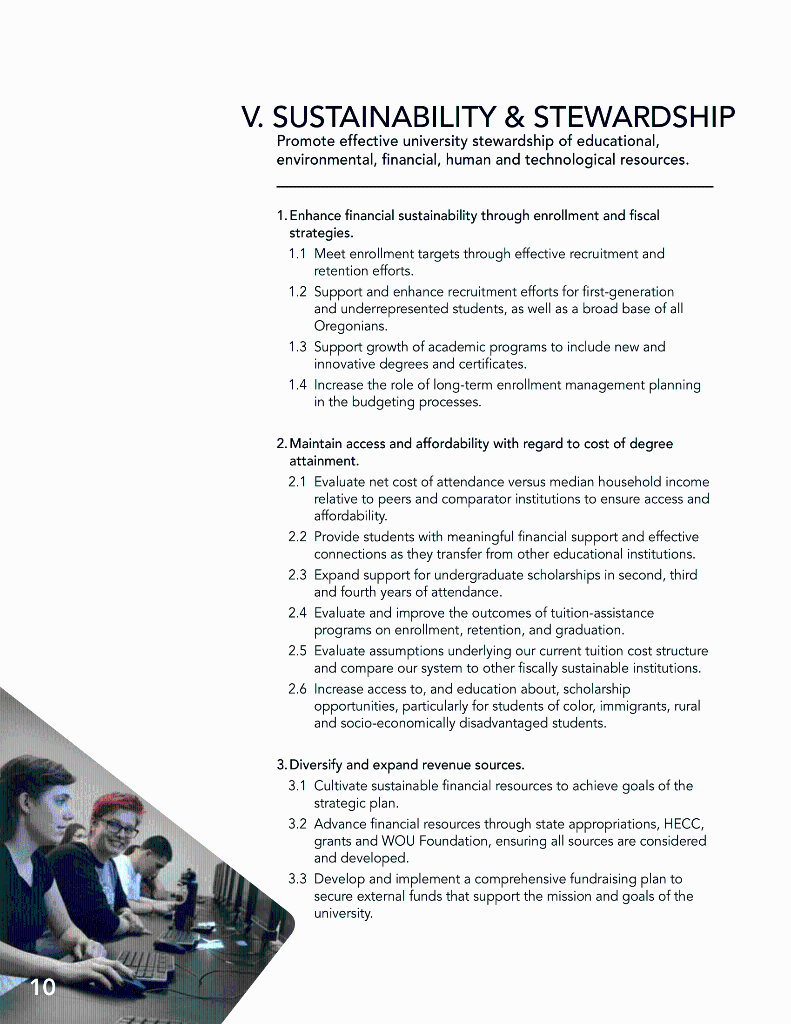
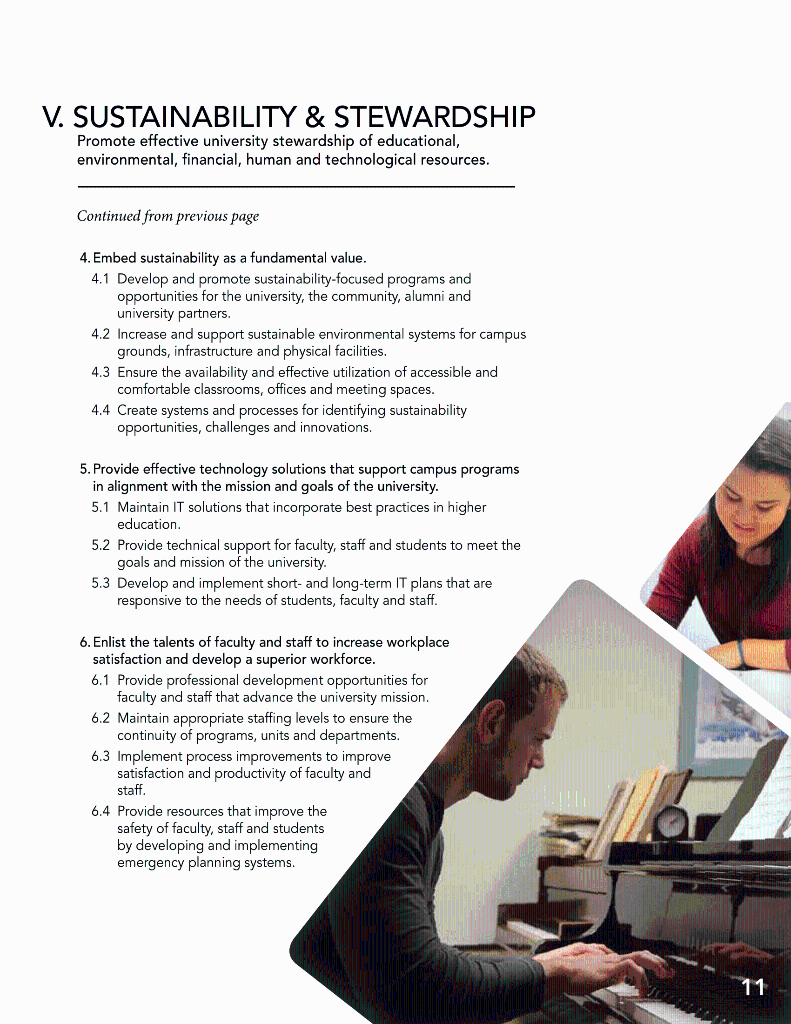
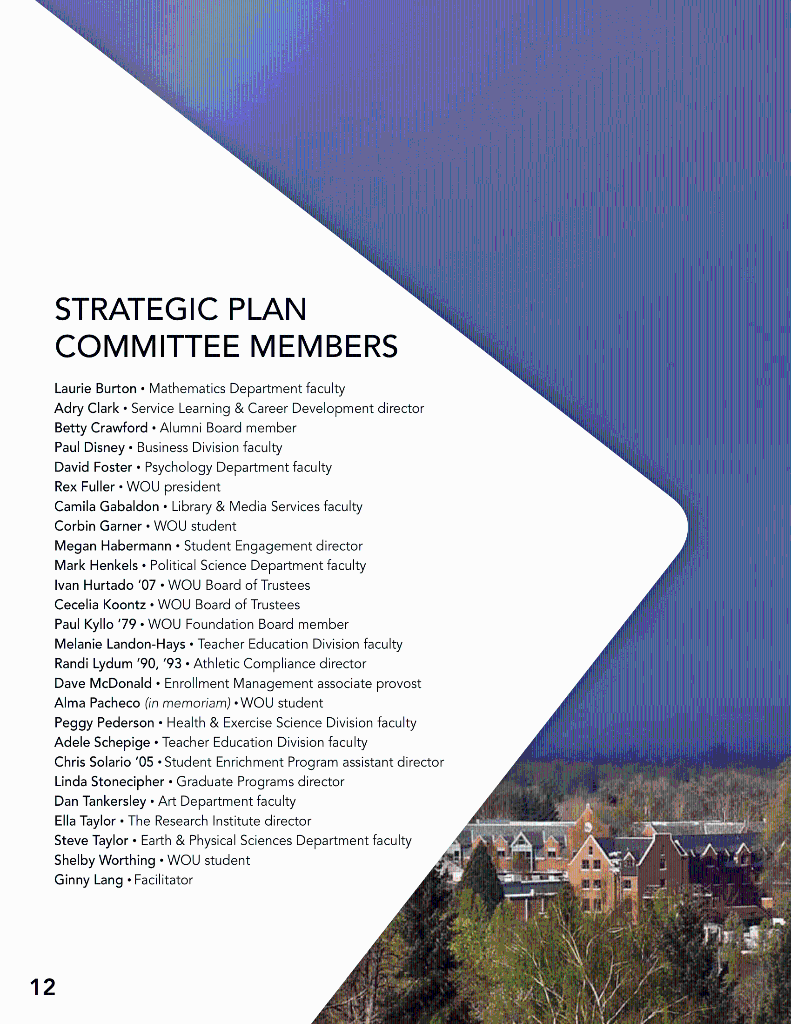
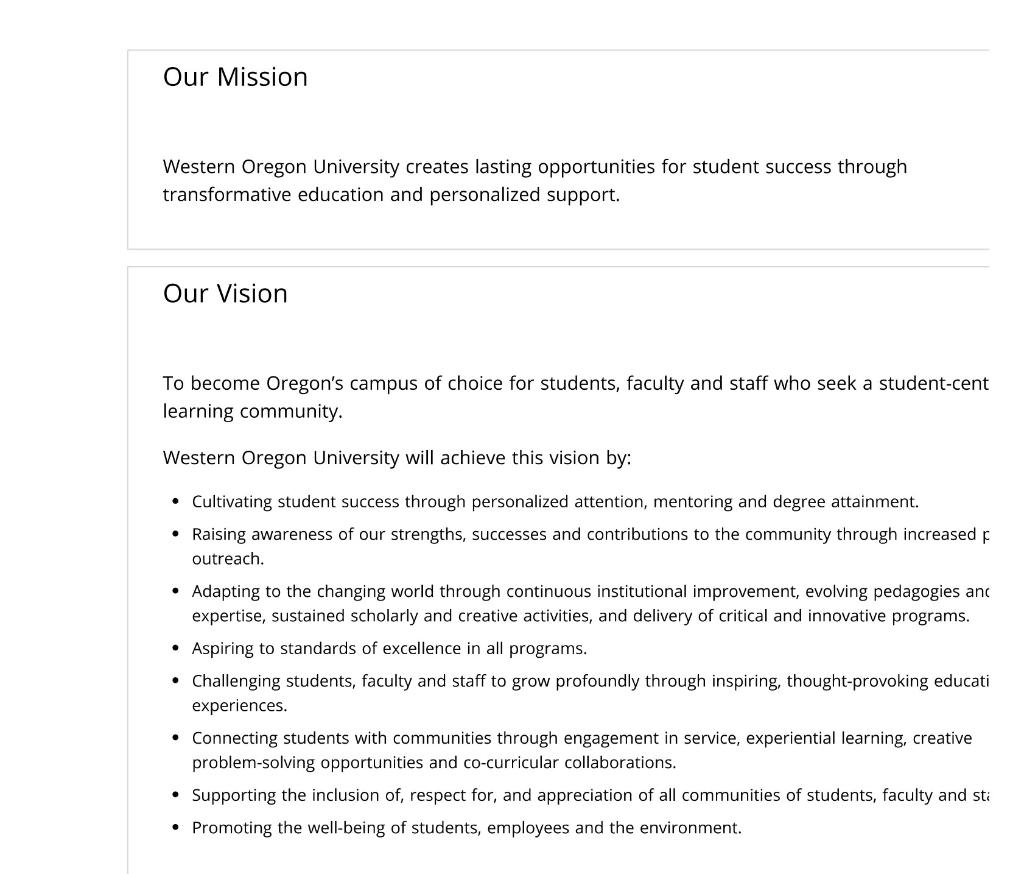
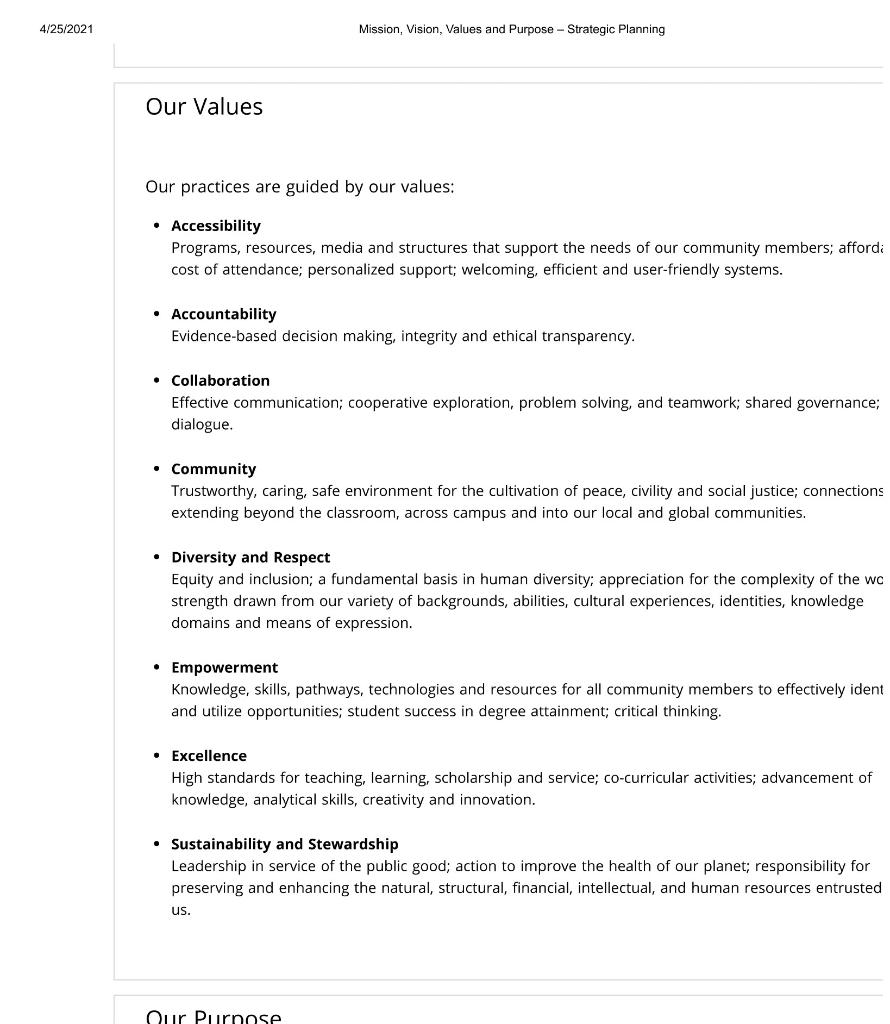
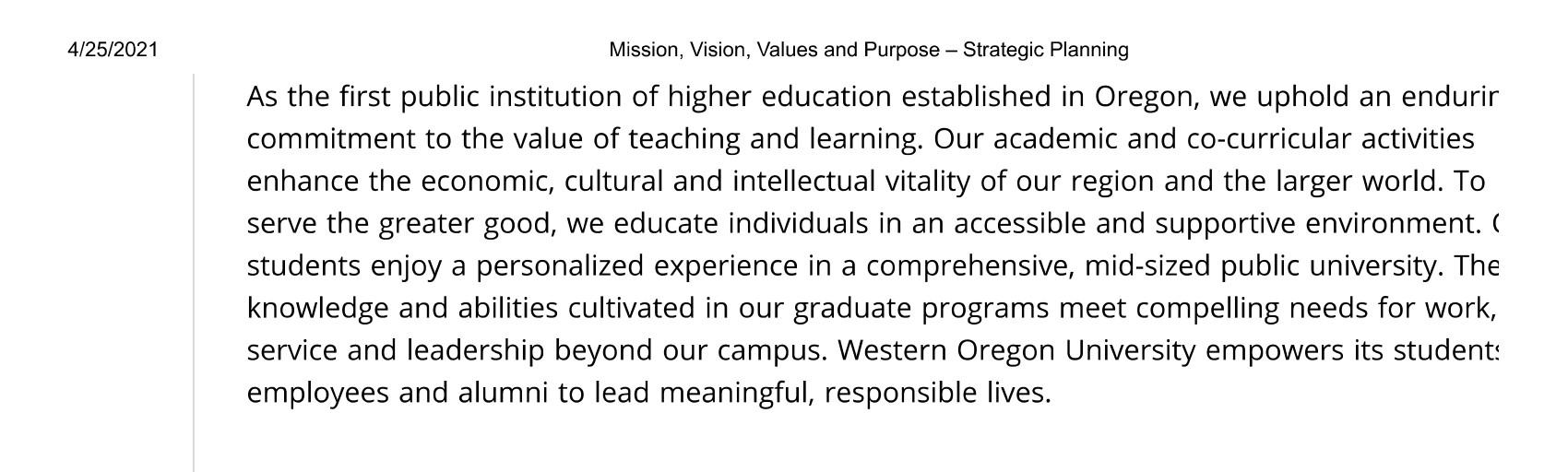
CHART:
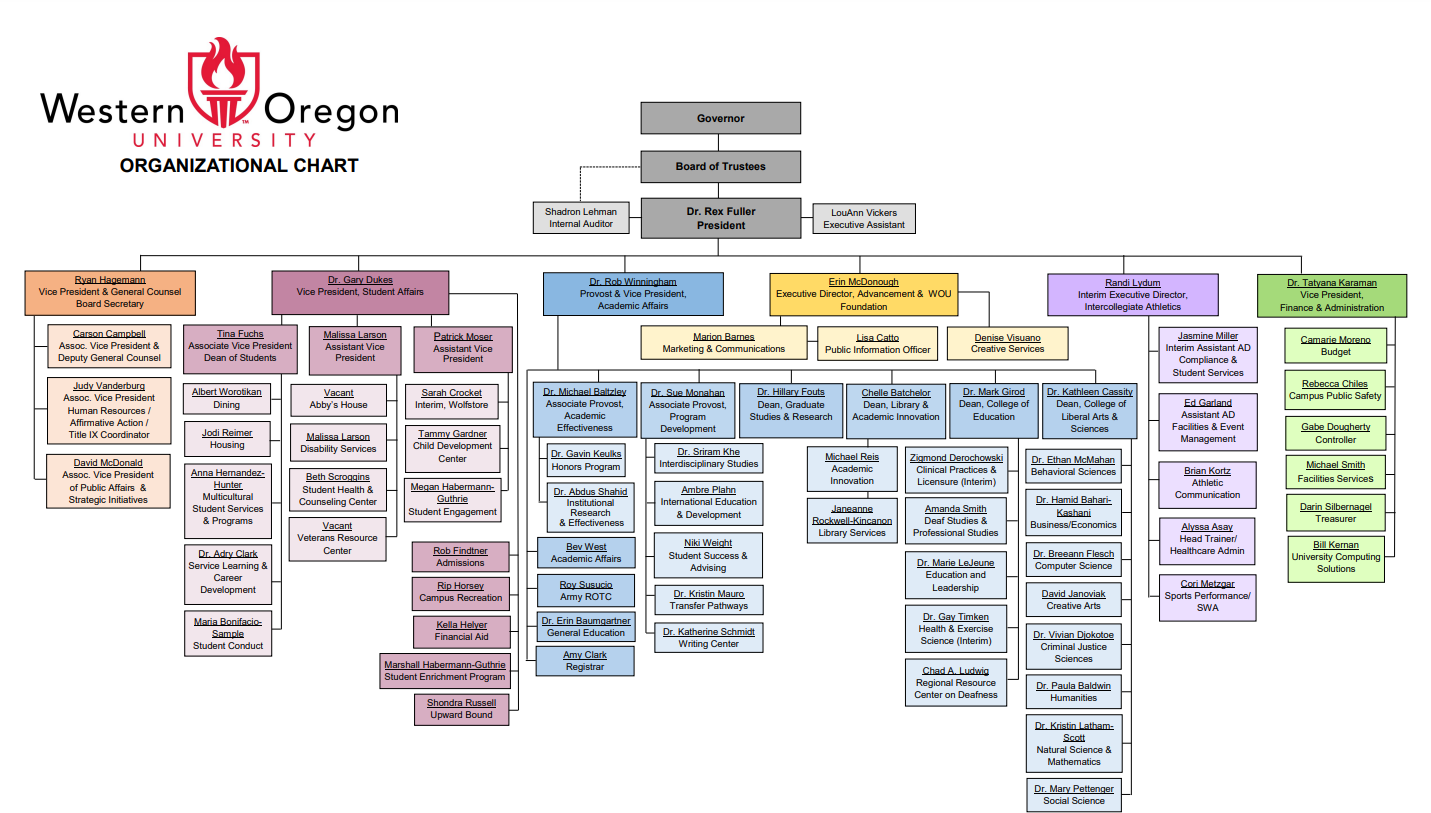
MISSION, VISION, VALUES & PURPOSE OUR MISSION Western Oregon University creates lasting opportunities for student success through transformative education and personalized support. OUR VISION To become Oregon's campus of choice for students, faculty and staff who seek a student-centered learning community. Western Oregon University will achieve this vision by: Cultivating student success through personalized attention, mentoring and degree attainment Raising awareness of our strengths, successes and contributions to the community through increased public outreach. Adapting to the changing world through continuous institutional improvement, evolving pedagogies and expertise, sustained scholarly and creative activities, and delivery of critical and innovative programs. Aspiring to standards of excellence in all programs. Challenging students, faculty and staff to grow profoundly through inspiring, thought-provoking educational experiences. Connecting students with communities through engagement in service, experiential learning, creative problem-solving opportunities and co-curricular collaborations. Supporting the inclusion of, respect for, and appreciation of all communities of students, faculty and staff. Promoting the well-being of students, employees and the environment. OUR VALUES Our practices are guided by our values: Accessibility Programs, resources, media and structures that support the needs of our community members; affordable cost of attendance; personalized support; welcoming, efficient and user-friendly systems. Accountability Evidence-based decision making, integrity and ethical transparency Collaboration Effective communication; cooperative exploration, problem solving, and teamwork; shared governance; dialogue. 2 MISSION, VISION, VALUES & PURPOSE Continued from previous page Community Trustworthy, caring, safe environment for the cultivation of peace, civility and social justice; connections extending beyond the classroom, across campus and into our local and global communities. Diversity and respect Equity and inclusion; a fundamental basis in human diversity; appreciation for the complexity of the world; strength drawn from our variety of backgrounds, abilities, cultural experiences, identities, knowledge domains and means of expression. Empowerment Knowledge, skills, pathways, technologies and resources for all community members to effectively identify and utilize opportunities; student success in degree attainment; critical thinking. Excellence High standards for teaching, learning, scholarship and service; co- curricular activities; advancement of knowledge, analytical skills, creativity and innovation. Sustainability and stewardship Leadership in service of the public good; action to improve the health of our planet; responsibility for preserving and enhancing the natural, structural, financial, intellectual and human resources entrusted to us. OUR PURPOSE As the first public institution of higher education established in Oregon, we uphold an enduring commitment to the value of teaching and learning. Our academic and co-curricular activities enhance the economic, cultural and intellectual vitality of our region and the larger world. To serve the greater good, we educate individuals in an accessible and supportive environment. Our undergraduate students enjoy a personalized experience in a comprehensive, mid-sized public university. The knowledge and abilities cultivated in our graduate programs meet compelling needs for work, service and leadership beyond our campus. Western Oregon University empowers its students, employees and alumni to lead meaningful, responsible lives. 3 1. STUDENT SUCCESS Promote student success, learning and graduation through personalized support in a student-centered education community. 1. Cultivate academic success. 1.1 Provide a campus environment that enhances learning and the development of the whole person. 1.2 Strengthen and centralize programs and practices that support academic achievement for all students. 1.3 Strengthen programs that support graduates' career, professional, and graduate school preparedness. 2. Streamline university requirements and academic pathways to graduation 2.1 Provide intentional and effective paths to graduation within 180 credits 2.2 Provide intentional and effective transfer paths to graduation. 2.3 Improve access to coursework for degrees, programs and certificates. 3. Align, assess and improve the academic effectiveness of learning outcomes. 3.1 Align curriculum with learning goals for all programs. 3.2 Improve curriculum based on effective assessment of student learning outcomes. 3.3 Support curricular innovation and accountability. 4. Streamline and improve university processes in support of student achievement. 4.1 Improve academic advising for all students. 4.2 Develop user-friendly catalog, scheduling and registration systems. 4.3 Provide culturally responsive support for students from diverse communities. 4.4 Strengthen commitment to diversity and equity by enhancing support and academic services for students. f 5 II. ACADEMIC EXCELLENCE Promote academic excellence in an engaged student- focused learning environment. 1. Student initiatives. 1.1 Ensure appropriate class sizes to maximize faculty student and student-student interactions. 1.2 Increase support for programs and activities that demonstrate and inspire academic excellence. 1.3 Provide financial support for student conference presentations and other student activities that showcase the university's educational practices and unique accomplishments. 1.4 Implement student orientation programs that reflect diverse linguistic and cultural needs as well as differences in preparation and background. 2. Faculty initiatives. 2.1 Attract and retain faculty who reflect the diversity of our students and are excellent teachers and leaders in scholarly and creative pursuits within their respective fields of expertise. 2.2 Increase faculty development support for scholarly and creative pursuits as well as innovative curricular design and delivery efforts. 2.3 Provide competitive salaries and supportive working conditions that improve faculty recruitment and retention. 2.4 Increase faculty development support to implement culturally responsive pedagogy and curriculum. 3. Staff initiatives. 3.1 Attract and retain staff members who reflect the diversity of our students, excel in their areas of expertise and support academic excellence. 3.2 Increase professional development opportunities for staff in support of academic excellence and student achievement. 3.3 Provide competitive salaries and supportive working conditions that improve staff recruitment and retention. 3.4 Increase support for professional development for staff to provide culturally and linguistically responsive services. II. ACADEMIC EXCELLENCE Promote academic excellence in an engaged student- focused learning environment. Continued from previous page 4. Academic program initiatives. 4.1 Promote academic array that provides distinctive, high-quality programs. 4.2 Develop internal processes that regularly review academic programs to ensure academic effectiveness, relevance, quality and currency 4.3 Promote high-quality, diverse and innovative models of program delivery that enhance both undergraduate and graduate student access and achievement. 4.4 Promote interdisciplinary courses and degree programs that support collaborative and multidimensional educational experiences and pathways. 4.5 Redesign the general education program to be consistent with undergraduate learning outcomes and timely degree completion. 5. Identify and support activities, programs and practices that promote excellence in all academic programs. 5.1 Create opportunities for all undergraduate programs to include high-impact activities that support achievement of undergraduate learning outcomes. 5.2 Create opportunities for all graduate programs to include high- impact activities that support attainment of graduate learning outcomes. 5.3 Continue and enhance support for undergraduate research experience, presentation and publication opportunities. 5.4 Promote enhanced communication and collaboration between staff and faculty pertaining to student excellence. 7 III. COMMUNITY ENGAGEMENT Create meaningful opportunities for lasting partnerships with local communities and regional and global organizations. 1. Enhance access to and support for experiential learning and co- curricular activities. 1.1 Adopt experiential learning guidelines and align high-impact practices with these guidelines. 1.2 Articulate internship or service learning opportunities for all academic programs. 1.3 Develop experiential and co-curricular activities that provide appropriate accommodations for faculty, staff and students. 2. Increase institutional engagement with local, regional and global communities. 2.1 Increase support for student engagement in community service. 2.2 Provide professional development for faculty and staff to promote engagement in community service. 2.3 Establish processes to recognize faculty, staff and students for public service. 2.4 Create and enhance educational partnerships with local communities, particularly for underrepresented student groups. 2.5 Enhance educational partnerships with international universities that promote global connections for faculty, staff and students. 2.6 Strengthen partnerships with community organizations and businesses and local, regional and state government agencies. 3. Improve the connections between university programs and activities and surrounding communities. 3.1 Expand activities and partnership with local and regional organizations 3.2 Increase community and alumni participation in, and support for, campus activities. 4. Support knowledge, experiences and activities that promote a better understanding of diversity-related topics. 4.1 Enhance diversity of university community as a matter of institutional priority and an integral component of academic success. 4.2 Provide professional development to improve institutional climate and personal commitment to, and understanding of, cultural competencies. 4.3 Recognize that knowledge of, and experience in, diversity-related topics are professional competencies that are expected of all employees. 8 IV. ACCOUNTABILITY Promote teamwork and transparency in budgeting, decision-making and the stewardship of resources. 1. Improve university budgetary systems. 1.1 Develop and implement a transparent, evidence-based budget model that supports institutional priorities. 1.2 Create campus budget advisory committee incorporating shared governance principles and budget transparency. 1.3 Align budget process with the current Strategic Plan, mission and core themes. 1.4 Maintain budget reserves to meet university Board of Trustees- approved policies. 2. Operate in manner that supports the university's values and continuous improvement. 2.1 Develop institutional research capacity. 2.2 Use institutional data to inform decisions, address program outcomes and meet strategic goals and accreditation standards. 2.3 Promote culture of evidence-based decision-making and accountability 3. Strengthen the university's visibility within Oregon. 3.1 Create strategic communications and marketing unit. 3.2 Support and enhance effective marketing and consistent branding 3.3 Utilize web presence, social media and other forms of media to expand the university's visibility 3.4 Enhance public awareness of community events and the scholarly and creative works of students, faculty and staff to help showcase the university's unique accomplishments in all program areas. 3.5 Strengthen and expand community college partnerships to promote educational attainment. 4. Enhance and support campus communication systems. 4.1 Enhance communications systems to disseminate campus-wide information and share expertise, successes and challenges. 4.2 Improve teamwork and collaboration among students, faculty, staff and administration. 4.3 Provide sufficient resources to develop and maintain timely communication avenues, such as websites and social media. 9 V. SUSTAINABILITY & STEWARDSHIP Promote effective university stewardship of educational, environmental, financial, human and technological resources. 1. Enhance financial sustainability through enrollment and fiscal strategies. 1.1 Meet enrollment targets through effective recruitment and retention efforts. 1.2 Support and enhance recruitment efforts for first-generation and underrepresented students, as well as a broad base of all Oregonians. 1.3 Support growth of academic programs to include new and innovative degrees and certificates. 1.4 Increase the role of long-term enrollment management planning in the budgeting processes. 2. Maintain access and affordability with regard to cost of degree attainment. 2.1 Evaluate net cost of attendance versus median household income relative to peers and comparator institutions to ensure access and affordability. 2.2 Provide students with meaningful financial support and effective connections as they transfer from other educational institutions. 2.3 Expand support for undergraduate scholarships in second, third and fourth years of attendance. 2.4 Evaluate and improve the outcomes of tuition-assistance programs on enrollment, retention, and graduation. 2.5 Evaluate assumptions underlying our current tuition cost structure and compare our system to other fiscally sustainable institutions. 2.6 Increase access to, and education about, scholarship opportunities, particularly for students of color, immigrants, rural and socio-economically disadvantaged students. 3. Diversify and expand revenue sources. 3.1 Cultivate sustainable financial resources to achieve goals of the strategic plan. 3.2 Advance financial resources through state appropriations, HECC, grants and WOU Foundation, ensuring all sources are considered and developed 3.3 Develop and implement a comprehensive fundraising plan to secure external funds that support the mission and goals of the university 10 V. SUSTAINABILITY & STEWARDSHIP Promote effective university stewardship of educational, environmental, financial, human and technological resources. Continued from previous page 4. Embed sustainability as a fundamental value. 4.1 Develop and promote sustainability-focused programs and opportunities for the university, the community, alumni and university partners. 4.2 Increase and support sustainable environmental systems for campus grounds, infrastructure and physical facilities, 4.3 Ensure the availability and effective utilization of accessible and comfortable classrooms, offices and meeting spaces. 4.4 Create systems and processes for identifying sustainability opportunities, challenges and innovations. 5. Provide effective technology solutions that support campus programs in alignment with the mission and goals of the university. 5.1 Maintain IT solutions that incorporate best practices in higher education. 5.2 Provide technical support for faculty, staff and students to meet the goals and mission of the university. 5.3 Develop and implement short- and long-term IT plans that are responsive to the needs of students, faculty and staff. 6. Enlist the talents of faculty and staff to increase workplace satisfaction and develop a superior workforce. 6.1 Provide professional development opportunities for faculty and staff that advance the university mission. 6.2 Maintain appropriate staffing levels to ensure the continuity of programs, units and departments. 6.3 Implement process improvements to improve satisfaction and productivity of faculty and staff. 6.4 Provide resources that improve the safety of faculty, staff and students by developing and implementing emergency planning systems. 11 STRATEGIC PLAN COMMITTEE MEMBERS Laurie Burton. Mathematics Department faculty Adry Clark. Service Learning & Career Development director Betty Crawford . Alumni Board member Paul Disney. Business Division faculty David Foster. Psychology Department faculty Rex Fuller. WOU president Camila Gabaldon Library & Media Services faculty Corbin Garner. WOU student Megan Habermann. Student Engagement director Mark Henkels. Political Science Department faculty Ivan Hurtado '07. WOU Board of Trustees Cecelia Koontz. WOU Board of Trustees Paul Kyllo '79. WOU Foundation Board member Melanie Landon-Hays. Teacher Education Division faculty Randi Lydum '90, '93. Athletic Compliance director Dave McDonald Enrollment Management associate provost Alma Pacheco (in memoriam). WOU student Peggy Pederson. Health & Exercise Science Division faculty Adele Schepige. Teacher Education Division faculty Chris Solario '05. Student Enrichment Program assistant director Linda Stonecipher Graduate Programs director Dan Tankersley. Art Department faculty Ella Taylor The Research Institute director Steve Taylor. Earth & Physical Sciences Department faculty Shelby Worthing. WOU student Ginny Lang. Facilitator 12 Our Mission Western Oregon University creates lasting opportunities for student success through transformative education and personalized support. Our Vision To become Oregon's campus of choice for students, faculty and staff who seek a student-cent learning community. Western Oregon University will achieve this vision by: . Cultivating student success through personalized attention, mentoring and degree attainment. Raising awareness of our strengths, successes and contributions to the community through increased p outreach Adapting to the changing world through continuous institutional improvement, evolving pedagogies and expertise, sustained scholarly and creative activities, and delivery of critical and innovative programs. Aspiring to standards of excellence in all programs. Challenging students, faculty and staff to grow profoundly through inspiring, thought-provoking educati experiences. Connecting students with communities through engagement in service, experiential learning, creative problem-solving opportunities and co-curricular collaborations. Supporting the inclusion of, respect for, and appreciation of all communities of students, faculty and sti Promoting the well-being of students, employees and the environment. 4/25/2021 Mission, Vision, Values and Purpose - Strategic Planning Our Values Our practices are guided by our values: Accessibility Programs, resources, media and structures that support the needs of our community members; affordi cost of attendance; personalized support; welcoming, efficient and user-friendly systems. Accountability Evidence-based decision making, integrity and ethical transparency. Collaboration Effective communication; cooperative exploration, problem solving, and teamwork; shared governance; dialogue Community Trustworthy, caring, safe environment for the cultivation of peace, civility and social justice; connections extending beyond the classroom, across campus and into our local and global communities. Diversity and Respect Equity and inclusion; a fundamental basis in human diversity, appreciation for the complexity of the wc strength drawn from our variety of backgrounds, abilities, cultural experiences, identities, knowledge domains and means of expression. Empowerment Knowledge, skills, pathways, technologies and resources for all community members to effectively ident and utilize opportunities; student success in degree attainment; critical thinking. Excellence High standards for teaching, learning, scholarship and service; co-curricular activities, advancement of knowledge, analytical skills, creativity and innovation. Sustainability and Stewardship Leadership in service of the public good; action to improve the health of our planet; responsibility for preserving and enhancing the natural, structural, financial, intellectual, and human resources entrusted us. Our Purpose 4/25/2021 Mission, Vision, Values and Purpose - Strategic Planning As the first public institution of higher education established in Oregon, we uphold an endurir commitment to the value of teaching and learning. Our academic and co-curricular activities enhance the economic, cultural and intellectual vitality of our region and the larger world. To serve the greater good, we educate individuals in an accessible and supportive environment. ( students enjoy a personalized experience in a comprehensive, mid-sized public university. The knowledge and abilities cultivated in our graduate programs meet compelling needs for work, service and leadership beyond our campus. Western Oregon University empowers its student: employees and alumni to lead meaningful, responsible lives. Western JL. Oregon Governor UNIVERSITY ORGANIZATIONAL CHART Board of Trustees Shadron Lehman Internal Auditor Dr. Rex Fuller President LouAnn Vickers Executive Assistant Ryan Hagemann Vice President & General Counsel Board Secretary Dr. Gary Dukes Vice President, Student Affairs Dr. Rob Winningham Provost & Vice President, Academic Affairs Erin McDonough Executive Director, Advancement & WOU Foundation Randi Lydum Interim Executive Director, Intercollegiate Athletics Dr. Tatyana Karaman Vice President, Finance & Administration Carson Campbell Assoc. Vice President & Deputy General Counsel Tina Fuchs Associate Vice President Dean of Students Malissa Larson Assistant Vice President Patrick Moser Assistant Vice Marion Barnes Marketing & Communications Lisa Catto Public Information Officer Denise Visuano Creative Services Jasmine Miller Interim Assistant AD Compliance & Student Services Camarie Moreno Budget President Albert Worotikan Dining Vacant Abby's House Sarah Crocket Interim, Wolfstore Rebecca Chiles Campus Public Safety Judy Vanderburg Assoc. Vice President Human Resources/ Affirmative Action / Title IX Coordinator Dr. Michael Baltzley Associate Provost, Academic Effectiveness Dr. Sue Monahan Associate Provost, Program Development Dr. Hillary Fouts Dean, Graduate Studies & Research Chelle Batchelor Dean, Library & Academic Innovation Dr. Mark Girod Dean, College of Education Dr. Kathleen Cassity Dean, College of Liberal Arts & Sciences Ed Garland Assistant AD Facilities & Event Management Jodi Reimer Housing Malissa Larson Disability Services Gabe Dougherty Controller Tammy Gardner Child Development Center Dr. Gavin Keulks Honors Program Dr. Sriram Khe Interdisciplinary Studies David McDonald Assoc. Vice President of Public Affairs & Strategic Initiatives Michael Reis Academic Innovation Zigmond Derochowski Clinical Practices & Licensure (Interim) Dr. Ethan McMahan Behavioral Sciences Michael Smith Facilities Services Anna Hemandez- Hunter Multicultural Student Services & Programs Beth Scroggins Student Health & Counseling Center Megan Habermann- Guthrie Student Engagement Brian Kortz Athletic Communication Dr. Abdus Shahid Institutional Research & Effectiveness Ambre Plahn International Education & Development Janeanne Rockwell-Kincanon Library Services Dr. Hamid Bahari- Kashani Business/Economics Amanda Smith Deaf Studies & Professional Studies Vacant Veterans Resource Center Darin Silbernagel Treasurer Alyssa Asay Head Trainer Healthcare Admin Rob Findtner Admissions Niki Weight Student Success & Advising Bey West Academic Affairs Dr. Breeann Flesch Computer Science Dr. Adry Clark Service Learning & Career Development Bill Kernan University Computing Solutions Dr. Marie Le Jeune Education and Leadership Rip Horsey Campus Recreation Roy Susucio Army ROTC Dr. Kristin Mauro Transfer Pathways David Janoviak Creative Arts Cori Metzgar Sports Performance SWA Maria Bonifacio Sample Student Conduct Kella Helyer Financial Aid Dr. Erin Baumgartner General Education Dr. Katherine Schmidt Writing Center Dr. Gay Timken Health & Exercise Science (Interim) Dr. Vivian Djokotoe Criminal Justice Sciences Marshall Habermann-Guthrie Student Enrichment Program Amy Clark Registrar Chad A. Ludwig Regional Resource Center on Deafness Dr. Paula Baldwin Humanities Shondrn Russell Upward Bound Dr. Kristin Latham- Scott Natural Science & Mathematics Dr. Mary Pettenger Social Science MISSION, VISION, VALUES & PURPOSE OUR MISSION Western Oregon University creates lasting opportunities for student success through transformative education and personalized support. OUR VISION To become Oregon's campus of choice for students, faculty and staff who seek a student-centered learning community. Western Oregon University will achieve this vision by: Cultivating student success through personalized attention, mentoring and degree attainment Raising awareness of our strengths, successes and contributions to the community through increased public outreach. Adapting to the changing world through continuous institutional improvement, evolving pedagogies and expertise, sustained scholarly and creative activities, and delivery of critical and innovative programs. Aspiring to standards of excellence in all programs. Challenging students, faculty and staff to grow profoundly through inspiring, thought-provoking educational experiences. Connecting students with communities through engagement in service, experiential learning, creative problem-solving opportunities and co-curricular collaborations. Supporting the inclusion of, respect for, and appreciation of all communities of students, faculty and staff. Promoting the well-being of students, employees and the environment. OUR VALUES Our practices are guided by our values: Accessibility Programs, resources, media and structures that support the needs of our community members; affordable cost of attendance; personalized support; welcoming, efficient and user-friendly systems. Accountability Evidence-based decision making, integrity and ethical transparency Collaboration Effective communication; cooperative exploration, problem solving, and teamwork; shared governance; dialogue. 2 MISSION, VISION, VALUES & PURPOSE Continued from previous page Community Trustworthy, caring, safe environment for the cultivation of peace, civility and social justice; connections extending beyond the classroom, across campus and into our local and global communities. Diversity and respect Equity and inclusion; a fundamental basis in human diversity; appreciation for the complexity of the world; strength drawn from our variety of backgrounds, abilities, cultural experiences, identities, knowledge domains and means of expression. Empowerment Knowledge, skills, pathways, technologies and resources for all community members to effectively identify and utilize opportunities; student success in degree attainment; critical thinking. Excellence High standards for teaching, learning, scholarship and service; co- curricular activities; advancement of knowledge, analytical skills, creativity and innovation. Sustainability and stewardship Leadership in service of the public good; action to improve the health of our planet; responsibility for preserving and enhancing the natural, structural, financial, intellectual and human resources entrusted to us. OUR PURPOSE As the first public institution of higher education established in Oregon, we uphold an enduring commitment to the value of teaching and learning. Our academic and co-curricular activities enhance the economic, cultural and intellectual vitality of our region and the larger world. To serve the greater good, we educate individuals in an accessible and supportive environment. Our undergraduate students enjoy a personalized experience in a comprehensive, mid-sized public university. The knowledge and abilities cultivated in our graduate programs meet compelling needs for work, service and leadership beyond our campus. Western Oregon University empowers its students, employees and alumni to lead meaningful, responsible lives. 3 1. STUDENT SUCCESS Promote student success, learning and graduation through personalized support in a student-centered education community. 1. Cultivate academic success. 1.1 Provide a campus environment that enhances learning and the development of the whole person. 1.2 Strengthen and centralize programs and practices that support academic achievement for all students. 1.3 Strengthen programs that support graduates' career, professional, and graduate school preparedness. 2. Streamline university requirements and academic pathways to graduation 2.1 Provide intentional and effective paths to graduation within 180 credits 2.2 Provide intentional and effective transfer paths to graduation. 2.3 Improve access to coursework for degrees, programs and certificates. 3. Align, assess and improve the academic effectiveness of learning outcomes. 3.1 Align curriculum with learning goals for all programs. 3.2 Improve curriculum based on effective assessment of student learning outcomes. 3.3 Support curricular innovation and accountability. 4. Streamline and improve university processes in support of student achievement. 4.1 Improve academic advising for all students. 4.2 Develop user-friendly catalog, scheduling and registration systems. 4.3 Provide culturally responsive support for students from diverse communities. 4.4 Strengthen commitment to diversity and equity by enhancing support and academic services for students. f 5 II. ACADEMIC EXCELLENCE Promote academic excellence in an engaged student- focused learning environment. 1. Student initiatives. 1.1 Ensure appropriate class sizes to maximize faculty student and student-student interactions. 1.2 Increase support for programs and activities that demonstrate and inspire academic excellence. 1.3 Provide financial support for student conference presentations and other student activities that showcase the university's educational practices and unique accomplishments. 1.4 Implement student orientation programs that reflect diverse linguistic and cultural needs as well as differences in preparation and background. 2. Faculty initiatives. 2.1 Attract and retain faculty who reflect the diversity of our students and are excellent teachers and leaders in scholarly and creative pursuits within their respective fields of expertise. 2.2 Increase faculty development support for scholarly and creative pursuits as well as innovative curricular design and delivery efforts. 2.3 Provide competitive salaries and supportive working conditions that improve faculty recruitment and retention. 2.4 Increase faculty development support to implement culturally responsive pedagogy and curriculum. 3. Staff initiatives. 3.1 Attract and retain staff members who reflect the diversity of our students, excel in their areas of expertise and support academic excellence. 3.2 Increase professional development opportunities for staff in support of academic excellence and student achievement. 3.3 Provide competitive salaries and supportive working conditions that improve staff recruitment and retention. 3.4 Increase support for professional development for staff to provide culturally and linguistically responsive services. II. ACADEMIC EXCELLENCE Promote academic excellence in an engaged student- focused learning environment. Continued from previous page 4. Academic program initiatives. 4.1 Promote academic array that provides distinctive, high-quality programs. 4.2 Develop internal processes that regularly review academic programs to ensure academic effectiveness, relevance, quality and currency 4.3 Promote high-quality, diverse and innovative models of program delivery that enhance both undergraduate and graduate student access and achievement. 4.4 Promote interdisciplinary courses and degree programs that support collaborative and multidimensional educational experiences and pathways. 4.5 Redesign the general education program to be consistent with undergraduate learning outcomes and timely degree completion. 5. Identify and support activities, programs and practices that promote excellence in all academic programs. 5.1 Create opportunities for all undergraduate programs to include high-impact activities that support achievement of undergraduate learning outcomes. 5.2 Create opportunities for all graduate programs to include high- impact activities that support attainment of graduate learning outcomes. 5.3 Continue and enhance support for undergraduate research experience, presentation and publication opportunities. 5.4 Promote enhanced communication and collaboration between staff and faculty pertaining to student excellence. 7 III. COMMUNITY ENGAGEMENT Create meaningful opportunities for lasting partnerships with local communities and regional and global organizations. 1. Enhance access to and support for experiential learning and co- curricular activities. 1.1 Adopt experiential learning guidelines and align high-impact practices with these guidelines. 1.2 Articulate internship or service learning opportunities for all academic programs. 1.3 Develop experiential and co-curricular activities that provide appropriate accommodations for faculty, staff and students. 2. Increase institutional engagement with local, regional and global communities. 2.1 Increase support for student engagement in community service. 2.2 Provide professional development for faculty and staff to promote engagement in community service. 2.3 Establish processes to recognize faculty, staff and students for public service. 2.4 Create and enhance educational partnerships with local communities, particularly for underrepresented student groups. 2.5 Enhance educational partnerships with international universities that promote global connections for faculty, staff and students. 2.6 Strengthen partnerships with community organizations and businesses and local, regional and state government agencies. 3. Improve the connections between university programs and activities and surrounding communities. 3.1 Expand activities and partnership with local and regional organizations 3.2 Increase community and alumni participation in, and support for, campus activities. 4. Support knowledge, experiences and activities that promote a better understanding of diversity-related topics. 4.1 Enhance diversity of university community as a matter of institutional priority and an integral component of academic success. 4.2 Provide professional development to improve institutional climate and personal commitment to, and understanding of, cultural competencies. 4.3 Recognize that knowledge of, and experience in, diversity-related topics are professional competencies that are expected of all employees. 8 IV. ACCOUNTABILITY Promote teamwork and transparency in budgeting, decision-making and the stewardship of resources. 1. Improve university budgetary systems. 1.1 Develop and implement a transparent, evidence-based budget model that supports institutional priorities. 1.2 Create campus budget advisory committee incorporating shared governance principles and budget transparency. 1.3 Align budget process with the current Strategic Plan, mission and core themes. 1.4 Maintain budget reserves to meet university Board of Trustees- approved policies. 2. Operate in manner that supports the university's values and continuous improvement. 2.1 Develop institutional research capacity. 2.2 Use institutional data to inform decisions, address program outcomes and meet strategic goals and accreditation standards. 2.3 Promote culture of evidence-based decision-making and accountability 3. Strengthen the university's visibility within Oregon. 3.1 Create strategic communications and marketing unit. 3.2 Support and enhance effective marketing and consistent branding 3.3 Utilize web presence, social media and other forms of media to expand the university's visibility 3.4 Enhance public awareness of community events and the scholarly and creative works of students, faculty and staff to help showcase the university's unique accomplishments in all program areas. 3.5 Strengthen and expand community college partnerships to promote educational attainment. 4. Enhance and support campus communication systems. 4.1 Enhance communications systems to disseminate campus-wide information and share expertise, successes and challenges. 4.2 Improve teamwork and collaboration among students, faculty, staff and administration. 4.3 Provide sufficient resources to develop and maintain timely communication avenues, such as websites and social media. 9 V. SUSTAINABILITY & STEWARDSHIP Promote effective university stewardship of educational, environmental, financial, human and technological resources. 1. Enhance financial sustainability through enrollment and fiscal strategies. 1.1 Meet enrollment targets through effective recruitment and retention efforts. 1.2 Support and enhance recruitment efforts for first-generation and underrepresented students, as well as a broad base of all Oregonians. 1.3 Support growth of academic programs to include new and innovative degrees and certificates. 1.4 Increase the role of long-term enrollment management planning in the budgeting processes. 2. Maintain access and affordability with regard to cost of degree attainment. 2.1 Evaluate net cost of attendance versus median household income relative to peers and comparator institutions to ensure access and affordability. 2.2 Provide students with meaningful financial support and effective connections as they transfer from other educational institutions. 2.3 Expand support for undergraduate scholarships in second, third and fourth years of attendance. 2.4 Evaluate and improve the outcomes of tuition-assistance programs on enrollment, retention, and graduation. 2.5 Evaluate assumptions underlying our current tuition cost structure and compare our system to other fiscally sustainable institutions. 2.6 Increase access to, and education about, scholarship opportunities, particularly for students of color, immigrants, rural and socio-economically disadvantaged students. 3. Diversify and expand revenue sources. 3.1 Cultivate sustainable financial resources to achieve goals of the strategic plan. 3.2 Advance financial resources through state appropriations, HECC, grants and WOU Foundation, ensuring all sources are considered and developed 3.3 Develop and implement a comprehensive fundraising plan to secure external funds that support the mission and goals of the university 10 V. SUSTAINABILITY & STEWARDSHIP Promote effective university stewardship of educational, environmental, financial, human and technological resources. Continued from previous page 4. Embed sustainability as a fundamental value. 4.1 Develop and promote sustainability-focused programs and opportunities for the university, the community, alumni and university partners. 4.2 Increase and support sustainable environmental systems for campus grounds, infrastructure and physical facilities, 4.3 Ensure the availability and effective utilization of accessible and comfortable classrooms, offices and meeting spaces. 4.4 Create systems and processes for identifying sustainability opportunities, challenges and innovations. 5. Provide effective technology solutions that support campus programs in alignment with the mission and goals of the university. 5.1 Maintain IT solutions that incorporate best practices in higher education. 5.2 Provide technical support for faculty, staff and students to meet the goals and mission of the university. 5.3 Develop and implement short- and long-term IT plans that are responsive to the needs of students, faculty and staff. 6. Enlist the talents of faculty and staff to increase workplace satisfaction and develop a superior workforce. 6.1 Provide professional development opportunities for faculty and staff that advance the university mission. 6.2 Maintain appropriate staffing levels to ensure the continuity of programs, units and departments. 6.3 Implement process improvements to improve satisfaction and productivity of faculty and staff. 6.4 Provide resources that improve the safety of faculty, staff and students by developing and implementing emergency planning systems. 11 STRATEGIC PLAN COMMITTEE MEMBERS Laurie Burton. Mathematics Department faculty Adry Clark. Service Learning & Career Development director Betty Crawford . Alumni Board member Paul Disney. Business Division faculty David Foster. Psychology Department faculty Rex Fuller. WOU president Camila Gabaldon Library & Media Services faculty Corbin Garner. WOU student Megan Habermann. Student Engagement director Mark Henkels. Political Science Department faculty Ivan Hurtado '07. WOU Board of Trustees Cecelia Koontz. WOU Board of Trustees Paul Kyllo '79. WOU Foundation Board member Melanie Landon-Hays. Teacher Education Division faculty Randi Lydum '90, '93. Athletic Compliance director Dave McDonald Enrollment Management associate provost Alma Pacheco (in memoriam). WOU student Peggy Pederson. Health & Exercise Science Division faculty Adele Schepige. Teacher Education Division faculty Chris Solario '05. Student Enrichment Program assistant director Linda Stonecipher Graduate Programs director Dan Tankersley. Art Department faculty Ella Taylor The Research Institute director Steve Taylor. Earth & Physical Sciences Department faculty Shelby Worthing. WOU student Ginny Lang. Facilitator 12 Our Mission Western Oregon University creates lasting opportunities for student success through transformative education and personalized support. Our Vision To become Oregon's campus of choice for students, faculty and staff who seek a student-cent learning community. Western Oregon University will achieve this vision by: . Cultivating student success through personalized attention, mentoring and degree attainment. Raising awareness of our strengths, successes and contributions to the community through increased p outreach Adapting to the changing world through continuous institutional improvement, evolving pedagogies and expertise, sustained scholarly and creative activities, and delivery of critical and innovative programs. Aspiring to standards of excellence in all programs. Challenging students, faculty and staff to grow profoundly through inspiring, thought-provoking educati experiences. Connecting students with communities through engagement in service, experiential learning, creative problem-solving opportunities and co-curricular collaborations. Supporting the inclusion of, respect for, and appreciation of all communities of students, faculty and sti Promoting the well-being of students, employees and the environment. 4/25/2021 Mission, Vision, Values and Purpose - Strategic Planning Our Values Our practices are guided by our values: Accessibility Programs, resources, media and structures that support the needs of our community members; affordi cost of attendance; personalized support; welcoming, efficient and user-friendly systems. Accountability Evidence-based decision making, integrity and ethical transparency. Collaboration Effective communication; cooperative exploration, problem solving, and teamwork; shared governance; dialogue Community Trustworthy, caring, safe environment for the cultivation of peace, civility and social justice; connections extending beyond the classroom, across campus and into our local and global communities. Diversity and Respect Equity and inclusion; a fundamental basis in human diversity, appreciation for the complexity of the wc strength drawn from our variety of backgrounds, abilities, cultural experiences, identities, knowledge domains and means of expression. Empowerment Knowledge, skills, pathways, technologies and resources for all community members to effectively ident and utilize opportunities; student success in degree attainment; critical thinking. Excellence High standards for teaching, learning, scholarship and service; co-curricular activities, advancement of knowledge, analytical skills, creativity and innovation. Sustainability and Stewardship Leadership in service of the public good; action to improve the health of our planet; responsibility for preserving and enhancing the natural, structural, financial, intellectual, and human resources entrusted us. Our Purpose 4/25/2021 Mission, Vision, Values and Purpose - Strategic Planning As the first public institution of higher education established in Oregon, we uphold an endurir commitment to the value of teaching and learning. Our academic and co-curricular activities enhance the economic, cultural and intellectual vitality of our region and the larger world. To serve the greater good, we educate individuals in an accessible and supportive environment. ( students enjoy a personalized experience in a comprehensive, mid-sized public university. The knowledge and abilities cultivated in our graduate programs meet compelling needs for work, service and leadership beyond our campus. Western Oregon University empowers its student: employees and alumni to lead meaningful, responsible lives. Western JL. Oregon Governor UNIVERSITY ORGANIZATIONAL CHART Board of Trustees Shadron Lehman Internal Auditor Dr. Rex Fuller President LouAnn Vickers Executive Assistant Ryan Hagemann Vice President & General Counsel Board Secretary Dr. Gary Dukes Vice President, Student Affairs Dr. Rob Winningham Provost & Vice President, Academic Affairs Erin McDonough Executive Director, Advancement & WOU Foundation Randi Lydum Interim Executive Director, Intercollegiate Athletics Dr. Tatyana Karaman Vice President, Finance & Administration Carson Campbell Assoc. Vice President & Deputy General Counsel Tina Fuchs Associate Vice President Dean of Students Malissa Larson Assistant Vice President Patrick Moser Assistant Vice Marion Barnes Marketing & Communications Lisa Catto Public Information Officer Denise Visuano Creative Services Jasmine Miller Interim Assistant AD Compliance & Student Services Camarie Moreno Budget President Albert Worotikan Dining Vacant Abby's House Sarah Crocket Interim, Wolfstore Rebecca Chiles Campus Public Safety Judy Vanderburg Assoc. Vice President Human Resources/ Affirmative Action / Title IX Coordinator Dr. Michael Baltzley Associate Provost, Academic Effectiveness Dr. Sue Monahan Associate Provost, Program Development Dr. Hillary Fouts Dean, Graduate Studies & Research Chelle Batchelor Dean, Library & Academic Innovation Dr. Mark Girod Dean, College of Education Dr. Kathleen Cassity Dean, College of Liberal Arts & Sciences Ed Garland Assistant AD Facilities & Event Management Jodi Reimer Housing Malissa Larson Disability Services Gabe Dougherty Controller Tammy Gardner Child Development Center Dr. Gavin Keulks Honors Program Dr. Sriram Khe Interdisciplinary Studies David McDonald Assoc. Vice President of Public Affairs & Strategic Initiatives Michael Reis Academic Innovation Zigmond Derochowski Clinical Practices & Licensure (Interim) Dr. Ethan McMahan Behavioral Sciences Michael Smith Facilities Services Anna Hemandez- Hunter Multicultural Student Services & Programs Beth Scroggins Student Health & Counseling Center Megan Habermann- Guthrie Student Engagement Brian Kortz Athletic Communication Dr. Abdus Shahid Institutional Research & Effectiveness Ambre Plahn International Education & Development Janeanne Rockwell-Kincanon Library Services Dr. Hamid Bahari- Kashani Business/Economics Amanda Smith Deaf Studies & Professional Studies Vacant Veterans Resource Center Darin Silbernagel Treasurer Alyssa Asay Head Trainer Healthcare Admin Rob Findtner Admissions Niki Weight Student Success & Advising Bey West Academic Affairs Dr. Breeann Flesch Computer Science Dr. Adry Clark Service Learning & Career Development Bill Kernan University Computing Solutions Dr. Marie Le Jeune Education and Leadership Rip Horsey Campus Recreation Roy Susucio Army ROTC Dr. Kristin Mauro Transfer Pathways David Janoviak Creative Arts Cori Metzgar Sports Performance SWA Maria Bonifacio Sample Student Conduct Kella Helyer Financial Aid Dr. Erin Baumgartner General Education Dr. Katherine Schmidt Writing Center Dr. Gay Timken Health & Exercise Science (Interim) Dr. Vivian Djokotoe Criminal Justice Sciences Marshall Habermann-Guthrie Student Enrichment Program Amy Clark Registrar Chad A. Ludwig Regional Resource Center on Deafness Dr. Paula Baldwin Humanities Shondrn Russell Upward Bound Dr. Kristin Latham- Scott Natural Science & Mathematics Dr. Mary Pettenger Social Science









 Study Help