Question: Help me please, If you were to ask this what will be your answer? Kindly answer this with detailed and clear explanation. Thank you. Copy
Help me please, If you were to ask this what will be your answer? Kindly answer this with detailed and clear explanation. Thank you. Copy the question and then the answer
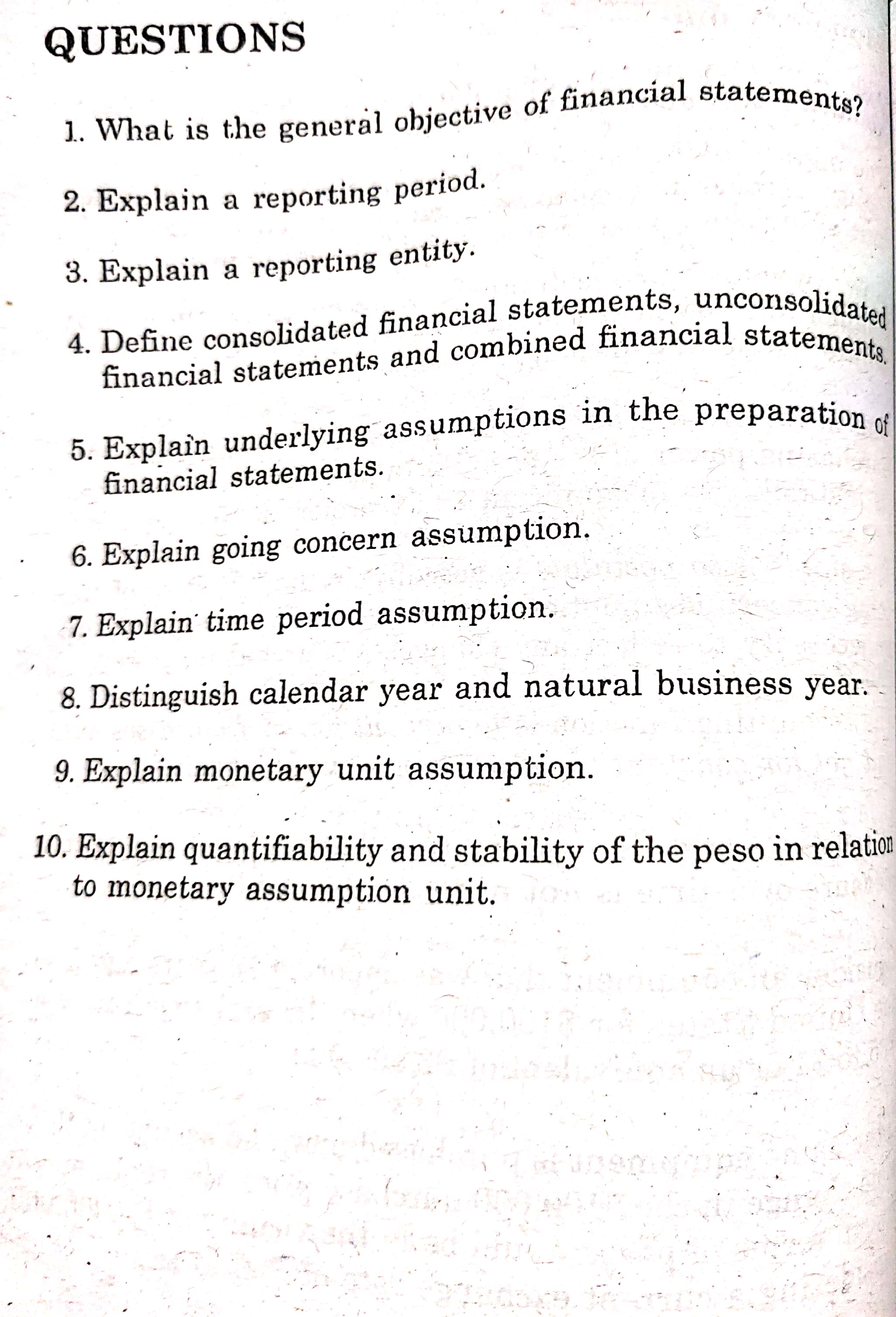
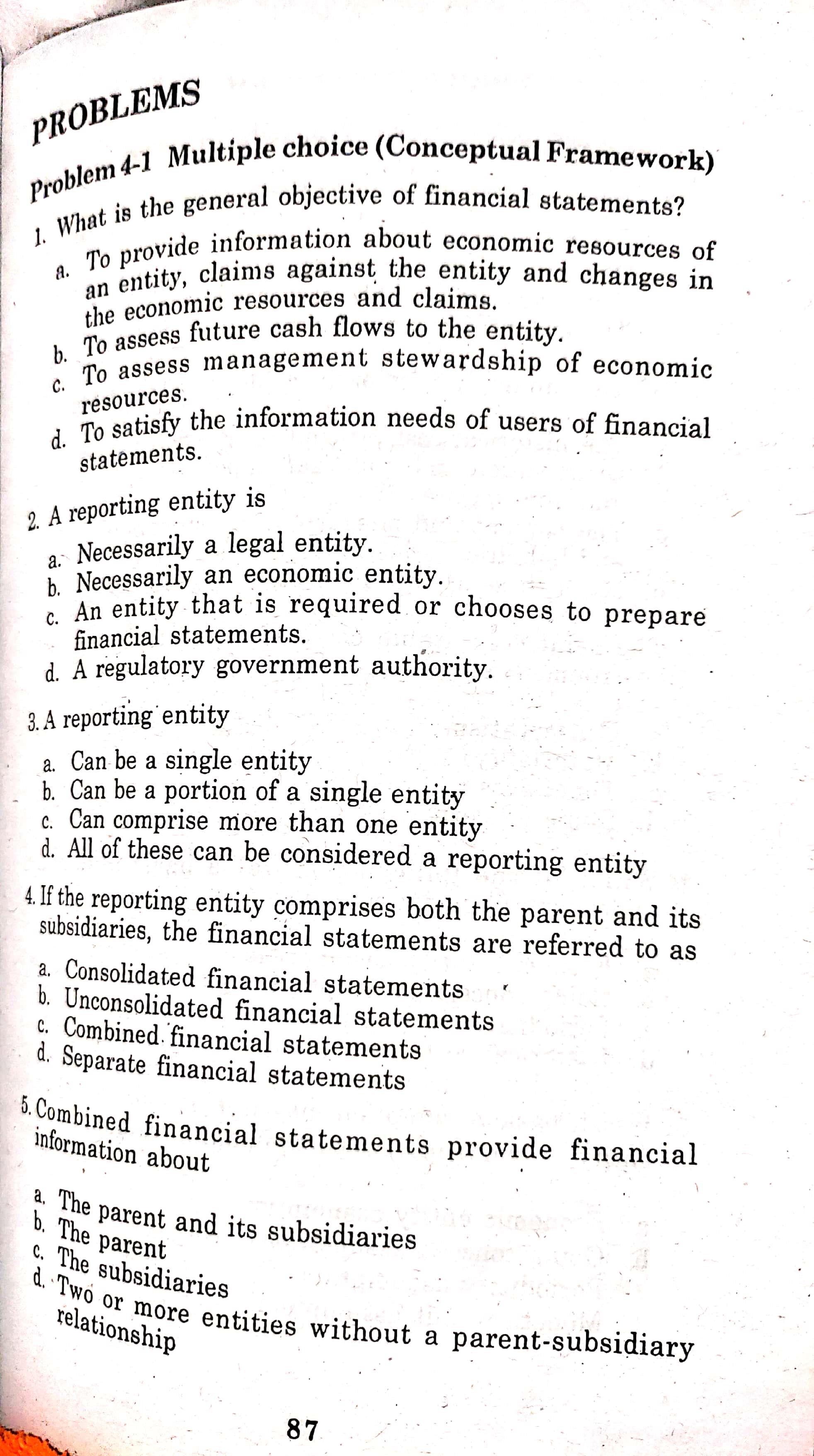
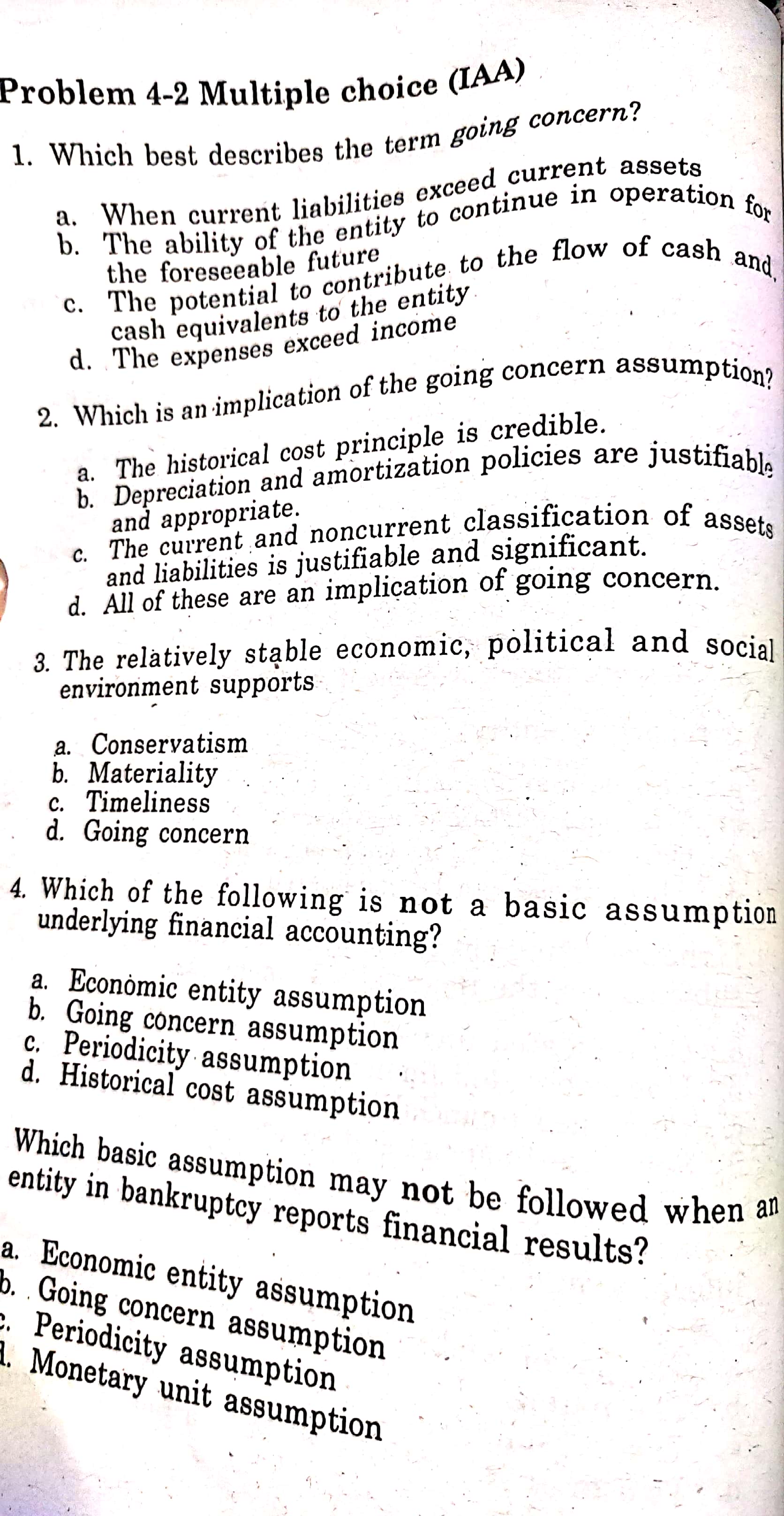
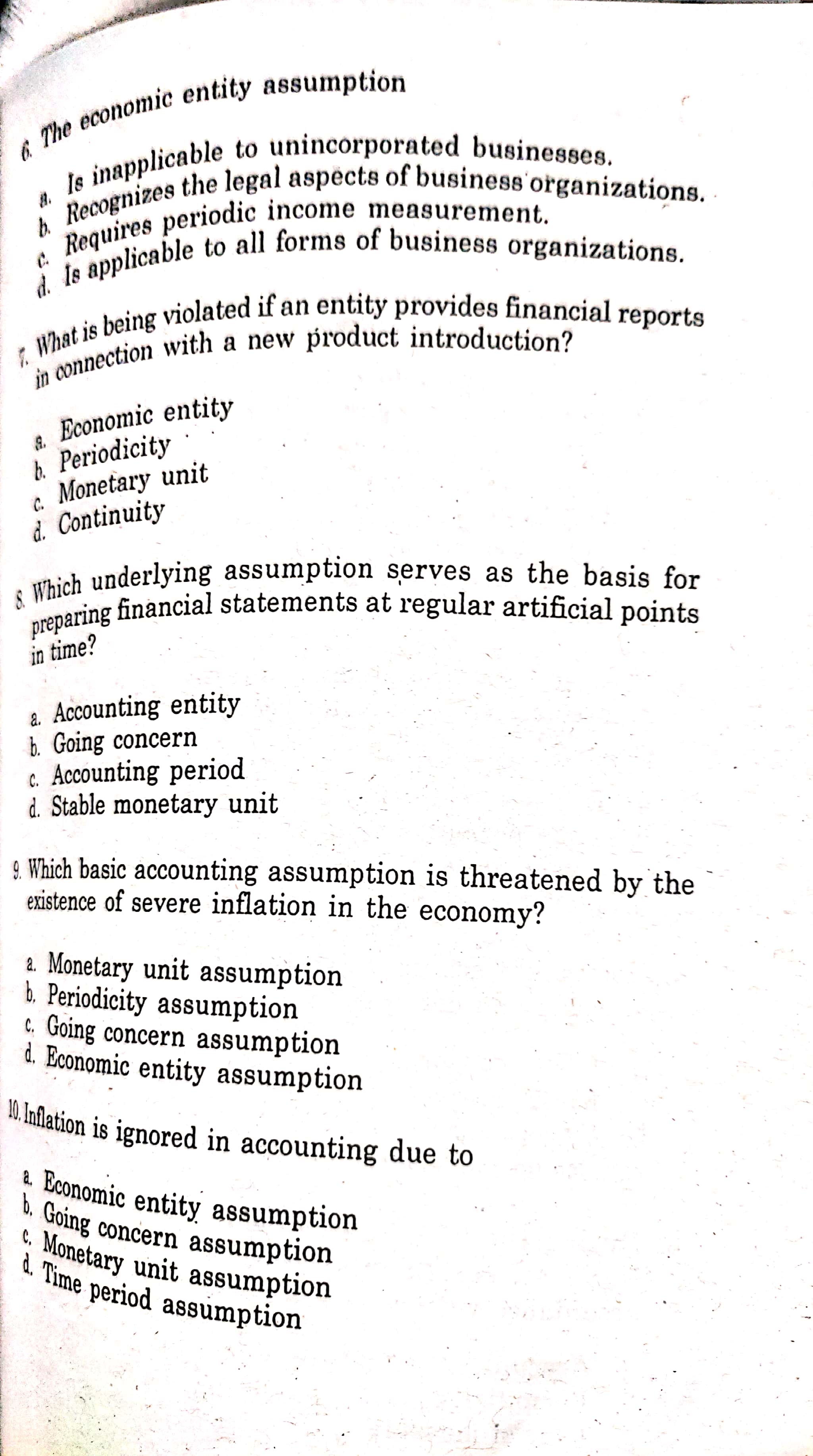
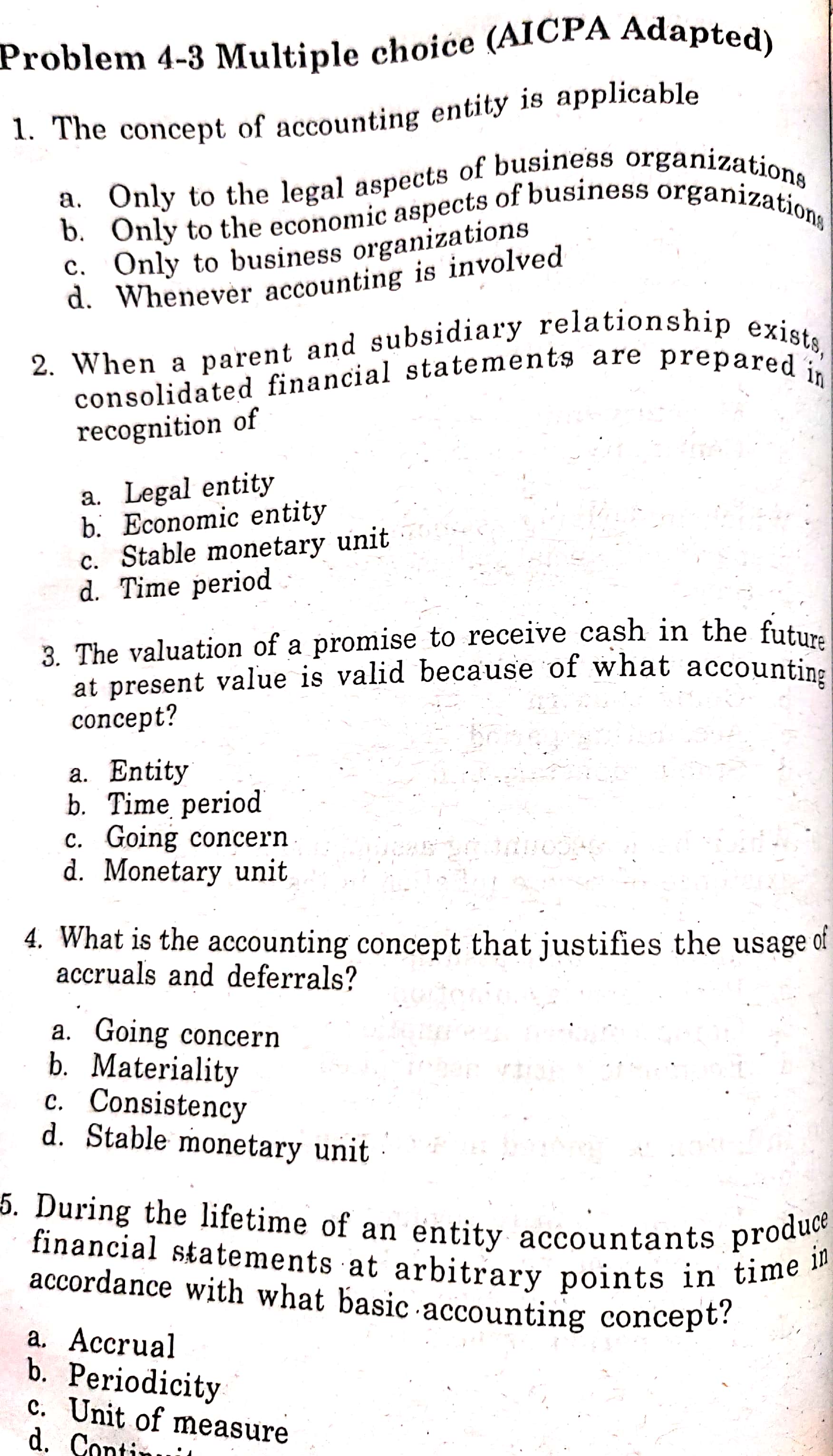
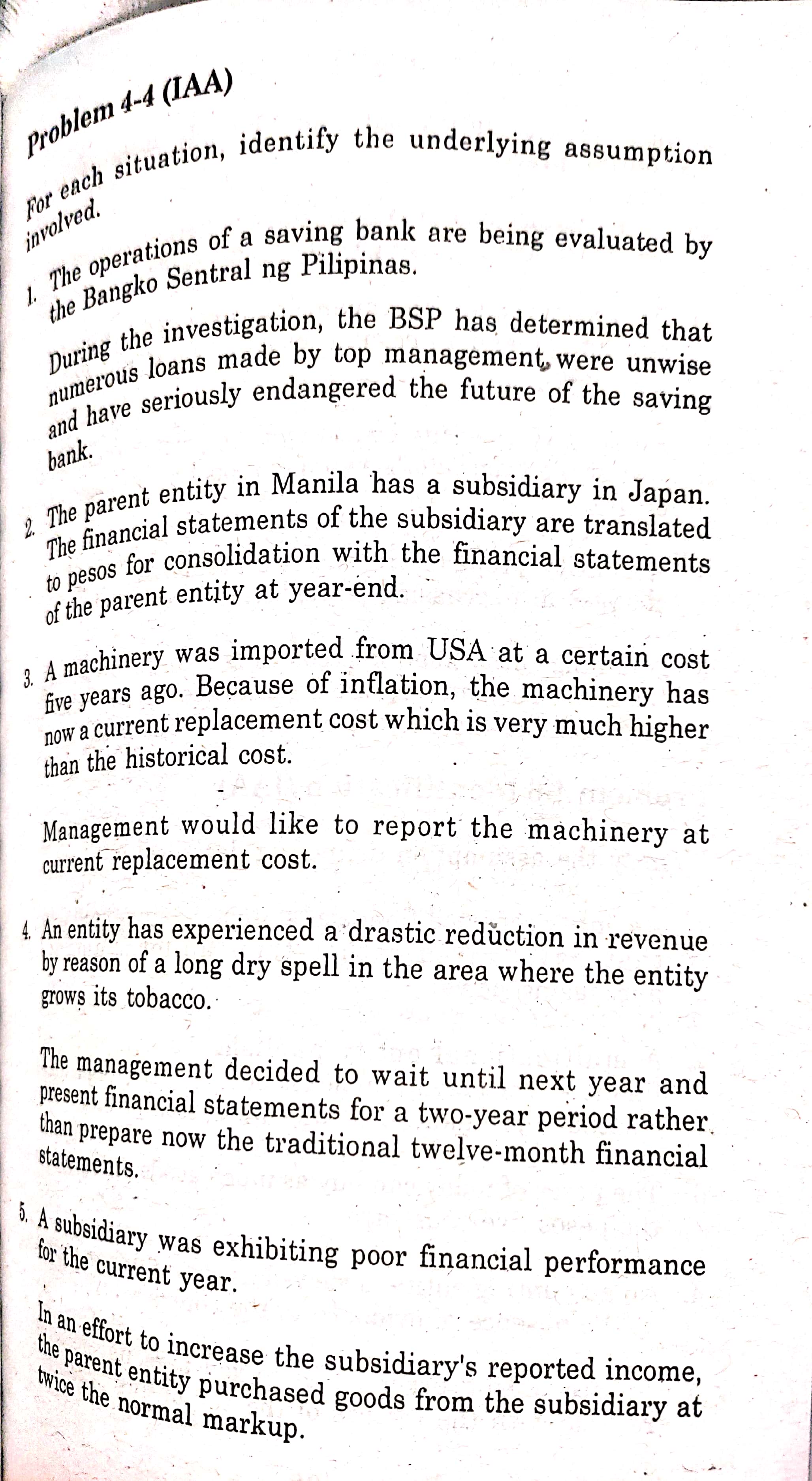
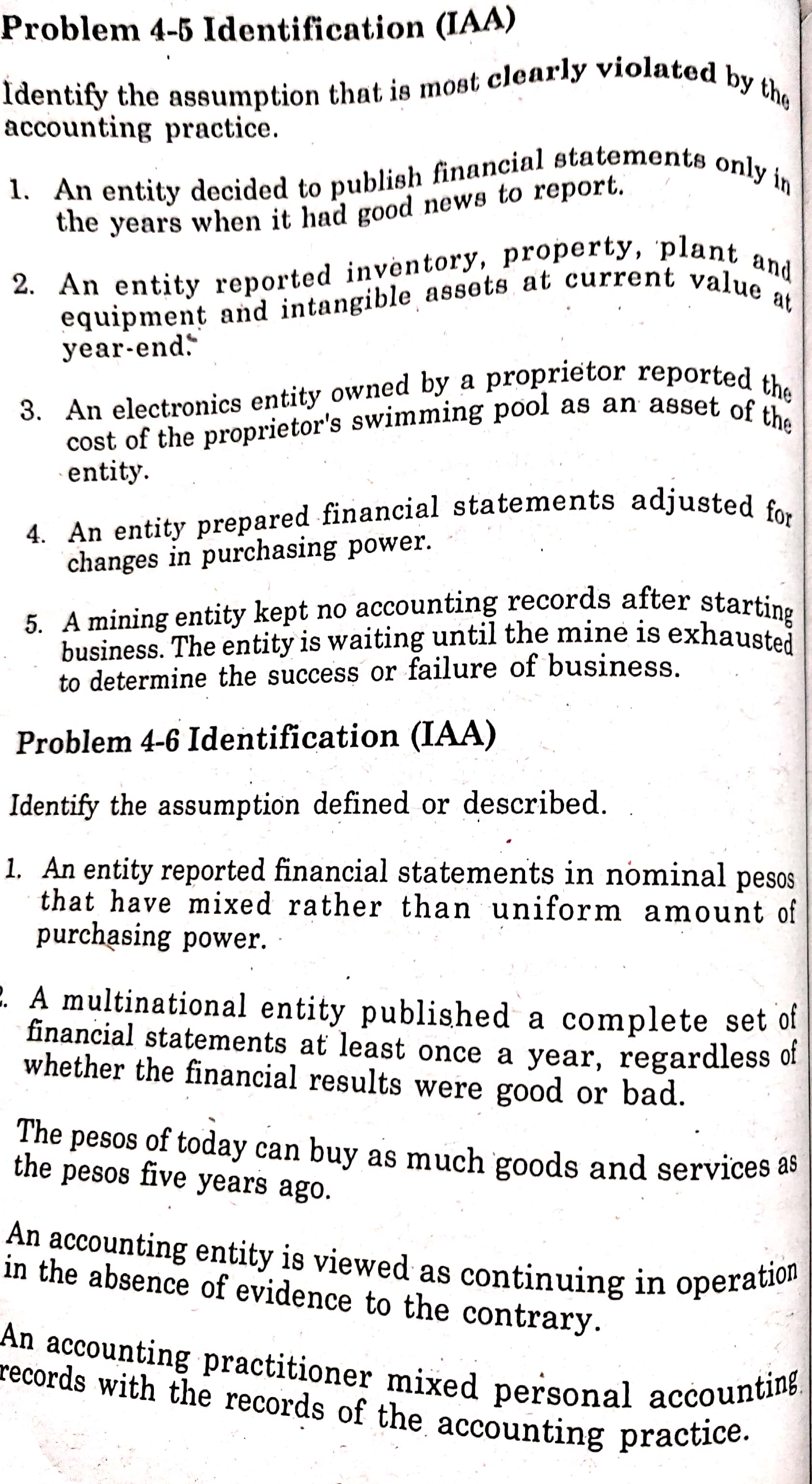
QUESTIONS J. What is the general objective of financial statements? 2. Explain a reporting period. 3. Explain a reporting entity. 4. Define consolidated financial statements, unconsolidated financial statements and combined financial statements 5. Explain underlying assumptions in the preparation of financial statements. 6. Explain going concern assumption. 7. Explain time period assumption. 8. Distinguish calendar year and natural business year. 9. Explain monetary unit assumption. 10. Explain quantifiablety and stability of the peso in relation to monetary assumption unit.PROBLEMS Problem 4-1 Multiple choice (Conceptual Framework) 1. What is the general objective of financial statements? a. To provide information about economic resources of an entity, claims against the entity and changes in the economic resources and claims. b. To assess future cash flows to the entity. c. To assess management stewardship of economic resources. d. To satisfy the information needs of users of financial statements. 2. A reporting entity is a. Necessarily a legal entity. b. Necessarily an economic entity. c. An entity that is required or chooses to prepare financial statements. d. A regulatory government authority. 3. A reporting entity a. Can be a single entity b. Can be a portion of a single entity c. Can comprise more than one entity d. All of these can be considered a reporting entity 4. If the reporting entity comprises both the parent and its subsidiaries, the financial statements are referred to as a. Consolidated financial statements b. Unconsolidated financial statements c. Combined financial statements d. Separate financial statements 5. Combined financial statements provide financial information about a, The parent and its subsidiaries b. The parent C. The subsidiaries relationship . Two or more entities without a parent-subsidiary 87Problem 4-2 Multiple choice (IAA) 1. Which best describes the term going concern? a. When current liabilities exceed current assets b. The ability of the entity to continue in operation for the foreseeable future C. The potential to contribute to the flow of cash and cash equivalents to the entity d. The expenses exceed income 2. Which is an implication of the going concern assumption a. The historical cost principle is credible. b. Depreciation and amortization policies are justifiable and appropriate. c. The current and noncurrent classification of assets and liabilities is justifiable and significant. d. All of these are an implication of going concern. 3. The relatively stable economic, political and social environment supports a. Conservatism b. Materiality c. Timeliness d. Going concern 4. Which of the following is not a basic assumption underlying financial accounting? a. Economic entity assumption b. Going concern assumption c. Periodicity assumption d. Historical cost assumption Which basic assumption may not be followed when an entity in bankruptcy reports financial results? a. Economic entity assumption b. Going concern assumption Periodicity assumption Monetary unit assumption6. The economic entity assumption Is inapplicable to unincorporated businesses. Recognizes the legal aspects of business organizations. c. Requires periodic income measurement. . Is applicable to all forms of business organizations. What is being violated if an entity provides financial reports in connection with a new product introduction? a. Economic entity b. Periodicity c. Monetary unit d. Continuity Which underlying assumption serves as the basis for preparing financial statements at regular artificial points in time? a. Accounting entity b. Going concern c. Accounting period d. Stable monetary unit 9. Which basic accounting assumption is threatened by the existence of severe inflation in the economy? a. Monetary unit assumption b, Periodicity assumption C. Going concern assumption d. Economic entity assumption 10. Inflation is ignored in accounting due to a. Economic entity assumption b. Going concern assumption C. Monetary unit assumption d. Time period assumptionProblem 4-3 Multiple choice (AICPA Adapted) 1. The concept of accounting entity is applicable a. Only to the legal aspects of business organizations b. Only to the economic aspects of business organization. c. Only to business organizations d. Whenever accounting is involved 2. When a parent and subsidiary relationship exist consolidated financial statements are prepared in recognition of a. Legal entity b. Economic entity c. Stable monetary unit d. Time period 3. The valuation of a promise to receive cash in the future at present value is valid because of what accounting concept? a. Entity b. Time period c. Going concern d. Monetary unit 4. What is the accounting concept that justifies the usage of accruals and deferrals? a. Going concern b. Materiality c. Consistency d. Stable monetary unit . 5. During the lifetime of an entity accountants produce financial statements at arbitrary points in time in accordance with what basic accounting concept? a. Accrual b. Periodicity c. Unit of measure d. ContiProblem 4-4 (JAA) for each situation, identify the underlying assumption involved. The operations of a saving bank are being evaluated by the Bangko Sentral ng Pilipinas. During the investigation, the BSP has determined that numerous loans made by top management, were unwise and have seriously endangered the future of the saving bank. The parent entity in Manila has a subsidiary in Japan. The financial statements of the subsidiary are translated to pesos for consolidation with the financial statements of the parent entity at year-end. 3. A machinery was imported from USA at a certain cost five years ago. Because of inflation, the machinery has now a current replacement cost which is very much higher than the historical cost. Management would like to report the machinery at current replacement cost. 4. An entity has experienced a drastic reduction in revenue by reason of a long dry spell in the area where the entity grows its tobacco. The management decided to wait until next year and present financial statements for a two-year period rather statements. than prepare now the traditional twelve-month financial . A subsidiary was exhibiting poor financial performance for the current year. In an effort to increase the subsidiary's reported income, the parent entity purchased goods from the subsidiary at twice the normal markup.Problem 4-5 Identification (IAA) Identify the assumption that is most clearly violated by the accounting practice. I. An entity decided to publish financial statements only in the years when it had good news to report. 2. An entity reported inventory, property, plant and equipment and intangible assets at current value . year-end. 3. An electronics entity owned by a proprietor reported the cost of the proprietor's swimming pool as an asset of the entity. 4. An entity prepared financial statements adjusted for changes in purchasing power. 5. A mining entity kept no accounting records after starting business. The entity is waiting until the mine is exhausted to determine the success or failure of business. Problem 4-6 Identification (IAA) Identify the assumption defined or described. 1. An entity reported financial statements in nominal pesos that have mixed rather than uniform amount of purchasing power. A multinational entity published a complete set of financial statements at least once a year, regardless of whether the financial results were good or bad. The pesos of today can buy as much goods and services as the pesos five years ago. An accounting entity is viewed as continuing in operation in the absence of evidence to the contrary. An accounting practitioner mixed personal accounting records with the records of the accounting practice
Step by Step Solution
There are 3 Steps involved in it
1 Expert Approved Answer
Step: 1 Unlock
Question Has Been Solved by an Expert!
Get step-by-step solutions from verified subject matter experts
Step: 2 Unlock
Step: 3 Unlock
Students Have Also Explored These Related Accounting Questions!