







Question: HERE IS THE EXAMPLE We next calculate the eccentricity. We have 2(-1.3792 107)(6.0797 1010)2 (3.986 x 10¹⁴)2 2Eh2 0.64172 [el = so that from Eq.

HERE IS THE EXAMPLE
![from Eq. [3.8.15] -./1-0.64172-0.59857 From Eq. [3.8.18, the semimajor axis is 14.450](https://dsd5zvtm8ll6.cloudfront.net/si.experts.images/questions/2024/10/6704006632308_4936704006595bbc.jpg)
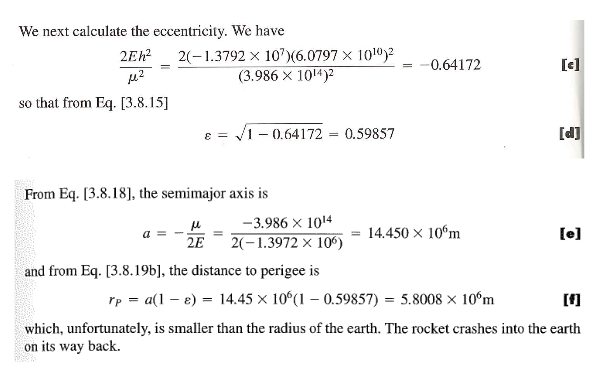
We next calculate the eccentricity. We have 2(-1.3792 107)(6.0797 1010)2 (3.986 x 10¹⁴)2 2Eh2 0.64172 [el = so that from Eq. [3.8.15] -./1-0.64172-0.59857 From Eq. [3.8.18, the semimajor axis is 14.450 in [el d2E2-1.3972 X 10 and from Eq. [3.8.19b], the distance to perigee is 2(-1.3972 x 10⁶) ry-a(I-e)-14.45 xi 06(1-0.59857) 5.8008 x 10⁶m which, unfortunately, is smaller than the radius of the earth. The rocket crashes into the earth I1 on its way back We next calculate the eccentricity. We have 2(-1.3792 107)(6.0797 1010)2 (3.986 x 10¹⁴)2 2Eh2 0.64172 [el = so that from Eq. [3.8.15] -./1-0.64172-0.59857 From Eq. [3.8.18, the semimajor axis is 14.450 in [el d2E2-1.3972 X 10 and from Eq. [3.8.19b], the distance to perigee is 2(-1.3972 x 10⁶) ry-a(I-e)-14.45 xi 06(1-0.59857) 5.8008 x 10⁶m which, unfortunately, is smaller than the radius of the earth. The rocket crashes into the earth I1 on its way back
Step by Step Solution
There are 3 Steps involved in it

Get step-by-step solutions from verified subject matter experts
 Study Help