







Question: Hi! Can you please help me with these multiple choices questions? 1. Suppose that consumption function is given by: C -100+0.8*(Y-7), where ) is income
Hi! Can you please help me with these multiple choices questions?
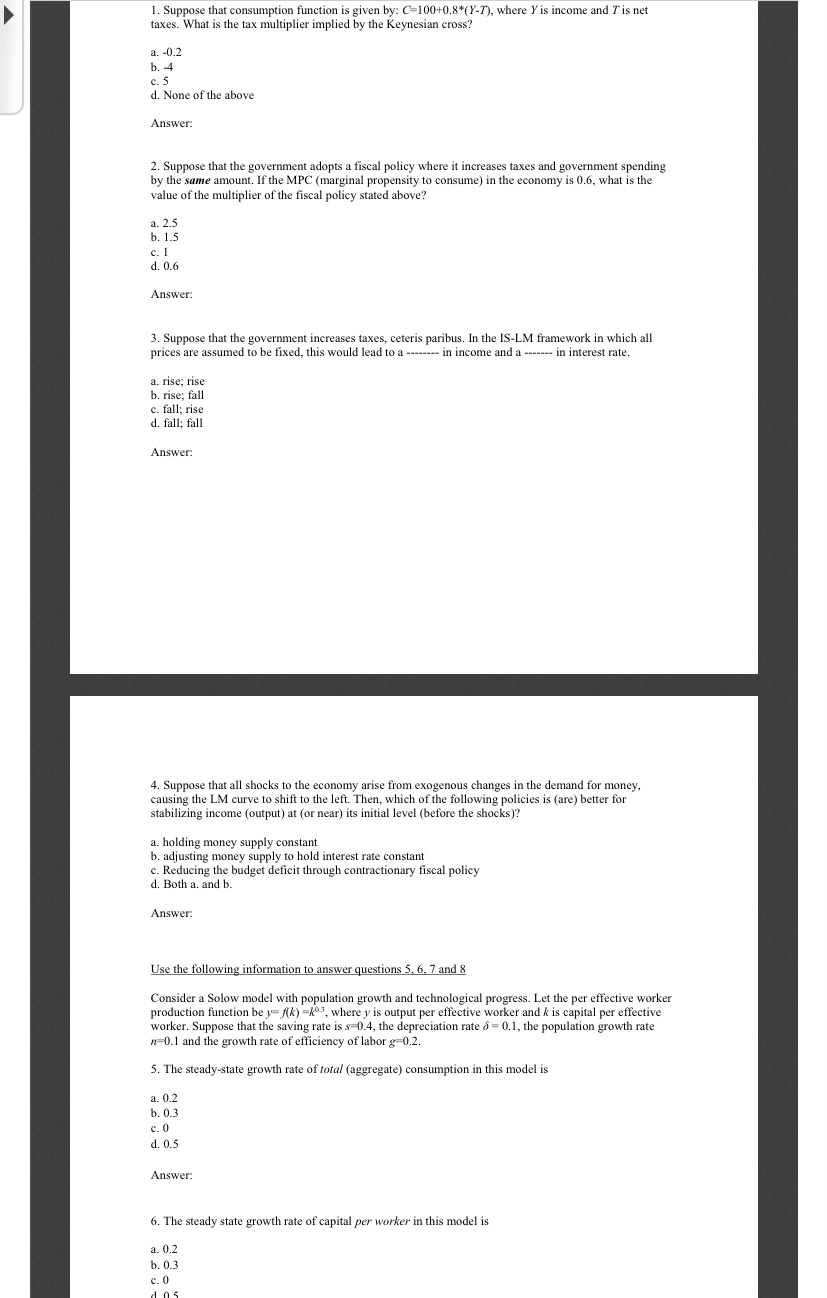
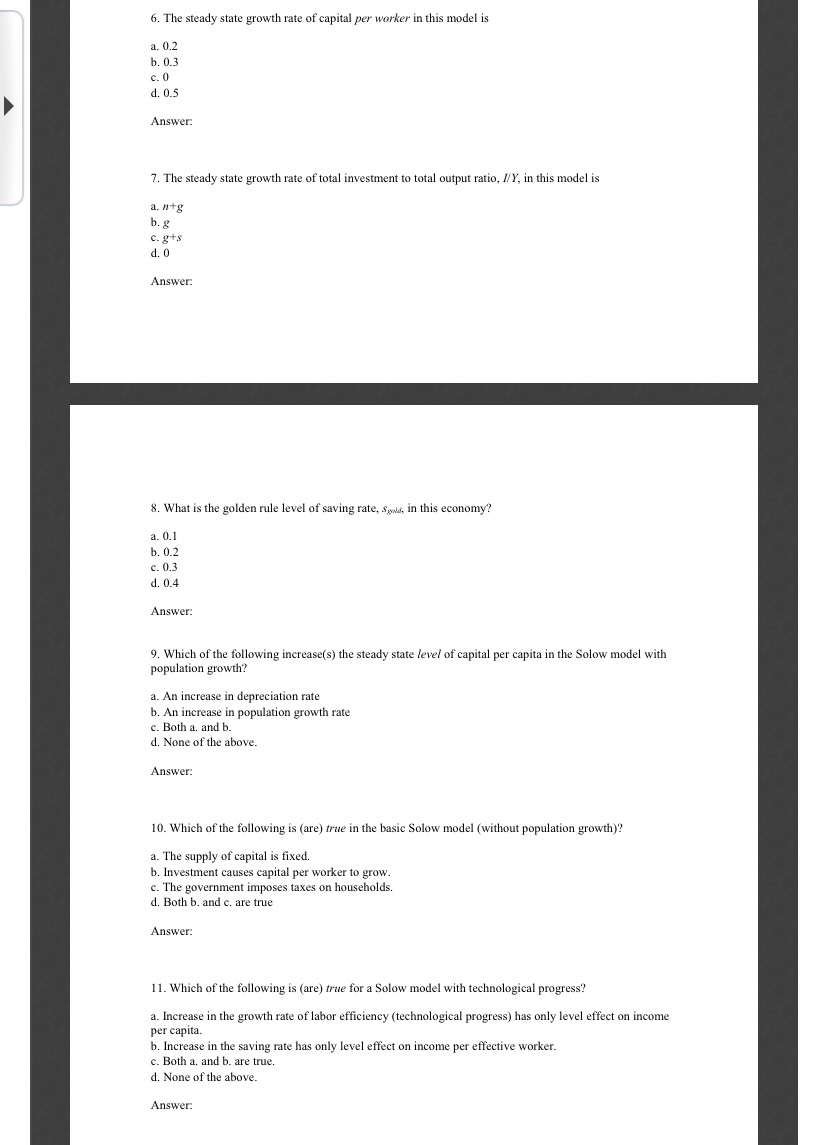
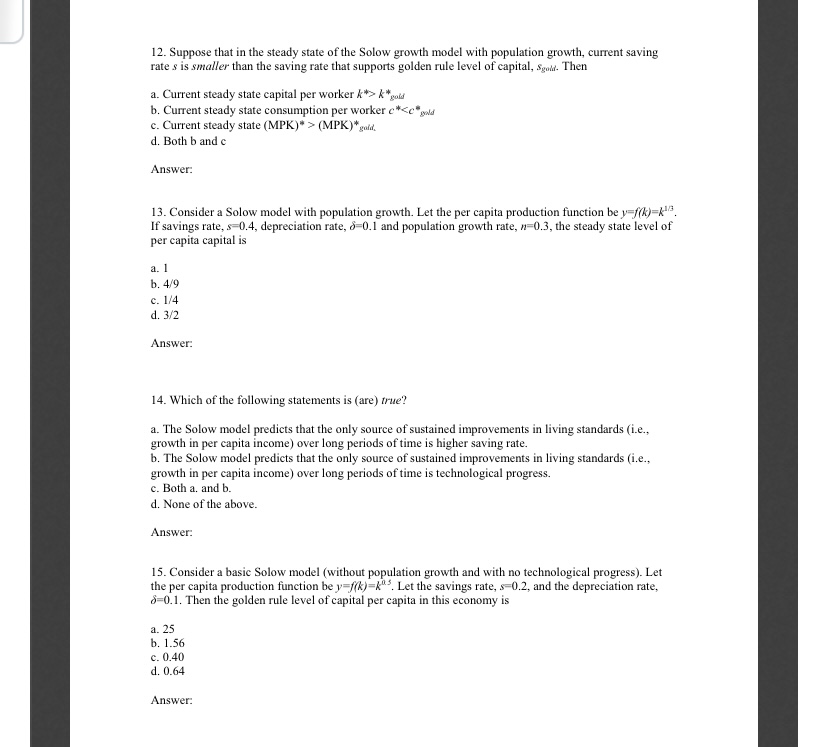
1. Suppose that consumption function is given by: C -100+0.8*(Y-7), where ) is income and 7 is net taxes. What is the tax multiplier implied by the Keynesian cross? a. -0.2 b. 4 c. 5 d. None of the above Answer: 2. Suppose that the government adopts a fiscal policy where it increases taxes and government spending by the same amount. If the MPC (marginal propensity to consume) in the economy is 0.6, what is the value of the multiplier of the fiscal policy stated above? a. 2.5 b. 1.5 c. 1 d. 0.6 Answer: 3. Suppose that the government increases taxes, ceteris paribus. In the IS-LM framework in which all prices are assumed to be fixed, this would lead to a -------- in income and a ------- in interest rate. a. rise; rise b. rise; fall c. fall; rise d. fall; fall Answer: 4. Suppose that all shocks to the economy arise from exogenous changes in the demand for money, causing the LM curve to shift to the left. Then, which of the following policies is (are) better for stabilizing income (output) at (or near) its initial level (before the shocks)? a. holding money supply constant b. adjusting money supply to hold interest rate constant c. Reducing the budget deficit through contractionary fiscal policy d. Both a. and b. Answer: Use the following information to answer questions 5. 6. 7 and & Consider a Solow model with population growth and technological progress. Let the per effective worker production function be y- f(k) =203, where y is output per effective worker and & is capital per effective worker. Suppose that the saving rate is s=0.4, the depreciation rate o = 0.1, the population growth rate "1 0.1 and the growth rate of efficiency of labor g=0.2. 5. The steady-state growth rate of total (aggregate) consumption in this model is a. 0.2 b. 0.3 C. Q d. 0.5 Answer: 6. The steady state growth rate of capital per worker in this model is a. 0.2 b. 0.3 C. U6. The steady state growth rate of capital per worker in this model is a. 0.2 b. 0.3 c. 0 d. 0.5 Answer: 7. The steady state growth rate of total investment to total output ratio, //Y, in this model is a. ntg b. g C. gts 1. 0 Answer: 8. What is the golden rule level of saving rate, $gold, in this economy? a. 0.1 b. 0.2 c. 0.3 d. 0.4 Answer: 9. Which of the following increase(s) the steady state level of capital per capita in the Solow model with population growth? a. An increase in depreciation rate b. An increase in population growth rate c. Both a. and b. d. None of the above. Answer: 10. Which of the following is (are) true in the basic Solow model (without population growth)? a. The supply of capital is fixed. b. Investment causes capital per worker to grow. c. The government imposes taxes on households. d. Both b. and c. are true Answer: 1 1. Which of the following is (are) true for a Solow model with technological progress? a. Increase in the growth rate of labor efficiency (technological progress) has only level effect on income per capita. b. Increase in the saving rate has only level effect on income per effective worker. c. Both a. and b. are true. d. None of the above. Answer:12. Suppose that in the steady state of the Solow growth model with population growth, current saving rate s is smaller than the saving rate that supports golden rule level of capital, Saw. Then a. Current steady state capital per worker (*> k*gur b. Current steady state consumption per worker c*ccg c. Current steady state (MPK)* > (MPK)*gold. d. Both b and c Answer: 13. Consider a Solow model with population growth. Let the per capita production function be y f()=43. If savings rate, s=0.4, depreciation rate, 6=0.1 and population growth rate, "=0.3, the steady state level of per capita capital is a. 1 b. 4/9 c. 1/4 d. 3/2 Answer: 14. Which of the following statements is (are) true? a. The Solow model predicts that the only source of sustained improvements in living standards (i.e., growth in per capita income) over long periods of time is higher saving rate. b. The Solow model predicts that the only source of sustained improvements in living standards (i.e., growth in per capita income) over long periods of time is technological progress. c. Both a. and b. d. None of the above. Answer: 15. Consider a basic Solow model (without population growth and with no technological progress). Let the per capita production function be y-f(k)=". Let the savings rate, s=0.2, and the depreciation rate. 5 0.1. Then the golden rule level of capital per capita in this economy is a. 25 b. 1.56 c. 0.40 d. 0.64
Step by Step Solution
There are 3 Steps involved in it

Get step-by-step solutions from verified subject matter experts
 Study Help