







Question: Host A has established a TCP connection and is sending segments to Host B. Assume that the timeout value for TCP protocol is sufficiently long
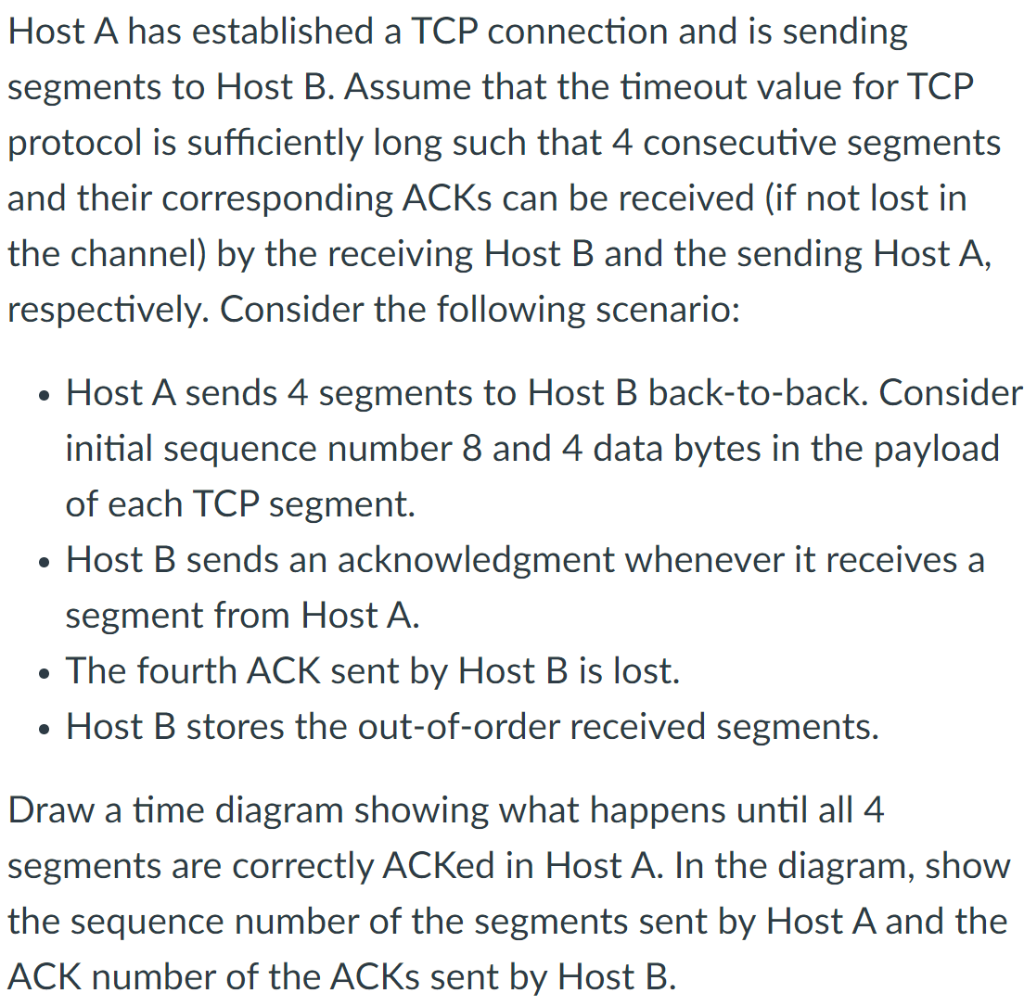
Host A has established a TCP connection and is sending segments to Host B. Assume that the timeout value for TCP protocol is sufficiently long such that 4 consecutive segments and their corresponding ACKs can be received (if not lost in the channel) by the receiving Host B and the sending Host A, respectively. Consider the following scenario: Host A sends 4 segments to Host B back-to-back. Consider initial sequence number 8 and 4 data bytes in the payload of each TCP segment. Host B sends an acknowledgment whenever it receives a segment from Host A. The fourth ACK sent by Host B is lost. Host B stores the out-of-order received segments. . Draw a time diagram showing what happens until all 4 segments are correctly ACKed in Host A. In the diagram, show the sequence number of the segments sent by Host A and the ACK number of the ACKs sent by Host B. Host A has established a TCP connection and is sending segments to Host B. Assume that the timeout value for TCP protocol is sufficiently long such that 4 consecutive segments and their corresponding ACKs can be received (if not lost in the channel) by the receiving Host B and the sending Host A, respectively. Consider the following scenario: Host A sends 4 segments to Host B back-to-back. Consider initial sequence number 8 and 4 data bytes in the payload of each TCP segment. Host B sends an acknowledgment whenever it receives a segment from Host A. The fourth ACK sent by Host B is lost. Host B stores the out-of-order received segments. . Draw a time diagram showing what happens until all 4 segments are correctly ACKed in Host A. In the diagram, show the sequence number of the segments sent by Host A and the ACK number of the ACKs sent by Host B
Step by Step Solution
There are 3 Steps involved in it

Get step-by-step solutions from verified subject matter experts
 Study Help