







Question: I need a summary Research has found that in practice the approach to strategic management accounting is at best partial (Scapens et al., 2003). Certainly
I need a summary
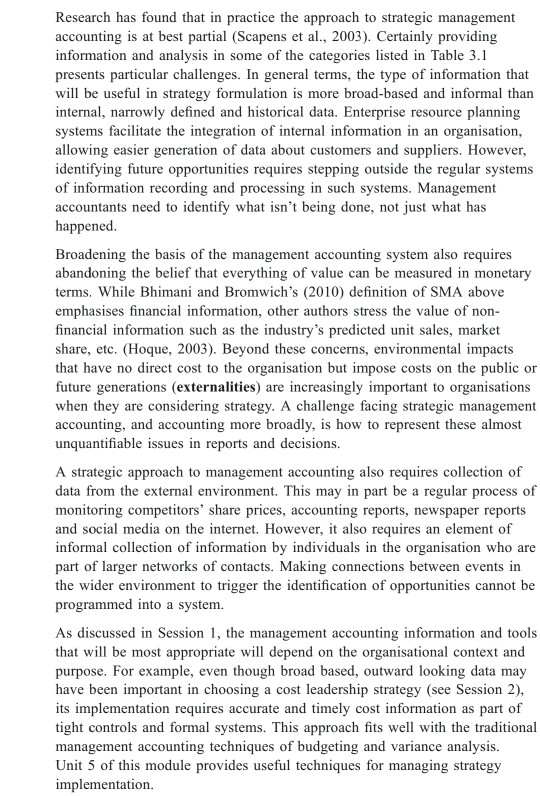
Research has found that in practice the approach to strategic management accounting is at best partial (Scapens et al., 2003). Certainly providing information and analysis in some of the categories listed in Table 3.1 presents particular challenges. In general terms, the type of information that will be useful in strategy formulation is more broad-based and informal than internal, narrowly defined and historical data. Enterprise resource planning systems facilitate the integration of internal information in an organisation, allowing easier generation of data about customers and suppliers. However, identifying future opportunities requires stepping outside the regular systems of information recording and processing in such systems. Management accountants need to identify what isn't being done, not just what has happened. Broadening the basis of the management accounting system also requires abandoning the belief that everything of value can be measured in monetary terms. While Bhimani and Bromwich's (2010) definition of SMA above emphasises financial information, other authors stress the value of non- financial information such as the industry's predicted unit sales, market share, etc. (Hoque, 2003). Beyond these concerns, environmental impacts that have no direct cost to the organisation but impose costs on the public or future generations (externalities) are increasingly important to organisations when they are considering strategy. A challenge facing strategic management accounting, and accounting more broadly, is how to represent these almost unquantifiable issues in reports and decisions. A strategic approach to management accounting also requires collection of data from the external environment. This may in part be a regular process of monitoring competitors' share prices, accounting reports, newspaper reports and social media on the internet. However, it also requires an element of informal collection of information by individuals in the organisation who are part of larger networks of contacts. Making connections between events in the wider environment to trigger the identification of opportunities cannot be programmed into a system. As discussed in Session 1, the management accounting information and tools that will be most appropriate will depend on the organisational context and purpose. For example, even though broad based, outward looking data may have been important in choosing a cost leadership strategy (see Session 2), its implementation requires accurate and timely cost information as part of tight controls and formal systems. This approach fits well with the traditional management accounting techniques of budgeting and variance analysis. Unit 5 of this module provides useful techniques for managing strategy implementation
Step by Step Solution
There are 3 Steps involved in it

Get step-by-step solutions from verified subject matter experts
 Study Help