







Question: I need help on figuring this out and show steps. bCLIC CUSUL 172 a. b. c. calculate(v, w); calculate(v, x): calculate(x, y): d. calculate(18, x);
I need help on figuring this out and show steps.
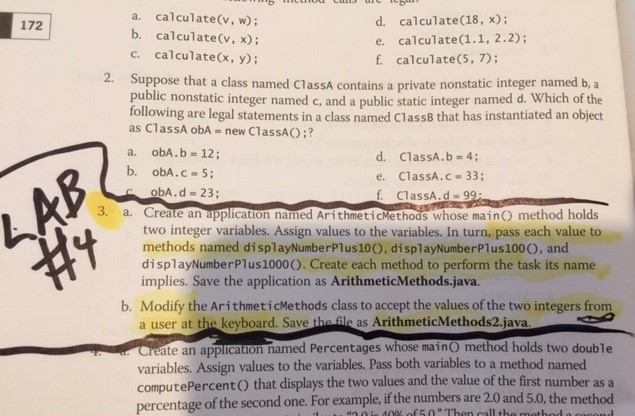
bCLIC CUSUL 172 a. b. c. calculate(v, w); calculate(v, x): calculate(x, y): d. calculate(18, x); e calculate(1.1, 2.2); f. calculate(5, 7); Suppose that a class named ClassA contains a private nonstatic integer named b, a public nonstatic integer named c, and a public static integer named d. Which of the following are legal statements in a class named ClassB that has instantiated an object as ClassA obA=new ClassAO:? a. obA.b - 12; d. ClassA.b = 4; b. obA.C-5; e. ClassA.C-33; ODA.d = 23; f. ClassA.d = 99; 3. a. Create an application named ArithmeticMethods whose main method holds two integer variables. Assign values to the variables. In turn, pass each value to methods named displayNumberPlus 100, displayNumberPlus1000, and displayNumberPlus 10000. Create each method to perform the task its name implies. Save the application as ArithmeticMethods.java. b. Modify the ArithmeticMethods class to accept the values of the two integers from a user at the keyboard. Save the file as ArithmeticMethods2.java. Create an application named Percentages whose main() method holds two double variables. Assign values to the variables. Pass both variables to a method named computePercent that displays the two values and the value of the first number as a percentage of the second one. For example, if the numbers are 2.0 and 5.0, the method A f50" Then all the method and
Step by Step Solution
There are 3 Steps involved in it

Get step-by-step solutions from verified subject matter experts
 Study Help