







Question: I need help with answering these questions. For part 1 I need 2 examples that are direct quotes from my previous writings. For part 2
I need help with answering these questions. For part 1 I need 2 examples that are direct quotes from my previous writings. For part 2 I need 4 textual examples and for part 5 I need one.
You will compose a reflective essay that shares what you have learned this semester, according to the learning outcomes in our course as well as your development as a writer, scholar, and community member. You will use evidence from your own learning and writing experiences (such as in-class activities, readings, low-stakes assignments, and major projects) as support for the claims you make about your learning.
Context: Why are we doing this?
For Assessment:
Researchers in the field of writing studies believe that portfolios are the best way to assess student progress in writing over the course of a semester. Because a portfolio includes samples of writing in several writing genres, it provides a more holistic sense of the writer's skills and reveals aspects of the writing process to the reader; readers can be anyone from individual instructors to faculty members on English program assessment teams as well as external audiences like institutional assessment committees.
To Enhance Learning:
More importantly, the Portfolio Reflection enhances learning and increases the likelihood that you will be able to transfer writing skills to other courses and non-academic contexts. By exploring the nature of your skills and reflecting on how those skills have developed (and what remains to be developed), you will better understand how to adapt your skills to future writing opportunities.
Tips: How do I do it?
Please use the following questions, below, to construct a reflective essay that demonstrates how you have met the learning outcomes for our course this semester.This essay should be AT LEAST 750 wods (which is roughly 150 wods per paragraph).
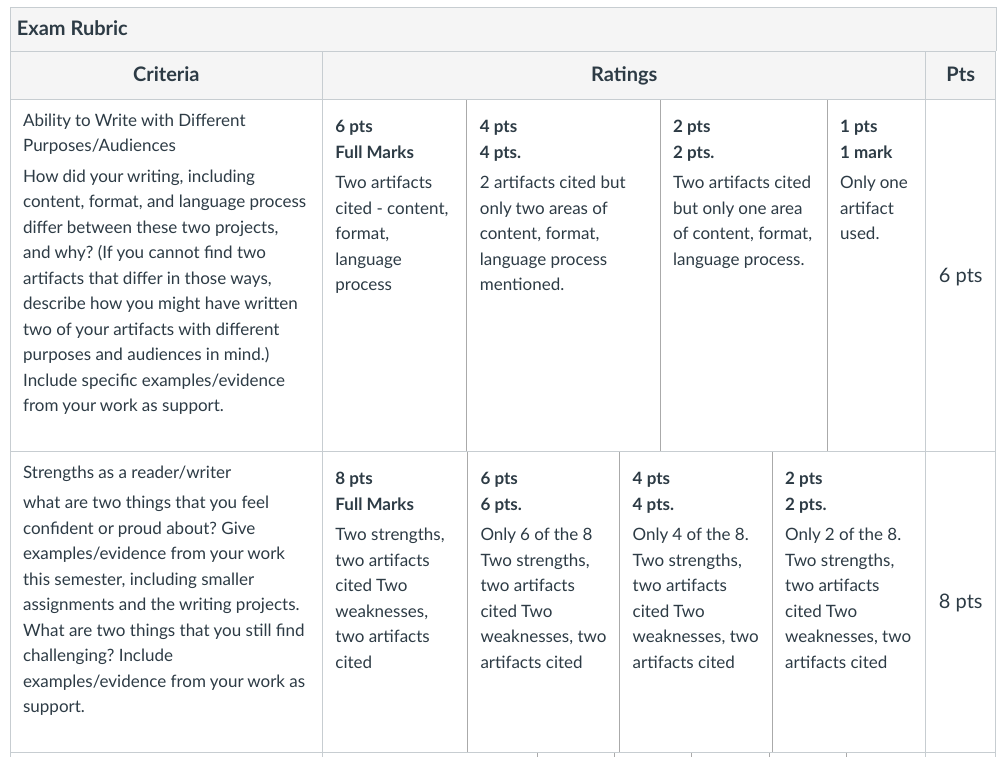
P1: Reflect on your rhetorical knowledge: 2 examples
- Select two artifacts from your work this semester that demonstrate your ability to write with different purposes in mind and different target audiences. How did your writing, including content, format, and language process differ between these two projects, and why?Include specific examples/evidence from your work as support.
- This semester in Eng 101, I honed my ability to adapt writing different purposes and audiences. In my personal narrative
P2: Reflect on critical thinking and reading experiences: 4 textual examples
- Identify your strengths as a writer: what are two things that you feel confident or proud about?Give examples/evidence from your work this semester, including smaller assignments and the writing projects.What are two things that you still find challenging? Include examples/evidence from your work as support.
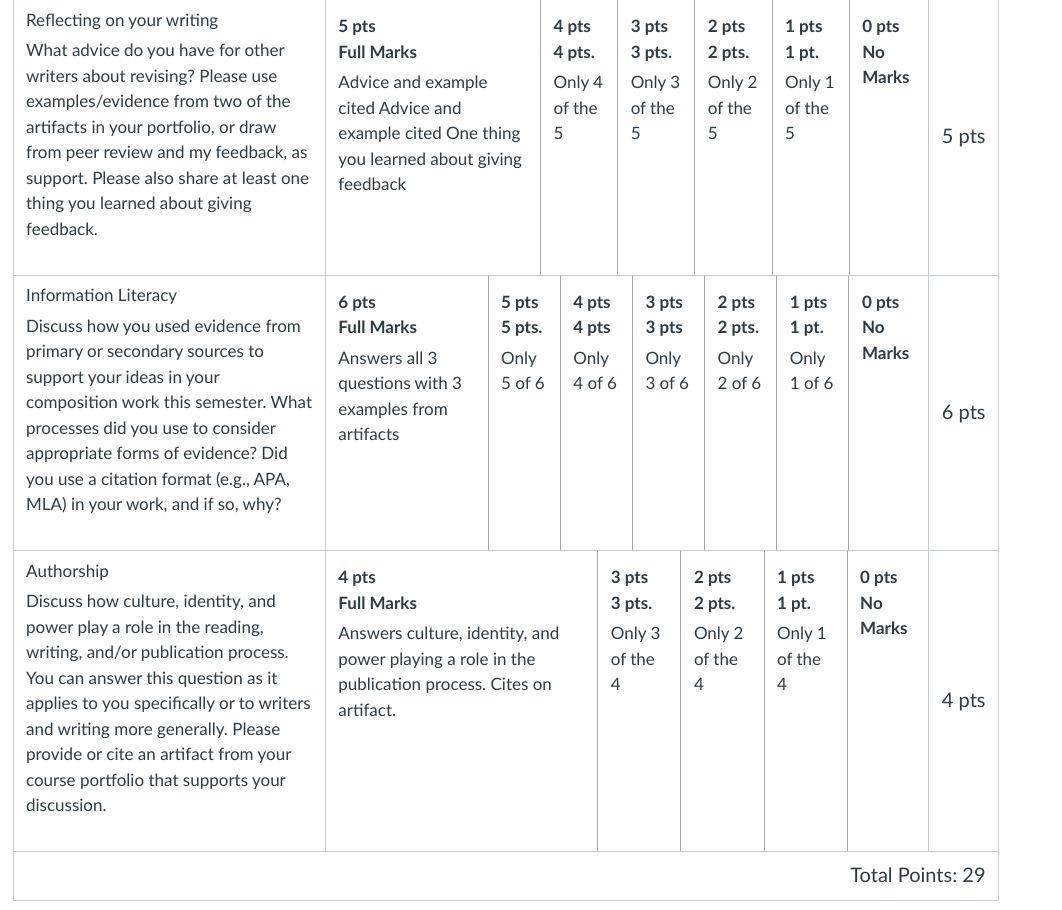
P3: Reflect on your writing process: 2 examples
- What advice do you have for other writers about revising? Please use examples/evidence from two of the artifacts in your portfolio, or draw from peer review and my feedback, as support. Please also share at leastone thing you learned about giving feedback.
P4: Reflect on information literacy: we used apa we are gonna use it for our social science class. Used cites with edu or .gov
- Discuss how you used evidence from primary or secondary sources to support your ideas in your composition work this semester. What processes did you use to consider appropriate forms of evidence? Did you use a citation format (e.g., APA, MLA) in your work, and if so, why?
P5: Reflect on your authorship: poem, resume, where im from 1 example
- Discuss how culture, identity, and power play a role in the reading, writing, and/or publication process. You can answer this question as it applies to you specifically or to writers and writing more generally. Please provide or cite an artifact from your course portfolio that supports your discussion.
Assessment: How will this be graded?
Please use the attached rubric when writing this essay.
Assignments to consider when writing this essay:
Resume The College Essay
Cover Letter Product Project
Essence Box Evaluative Essay
Where I'm From poem Scholarship Essays
You can also use evidence from peer edits from classmates and/or ChatGPT along with feedback I have left for you on your assignments.
My writings for the examples;
Personal Narrative:
Laughter fills my mother's SUV as my friends' happy voices crash against the car windows like ocean waves. One of them yells: "Did y'all see that?!" Suddenly, the sharp ring of my father's phone slices through our celebration. His grip tightens around the steering wheel, as the happy vibe disappears like morning mist. An uncomfortable silence envelops us.
We had just finished a fierce paintball game???a laid-back weekend full of the joys of youth. As we loaded into the car, I had no idea that a singular phone call would change my life. My father's knuckles turned pale, and his face tightened. "Where? No... that cannot be right," he said, disbelief heavy in his voice. I leaned forward, trying to hear, while my friends exchanged nervous glances. My grandmother had been at Bingo. His voice broke, delivering a reality I was not ready for. Were they sure it was a heart attack?
Sensing something was off, my friends fell silent, unsure of what to say. Noah tried to ease the tension with a joke; his humor was a lifeline amid the rising anxiety. The calm, yet sorrowful voice of my father, hung in the air. "Your grandmother... she had a heart attack during Bingo." As we approached home, we all knew that the carefree teenagers who had climbed into the car were not the same ones who left.
Looking back, that event transformed me. Losing my grandmother forced me to face a harsh reality: life is fragile, and those we love can be taken away without notice. I came to understand how fleeting the moments we often take for granted are. Before that day, I felt invincible, like most teenagers do. This painful experience taught me that life's demands can be overwhelming, but they also provide opportunities to build resilience and strength.
Over the next three years, this resilience guided me as the commander of my AFJROTC Armed Drill Team. Drawing on the lessons from my grandmother's death, I viewed every drill practice as a chance to instill discipline, commitment, and respect. I knew that our final performance would showcase the hours we dedicated to perfecting every movement. This role tested me; moments of fatigue, frustration, and doubt surfaced as I trained our team for events. The drill team became my way to honor the lessons I had learned: hardship is an opportunity to rise, not a barrier, reminding me to lead with intention and resilience.
Through this experience, I learned to see challenges as opportunities for growth and the courage to face them. Reflecting on my grandmother's death, I recognize it as a turning point that inspired me to become a better leader and a more resilient person. While pain is a part of life, our ability to overcome it is a tribute to those we have loved and lost. Now, as I set new goals, I carry these lessons forward, honoring my grandmother's memory by living with purpose, resilience, and a commitment to becoming my best self.
My Research paper
Navigating The Skies
Abstract
My objective in this evaluative essay was to determine the viability of a career as a U.S. Air Force pilot by examining its benefits, pay structure, educational requirements, job security and work-life balance. To achieve this, I analyzed official Air Force resources, government publications, and external evaluations. Through this research, I identified that Air Force pilots benefit from comprehensive healthcare, retirement plans and housing allowances, alongside competitive salaries with performance-based bonuses and structured promotion opportunities. It is a very demanding career in terms of education: a bachelor's degree is required, along with Officer Training School and intensive flight training. This way, only skilled aviators and leaders can be produced. Long-term contracts and retention bonuses guarantee job security, while annual leaves and mandatory rest periods ensure work-life balance. The results of my review indeed show that being a pilot in the Air Force is a lucrative career path, very fulfilling, with unparalleled stability, purpose, and avenues for growth. The stringent educational and training demands, though unpleasant it may be, would ensure that only the most capable people enter the profession. It is a career choice of great prestige and viability for anyone wanting to combine a passion for aviation with service to their country. Unique among the services, the Air Force provides a balance of professional development and personal well-being. This makes the Air Force especially appealing to potential candidates willing to meet its challenges.
Keywords: Air Force pilot, benefits, pay structure, job security, work-life balance, education requirements.
Navigating The Skies
"The future belongs to those who believe in the beauty of their dreams," Eleanor Roosevelt once wisely stated. Eleanor Roosevelt, the longest-serving First Lady of the United States and a renowned advocate for civil rights and women's rights, embodied the spirit of aspiration and perseverance. For many aspiring aviators, the dream of becoming an Air Force pilot embodies this sentiment. This career path represents more than just a job; it's a calling that combines service, skill, and adventure, demanding a high level of commitment, and a thirst for knowledge. The Air Force offers a comprehensive package that makes it an attractive option for those seeking a fulfilling and secure career while serving their country. This includes robust benefits like healthcare, retirement plans, and educational opportunities, ensuring financial security and peace of mind. Additionally, the Air Force boasts a competitive pay structure and clear promotion pathways, creating opportunities for financial growth and recognition for expertise. Although the educational requirements are rigorous, demanding a college degree and specialized pilot training, they ensure that only the most qualified individuals take to the skies. The unparalleled job security offered by the Air Force provides peace of mind in an uncertain world. The organization's commitment to work-life balance, demonstrated through policies like leave accrual and mandatory rest periods, ensures pilots can thrive both professionally and personally. Ultimately, the Air Force pilot career path meets these rigorous criteria, offering a secure and rewarding option for those who aspire to serve and excel.
The first criterion a person should consider when evaluating a career in the military such as a pilot is the range of benefits it provides. Firstly, the U.S. Air Force offers comprehensive healthcare coverage through Tricare, the military system (GEORGE, 2024). These healthcare benefits are essential, as they ensure that both service members and their families receive necessary medical attention without the burden of expensive out-of-pocket costs. The access to medical and dental care is a significant perk that can offer peace of mind, knowing that health concerns will be addressed promptly, allowing pilots to focus on their careers. Moreover, Airmen are "eligible to retire after 20 years of service," providing long-term financial security and the opportunity to pursue second careers post-service (GEORGE, 2024). Retirement benefits after just 20 years of service are a unique advantage in the military. It offers pilots the chance to enjoy their post-service years while still relatively young, creating an opportunity for career shifts or personal projects. This benefit is crucial for long-term planning, as it helps individuals secure their financial future earlier than many civilians would be able to, giving them a solid foundation for life after service. In addition, the Air Force also offers a "monthly tax-free housing allowance," which varies based on rank, location, and family status, helping to offset living expenses (Pilot - Requirements and Benefits - U.S. Air Force, n.d.). This allowance is a valuable benefit, particularly in areas with high living costs, as it ensures that Air Force pilots are not financially stretched when it comes to housing, improving their overall quality of life. It also helps Airmen focus on their work rather than financial stress, as housing is often one of the most significant expenses people face. The range of benefits provided by the Air Force, including healthcare, retirement options, and housing allowances, makes it a compelling choice for those seeking a stable and rewarding career in aviation.
Another key factor to consider when evaluating a career as a pilot in the Air Force is the pay structure and opportunities for promotion. For instance, an Air Force pilot's base pay is determined by rank and years of service. For example, as of 2024, a Captain (O-3) with four years of service earns a monthly base pay of approximately $5,273.70 (U.S. Air Force Pay Calculator 2024, n.d.). The pay is competitive, especially considering the responsibilities pilots undertake. This base salary allows Air Force pilots to comfortably support their families while also growing in their careers. The starting salary is just the beginning, and as pilots gain more experience, their compensation increases, making it a financially rewarding career path over time. In addition, pilots receive flight pay as an incentive, officers (O-1 to O-3) can receive monthly flight pay ranging from $150 to $840, depending on years of aviation service (GEORGE, 2024). Flight pay is an attractive perk for pilots, as it rewards their specialized skills and the risk involved in flying aircraft, providing extra financial motivation to stay in the role. This additional pay recognizes the unique challenges pilots face, enhancing the job's appeal. Similarly, promotion rates can vary. Historically, the Air Force has aimed for promotion rates of approximately 80% to Major (O-4), 70% to Lieutenant Colonel (O-5), and 50% to Colonel (O-6), though actual rates can fluctuate based on various factors (Officer Promotions, n.d.). These promotion rates indicate that there are clear paths for advancement, and individuals who stay committed to their careers will have opportunities to progress in rank and salary. Even though promotions are competitive, the relatively high rates show that the Air Force values career development and ensures that talented pilots are rewarded for their service. The attractive pay scale and promotion opportunities available to Air Force pilots make the career both financially rewarding and promising in terms of career advancement.
The educational requirements for becoming an Air Force pilot are another important consideration when evaluating the career. To begin with, becoming an Air Force pilot requires candidates to possess at least a bachelor's degree. This requirement ensures that pilots have a solid educational foundation (Pilot - Requirements and Benefits - U.S. Air Force, n.d.). Having a bachelor's degree is crucial for developing the critical thinking and problem-solving skills that pilots need in high-pressure situations, ensuring they are well-prepared for the demands of flying. It also demonstrates that pilots are not just skilled in aviation, but are also well-rounded individuals who can handle the intellectual challenges that come with the profession. Following that, candidates must complete Officer Training School (OTS), a rigorous program designed to develop leadership skills and military knowledge essential for officers (DEPARTMENT OF THE AIR FORCE WASHINGTON DC OFFICE OF THE ASSISTANT SECRETARY, 2023). OTS plays a critical role in shaping Air Force pilots into effective leaders, as they are not only responsible for flying aircraft but also for leading their teams and making life-or-death decisions. The demanding nature of OTS ensures that only the most capable individuals become pilots, maintaining the high standards expected in the Air Force. Subsequently, after OTS, aspiring pilots undergo Undergraduate Pilot Training (UPT), an intensive training program that lasts approximately one year and covers various aspects of aviation (Pilot - Requirements and Benefits - U.S. Air Force, n.d.). UPT is one of the most challenging aspects of becoming a pilot, but it ensures that individuals are fully equipped with the skills necessary for safely operating Air Force aircraft. The rigorous nature of this training program reflects the level of responsibility pilots hold, as their decisions directly affect national security and the safety of others. The extensive educational and training requirements for becoming an Air Force pilot ensure that only highly qualified individuals are entrusted with such a critical role.
Job security is a crucial factor to consider when assessing a career as an Air Force pilot, as it offers long-term stability and peace of mind. Specifically, military careers, including that of an Air Force pilot, offer stable employment with contracts that provide job security, even during economic downturns (Pay & Benefits - U.S. Air Force, n.d.). Job security is a vital advantage, especially in today's unpredictable economic environment, where many employees in the private sector experience frequent layoffs and job instability. In the Air Force, pilots benefit from the assurance of steady employment, enabling them to concentrate on their missions and personal development without the worry of job uncertainty. This stability fosters a solid foundation for career growth and encourages effective financial planning and self-confidence, both of which are crucial for professional success. Unlike civilian jobs, where factors like market downturns or corporate restructuring can affect employment, the Air Force offers its pilots long-term contracts. This job security shields them from economic fluctuations, allowing them to fully focus on the demands of their role, knowing they have ongoing support from their organization. Moreover, to retain experienced pilots, the Air Force provides significant retention bonuses. For instance, in 2023, pilots were eligible for bonuses totaling up to $600,000 over 12 years, emphasizing the value placed on their expertise (Cohen, 2023). The Air Force's substantial financial incentives highlight its commitment to recognizing and retaining skilled personnel. By offering retention bonuses, the Air Force acknowledges that experienced pilots are a valuable asset, with their training and expertise contributing significantly to both current missions and long-term defense strategies. These financial rewards enhance job security, providing pilots with stability as well as recognition and appreciation for their dedication and service. Retention bonuses encourage pilots to commit to the Air Force for longer periods, resulting in a more experienced and capable team. This continuity is beneficial for the Air Force as it ensures that a high standard of skill and knowledge is consistently maintained among its pilots. Furthermore, the structured promotion system in the Air Force provides a clear pathway for career advancement, which enhances long-term job security and opportunities for professional development (Officer Promotions, n.d.). The Air Force's promotion system offers a clear and merit-based path for pilots to envision their future within the organization. By clearly outlining the criteria and requirements for advancement, the Air Force provides pilots with a realistic and achievable route for career growth. This transparency motivates them to continuously improve their skills and leadership abilities. This structured system stands in stark contrast to the often unclear promotion paths in civilian careers, where advancement can be affected by external factors that are unrelated to an individual's performance. In the Air Force, pilots are recognized for their dedication and accomplishments, which not only enhances their job security but also gives them a greater sense of control over their career progression. The Air Force's commitment to job security through stable contracts, retention bonuses, and structured promotions makes it a highly attractive career path for those who seek long-term stability and growth.
While the Air Force requires a high level of dedication, it also emphasizes work-life balance by providing pilots with policies and benefits that support rest and well-being. Notably, Air Force personnel earn 2.5 days of leave each month, amounting to 30 days per year. This leave can be utilized for vacations, personal matters, or rest (Department of the Air Force Washington DC Office of the Assistant Secretary, 2023). This generous leave policy offers pilots the flexibility to take time off from their duties and prioritize their personal needs, which is crucial for maintaining their mental and physical health in a demanding career. Regular breaks enable pilots to recharge, enhancing their resilience and overall job satisfaction. By providing dedicated time for personal matters, the Air Force promotes a balanced lifestyle, allowing pilots to return to work with renewed energy and focus. Additionally, in a career with significant pressures, taking time off can help prevent burnout, which is often seen in high-stress professions. By acknowledging the importance of personal time, the Air Force demonstrates a commitment to the overall well-being of its personnel. This commitment is crucial for fostering a sustainable and fulfilling career. Equally important, to ensure safety and reduce fatigue, the Air Force requires a minimum 12-hour rest period, referred to as "crew rest," before flight duties. This period allows pilots to rest and adequately prepare for their missions (Pilot - Requirements and Benefits - U.S. Air Force, n.d.). The crew rest policy highlights the Air Force's commitment to ensuring both pilot safety and mission effectiveness. By mandating a rest period, the Air Force recognizes the physical and mental challenges of flight operations, understanding that adequate rest is essential for optimal performance and decision-making. This policy not only protects the well-being of individual pilots but also fosters a safer and more effective operational environment. Importantly, personnel are allowed to carry over a maximum of 60 days of leave into the next fiscal year. Any leave days beyond this limit will be forfeited if not used by the end of the fiscal year. This policy encourages personnel to regularly utilize their leave to help maintain their well-being (Pay & Benefits - U.S. Air Force, n.d.). This policy acknowledges that rest is crucial for maintaining both productivity and overall well-being. It encourages pilots to take regular breaks instead of accumulating unused leave, thereby helping to prevent the negative effects of continuous work without adequate downtime. This balanced approach ultimately promotes a more positive, productive, and sustainable work environment. Overall, the Air Force's policies regarding leave, mandatory rest, and leave carryover demonstrate a strong commitment to work-life balance, which is essential for supporting pilots' well-being and effectiveness.
When evaluating a career as demanding and prestigious as an Air Force pilot, key criteria such as benefits, pay, educational requirements, job security, and work-life balance must be carefully weighed. However, what truly sets this career apart is its unique combination of stability and purpose.The Air Force offers a compelling combination of benefits, competitive pay, structured advancement opportunities, and unparalleled job security, providing a solid foundation for a fulfilling and secure future. Beyond these practicalities, this career path embodies the perfect fusion of personal aspiration and national service. The Air Force's commitment to work-life balance, evident in policies like leave accrual and mandatory rest periods, creates an environment where pilots can thrive both professionally and personally. Eleanor Roosevelt's wisdom underscores the transformative journey of Air Force pilots, turning aspirations into service-driven achievements, as it allows individuals to turn their passion for aviation into a career while contributing to a greater purpose. While the educational and training requirements are undeniably challenging, they serve to forge not just skilled aviators, but leaders who are prepared for the responsibilities that come with defending our nation's skies. For those who dream of combining their passion for aviation with service to their country, the path of an Air Force pilot offers a unique opportunity to turn those dreams into reality while building a secure and meaningful future. Thus, the Air Force pilot career path meets these criteria of strong benefits, competitive pay, rigorous education, job security, and work-life balance, offering a fulfilling and secure career for aspiring aviators.
References
Cohen, R. (2023, December 8).Air Force again dangles $600,000 in bonuses to keep pilots in uniform. Air Force Times.https://www.airforcetimes.comews/your-air-force/2023/12/08/air-force-again-dangles-600000-in-bonuses-to-keep-pilots-in-uniform/
DEPARTMENT OF THE AIR FORCE WASHINGTON DC OFFICE OF THE ASSISTANT SECRETARY. (2023).https://static.e-publishing.af.mil/production/1/af_a1/publication/dafi36-3003/dafi36-3003.pdf
George. (2024, March 4).Air Force Pilot Pay & Benefits - USAF Sports. USAF Sports.https://www.airforcesports.com/air-force-pilot-pay-benefits/
Officer Promotions. (n.d.). www.afpc.af.mil. Retrieved November 1, 2024, fromhttps://www.afpc.af.mil/Promotion/Officer-Promotions/
Pay & Benefits - U.S. Air Force. (n.d.). Www.airforce.com. Retrieved November 1, 2024, fromhttps://www.airforce.com/pay-and-benefits
Pilot - Requirements and Benefits - U.S. Air Force. (n.d.). Www.airforce.com. Retrieved November 1, 2024, fromhttps://www.airforce.com/careers/aviation-and-flight/pilot
Recent Officer Promotion Rates by Race, Ethnicity, and Gender Issue Paper #45 Promotion. (n.d.). Retrieved November 1, 2024, fromhttps://diversity.defense.gov/Portals/51/Documents/Resources/Commission/docs/Issue%20Papers/Paper%2045%20-%20Officer%20Promotion%20by%20Race%20Ethnicity%20and%20Gender.pdf
Step by Step Solution
There are 3 Steps involved in it

Get step-by-step solutions from verified subject matter experts
 Study Help