Question: I need help with creating two poems, followed by these two instructions: The FIRST instructions are: Look at an email you recently sent to a
I need help with creating two poems, followed by these two instructions: The FIRST instructions are: Look at an email you recently sent to a friend or family member (or a text, or a post on social media)?something very informal; and then REmake the email/text/post so that it goes from having a low to a high (rhetorical) register.
The second instruction is: After reading several poems by the poet you have chosen to imitate, pay attention to what they do in their poems that gives their writing its unique voice. Look at the words they use; notice the line endings to the poems; listen for rhythms; ask yourself questions like: what kind of diction do they use? What kinds of images do they use? What kinds of subjects do they write about? What is the tone of their poems (serious, whimsical, formal, irreverent, etc.)? Whatever you can pick up on that makes the poet's poems stand out against others, note this.
Then, write a poem of your own that imitates the poet you have chosen. The point of the exercise is NOT to write just like the poet you have chosen but to use some of the characteristics of their poetry in your poems.
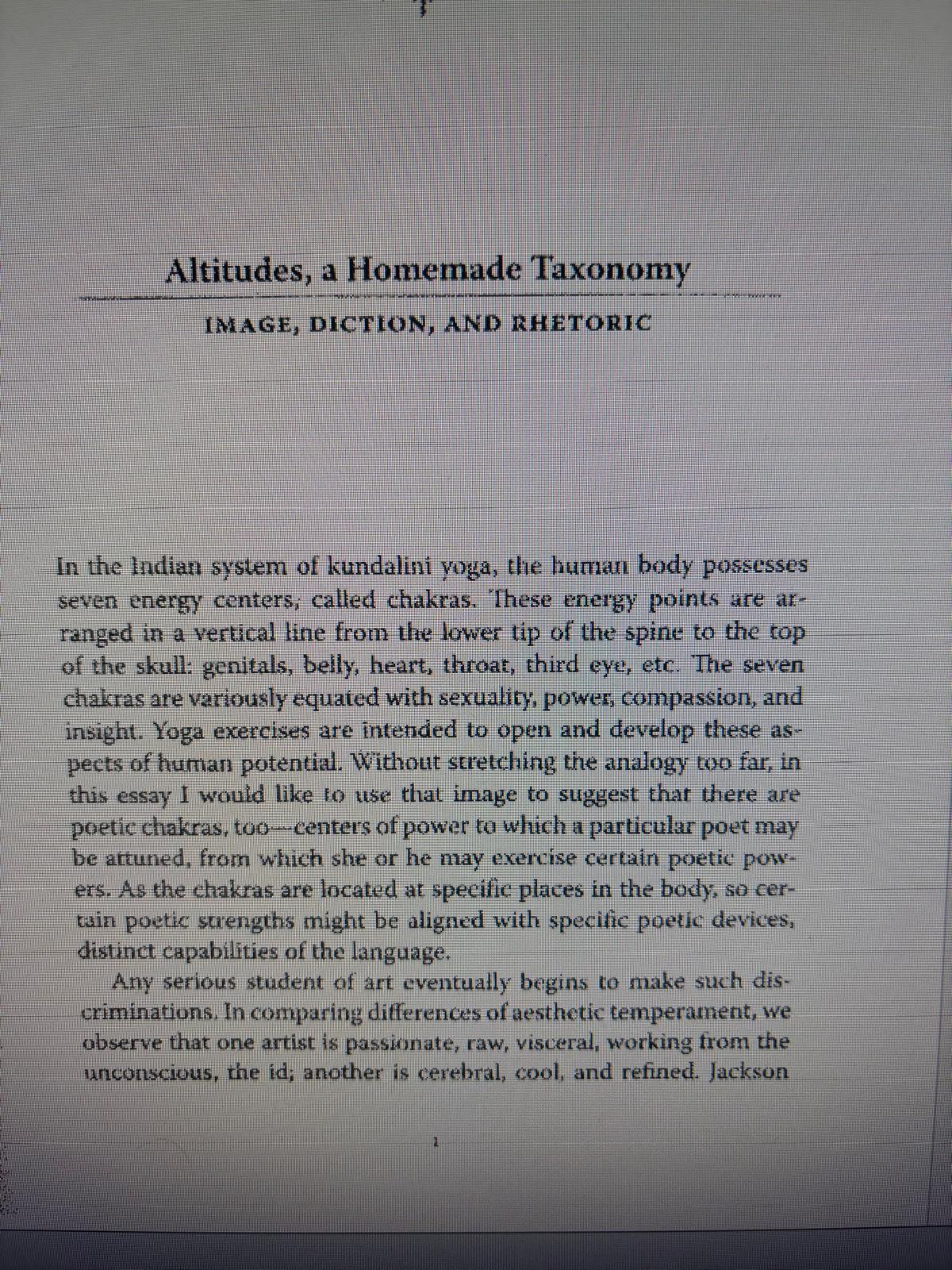
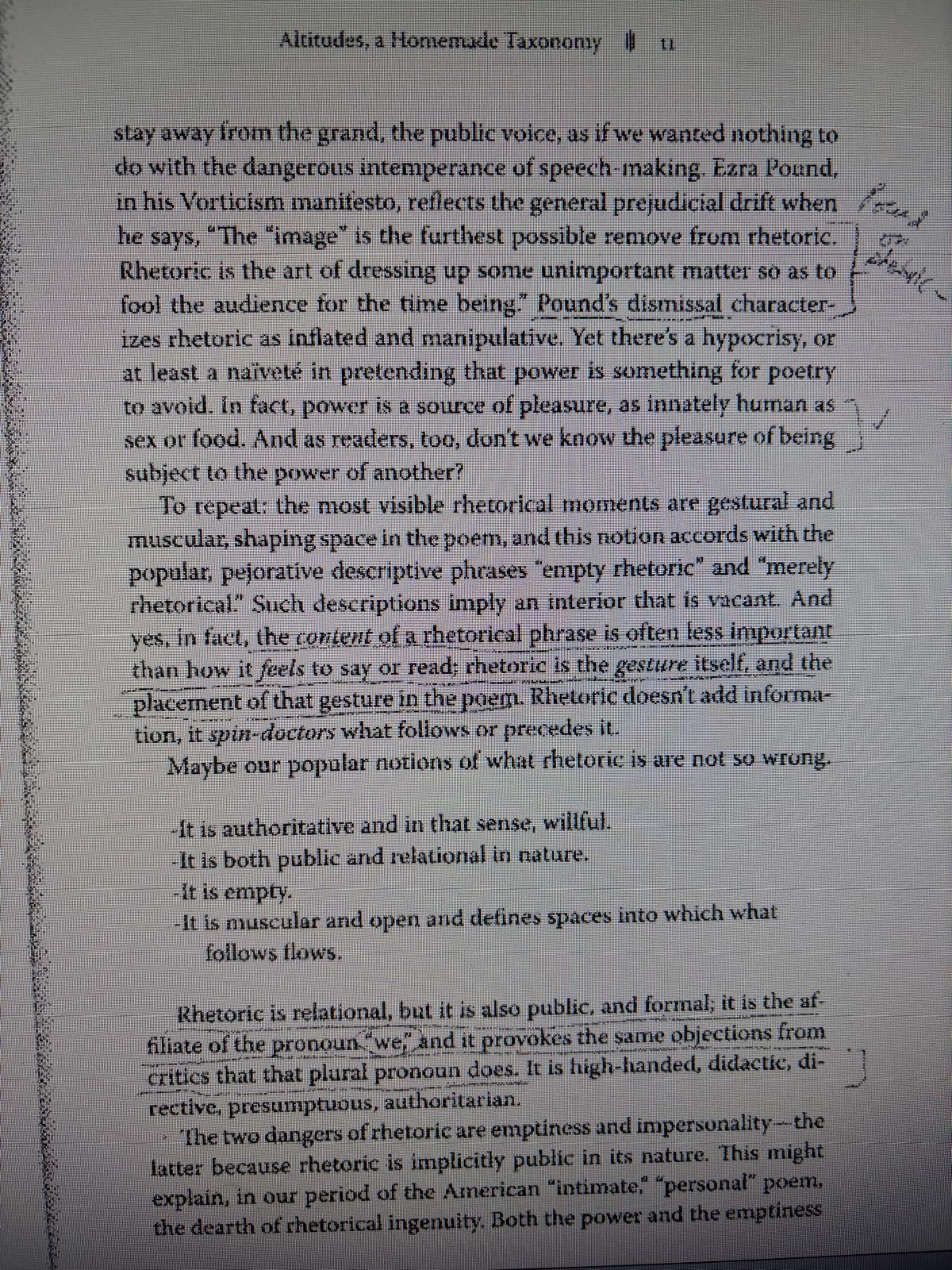
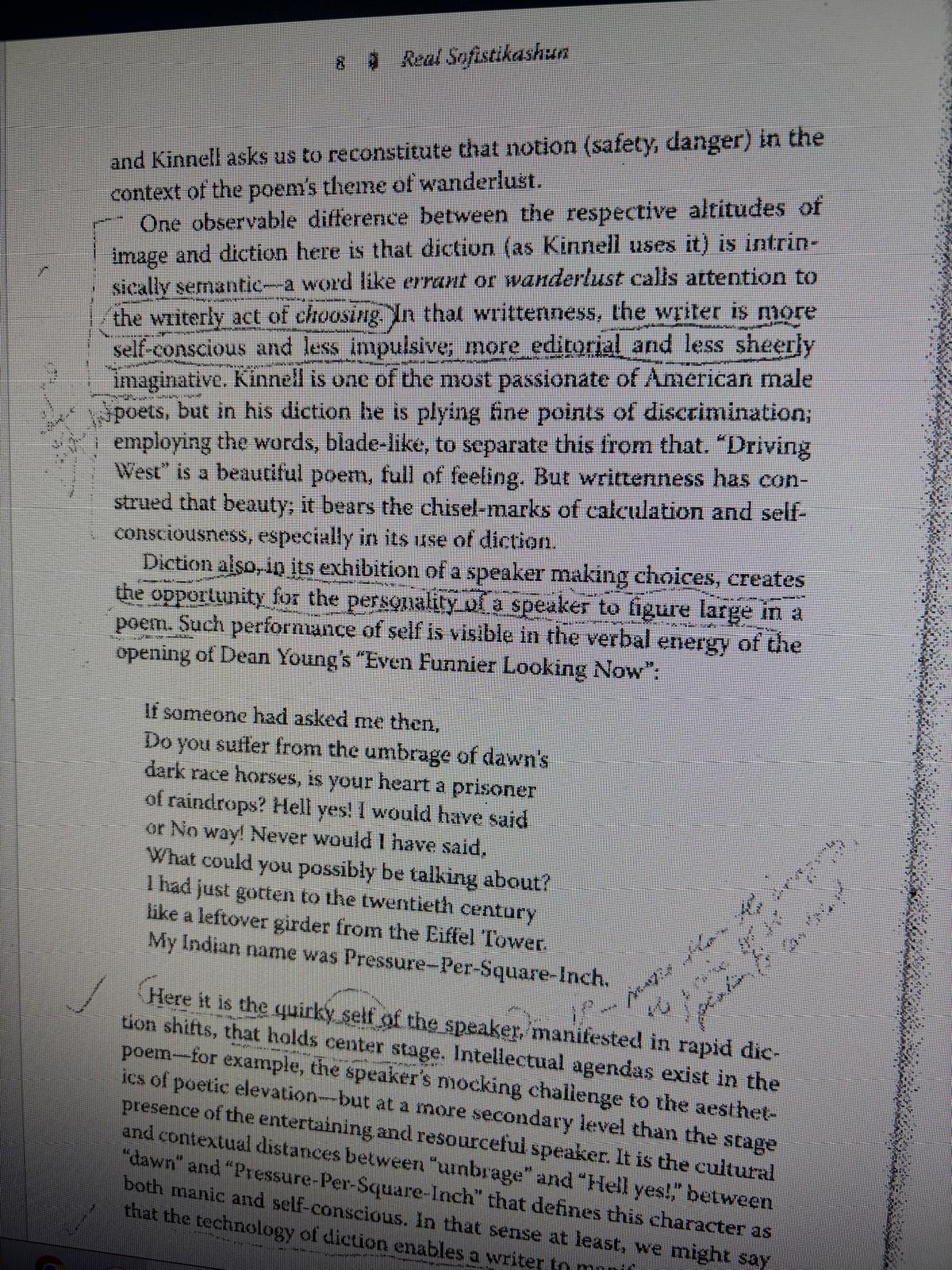
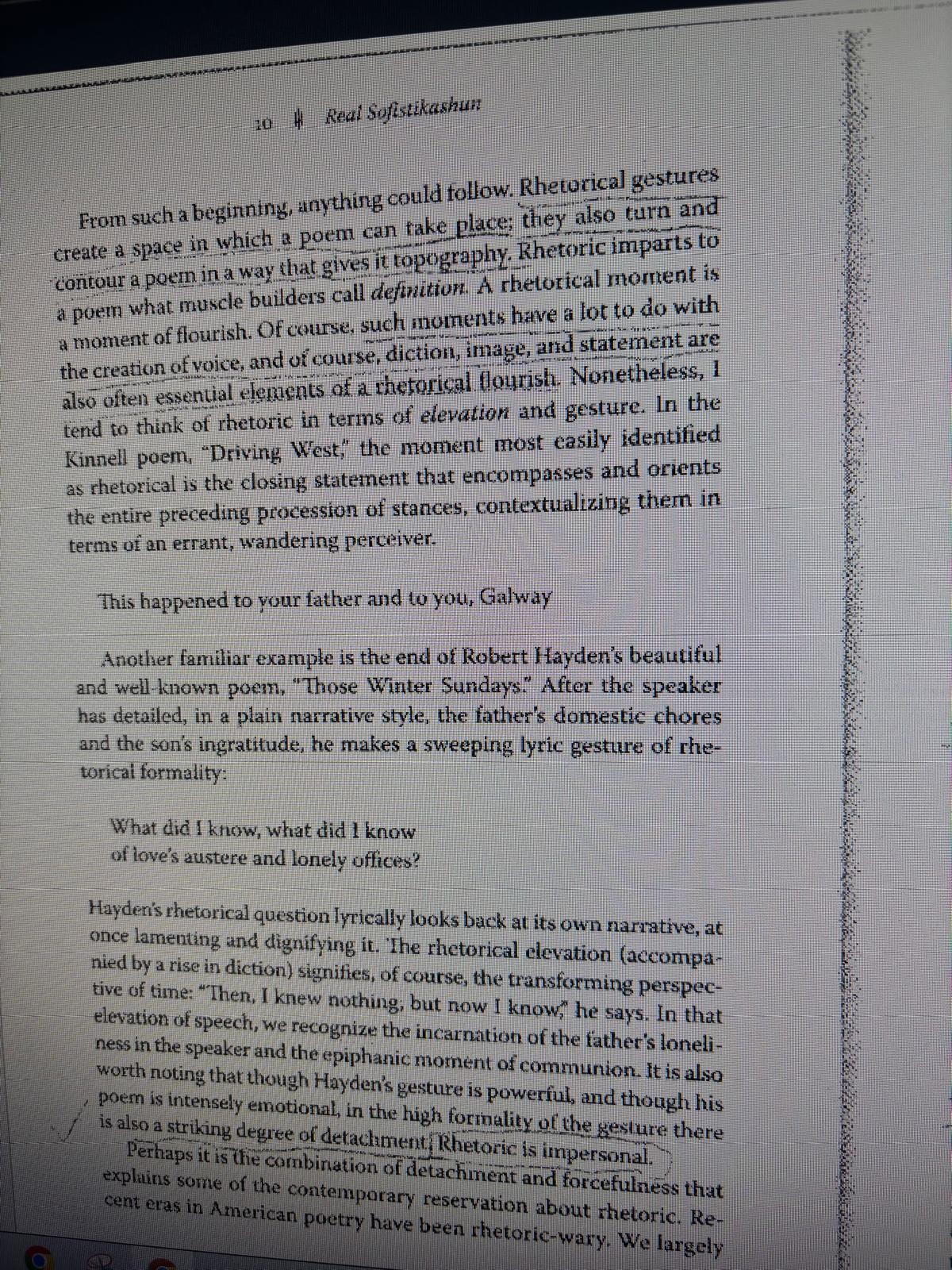
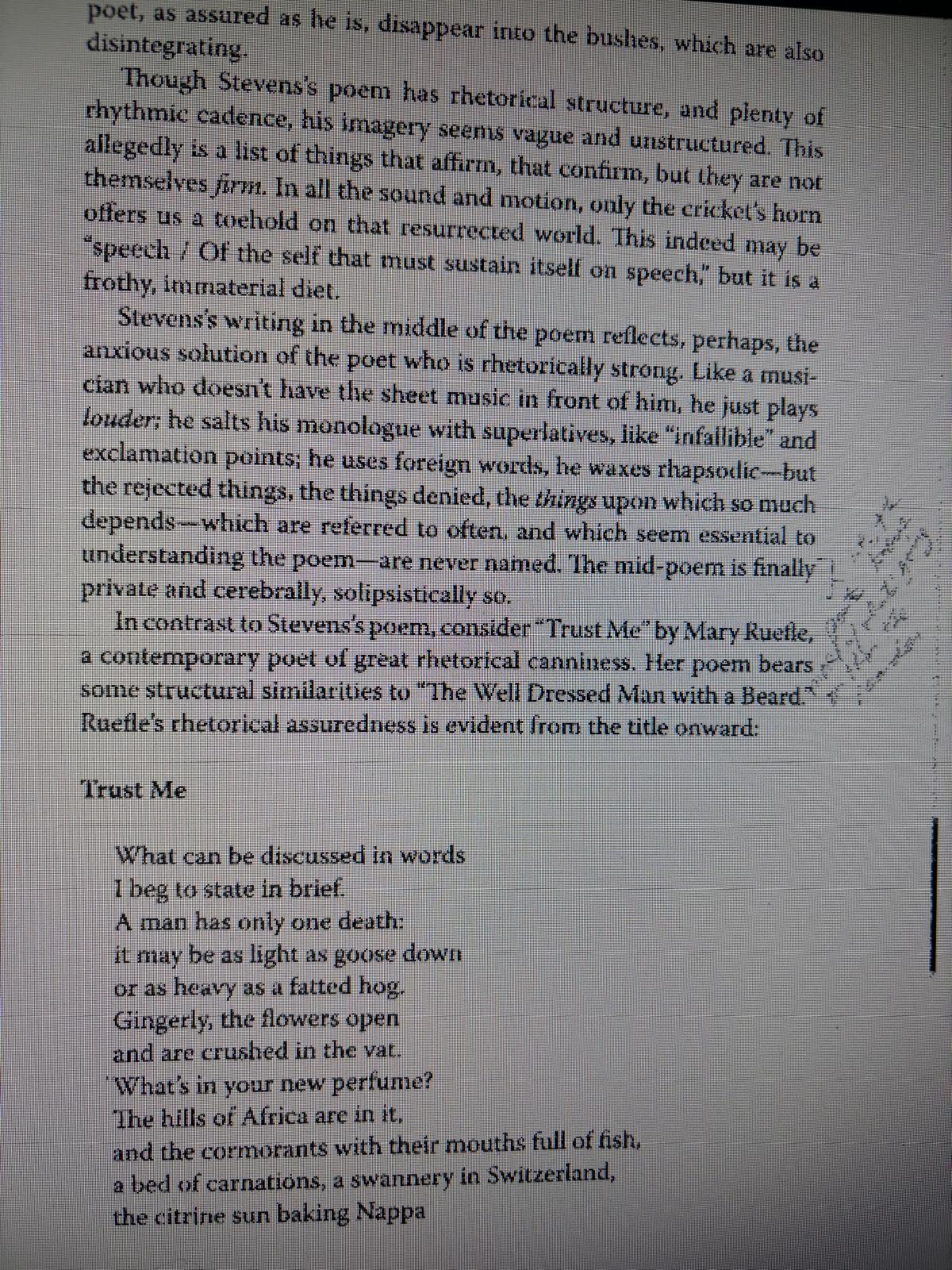
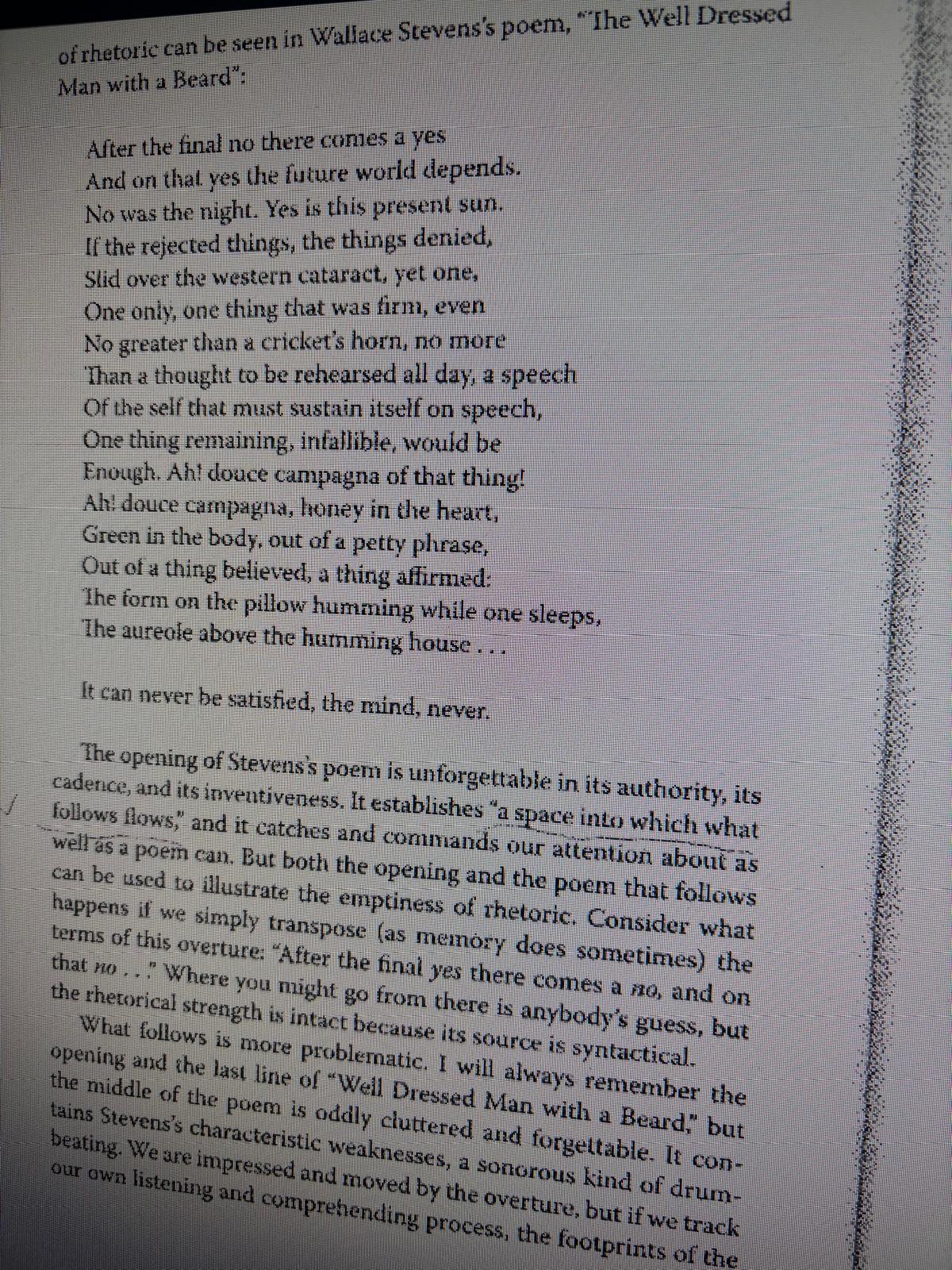
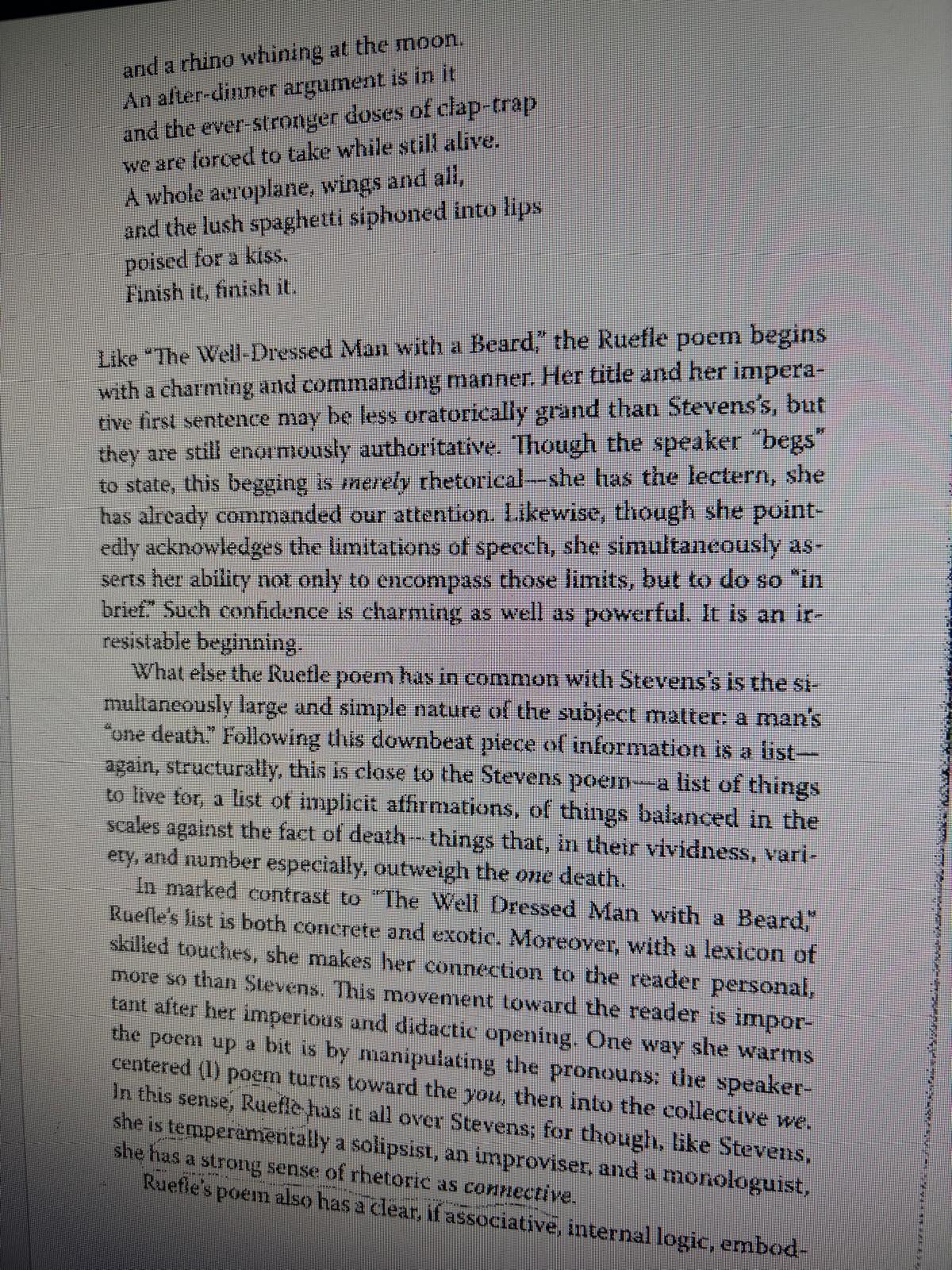
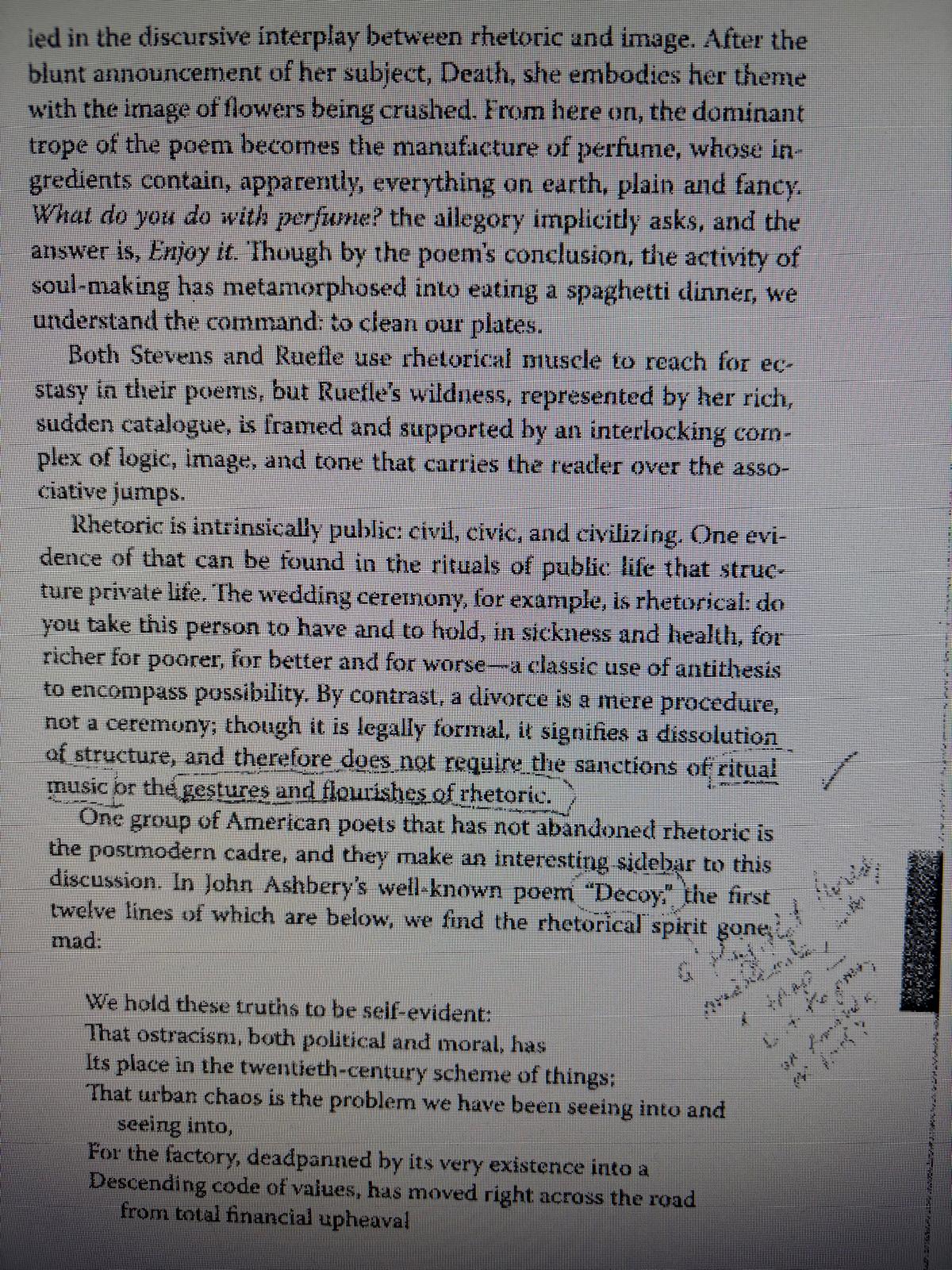
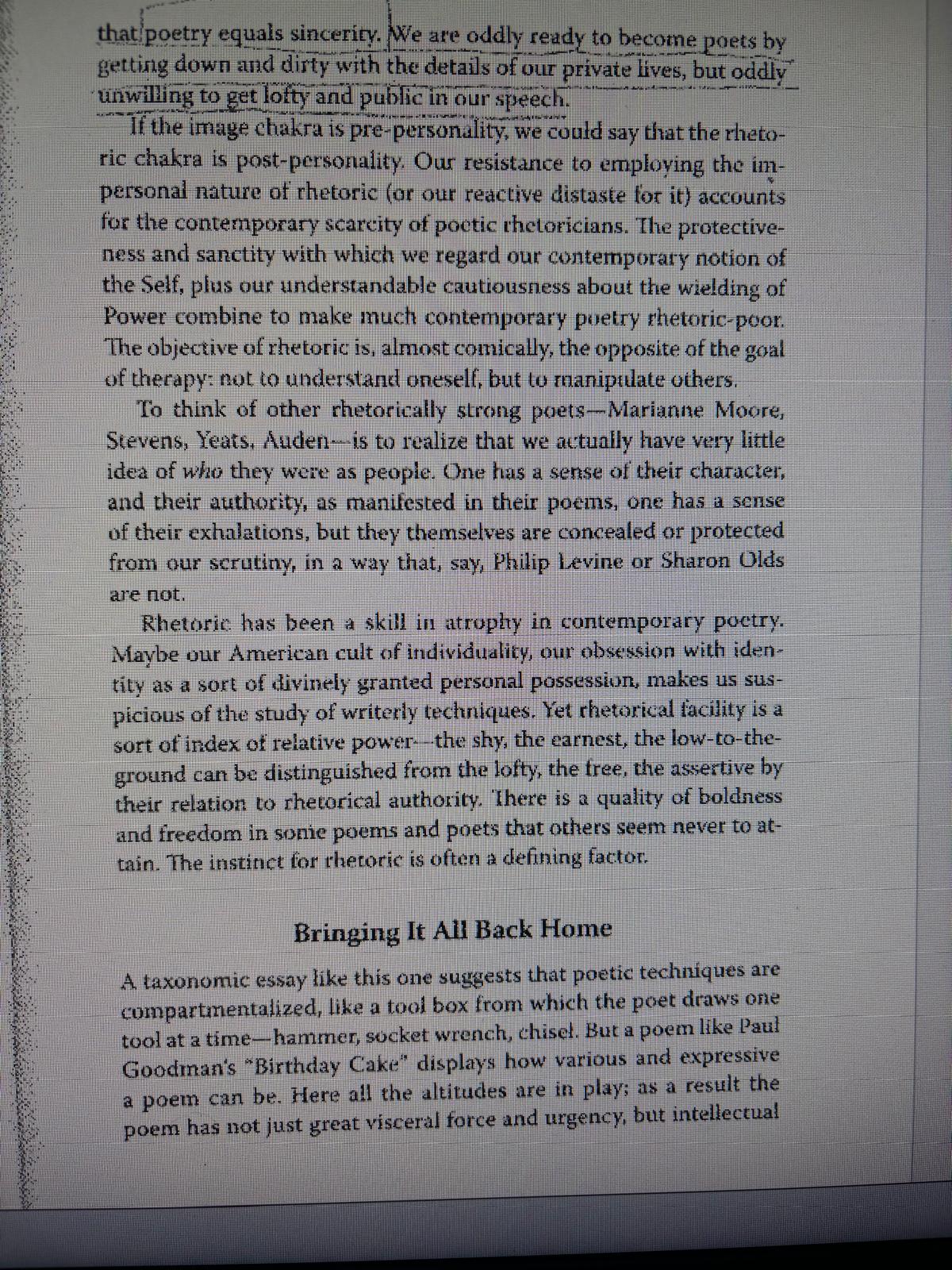
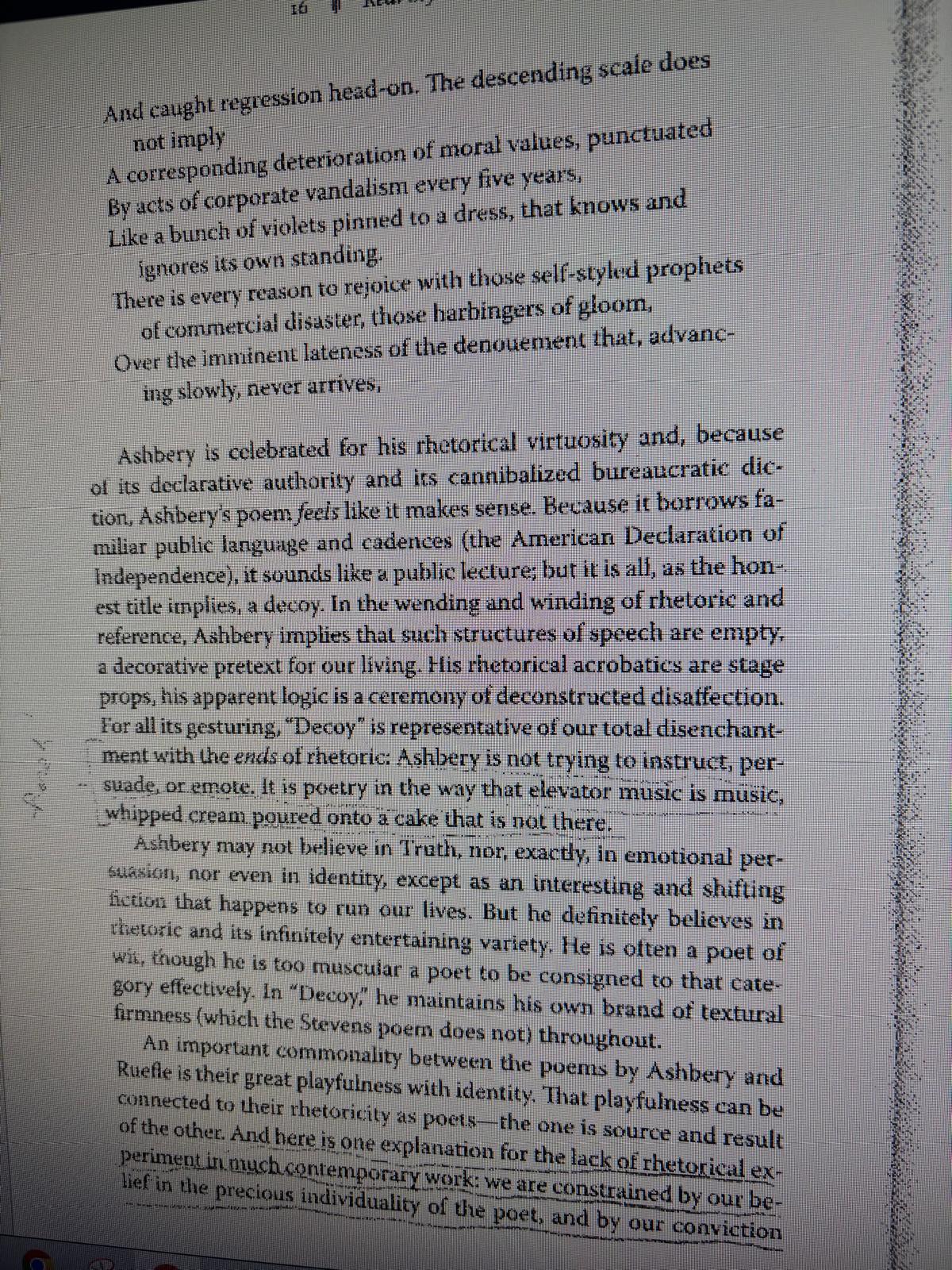
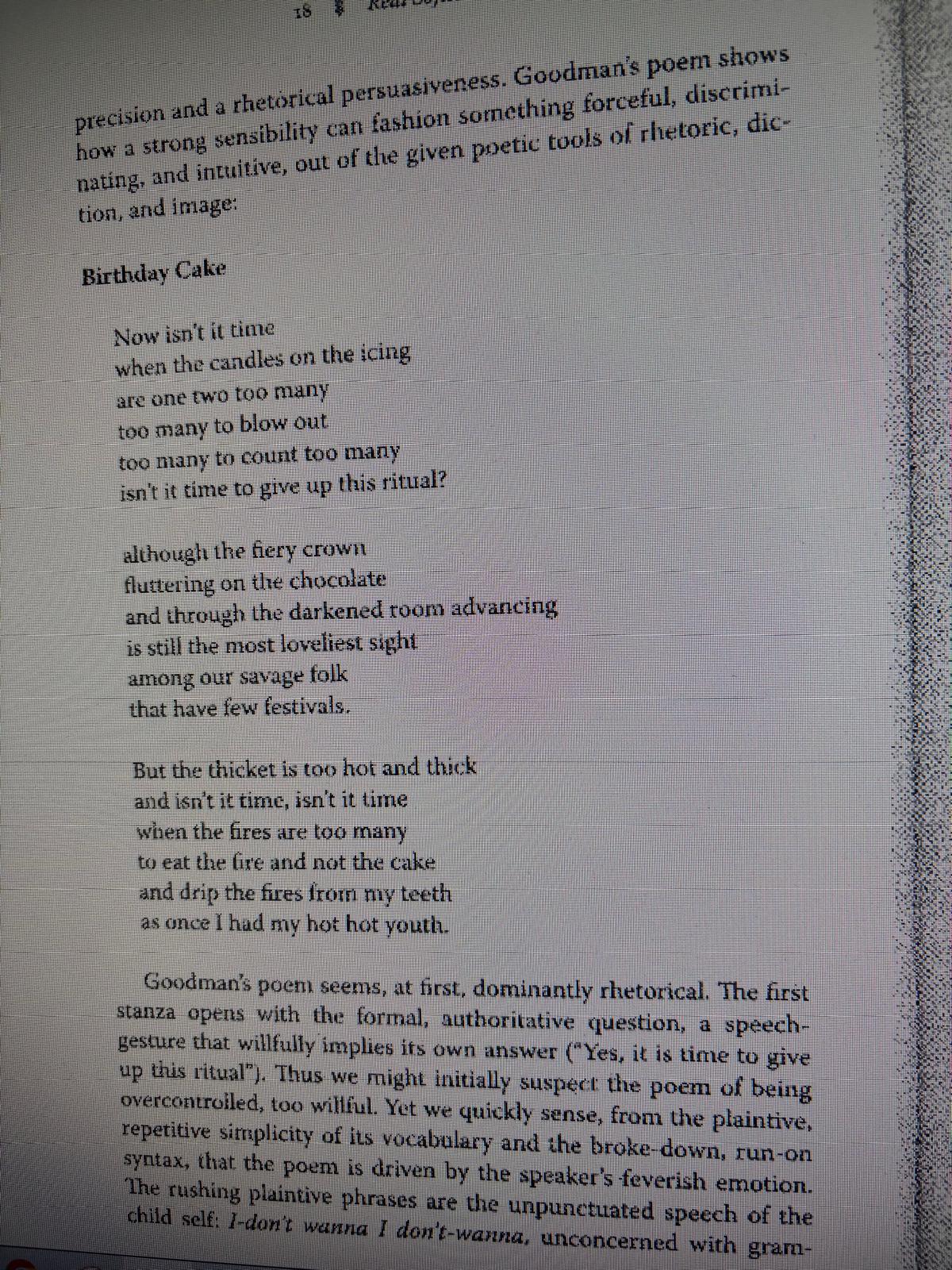
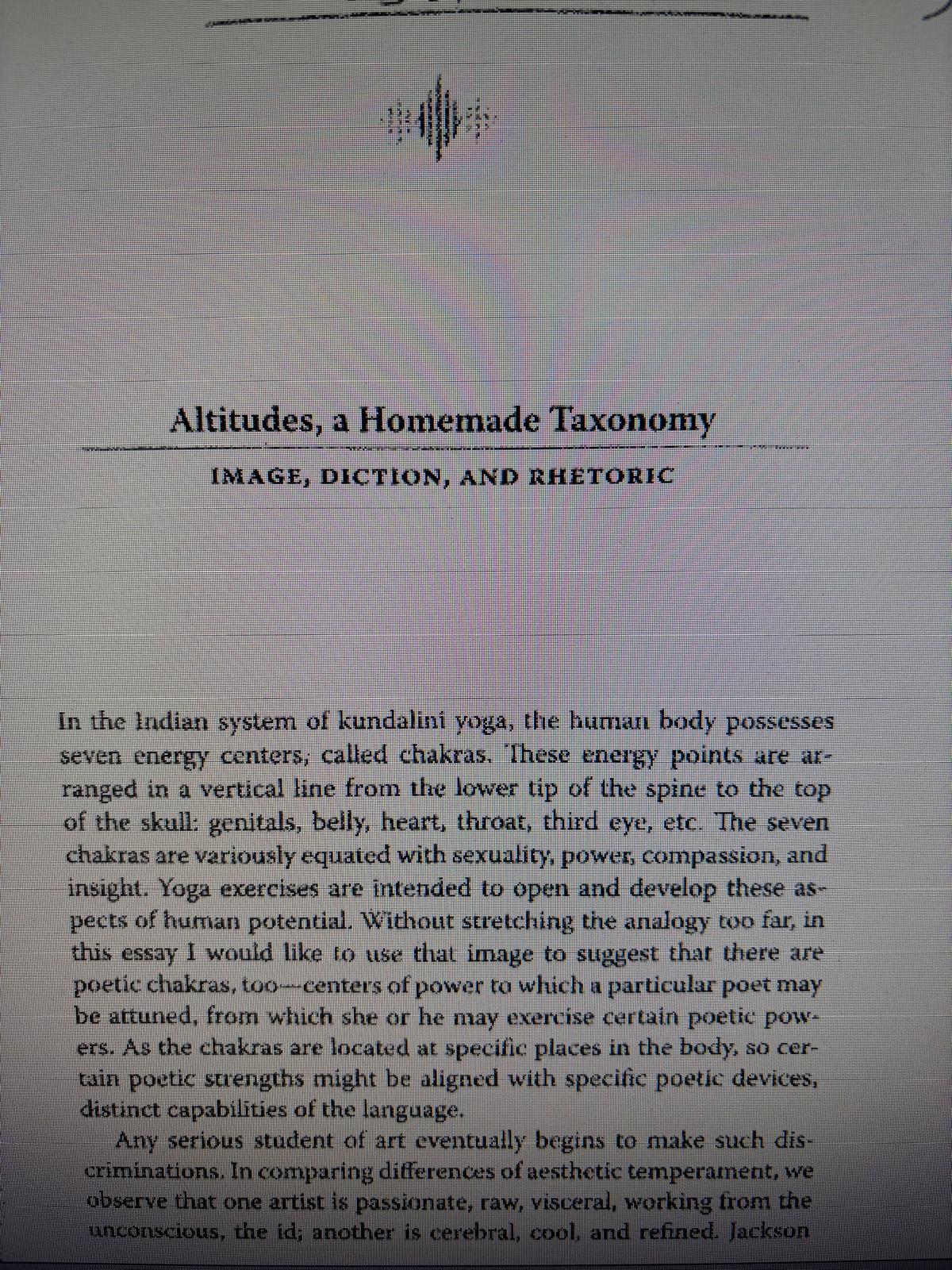
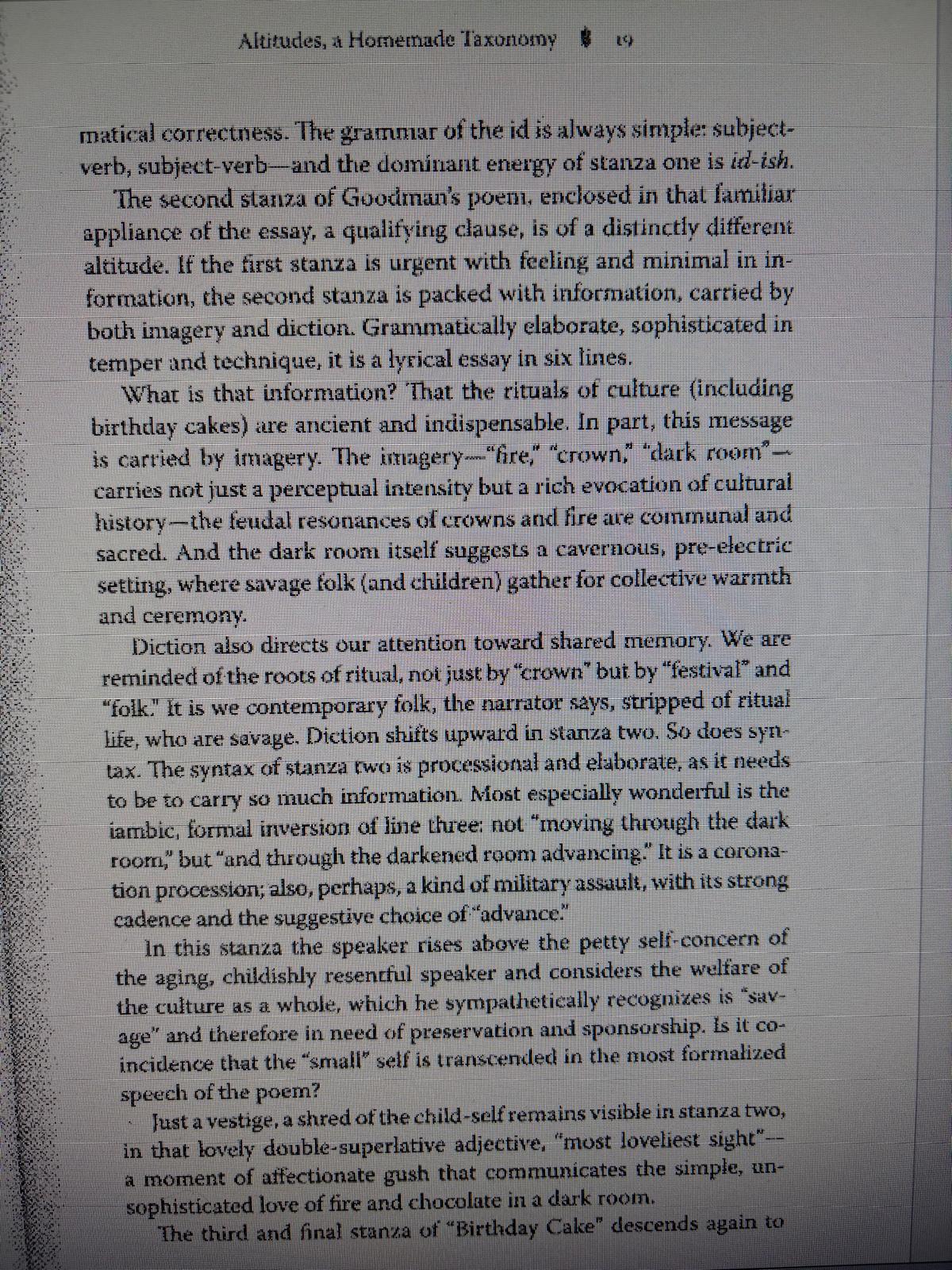
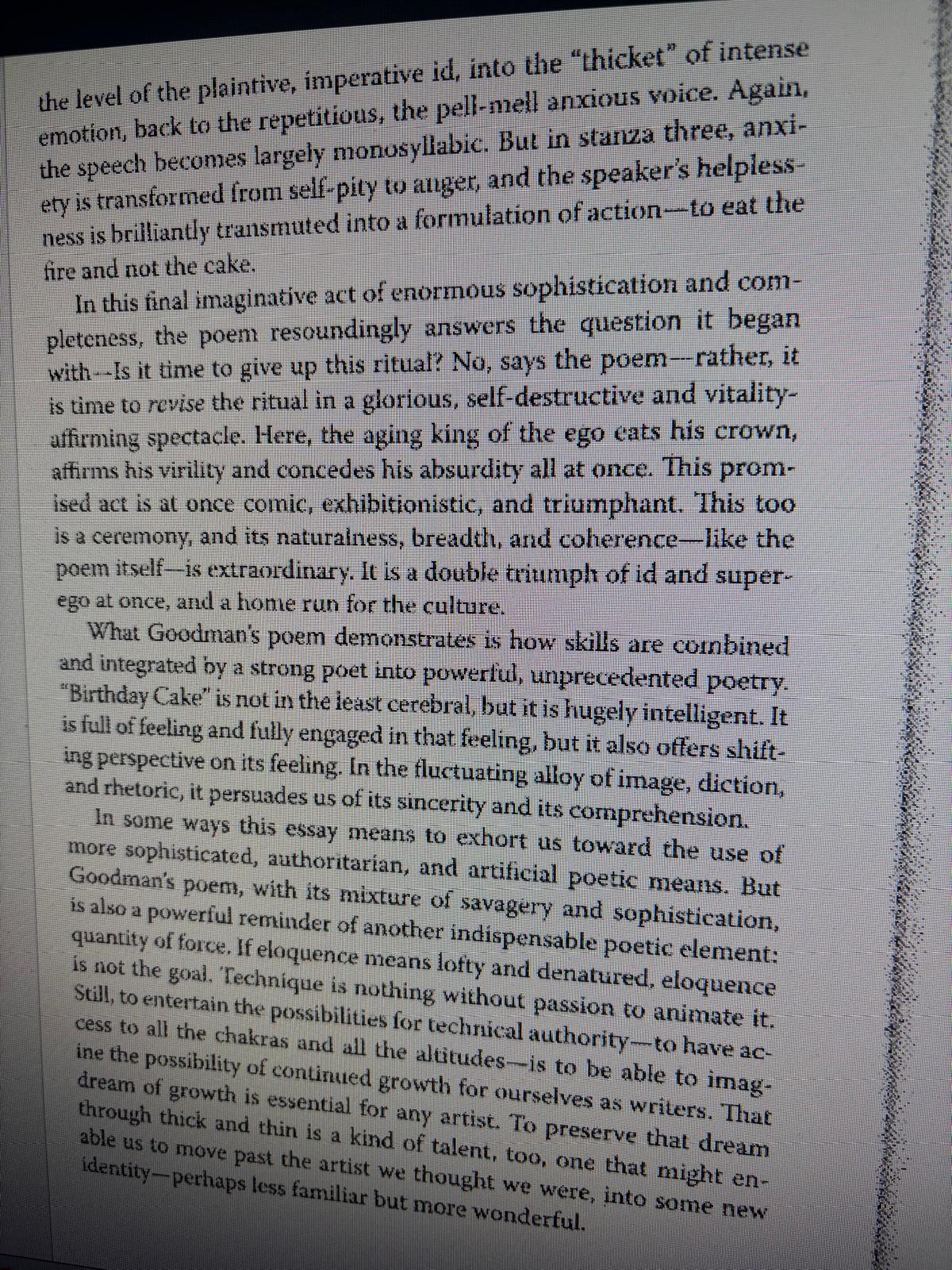
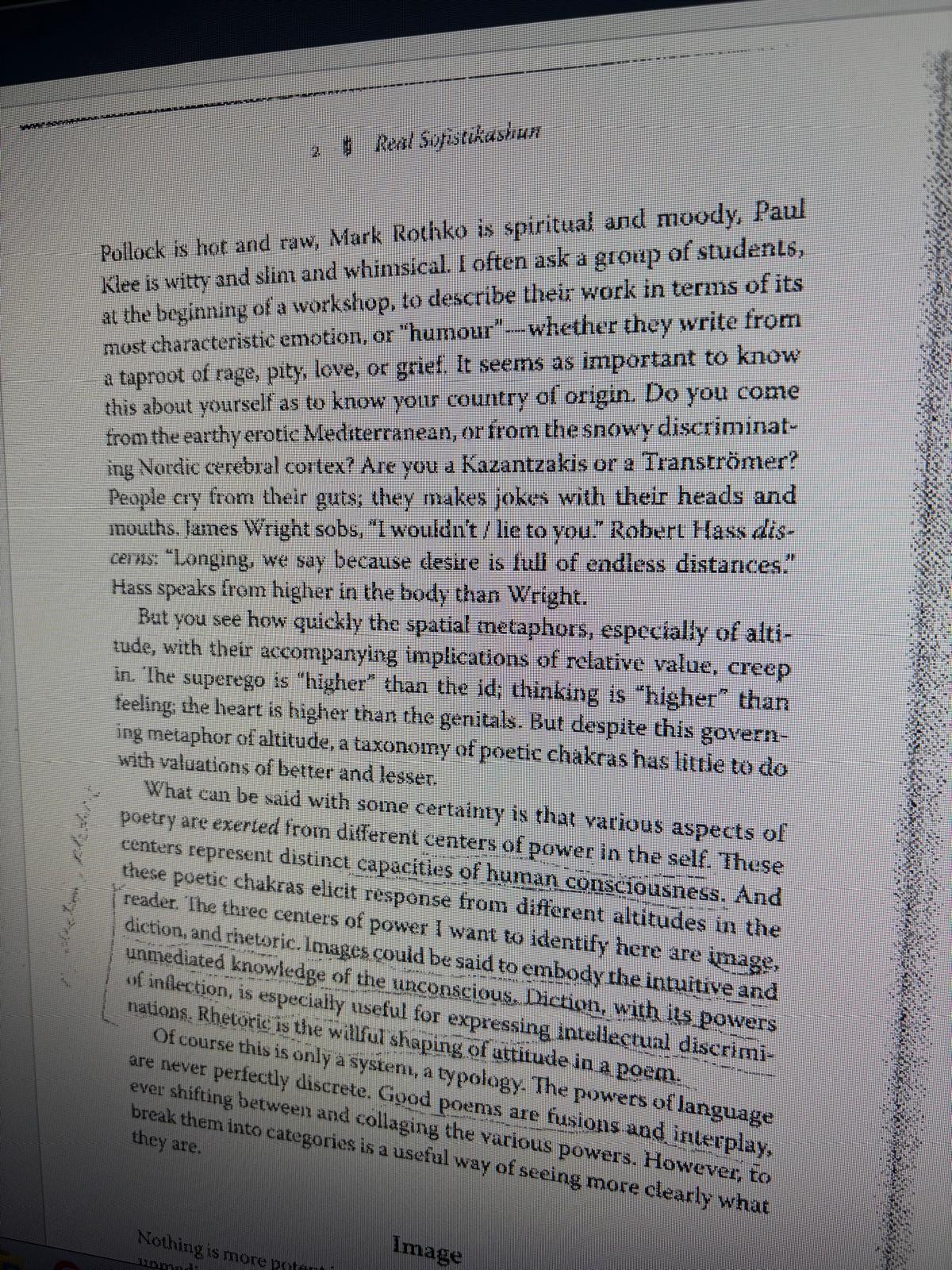
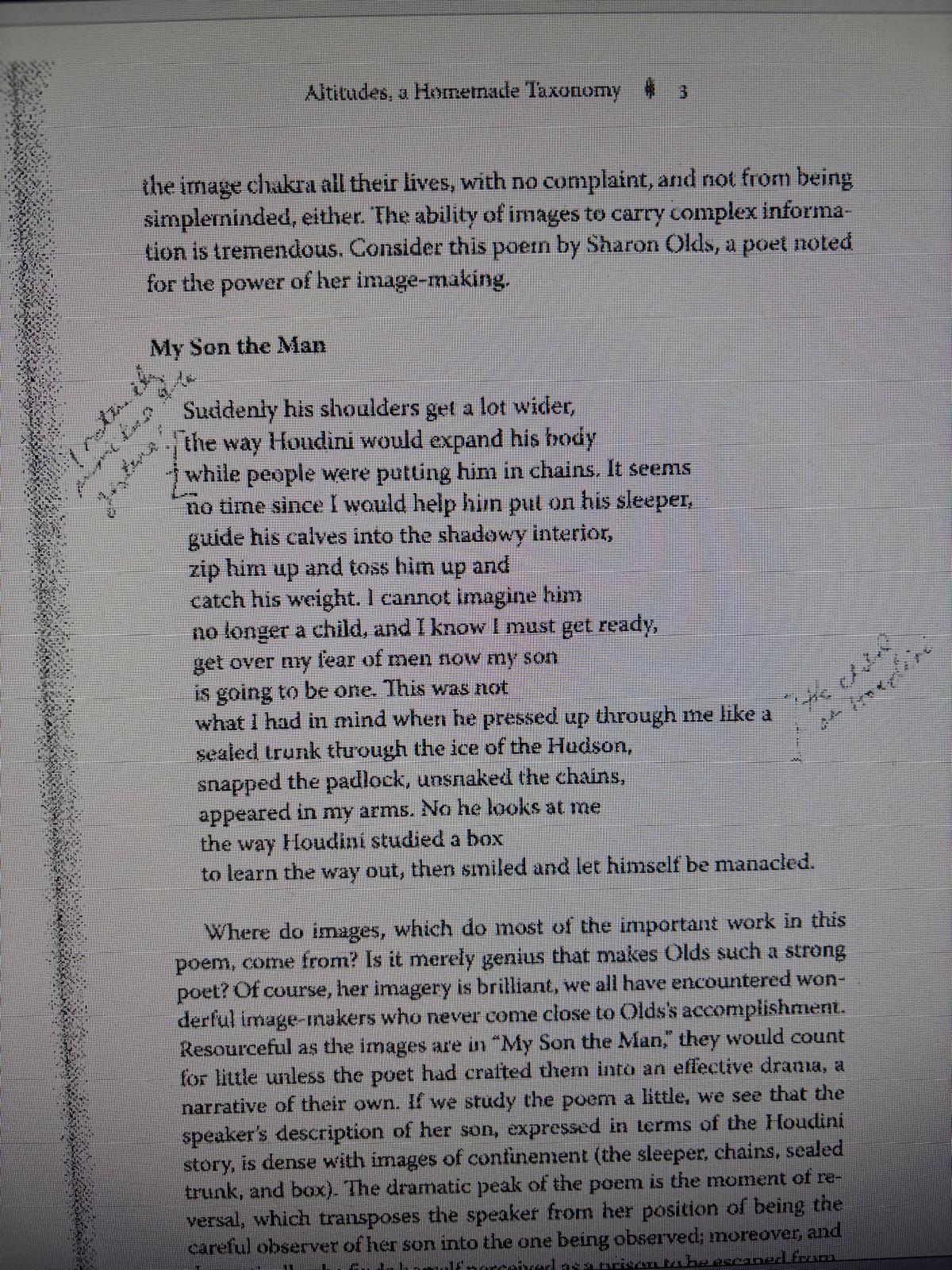
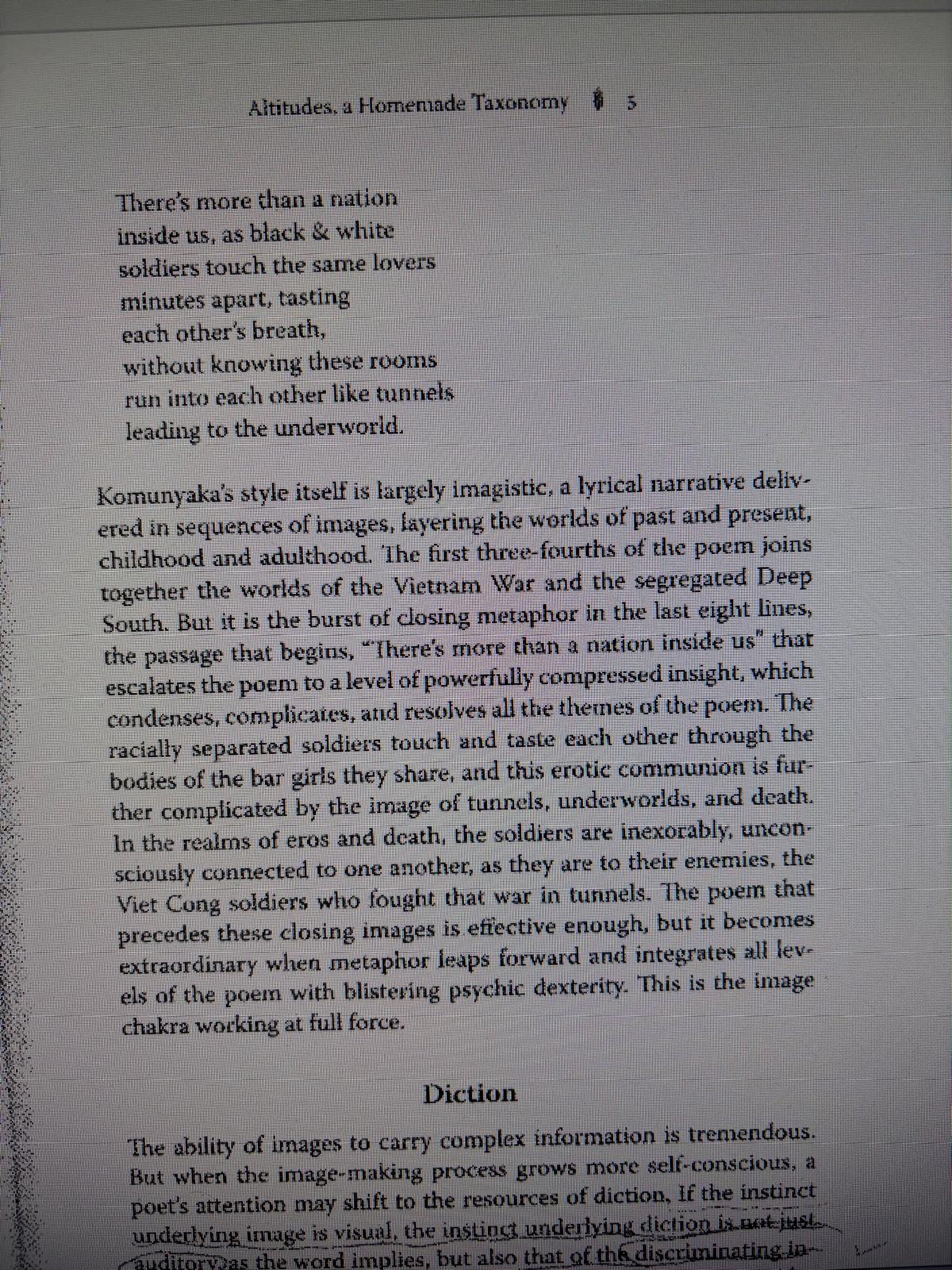
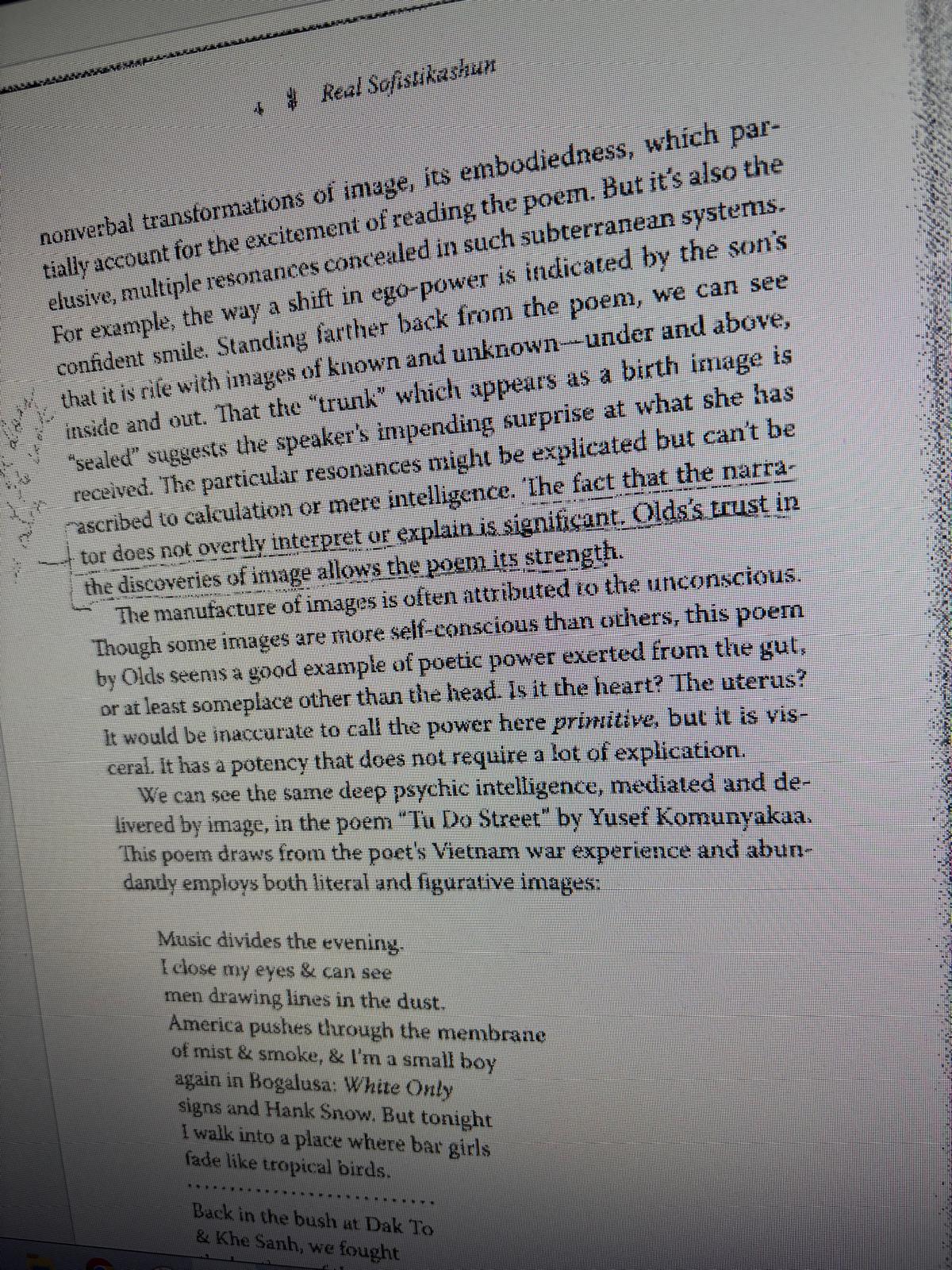
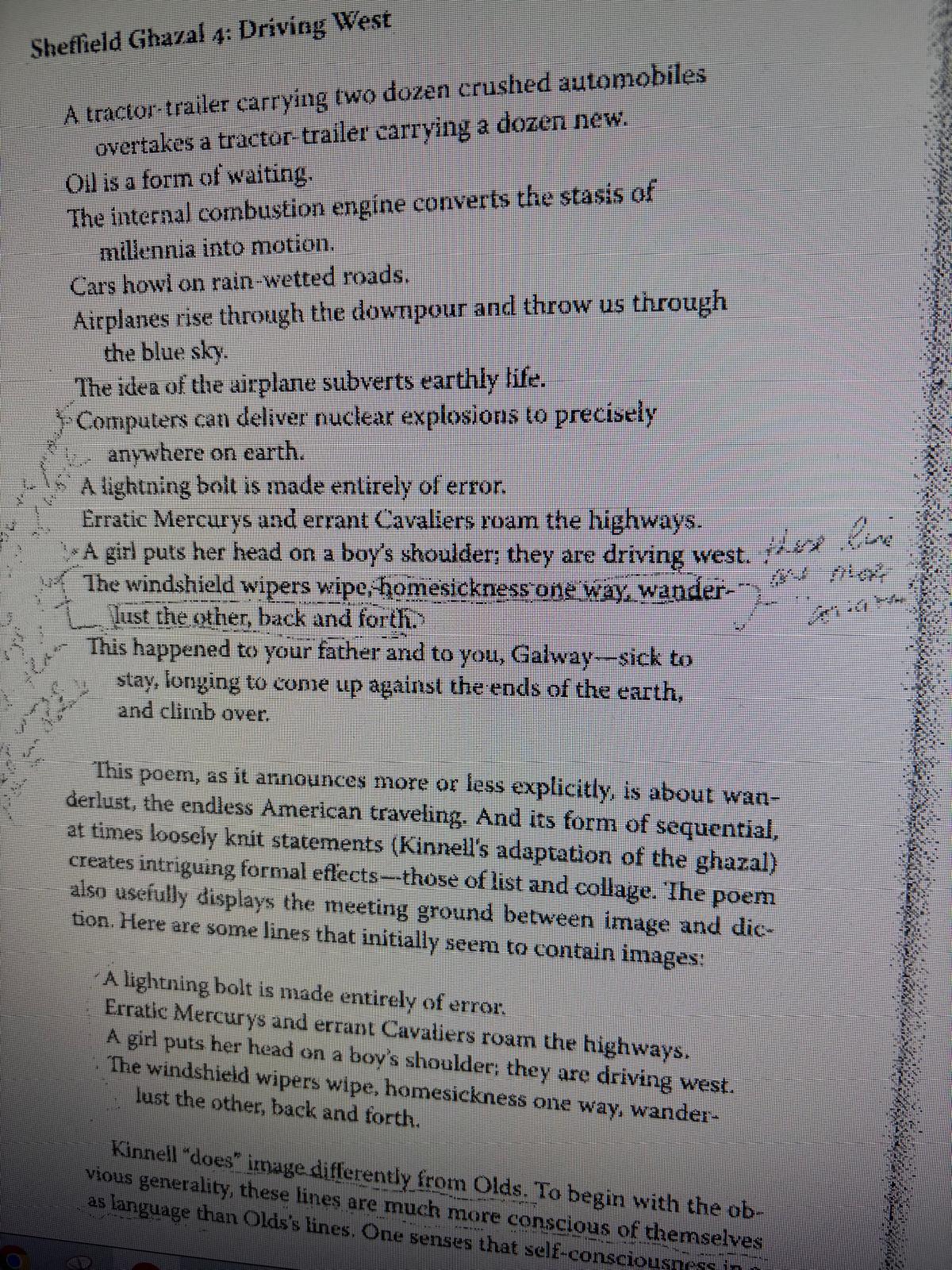
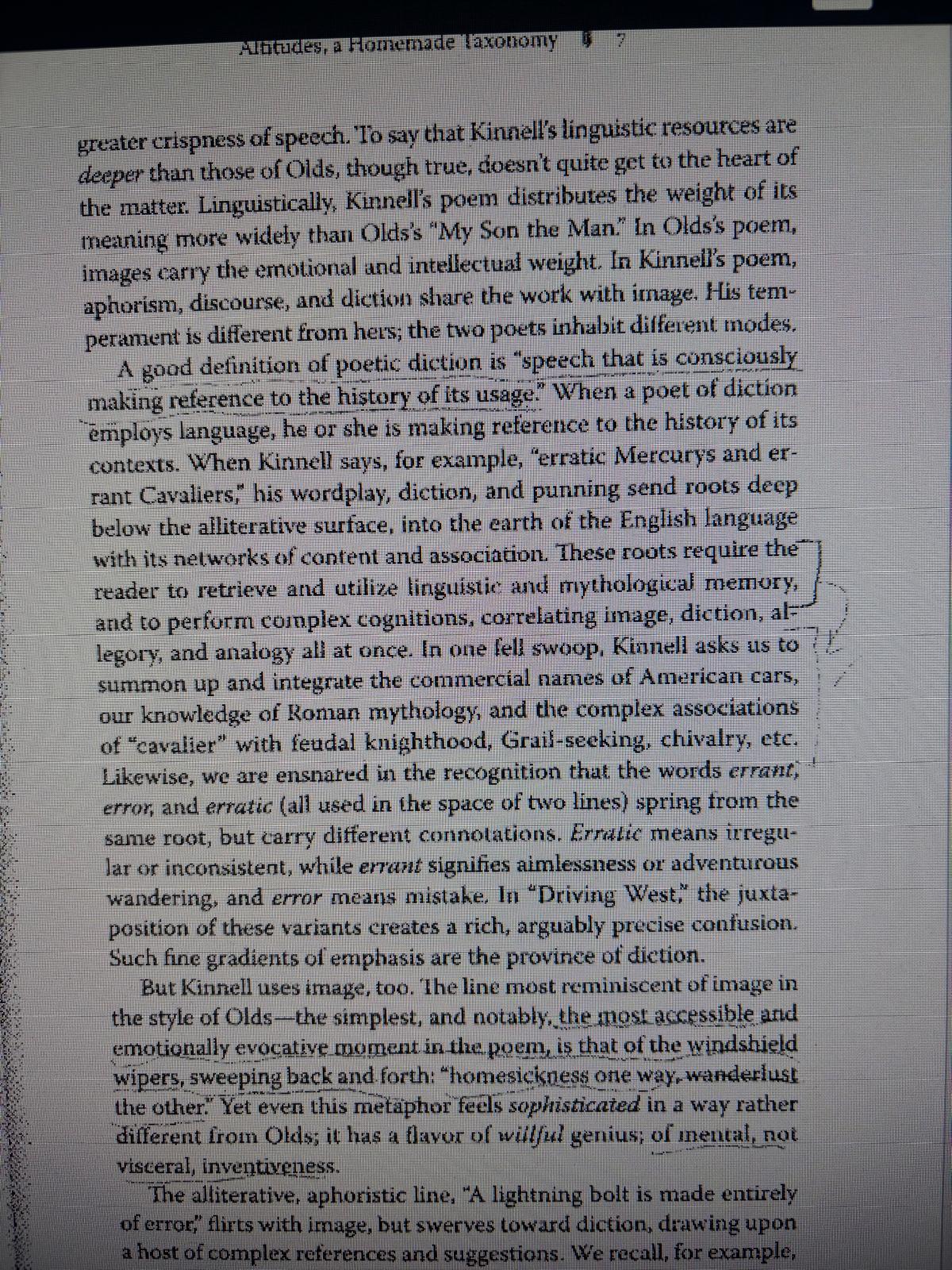
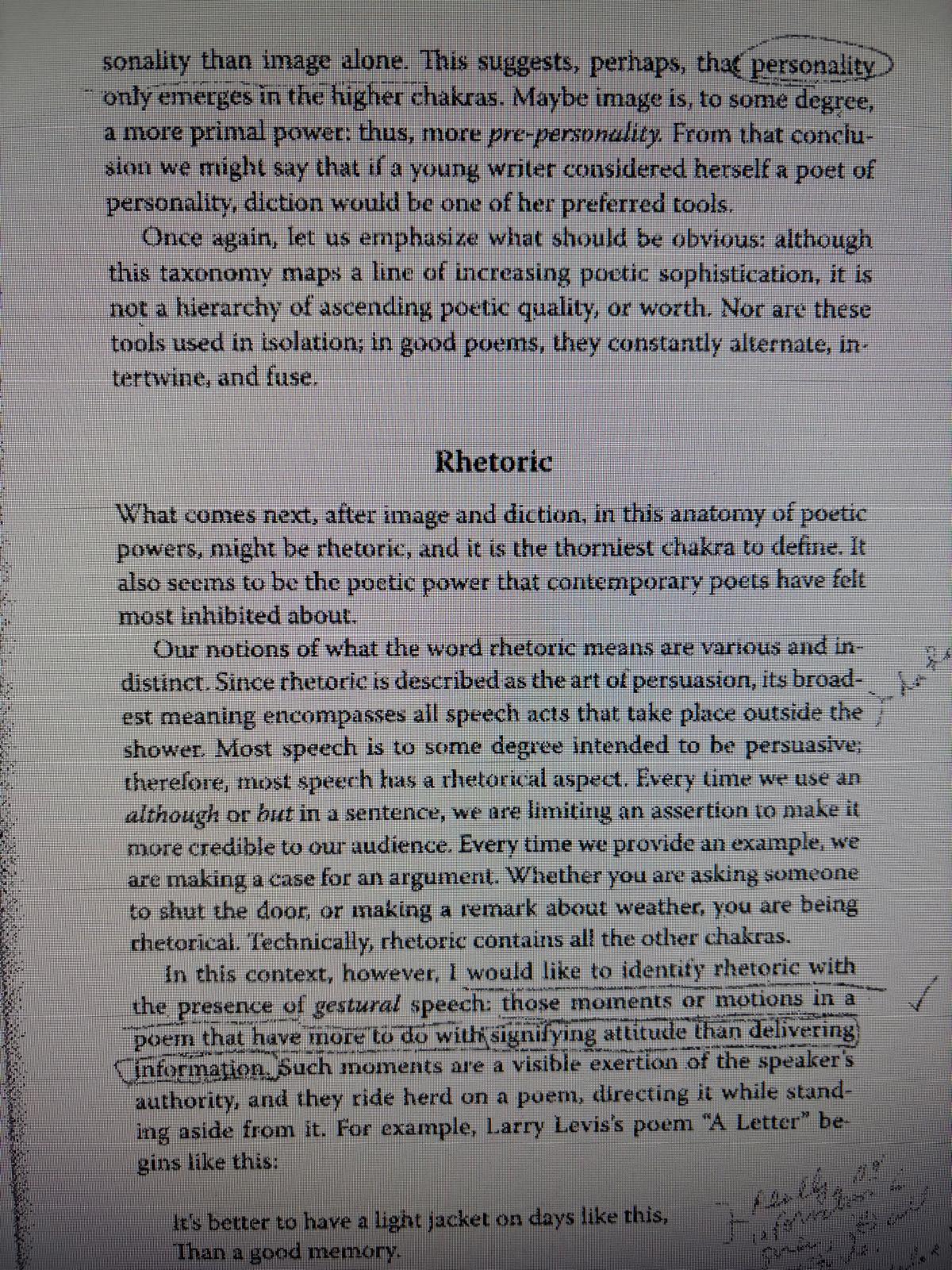
Altitudes, a Homemade Taxonomy IMAGE, DICTION, AND RHETORIC In the Indian system of kundalini yoga, the human body possesses seven energy centers, called chakras. These energy points are ar- ranged in a vertical line from the lower tip of the spine to the top of the skull: genitals, belly, heart, throat, third eye, etc. The seven chakras are variously equated with sexuality, power, compassion, and insight. Yoga exercises are intended to open and develop these as- pects of human potential. Without stretching the analogy too far, in this essay I would like to use that image to suggest that there are poetic chakras, too-centers of power to which a particular poet may be attuned, from which she or he may exercise certain poetic pow- ers. As the chakras are located at specific places in the body, so cer- tain poetic strengths might be aligned with specific poetic devices, distinct capabilities of the language. Any serious student of art eventually begins to make such dis- criminations. In comparing differences of aesthetic temperament, we observe that one artist is passionate, raw, visceral, working from the unconscious, the id; another is cerebral, cool, and refined. JacksonAltitudes, a Homemade Taxonomy stay away from the grand, the public voice, as if we wanted nothing to do with the dangerous intemperance of speech-making. Ezra Pound, in his Vorticism manitesto, reflects the general prejudicial drift when he says, "The "image" is the furthest possible remove from rhetoric. Rhetoric is the art of dressing up some unimportant matter so as to fool the audience for the time being." Pound's dismissal character- izes rhetoric as inflated and manipulative. Yet there's a hypocrisy, or at least a naivete in pretending that power is something for poetry to avoid. in fact, power is a source of pleasure, as innately human as sex or food. And as readers, too, don't we know the pleasure of being subject to the power of another? To repeat: the most visible rhetorical moments are gestural and muscular, shaping space in the poem, and this notion accords with the popular, pejorative descriptive phrases "empty rhetoric" and "merely rhetorical" Such descriptions imply an interior that is vacant. And yes, in fact, the content of a rhetorical phrase is often less important than how it feels to say or read; rhetoric is the gesture itself, and the placement of that gesture in the poem. Rhetoric doesn't add informa- tion, it spin-doctors what follows or precedes it. Maybe our popular notions of what rhetoric is are not so wrong it is authoritative and in that sense, willful. /It is both public and relational in nature. -it is empty. -It is muscular and open and defines spaces into which what follows flows. Rhetoric is relational, but it is also public, and formal; it is the at- filiate of the pronoun "we" and it provokes the same objections from critics that that plural pronoun does. It is high-handed, didactic, di- rective, presumptuous, authoritarian. "The two dangers of rhetoric are emptiness and impersonality-the latter because rhetoric is implicitly public in its nature. This might explain, in our period of the American "intimate." "personal" poem, the dearth of rhetorical ingenuity. Both the power and the emptiness8 3 Real Sofistikashua and Kinnell asks us to reconstitute that notion (safety, danger) in the context of the poem's theme of wanderlust. One observable difference between the respective altitudes of image and diction here is that diction (as Kinnell uses it) is intrin- sically semantic-a word like errant or wanderlust calls attention to the writerly act of choosing. In that writtenness, the writer is more self-conscious and less impulsive; more editorial and less sheerly imaginative. Kinnell is one of the most passionate of American male poets, but in his diction he is plying fine points of discrimination; employing the words, blade-like, to separate this from that. "Driving West" is a beautiful poem, full of feeling. But writtenness has con- strued that beauty; it bears the chisel-marks of calculation and self- consciousness, especially in its use of diction. Diction also, in its exhibition of a speaker making choices, creates the opportunity for the personality ola speaker to figure large in a poem. Such performance of self is visible in the verbal energy of the opening of Dean Young's "Even Funnier Looking Now": If someone had asked me then, Do you suffer from the umbrage of dawn's dark race horses, is your heart a prisoner of raindrops? Hell yes! I would have said or No way! Never would I have said. What could you possibly be talking about? I had just gotten to the twentieth century like a leftover girder from the Eiffel Tower. My Indian name was Pressure-Per-Square-Inch. Here it is the quirky self of the speaker, manifested in rapid dic- tion shifts, that holds center stage, Intellectual agendas exist in the poem-for example, the speaker's mocking challenge to the aesthet ics of poetic elevation-but at a more secondary level than the stage presence of the entertaining and resourceful speaker. It is the cultural and contextual distances between "winbrage" and "Hell yes!" between "dawn" and "Pressure-Per-Square-Inch" that defines this character as both manic and self-conscious. In that sense at least, we might say that the technology of diction enables a writer in my10 4 Real Sofistikashun From such a beginning, anything could follow. Rhetorical gestures create a space in which a poem can take place; they also turn and contour a poem in a way that gives it topography. Rhetoric imparts to a poem what muscle builders call definition. A rhetorical moment is a moment of flourish. Of course, such moments have a lot to do with the creation of voice, and of course, diction, image, and statement are also often essential elements of a rhetorical flourish. Nonetheless, I tend to think of rhetoric in terms of elevation and gesture. In the Kinnell poem, "Driving West," the moment most easily identified as rhetorical is the closing statement that encompasses and orients the entire preceding procession of stances, contextualizing them in terms of an errant, wandering perceiver- This happened to your father and to you, Galway Another familiar example is the end of Robert Hayden's beautiful and well-known poem, "Those Winter Sundays." After the speaker has detailed, in a plain narrative style, the father's domestic chores and the son's ingratitude, he makes a sweeping lyric gesture of the- torical formality: What did I know, what did I know of love's austere and lonely offices? Hayden's rhetorical question lyrically looks back at its own narrative, at once lamenting and dignifying it. The rhetorical elevation (accompa- nied by a rise in diction) signifies, of course, the transforming perspec- tive of time: "Then, I knew nothing, but now I know," he says. In that elevation of speech, we recognize the incarnation of the father's loneli- ness in the speaker and the epiphanic moment of communion. It is also worth noting that though Hayden's gesture is powerful, and though his poem is intensely emotional, in the high formality of the gesture there is also a striking degree of detachment Rhetoric is impersonal. Perhaps it is the combination of detachment and forcefulness that explains some of the contemporary reservation about rhetoric, Re- cent eras in American poetry have been rhetoric-wary. We largelypoet, as assured as he is, disappear into the bushes, which are also disintegrating. Though Stevens's poem has rhetorical structure, and plenty of rhythmic cadence, his imagery seems vague and unstructured. This allegedly is a list of things that affirm, that confirm, but they are not themselves firm. In all the sound and motion, only the cricket's horn offers us a toehold on that resurrected world. This indeed may be "speech / Of the self that must sustain itself on speech," but it is a frothy, immaterial diet. Stevens's writing in the middle of the poem reflects, perhaps, the anxious solution of the poet who is rhetorically strong. Like a musi- cian who doesn't have the sheet music in front of him, he just plays louder; he salts his monologue with superlatives, like "infallible" and exclamation points; he uses foreign words, he waxes rhapsodic-but the rejected things, the things denied, the things upon which so much depends-which are referred to often, and which seem essential to understanding the poem-are never named. The mid-poem is finally private and cerebrally, solipsistically so. In contrast to Stevens's poem, consider "Trust Me" by Mary Ruelle, temporary poet of great rhetorical canniness. Her poem bears some structural similarities to "The Well Dressed Man with a Beard." Ruefle's rhetorical assuredness is evident from the title onward: Trust Me What can be discussed in words I beg to state in brief. A man has only one death: it may be as light as goose down or as heavy as a fatted hog. Gingerly, the flowers open and are crushed in the vat. What's in your new perfume? The hills of Africa are in it. and the cormorants with their mouths full of fish, a bed of carnations, a swannery in Switzerland, the citrine sun baking Nappaof rhetoric can be seen in Wallace Stevens's poem, "The Well Dressed Man with a Beard": After the final no there comes a yes And on that yes the future world depends. No was the night. Yes is this present sun. If the rejected things, the things denied, Slid over the western cataract, yet one, One only, one thing that was firm, even No greater than a cricket's horn, no more Than a thought to be rehearsed all day, a speech Of the self that must sustain itself on speech, One thing remaining, infallible, would be Enough. Ah! douce campagna of that thing! Ah! douce campagna, honey in the heart, Green in the body, out of a petty phrase, Out of a thing believed, a thing affirmed: The form on the pillow humming while one sleeps, The aureole above the humming house . . . It can never be satisfied, the mind, never. The opening of Stevens's poem is unforgettable in its authority, its cadence, and its inventiveness. It establishes "a space into which what follows flows," and it catches and commands our attention about as well as a poem can. But both the opening and the poem that follows can be used to illustrate the emptiness of rhetoric. Consider what happens if we simply transpose (as memory does sometimes) the terms of this overture: "After the final yes there comes a no, and on that no . . . Where you might go from there is anybody's guess, but the rhetorical strength is intact because its source is syntactical. What follows is more problematic. I will always remember the opening and the last line of "Well Dressed Man with a Beard," but the middle of the poem is oddly cluttered and forgettable. It con- Lains Stevens's characteristic weaknesses, a songrous kind of drum- beating. We are impressed and moved by the overture, but if we track our own listening and comprehending process, the footprints of theand a chino whining at the moon. An after-dinner argument is in it and the ever-stronger doses of clap-trap we are forced to take while still alive. A whole aeroplane, wings and all, and the lush spaghetti siphoned into lips poised for a kiss. Finish it, finish it. Like "The Well-Dressed Man with a Beard," the Ruefle poem begins with a charming and commanding manner. Her title and her impera- tive first sentence may be less oratorically grand than Stevens's, but they are still enormously authoritative. Though the speaker "begs" to state, this begging is merely thetorical--she has the lectern, she has already commanded our attention. Likewise, though she point- edly acknowledges the limitations of speech, she simultaneously as- serts her ability not only to encompass those limits, but to do so "in brief." Such confidence is charming as well as powerful. It is an ir- resistable beginning. What else the Ruefle poem has in common with Stevens's is the si- multaneously large and simple nature of the subject matter: a man's "one death." Following this downbeat piece of information is a list- again, structurally, this is close to the Stevens poem-a list of things to live for, a list of implicit affirmations, of things balanced in the scales against the fact of death -- things that, in their vividness, vari- ety, and number especially, outweigh the one death. In marked contrast to "The Well Dressed Man with a Beard," Ruelle's list is both concrete and exotic. Moreover, with a lexicon of skilled touches, she makes her connection to the reader personal, more so than Stevens. This movement toward the reader is impor- tant after her imperious and didactic opening. One way she warms the poem up a bit is by manipulating the pronouns; the speaker- centered (1) poem turns toward the you, then into the collective we. In this sense, Ruefle has it all over Stevens; for though, like Stevens, she is temperamentally a solipsist, an improviser, and a monologuest, she has a strong sense of rhetoric as connective. Ruefie's poem also has a clear, if associative, internal logic, embod-led in the discursive interplay between rhetoric and image. After the blunt announcement of her subject, Death, she embodies her theme with the image of flowers being crushed. From here on, the dominant trope of the poem becomes the manufacture of perfume, whose in gredients contain, apparently, everything on earth, plain and fancy. What do you do with perfione? the allegory implicitly asks, and the answer is, Enjoy it. Though by the poem's conclusion, the activity of soul-making has metamorphosed into eating a spaghetti dinner, we understand the command: to clean our plates. Both Stevens and Ruefle use rhetorical muscle to reach for ec- stasy in their poems, but Ruelle's wildness, represented by her rich, sudden catalogue, is framed and supported by an interlocking com- plex of logic, image, and tone that carries the reader over the asso- ciative jumps. Rhetoric is intrinsically public: civil, civic, and civilizing. One evi- dence of that can be found in the rituals of public life that struc ture private life. The wedding ceremony, for example, is rhetorical: do you take this person to have and to hold, in sickness and health, for richer for poorer, for better and for worse-a classic use of antithesis to encompass possibility, By contrast, a divorce is a mere procedure, not a ceremony; though it is legally formal, it signifies a dissolution of structure, and therefore does not require the sanctions of ritual music or the gestures and flourishes of rhetoric. One group of American poets that has not abandoned rhetoric is the postmodern cadre, and they make an interesting sidebar to this discussion. In John Ashbery's well known poem "Decoy," the first twelve lines of which are below, we find the rhetorical spirit gone mad: We hold these truths to be self-evident: That ostracism, both political and moral, has Its place in the twentieth-century scheme of things: That urban chaos is the problem we have been seeing into and seeing into, For the factory, deadpanned by its very existence into a Descending code of values, has moved right across the road from total financial upheavalthat poetry equals sincerity. We are oddly ready to become poets by getting down and dirty with the details of our private lives, but oddly unwilling to get lofty and public in our speech. If the image chakra is pre-personality, we could say that the rheto- ric chakra is post-personality. Our resistance to employing the im- personal nature of rhetoric (or our reactive distaste for it) accounts for the contemporary scarcity of poetic rhetoricians. The protective- ness and sanctity with which we regard our contemporary notion of the Self, plus our understandable cautiousness about the wielding of Power combine to make much contemporary poetry rhetoric-poor. The objective of rhetoric is, almost comically, the opposite of the goal of therapy: not to understand oneself, but to manipulate others. To think of other rhetorically strong poets-Marianne Moore, Stevens, Yeats. Auden-is to realize that we actually have very little idea of who they were as people. One has a sense of their character, and their authority, as manifested in their poems, one has a sense of their exhalations, but they themselves are concealed or protected from our scrutiny, in a way that, say, Philip Levine or Sharon Olds are not. Rhetoric has been a skill in atrophy in contemporary poetry. Maybe our American cult of individuality, our obsession with iden- tity as a sort of divinely granted personal possession, makes us sus- picious of the study of writerly techniques. Yet rhetorical facility is a sort of index of relative power-the shy, the earnest, the low-to-the- ground can be distinguished from the lofty, the free, the assertive by their relation to rhetorical authority. There is a quality of boldness and freedom in some poems and poets that others seem never to at- tain. The instinct for rhetoric is often a defining factor. Bringing It All Back Home A taxonomic essay like this one suggests that poetic techniques are compartmentalized, like a tool box from which the poet draws one tool at a time-hammer, socket wrench, chisel. But a poem like Paul Goodman's "Birthday Cake" displays how various and expressive a poem can be. Here all the altitudes are in play; as a result the poem has not just great visceral force and urgency, but intellectualAnd caught regression head-on. The descending scale does not imply A corresponding deterioration of moral values, punctuated By acts of corporate vandalism every five years, Like a bunch of violets pinned to a dress, that knows and ignores its own standing. There is every reason to rejoice with those self-styled prophets of commercial disaster, those harbingers of gloom, Over the imminent lateness of the denouement that, advanc- ing slowly, never arrives, Ashbery is celebrated for his rhetorical virtuosity and, because of its declarative authority and its cannibalized bureaucratic dic- tion, Ashbery's poem feels like it makes sense. Because it borrows fa- miliar public language and cadences (the American Declaration of Independence), it sounds like a public lecture; but it is all, as the hon-. est title implies, a decoy. In the wending and winding of rhetoric and reference, Ashbery implies that such structures of speech are empty, a decorative pretext for our living. His rhetorical acrobatics are stage props, his apparent logic is a ceremony of deconstructed disaffection For all its gesturing, "Decoy" is representative of our total disenchant- ment with the ends of rhetoric: Ashbery is not trying to instruct, per- suade, or emote. It is poetry in the way that elevator music is music, whipped cream poured onto a cake that is not there. Ashbery may not believe in Truth, nor, exactly, in emotional per- suasion, nor even in identity, except as an interesting and shifting fiction that happens to run our lives. But he definitely believes in rhetoric and its infinitely entertaining variety, He is often a poet of wit, though he is too muscular a poet to be consigned to that cate- gory effectively. In "Decoy," he maintains his own brand of textural firmness (which the Stevens poem does not) throughout. An important commonality between the poems by Ashbery and Ruefle is their great playfulness with identity. That playfulness can be connected to their rhetoricity as poets-the one is source and result of the other. And here is one explanation for the lack of rhetorical ex- periment in much contemporary work: we are constrained by our be- lief in the precious individuality of the poet, and by our convictionprecision and a rhetorical persuasiveness. Goodman's poem shows how a strong sensibility can fashion something forceful, discrimi nating, and intuitive, out of the given poetic tools of rhetoric, dic- tion, and image: Birthday Cake Now isn't it time when the candles on the icing are one two too many too many to blow out too many to count too many isn't it time to give up this ritual? although the fiery crown fluttering on the chocolate and through the darkened room advancing is still the most loveliest sight among our savage folk that have few festivals. But the thicket is too hot and thick and isn't it time, isn't it time when the fires are too many to eat the fire and not the cake and drip the fires from my teeth as once I had my hot hot youth. Goodman's poem seems, at first, dominantly rhetorical. The first stanza opens with the formal, authoritative question, a speech- gesture that willfully implies its own answer ("Yes, it is time to give up this ritual"). Thus we might initially suspect the poem of being overcontrolled, too willful. Yet we quickly sense, from the plaintive, repetitive simplicity of its vocabulary and the broke down, run-on syntax, that the poem is driven by the speaker's feverish emotion. "The rushing plaintive phrases are the unpunctuated speech of the child self: I-don't wanna I don't-wanna, unconcerned with gram-Altitudes, a Homemade Taxonomy IMAGE, DICTION, AND RHETORIC In the Indian system of kundalini yoga, the human body possesses seven energy centers, called chakras. These energy points are ar- ranged in a vertical line from the lower tip of the spine to the top of the skull: genitals, belly, heart, throat, third eye, etc. The seven chakras are variously equated with sexuality, power, compassion, and insight. Yoga exercises are intended to open and develop these as- pects of human potential. Without stretching the analogy too far, in this essay I would like to use that image to suggest that there are poetic chakras, too--centers of power to which a particular poet may be attuned, from which she or he may exercise certain poetic pow- ers. As the chakras are located at specific places in the body, so cer- tain poetic strengths might be aligned with specific poetic devices, distinct capabilities of the language. Any serious student of art eventually begins to make such dis- criminations, In comparing differences of aesthetic temperament, we observe that one artist is passionate, raw, visceral, working from the unconscious, the id; another is cerebral, cool, and refined. JacksonAltitudes, a Homemade Taxonomy matical correctness. The grammar of the id is always simple: subject- verb, subject-verb-and the dominant energy of stanza one is id-ish. The second stanza of Goodman's poem, enclosed in that familiar appliance of the essay, a qualifying clause, is of a distinctly different altitude. If the first stanza is urgent with feeling and minimal in in- formation, the second stanza is packed with information, carried by both imagery and diction. Grammatically elaborate, sophisticated in temper and technique, it is a lyrical essay in six lines. What is that information? That the rituals of culture (including birthday cakes) are ancient and indispensable. In part, this message is carried by imagery. The imagery-"fire," "crown," "dark room"- carries not just a perceptual intensity but a rich evocation of cultural history-the feudal resonances of crowns and fire are communal and sacred. And the dark room itself suggests a cavernous, pre-electric setting, where savage folk (and children) gather for collective warmth and ceremony. Diction also directs our attention toward shared memory. We are reminded of the roots of ritual, not just by "crown" but by "festival" and "folk." It is we contemporary folk, the narrator says, stripped of ritual life, who are savage. Diction shifts upward in stanza two. So does syn tax. The syntax of stanza two is processional and elaborate, as it needs to be to carry so much information. Most especially wonderful is the iambic, formal inversion of line three: not "moving through the dark room," but "and through the darkened room advancing" It is a corona- tion procession; also, perhaps, a kind of military assault, with its strong cadence and the suggestive choice of "advance." In this stanza the speaker rises above the petty self-concern of the aging, childishly resentful speaker and considers the welfare of the culture as a whole, which he sympathetically recognizes is "sav- age" and therefore in need of preservation and sponsorship. Is it co- incidence that the "small" self is transcended in the most formalized speech of the poem? Just a vestige, a shred of the child-self remains visible in stanza two, in that lovely double-superlative adjective, "most loveliest sight"- a moment of affectionate gush that communicates the simple, un- sophisticated love of fire and chocolate in a dark room. The third and final stanza of "Birthday Cake" descends again tothe level of the plaintive, imperative id, into the "thicket" of intense emotion, back to the repetitious, the pell-mell anxious voice. Again, the speech becomes largely monosyllabic. But in stanza three, anxi- ety is transformed from self-pity to anger, and the speaker's helpless ness is brilliantly transmuted into a formulation of action-to eat the fire and not the cake. In this final imaginative act of enormous sophistication and com- pleteness, the poem resoundingly answers the question it began with--Is it time to give up this ritual? No, says the poem-rather, it is time to revise the ritual in a glorious, self-destructive and vitality- affirming spectacle. Here, the aging king of the ego cats his crown, affirms his virility and concedes his absurdity all at once. This prom- ised act is at once comic, exhibitionistic, and triumphant. This too is a ceremony, and its naturalness, breadth, and coherence-like the poem itself-is extraordinary. It is a double triumph of id and super- ego at once, and a home run for the culture. What Goodman's poem demonstrates is how skills are combined and integrated by a strong poet into powerful, unprecedented poetry. "Birthday Cake" is not in the least cerebral, but it is hugely intelligent. It is full of feeling and fully engaged in that feeling, but it also offers shift- ing perspective on its feeling. In the fluctuating alloy of image, diction, and rhetoric, it persuades us of its sincerity and its comprehension. In some ways this essay means to exhort us toward the use of more sophisticated, authoritarian, and artificial poetic means. But Goodman's poem, with its mixture of savagery and sophistication, is also a powerful reminder of another indispensable poetic element: quantity of force. If eloquence means lofty and denatured, eloquence is not the goal. Technique is nothing without passion to animate it. Still, to entertain the possibilities for technical authority-to have ac- cess to all the chakras and all the altitudes-is to be able to imag- ine the possibility of continued growth for ourselves as writers. That dream of growth is essential for any artist. To preserve that dream through thick and thin is a kind of talent, too, one that might en- able us to move past the artist we thought we were, into some new identity-perhaps less familiar but more wonderful.2 0 Real Sofistikashun Pollock is hot and raw, Mark Rothko is spiritual and moody, Paul Klee is witty and slim and whimsical. I often ask a group of students, at the beginning of a workshop, to describe their work in terms of its most characteristic emotion, or "humour"--whether they write from a taproot of rage, pity, love, or grief. It seems as important to know this about yourself as to know your country of origin. Do you come from the earthy erotic Mediterranean, or from the snowy discriminat- ing Nordic cerebral cortex? Are you a Kazantzakis or a Transtromer? People cry from their guts; they makes jokes with their heads and mouths. James Wright sobs, "I wouldn't / lie to you" Robert Hass dis- cerns: "Longing, we say because desire is full of endless distances." Hass speaks from higher in the body than Wright. But you see how quickly the spatial metaphors, especially of alti- tude, with their accompanying implications of relative value, creep in. 'The superego is "higher" than the id; thinking is "higher" than feeling; the heart is higher than the genitals. But despite this govern- ing metaphor of altitude, a taxonomy of poetic chakras has little to do with valuations of better and lesser. What can be said with some certainty is that various aspects of poetry are exerted from different centers of power in the self. These centers represent distinct capacities of human consciousness. And these poetic chakras elicit response from different altitudes in the reader. The three centers of power I want to identify here are image, diction, and rhetoric. Images could be said to embody the intuitive and unmediated knowledge of the unconscious. Diction, with its powers of inflection, is especially useful for expressing intellectual discrimi nations. Rhetoric is the willful shaping of attitude in a poem. Of course this is only a system, a typology. The powers of language are never perfectly discrete. Good poems are fusions and interplay, ever shifting between and collaging the various powers. However, to they are. break them into categories is a useful way of seeing more clearly what Nothing is more p ImageAltitudes, a Homemade Taxonomy the image chakra all their lives, with no complaint, and not from being simpleminded, either. The ability of images to carry complex informa- tion is tremendous. Consider this poein by Sharon Olds, a poet noted for the power of her image-making. My Son the Man Suddenly his shoulders get a lot wider, the way Houdini would expand his body i while people were putting him in chains. It seems no time since I would help him put on his sleeper, guide his calves into the shadowy interior, zip him up and toss him up and catch his weight. I cannot imagine him no longer a child, and I know I must get ready, get over my fear of men now my son is going to be one. This was not what I had in mind when he pressed up through me like a sealed trunk through the ice of the Hudson, snapped the padlock, unsnaked the chains, appeared in my arms. No he looks at me the way Houdini studied a box to learn the way out, then smiled and let himself be manacled. Where do images, which do most of the important work in this poem, come from? Is it merely genius that makes Olds such a strong poet? Of course, her imagery is brilliant, we all have encountered won- derful image-makers who never come close to Olds's accomplishment. Resourceful as the images are in "My Son the Man," they would count for little unless the poet had crafted them into an effective drama, a narrative of their own. If we study the poem a little, we see that the speaker's description of her son, expressed in terms of the Houdini story, is dense with images of confinement (the sleeper, chains, sealed trunk, and box)- The dramatic peak of the poem is the moment of re- versal, which transposes the speaker from her position of being the careful observer of her son into the one being observed; moreover, andAltitudes. a Homemade Taxonomy 1 5 There's more than a nation inside us, as black & white soldiers touch the same lovers minutes apart, tasting each other's breath, without knowing these rooms run into each other like tunnels leading to the underworld. Komunyaka's style itself is largely imagistic, a lyrical narrative dellv- ered in sequences of images, layering the worlds of past and present, childhood and adulthood. The first three-fourths of the poem joins together the worlds of the Vietnam War and the segregated Deep South. But it is the burst of closing metaphor in the last eight lines, the passage that begins, "There's more than a nation inside us" that escalates the poem to a level of powerfully compressed insight, which condenses, complicates, and resolves all the themes of the poem. The racially separated soldiers touch and taste each other through the bodies of the bar girls they share, and this erotic communion is fur- ther complicated by the image of tunnels, underworlds, and death. In the realms of eros and death, the soldiers are inexorably, uncon- sciously connected to one another, as they are to their enemies, the Viet Cong soldiers who fought that war in tunnels. The poem that precedes these closing images is effective enough, but it becomes extraordinary when metaphor leaps forward and integrates all lev- els of the poem with blistering psychic dexterity. This is the image chakra working at full force. Diction The ability of images to carry complex information is tremendous. But when the image-making process grows more self-conscious, a poet's attention may shift to the resources of diction, If the instinct underlying image is visual, the instinct underlying diction is not just audithewas the word implies, but also thatofthe discriminating is-4 4 Real Sofistikashun nonverbal transformations of image, its embodiedness, which par- tially account for the excitement of reading the poem. But it's also the elusive, multiple resonances concealed in such subterranean systems. For example, the way a shift in ego-power is indicated by the son's confident smile. Standing farther back from the poem, we can see that it is rife with images of known and unknown-under and above, inside and out. That the "trunk" which appears as a birth image is "sealed" suggests the speaker's impending surprise at what she has received. The particular resonances might be explicated but can't be ascribed to calculation or mere intelligence. 'The fact that the narra- tor does not overtly interpret or explain is significant, Olds's trust in the discoveries of image allows the poem its strength. The manufacture of images is often attributed to the unconscious. Though some images are more self-conscious than others, this poem by Olds seems a good example of poetic power exerted from the gut, or at least someplace other than the head. Is it the heart? The uterus? It would be inaccurate to call the power here primitive, but it is vis- ceral. It has a potency that does not require a lot of explication. We can see the same deep psychic intelligence, mediated and de- livered by image, in the poem "Tu Do Street" by Yusef Komunyakaa. This poem draws from the poet's Vietnam war experience and abun- dandy employs both literal and figurative images: Music divides the evening I close my eyes & can see men drawing lines in the dust. America pushes through the membrane of mist & smoke, & I'm a small boy again in Bogalusa: White Only signs and Hank Snow. But tonight I walk into a place where bar girls fade like tropical birds. Back in the bush at Dak To & Khe Sanh, we foughtSheffield Ghazal 4: Driving West A tractor-trailer carrying two dozen crushed automobiles overtakes a tractor-trailer carrying a dozen new. Oil is a form of waiting. The internal combustion engine converts the stasis of millennia into motion. Cars howl on rain-wetted roads. Airplanes rise through the downpour and throw us through the blue sky. "The idea of the airplane subverts earthly life. Computers can deliver nuclear explosions to precisely anywhere on earth. A lightning bolt is made entirely of error. Erratic Mercurys and errant Cavaliers roam the highways. " A girl puts her head on a boy's shoulder; they are driving west. The windshield wipers wipe, homesickness one way wander Just the other, back and forth. This happened to your father and to you, Galway-sick to stay, longing to come up against the ends of the earth, and climb over. This poem, as it announces more or less explicitly, is about wan- derlust, the endless American traveling. And its form of sequential, at times loosely knit statements (Kinnell's adaptation of the ghazal) creates intriguing formal effects--those of list and collage. The poem also usefully displays the meeting ground between image and dic- tion. Here are some lines that initially seem to contain images: A lightning bolt is made entirely of error. Erratic Mercurys and errant Cavaliers roam the highways. A girl puts her head on a boy's shoulder; they are driving west. The windshield wipers wipe, homesickness one way, wander- lust the other, back and forth. Kinnell "does" image differently from Olds. To begin with the ob- vious generality, these lines are much more conscious of themselves as language than Olds's lines. One senses that self-consciousnesstudes, a Homemade taxonomy greater crispness of speech. 'To say that Kinnell's linguistic resources are deeper than those of Olds, though true, doesn't quite get to the heart of the matter. Linguistically, Kinnell's poem bem distributes the weight of its meaning more widely than Olds's "My Son the Man." In Olds's poem, images carry the emotional and intellectual weight. In Kinnell's poem, aphorism, discourse, and diction share the work with image. His tem- perament is different from hers; the two poets inhabit different modes. A good definition of poetic diction is "speech that is consciously making reference to the history of its usage. When a poet of diction "employs language, he or she is making reference to the history of its contexts. When Kinnell says, for example, "erratic Mercurys and er- rant Cavaliers," his wordplay, diction, and punning send roots deep below the alliterative surface, into the earth of the English language with its networks of content and association. These roots require the reader to retrieve and utilize linguistic and mythological memory, and to perform complex cognitions, correlating image, diction, al= legory, and analogy all at once. In one fell swoop, Kinnell asks us to summon up and integrate the commercial names of American cars, our knowledge of Koman mythology, and the complex associations of "cavaller" with feudal knighthood, Grail-seeking, chivalry, etc. Likewise, we are ensnared in the recognition that the words errant, error, and erratic (all used in the space of two lines) spring from the same root, but carry different connotations. Erratic means irregu lar or inconsistent, while errant signifies aimlessness or adventurous wandering, and error means mistake, In "Driving West." the juxta position of these variants creates a rich, arguably precise confusion. Such fine gradients of emphasis are the province of diction. But Kinnell uses image, too. The line most reminiscent of image in the style of Olds-the simplest, and notably, the most accessible and emotionally evocative moment in the poem, is that of the windshield wipers, sweeping back and forth: "homesickness one way, wanderlust the other." Yet even this metaphor feels sophisticated in a way rather different from Olds; it has a flavor of willful genius; of mental, not visceral, inventiveness. The alliterative, aphoristic line, "A lightning bolt is made entirely of error, flirts with image, but swerves toward diction, drawing upon a host of complex references and suggestions. We recall, for example,sonality than image alone. This suggests, perhaps, that personality only emerges in the higher chakras. Maybe image is, to some degree, a more primal power: thus, more pre-personality. From that conclu sion we might say that if a young writer considered herself a poet of personality, diction would be one of her preferred tools. Once again, let us emphasize what should be obvious: although this taxonomy maps a line of increasing poetic sophistication, it is not a hierarchy of ascending poetic quality, or worth. Nor are these tools used in isolation; in good poems, they constantly alternate, in- tertwine, and fuse. Rhetoric What comes next, after image and diction, in this anatomy of poetic powers, might be rhetoric, and it is the thorniest chakra to define. It also seems to be the poetic power that contemporary poets have felt most inhibited about. Our notions of what the word rhetoric means are various and in- distinct. Since rhetoric is described as the art of persuasion, its broad- est meaning encompasses all speech acts that take place outside the shower. Most speech is to some degree intended to be persuasive; therefore, most speech has a rhetorical aspect. Every time we use an although or but in a sentence, we are limiting an assertion to make it more credible to our audience. Every time we provide an example, we are making a case for an argument. Whether you are asking someone to shut the door, or making a remark about weather, you are being rhetorical. Technically, rhetoric contains all the other chakras. In this context, however, I would like to identify rhetoric with the presence of gestural speech: those moments or motions in a poem that have more to do with signifying attitude than delivering information. Such moments are a visible exertion of the speakers authority, and they ride herd on a poem, directing it while stand- ing aside from it. For example, Larry Levis's poem "A Letter" be- gins like this: It's better to have a light jacket on days like this, Than a good memory
Step by Step Solution
There are 3 Steps involved in it
1 Expert Approved Answer
Step: 1 Unlock
Question Has Been Solved by an Expert!
Get step-by-step solutions from verified subject matter experts
Step: 2 Unlock
Step: 3 Unlock
Students Have Also Explored These Related Business Writing Questions!









 Study Help