







Question: I need help with these questions regarding, physics which are very tough on II and III which with II questions 3-5 and III questions 1-5,
I need help with these questions regarding, physics which are very tough on II and III which with II questions 3-5 and III questions 1-5, and I need help with step by step with these because I don't know how to show them.
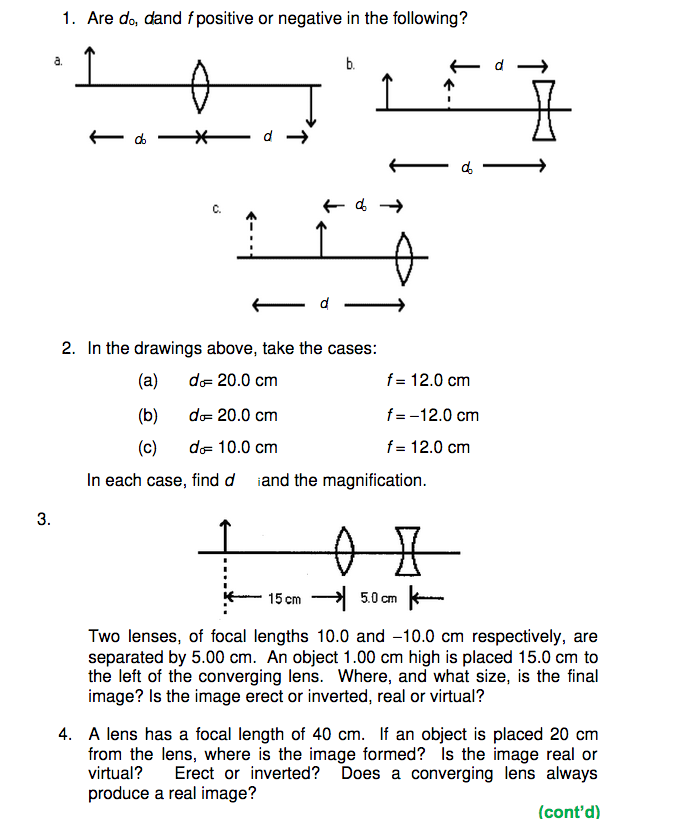
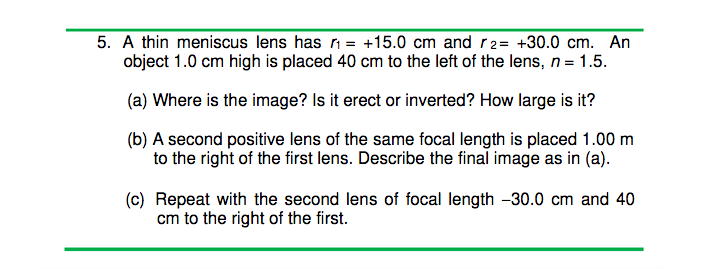
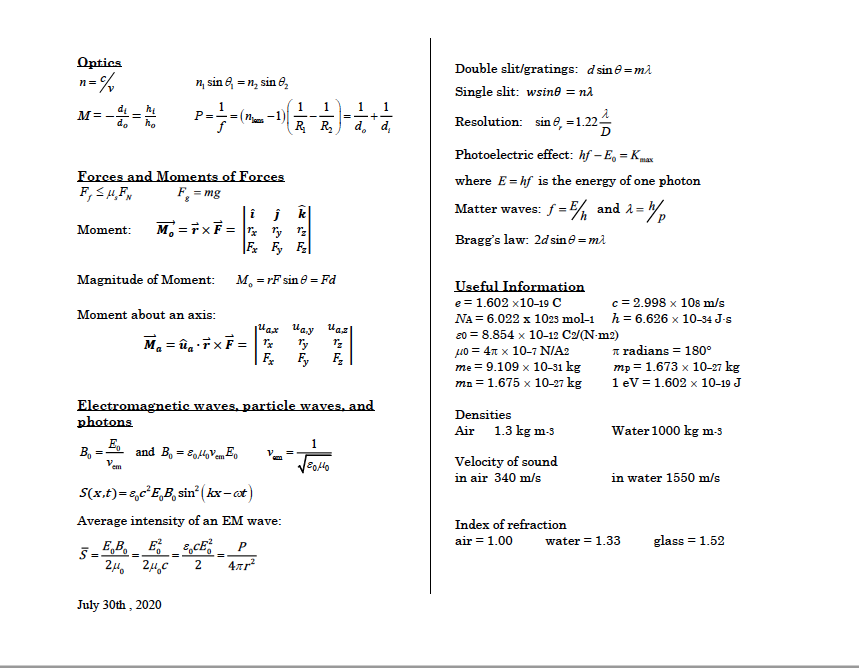
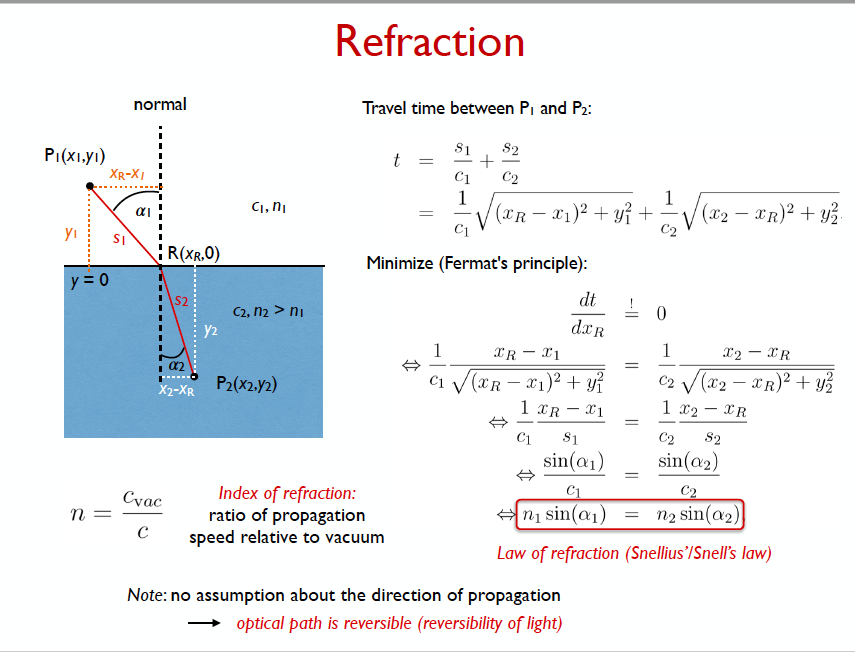
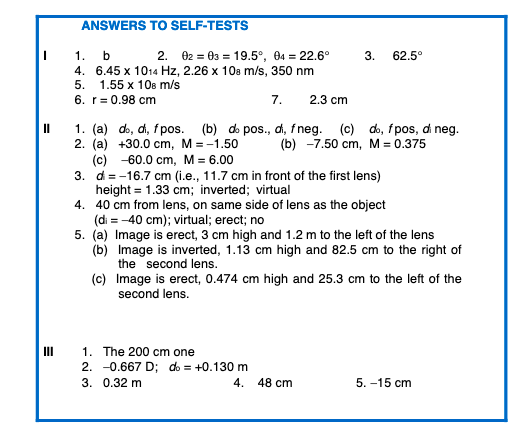
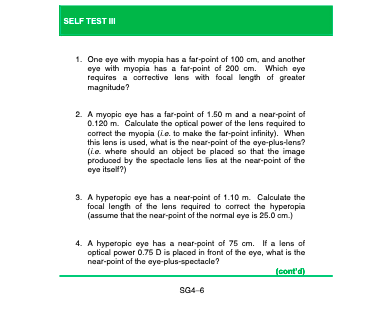
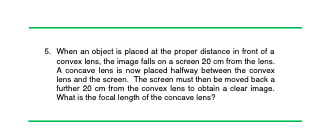
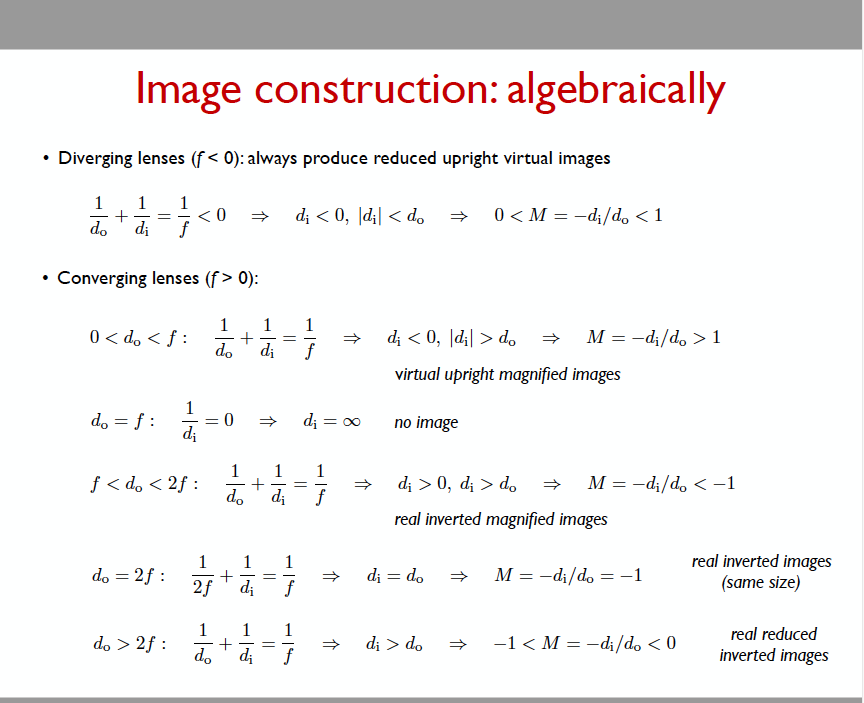
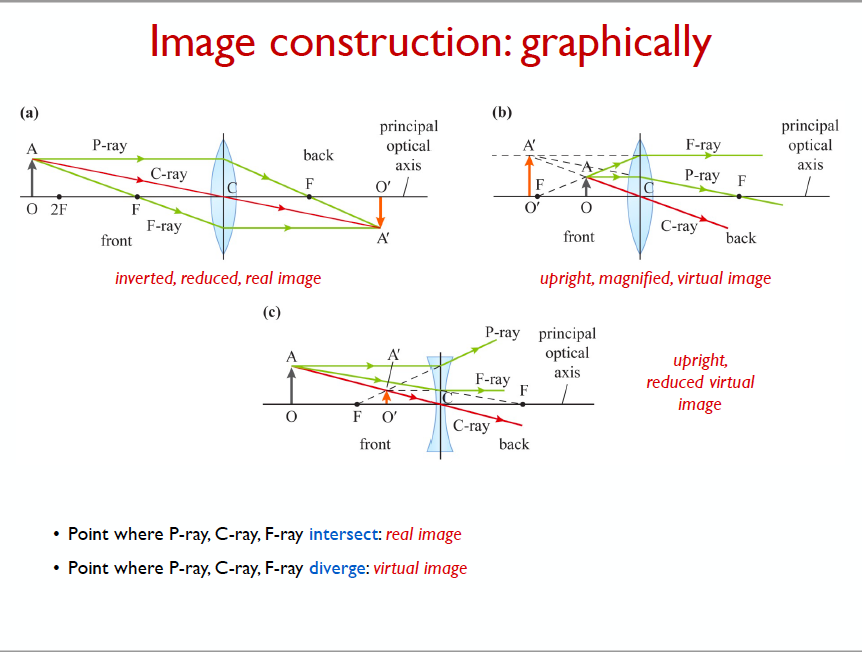
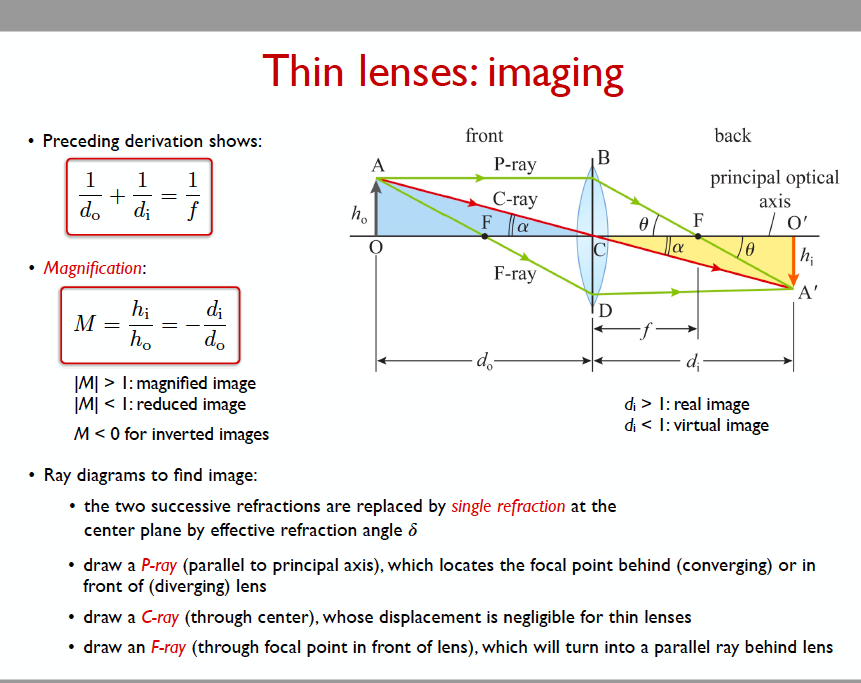
1. Are do, dand fpositive or negative in the following? a. b. d C. +d 2. In the drawings above, take the cases: (a) do= 20.0 cm f = 12.0 cm (b) do= 20.0 cm f= -12.0 cm (c) do= 10.0 cm f = 12.0 cm In each case, find d and the magnification. 3. 15 cm -5.0 cm Two lenses, of focal lengths 10.0 and -10.0 cm respectively, are separated by 5.00 cm. An object 1.00 cm high is placed 15.0 cm to the left of the converging lens. Where, and what size, is the final image? Is the image erect or inverted, real or virtual? 4. A lens has a focal length of 40 cm. If an object is placed 20 cm from the lens, where is the image formed? Is the image real or virtual? Erect or inverted? Does a converging lens always produce a real image? (cont'd)5. A thin meniscus lens has / = +15.0 cm and /2= +30.0 cm. An object 1.0 cm high is placed 40 cm to the left of the lens, n = 1.5. (a) Where is the image? Is it erect or inverted? How large is it? (b) A second positive lens of the same focal length is placed 1.00 m to the right of the first lens. Describe the final image as in (a). (c) Repeat with the second lens of focal length -30.0 cm and 40 cm to the right of the first.Optics Double slit/gratings: dsine=ml n = n, sin & = n, sin ez Single slit: wsine = nl M = -= P = =(maxx -1) 1_1 1 R Rda 1 Resolution: sine, =1.22~ Photoelectric effect: hf - E. = K. Forces and Moments of Forces where E = hy is the energy of one photon FSUFM F = mg i j k Matter waves: f =,, and a = #p Moment: M. = FXF = Ty Fy Bragg's law: 2d sine = mil Magnitude of Moment: M. = rF sine = Fd Useful Information e = 1.602 x10⁻¹⁹ C c= 2.998 x 10⁸ m/s Moment about an axis: NA = 6.022 x 10²³ mol-1 h = 6.626 x 10⁻³⁴ J-s Way 20 = 8.854 x 10⁻¹² C2/(N.m2) Ma = War XF = Ty Fx radians = 180 Fy F - 40 = 41 x 10-7 N/A2 me = 9.109 x 10⁻³¹ kg mp = 1.673 x 10⁻²⁷ kg mo = 1.675 x 10⁻²⁷ kg 1 eV = 1.602 x 10⁻¹⁹ J Electromagnetic waves, particle waves, and Densities photons Air 1.3 kg m-5 Water 1000 kg m-3 By = = and By = BathVem Fo Vem Velocity of sound in air 340 m/s in water 1550 m/s S(x,t) = =,c'E B, sin' (x - cot) Average intensity of an EM wave: Index of refraction E.Bo E _ECE P air = 1.00 water = 1.33 glass = 1.52 S = = 2 1 2 1.C 2 July 30th , 2020Refraction normal Travel time between Pi and P2: PI(XI,yI ) t : + XR-XI C1 C2 1 CI, nI (2R - 21 )2 +yit 1 V(12 - XR)2 + 93 C1 SI I R(XR.0) Minimize (Fermat's principle): y= 0 dt C2, n2 > nI y2 dxR CR - T1 T2 - XR P2(x2,y2) C1 VOR - 21)+ yi C2 (32 - XR)2+ 1/2 X2-XR 1 CR - $1 1 02 - CR = C1 $1 C2 S.2 sin(01) sin (02) C2 Cvac Index of refraction: C1 n = ratio of propagation nj sin(a1) = n2 sin(a2) C speed relative to vacuum Law of refraction (Snellius'/Snell's law) Note: no assumption about the direction of propagation - optical path is reversible (reversibility of light)ANSWERS TO SELF-TESTS 1. b 2. 02 = 03 = 19.50, 04 = 22.6 3. 62.50 4. 6.45 x 10¹⁴ Hz, 2.26 x 10a m/s, 350 nm 5. 1.55 x 10 m/s 6. r = 0.98 cm 7. 2.3 cm 1. (a) do, ad, fpos. (b) pos., d, fneg. (c) do, fpos, dineg. 2. (a) +30.0 cm, M =-1.50 (b) -7.50 cm, M = 0.375 (c) -60.0 cm, M = 6.00 3. d=-16.7 cm (i.e., 11.7 cm in front of the first lens) height = 1.33 cm; inverted; virtual 4. 40 cm from lens, on same side of lens as the object (di = -40 cm); virtual; erect; no 5. (a) Image is erect, 3 cm high and 1.2 m to the left of the lens (b) Image is inverted, 1.13 cm high and 82.5 cm to the right of the second lens. (c) Image is erect, 0.474 cm high and 25.3 cm to the left of the second lens. III 1. The 200 cm one 2. -0.667 D; do = +0.130 m 3. 0.32 m 4. 48 cm 5. -15 cmSELF TEST III 1. One eye with myopia has a far-point of 100 cm, and another gyo with myopia has a far-point of 200 cm. Which cyo requires a corrective lone with focal longth of greater magnitude? 2. A myopic oye has a far-point of 1.50 m and a near-point of 0.120 m. Calculate the optical power of the lens required to correct the myopia (Lo. to make the far-point infinity). When this lens is used, what is the near-point of the aye-plus-lens? (ie. where should an object be placed so that the image produced by the spoolacle lens lies at the near-point of the cyo itself?) 3. A hyperopio aye has a near-point of 1.10 m. Calculate the focal longth of the lens required to correct the hypotopia (assume that the near-point of the normal cye is 25.0 om.} 4. A hypotopic oye has a near-point of 75 cm. If a lens of optical power 0.76 D is placed in front of the eye, what is the near-point of the aye-plus-spectacle? cont'd SG4-65. When an object is placed at the proper distance in front of a convex lone, the image falls on a scroon 20 om from the lons. IA conoave lens is now placed halfway between the comex lens and the scroon. The screen must then be moved back a further 20 cm from the convex lons to obtain a clear image. What is the focal length of the concave lans?Image construction: algebraically . Diverging lenses (f 0): 1 1 0
Step by Step Solution
There are 3 Steps involved in it

Get step-by-step solutions from verified subject matter experts
 Study Help