







Question: I need new and unique answers , please. (Use your own words, don't copy and paste), Please Use your keyboard (Don't use handwriting) Thank you..
I need new and unique answers, please. (Use your own words, don't copy and paste),
Please Use your keyboard (Don't use handwriting) Thank you..
MGT 101
Assignment-2
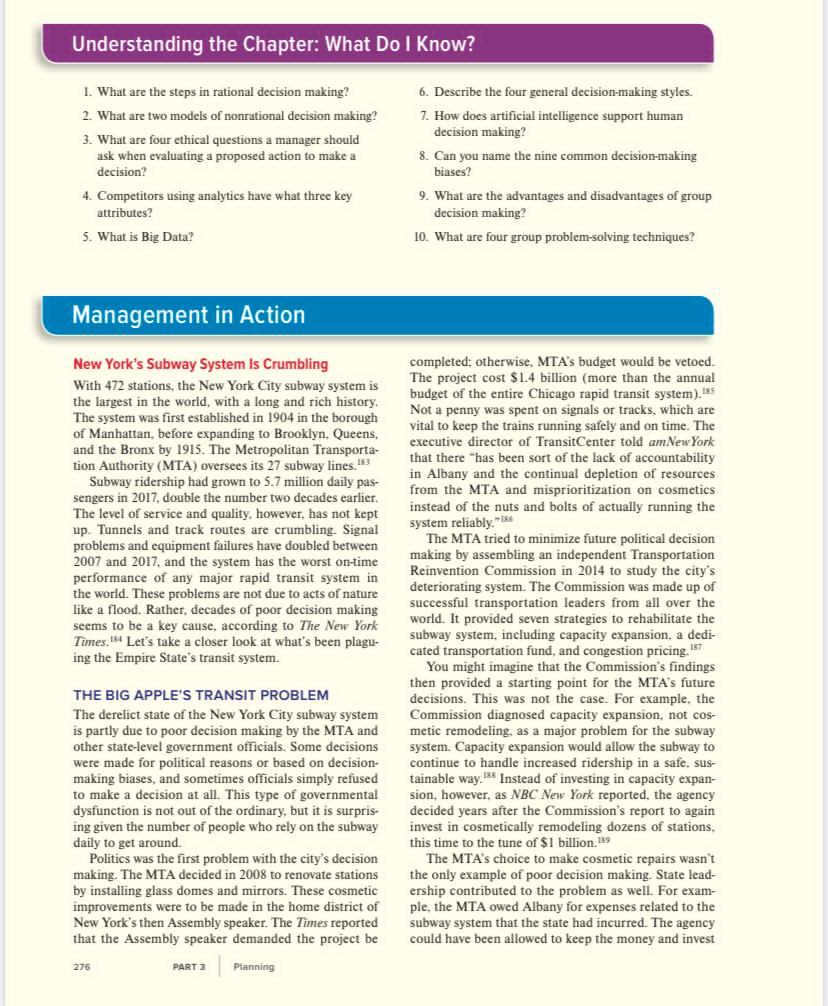
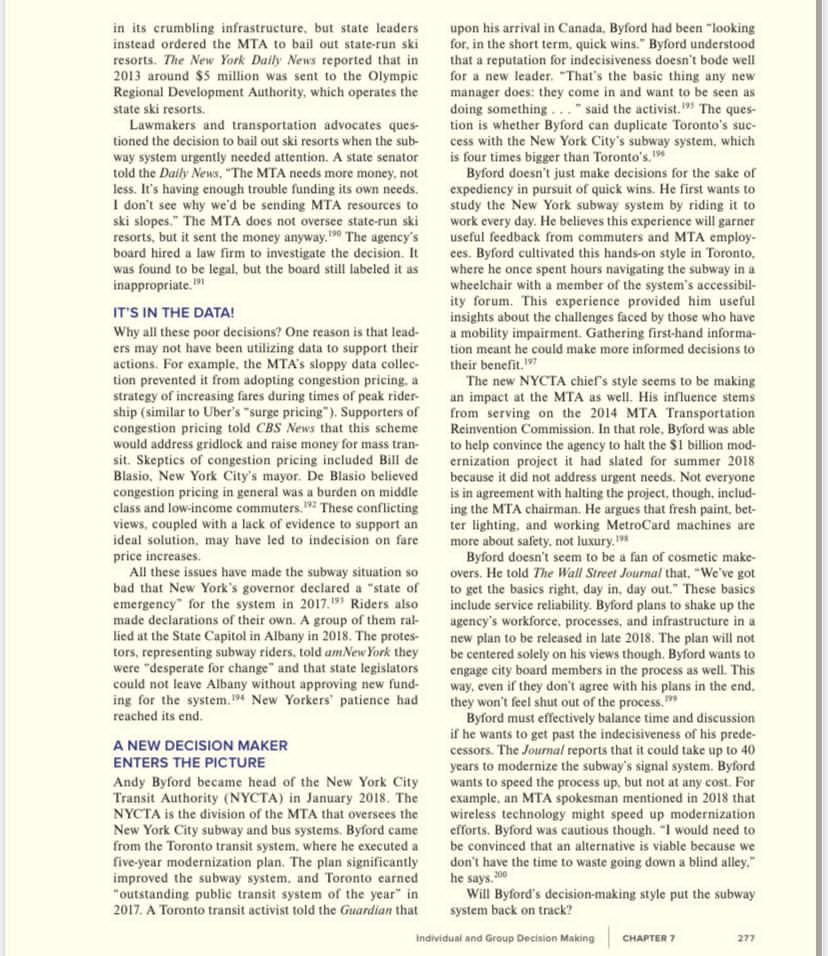
- Please read the case New Yorks Subway System Is Crumbling on Page number 277, Chapter 7 Individual & Group Decision Making available in your textbook/e-textbook Management: A Practical Approach 9th edition by Kinicki, A., & Williams, B., and answer the following questions:
Assignment Question(s): (Marks 5)
- What is the underlying problem in this case from NYCTA President Andy Byfords perspective? (2marks)
- What barriers to decision making were prevalent before Byfords arrival? Explain. (1.5 marks)
- Which Nonrational decision making model does Byford employ? How? (1.5 marks)
Show transcribed image text
Expert Answer
Understanding the Chapter: What Do I know? 1. What are the steps in rational decision making? 2. What are two models of nonrational decision making? 3. What are four ethical questions a manager should ask when evaluating a proposed action to make a decision? 4. Competitors using analytics have what three key attributes? 5. What is Big Data? 6. Describe the four general decision-making styles. 7. How does artificial intelligence support human decision making? 8. Can you name the nine common decision-making biases? 9. What are the advantages and disadvantages of group decision making? 10. What are four group problem-solving techniques? Management in Action time New York's Subway System Is Crumbling With 472 stations, the New York City subway system is the largest in the world, with a long and rich history The system was first established in 1904 in the borough of Manhattan, before expanding to Brooklyn. Queens, and the Bronx by 1915. The Metropolitan Transporta tion Authority (MTA) oversees its 27 subway lines. 13 Subway ridership had grown to 5.7 million sengers in 2017. double the number two decades earlier. The level of service and quality, however, has not kept up. Tunnels and track routes are crumbling Signal problems and equipment failures have doubled between 2007 and 2017, and the system has the worst ontime performance of any major rapid transit system in the world. These problems are not due to acts of nature like a flood. Rather, decades of poor decision making seems to be a key cause, according to The New York Times. Let's take a closer look at what's been plagu- ing the Empire State's transit system making completed otherwise, MTA's budget would be vetoed. The project cost $1.4 billion (more than the annual budget of the entire Chicago rapid transit system).15 Not a penny was spent on signals or tracks, which are vital to keep the trains running safely and on The executive director of Transit Center told am New York that there has been sort of the lack of accountability in Albany and the continual depletion of resources from the MTA and misprioritization on cosmetics instead of the nuts and bolts of actually running the system reliably. The MTA tried to minimize future political decision by assembling an independent Transportation Reinvention Commission in 2014 to study the city's deteriorating system. The Commission was made up of successful transportation leaders from all over the world. It provided seven strategies to rehabilitate the subway system, including capacity expansion, a dedi. cated transportation fund, and congestion pricing. You might imagine that the Commission's findings then provided a a starting point for the MTA's future decisions. This was not the case. For example, the Commission diagnosed capacity expansion, not cos- metic remodeling as a major problem for the subway system. Capacity expansion would allow the subway to continue to handle increased ridership in a safe. sus- tainable way. Instead of investing in capacity expan- as NBC New York reported. the agency decided years after the the Commission's report to again invest in cosmetically remodeling dozens of stations, this time to the tune of $1 billion. 119 The MTA's choice to make cosmetic repairs wasn't the only example of poor de making ership contributed to the problem as well. For exam- ple, the MTA owed Albany for expenses related to the subway system that the state had incurred. The agency could have been allowed to keep the money and invest sion, however, as THE BIG APPLE'S TRANSIT PROBLEM The derelict state of the New York City subway system is partly due to poor decision making by the MTA and other state-level government officials. Some decisions were made for political reasons or based on decision- making biases, and sometimes officials simply refused to make a decision at all. This type of governmental dysfunction is not out of the ordinary, but it is surpris- ing given the number of people who rely on the subway daily to to get around Politics was the first problem with the city's decision making. The MTA decided in 2008 renovate stations by installing glass domes and mirrors. These cosmetic improvements were to be made in the home district of New York's then Assembly speaker. The Times reported that the Assembly speaker demanded the project be 276 PART 2 Planning in its crumbling infrastructure, but state leaders upon his arrival in Canada. Byford had been looking instead ordered the MTA to bail out state-run ski for, in the short term, quick wins." Byford understood resorts. The New York Daily News reported that in that a reputation for indecisiveness doesn't bode well 2013 around $5 million was sent to the Olympic for a new leader. "That's the basic thing any new Regional Development Authority, which operates the manager does: they come in and want to be seen as state ski resorts. doing something..said the activist."" The ques- Lawmakers and transportation advocates ques tion is whether Byford can duplicate Toronto's suc- tioned the decision to bail out ski resorts when the sub cess with the New York City's subway system, which way system urgently needed attention. A state senator is four times bigger than Toronto's. told the Daily News, "The MTA needs more money, not Byford doesn't just make decisions for the sake of less. It's having enough trouble funding its own needs. expediency in pursuit of quick wins. He first wants to I don't see why we'd be sending MTA resources to study the New York subway system by riding it to ski slopes." The MTA does not oversee state-run ski work every day. He believes this experience will garner resorts, but it sent the money anyway. The agency's useful feedback from commuters and MTA employ- board hired a law firm to investigate the decision. It ces. Byford cultivated this hands-on style in Toronto was found to be legal, but the board still labeled it as where he once spent hours navigating the subway in a inappropriate wheelchair with a member of the system's accessibil- ity forum. This experience provided him useful IT'S IN THE DATA! Insights about the challenges faced by those who have Why all these poor decisions? One reason is that lead a mobility impairment. Gathering first-hand informa- ers may not have been utilizing data to support their tion meant he could make more informed decisions to actions. For example, the MTA's sloppy data collec their benefit tion prevented it from adopting congestion pricing, a The new NYCTA chief's style seems to be making strategy of increasing fares during times of peak rider un impact at the MTA as well. His influence stems ship (similar to Uber's "surge pricing"). Supporters of from serving on the 2014 MTA Transportation congestion pricing told CBS News that this scheme Reinvention Commission. In that role. Byford was able would address gridlock and raise money for mass tran to help convince the agency to halt the S1 billion mod- sit. Skeptics of congestion pricing included Bill de ernization project it had slated for summer 2018 Blasio, New York City's mayor. De Blasio believed because it did not address urgent needs. Not everyone congestion pricing in general was a burden on middle is in agreement with halting the project, though, includ- class and low-income commuters." These conflicting ing the MTA chairman. He argues that fresh paint bet- views, coupled with a lack of evidence to support an ter lighting, and working MetroCard machines are ideal solution, may have led to indecision on fare more about safety, not luxury price increases. Byford doesn't seem to be a fan of cosmetic make- All these issues have made the subway situation so overs. He told The Wall Street Journal that "We've got bad that New York's governor declared a "state of to get the basics right, day in, day out." These basics emergency for the system in 2017.15 Riders also include service reliability. Byford plans to shake up the made declarations of their own. A group of them ral agency's workforce, processes, and infrastructure in a lied at the State Capitol in Albany in 2018. The protes new plan to be released in late 2018. The plan will not tors, representing subway riders, told am New York they be centered solely on his views though. Byford wants to were "desperate for change and that state legislators engage city board members in the process as well. This could not leave Albany without approving new fund way, even if they don't agree with his plans in the end ing for the system. New Yorkers' patience had they won't feel shut out of the process." reached its end. Byford must effectively balance time and discussion if he wants to get past the indecisiveness of his prede- A NEW DECISION MAKER cessors. The Journal reports that it could take up to 40 ENTERS THE PICTURE years to modernize the subway's signal system. Byford Andy Byford became head of the New York City wants to speed the process up, but not at any cost. For Transit Authority (NYCTA) in January 2018. The example, an MTA spokesman mentioned in 2018 that NYCTA is the division of the MTA that oversees the wireless technology might speed up modernization New York City subway and bus systems. Byford came efforts. Byford was cautious though. "I would need to from the Toronto transit system, where he executed a be convinced that an alternative is viable because we five-year modernization plan. The plan significantly don't have the time to waste going down a blind alley." improved the subway system, and Toronto earned he says. 200 houtstanding public transit system of the year" in Will Byford's decision-making style put the subway 2017. A Toronto transit activist told the Guardian that system back on track? Individual and Group Decision Making CHAPTER 7 277 Understanding the Chapter: What Do I know? 1. What are the steps in rational decision making? 2. What are two models of nonrational decision making? 3. What are four ethical questions a manager should ask when evaluating a proposed action to make a decision? 4. Competitors using analytics have what three key attributes? 5. What is Big Data? 6. Describe the four general decision-making styles. 7. How does artificial intelligence support human decision making? 8. Can you name the nine common decision-making biases? 9. What are the advantages and disadvantages of group decision making? 10. What are four group problem-solving techniques? Management in Action time New York's Subway System Is Crumbling With 472 stations, the New York City subway system is the largest in the world, with a long and rich history The system was first established in 1904 in the borough of Manhattan, before expanding to Brooklyn. Queens, and the Bronx by 1915. The Metropolitan Transporta tion Authority (MTA) oversees its 27 subway lines. 13 Subway ridership had grown to 5.7 million sengers in 2017. double the number two decades earlier. The level of service and quality, however, has not kept up. Tunnels and track routes are crumbling Signal problems and equipment failures have doubled between 2007 and 2017, and the system has the worst ontime performance of any major rapid transit system in the world. These problems are not due to acts of nature like a flood. Rather, decades of poor decision making seems to be a key cause, according to The New York Times. Let's take a closer look at what's been plagu- ing the Empire State's transit system making completed otherwise, MTA's budget would be vetoed. The project cost $1.4 billion (more than the annual budget of the entire Chicago rapid transit system).15 Not a penny was spent on signals or tracks, which are vital to keep the trains running safely and on The executive director of Transit Center told am New York that there has been sort of the lack of accountability in Albany and the continual depletion of resources from the MTA and misprioritization on cosmetics instead of the nuts and bolts of actually running the system reliably. The MTA tried to minimize future political decision by assembling an independent Transportation Reinvention Commission in 2014 to study the city's deteriorating system. The Commission was made up of successful transportation leaders from all over the world. It provided seven strategies to rehabilitate the subway system, including capacity expansion, a dedi. cated transportation fund, and congestion pricing. You might imagine that the Commission's findings then provided a a starting point for the MTA's future decisions. This was not the case. For example, the Commission diagnosed capacity expansion, not cos- metic remodeling as a major problem for the subway system. Capacity expansion would allow the subway to continue to handle increased ridership in a safe. sus- tainable way. Instead of investing in capacity expan- as NBC New York reported. the agency decided years after the the Commission's report to again invest in cosmetically remodeling dozens of stations, this time to the tune of $1 billion. 119 The MTA's choice to make cosmetic repairs wasn't the only example of poor de making ership contributed to the problem as well. For exam- ple, the MTA owed Albany for expenses related to the subway system that the state had incurred. The agency could have been allowed to keep the money and invest sion, however, as THE BIG APPLE'S TRANSIT PROBLEM The derelict state of the New York City subway system is partly due to poor decision making by the MTA and other state-level government officials. Some decisions were made for political reasons or based on decision- making biases, and sometimes officials simply refused to make a decision at all. This type of governmental dysfunction is not out of the ordinary, but it is surpris- ing given the number of people who rely on the subway daily to to get around Politics was the first problem with the city's decision making. The MTA decided in 2008 renovate stations by installing glass domes and mirrors. These cosmetic improvements were to be made in the home district of New York's then Assembly speaker. The Times reported that the Assembly speaker demanded the project be 276 PART 2 Planning in its crumbling infrastructure, but state leaders upon his arrival in Canada. Byford had been looking instead ordered the MTA to bail out state-run ski for, in the short term, quick wins." Byford understood resorts. The New York Daily News reported that in that a reputation for indecisiveness doesn't bode well 2013 around $5 million was sent to the Olympic for a new leader. "That's the basic thing any new Regional Development Authority, which operates the manager does: they come in and want to be seen as state ski resorts. doing something..said the activist."" The ques- Lawmakers and transportation advocates ques tion is whether Byford can duplicate Toronto's suc- tioned the decision to bail out ski resorts when the sub cess with the New York City's subway system, which way system urgently needed attention. A state senator is four times bigger than Toronto's. told the Daily News, "The MTA needs more money, not Byford doesn't just make decisions for the sake of less. It's having enough trouble funding its own needs. expediency in pursuit of quick wins. He first wants to I don't see why we'd be sending MTA resources to study the New York subway system by riding it to ski slopes." The MTA does not oversee state-run ski work every day. He believes this experience will garner resorts, but it sent the money anyway. The agency's useful feedback from commuters and MTA employ- board hired a law firm to investigate the decision. It ces. Byford cultivated this hands-on style in Toronto was found to be legal, but the board still labeled it as where he once spent hours navigating the subway in a inappropriate wheelchair with a member of the system's accessibil- ity forum. This experience provided him useful IT'S IN THE DATA! Insights about the challenges faced by those who have Why all these poor decisions? One reason is that lead a mobility impairment. Gathering first-hand informa- ers may not have been utilizing data to support their tion meant he could make more informed decisions to actions. For example, the MTA's sloppy data collec their benefit tion prevented it from adopting congestion pricing, a The new NYCTA chief's style seems to be making strategy of increasing fares during times of peak rider un impact at the MTA as well. His influence stems ship (similar to Uber's "surge pricing"). Supporters of from serving on the 2014 MTA Transportation congestion pricing told CBS News that this scheme Reinvention Commission. In that role. Byford was able would address gridlock and raise money for mass tran to help convince the agency to halt the S1 billion mod- sit. Skeptics of congestion pricing included Bill de ernization project it had slated for summer 2018 Blasio, New York City's mayor. De Blasio believed because it did not address urgent needs. Not everyone congestion pricing in general was a burden on middle is in agreement with halting the project, though, includ- class and low-income commuters." These conflicting ing the MTA chairman. He argues that fresh paint bet- views, coupled with a lack of evidence to support an ter lighting, and working MetroCard machines are ideal solution, may have led to indecision on fare more about safety, not luxury price increases. Byford doesn't seem to be a fan of cosmetic make- All these issues have made the subway situation so overs. He told The Wall Street Journal that "We've got bad that New York's governor declared a "state of to get the basics right, day in, day out." These basics emergency for the system in 2017.15 Riders also include service reliability. Byford plans to shake up the made declarations of their own. A group of them ral agency's workforce, processes, and infrastructure in a lied at the State Capitol in Albany in 2018. The protes new plan to be released in late 2018. The plan will not tors, representing subway riders, told am New York they be centered solely on his views though. Byford wants to were "desperate for change and that state legislators engage city board members in the process as well. This could not leave Albany without approving new fund way, even if they don't agree with his plans in the end ing for the system. New Yorkers' patience had they won't feel shut out of the process." reached its end. Byford must effectively balance time and discussion if he wants to get past the indecisiveness of his prede- A NEW DECISION MAKER cessors. The Journal reports that it could take up to 40 ENTERS THE PICTURE years to modernize the subway's signal system. Byford Andy Byford became head of the New York City wants to speed the process up, but not at any cost. For Transit Authority (NYCTA) in January 2018. The example, an MTA spokesman mentioned in 2018 that NYCTA is the division of the MTA that oversees the wireless technology might speed up modernization New York City subway and bus systems. Byford came efforts. Byford was cautious though. "I would need to from the Toronto transit system, where he executed a be convinced that an alternative is viable because we five-year modernization plan. The plan significantly don't have the time to waste going down a blind alley." improved the subway system, and Toronto earned he says. 200 houtstanding public transit system of the year" in Will Byford's decision-making style put the subway 2017. A Toronto transit activist told the Guardian that system back on track? Individual and Group Decision Making CHAPTER 7 277
Step by Step Solution
There are 3 Steps involved in it

Get step-by-step solutions from verified subject matter experts
 Study Help