







Question: I need to answer the following questions based on this case study as A STORYTELLING ( ANALYSIS ALL BUSINESS CASE ) NOT answer them as
I need to answer the following questions based on this case study as A STORYTELLING ( ANALYSIS ALL BUSINESS CASE ) NOT answer them as separate questions, and please give actual answers
textbook : Innovation Management and New Product Development, 7th Edition, by Trott
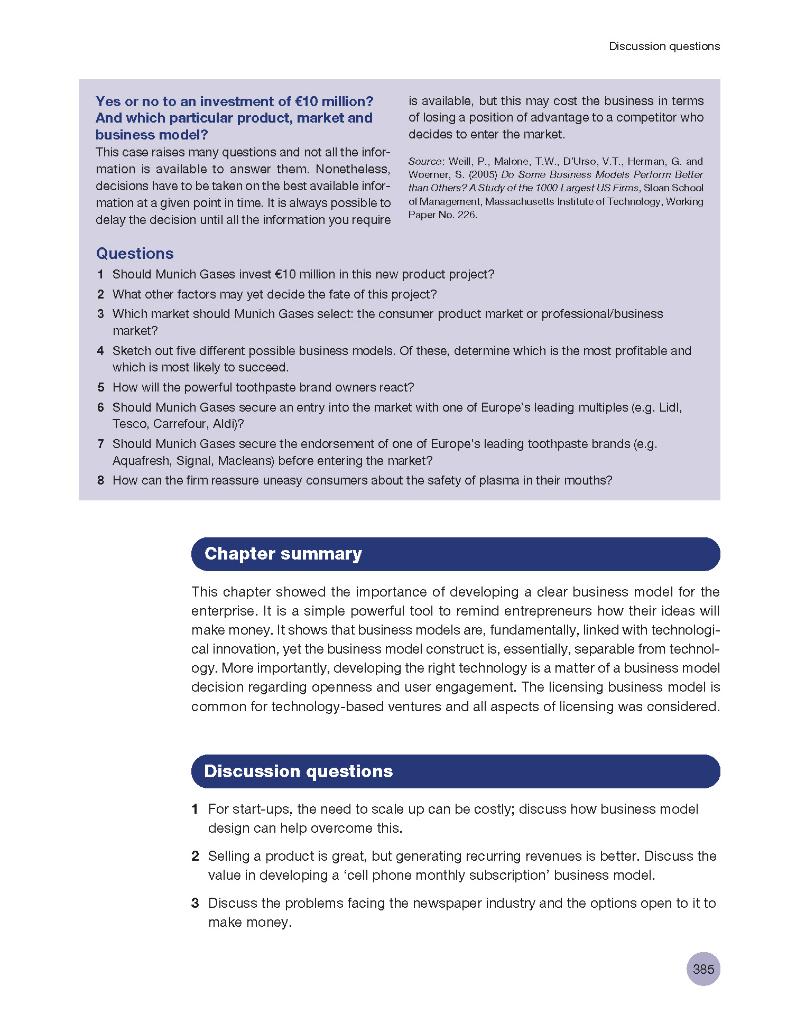
Questions 1 Should Munich Gases invest 10 million in this new product project? 2 What other factors may yet decide the fate of this project? 3 Which market should Munich Gases select: the consumer product market or professional/business market? 4 Sketch out five different possible business models. Of these, determine which is the most profitable and which is most likely to succeed. 5 How will the powerful toothpaste brand owners react? 6 Should Munich Gases secure an entry into the market with one of Europe's leading multiples (e.g. Lidl, Tesco, Carrefour, Aldi)? 7 Should Munich Gases secure the endorsement of one of Europe's leading toothpaste brands (e.g. Aquafresh, Signal, Macleans) before entering the market? 8 How can the firm reassure uneasy consumers about the safety of plasma in their mouths?
Show transcribed data
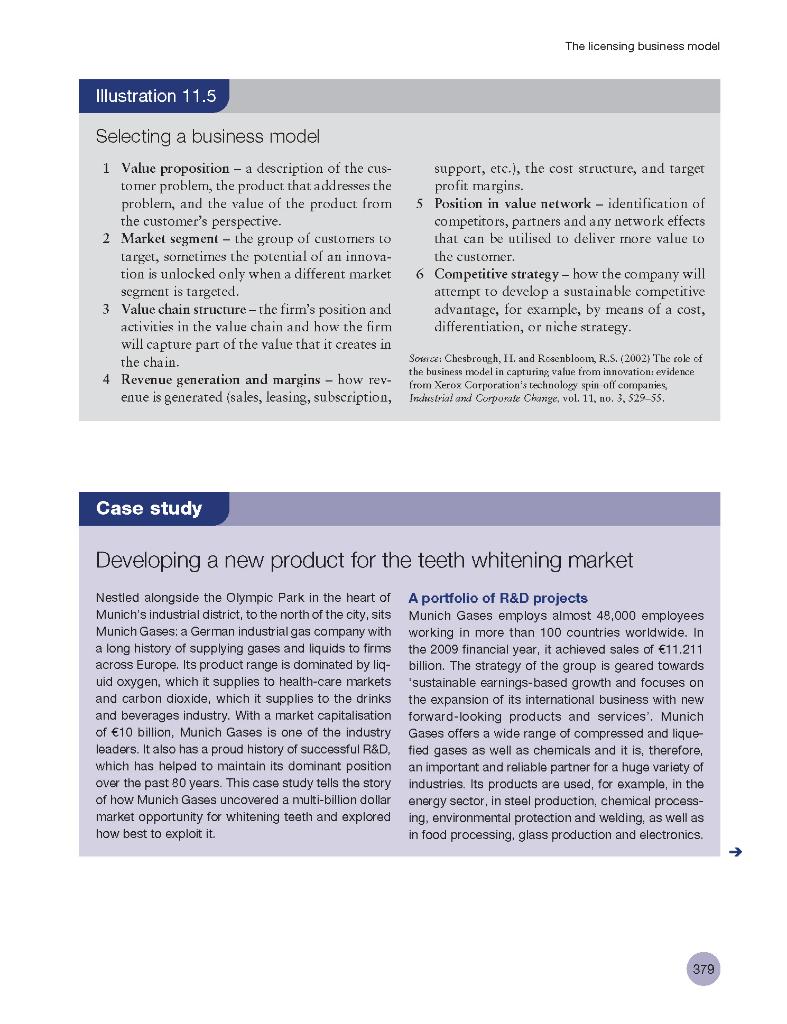
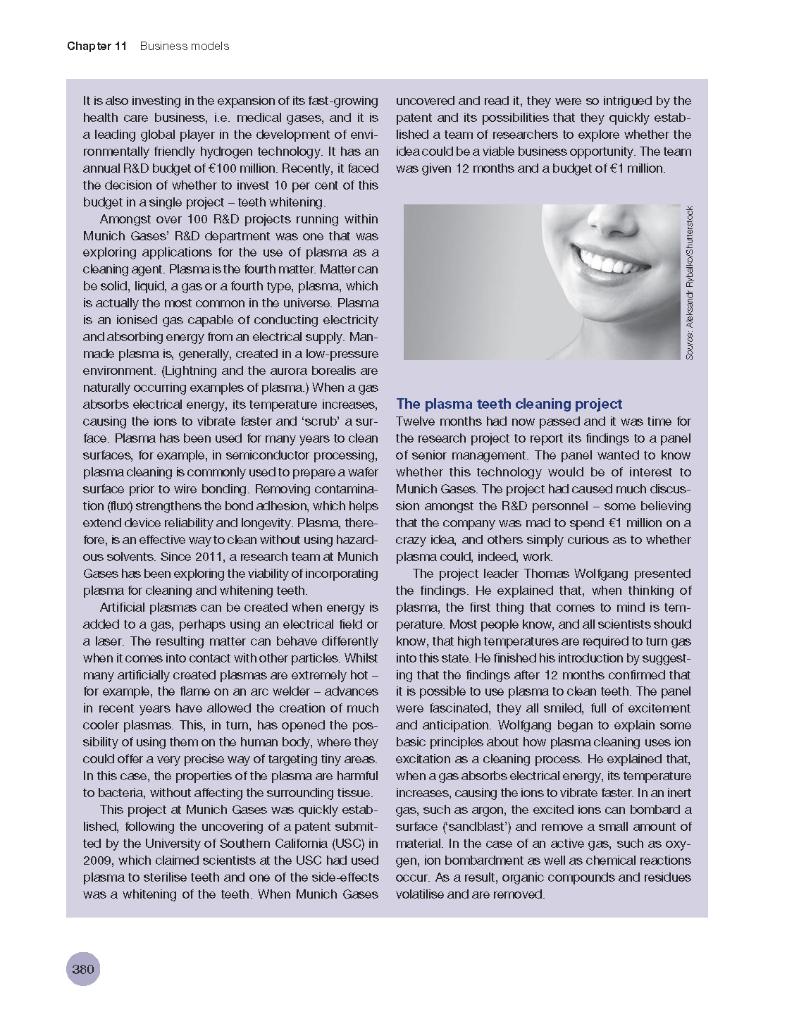
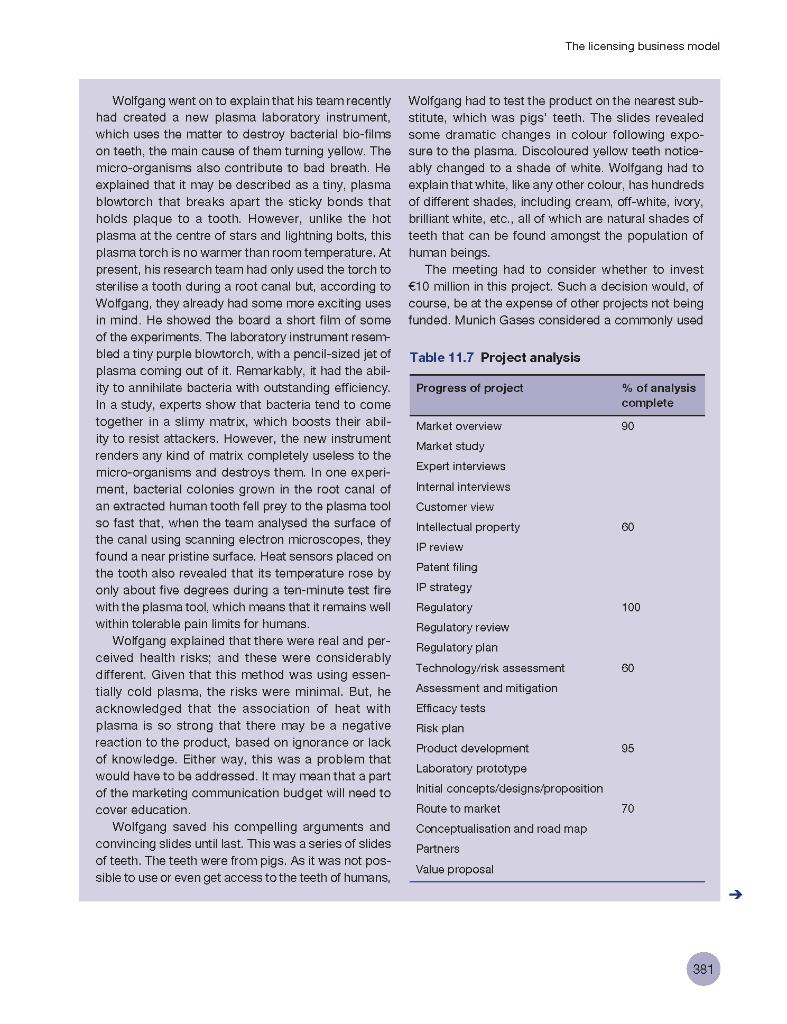
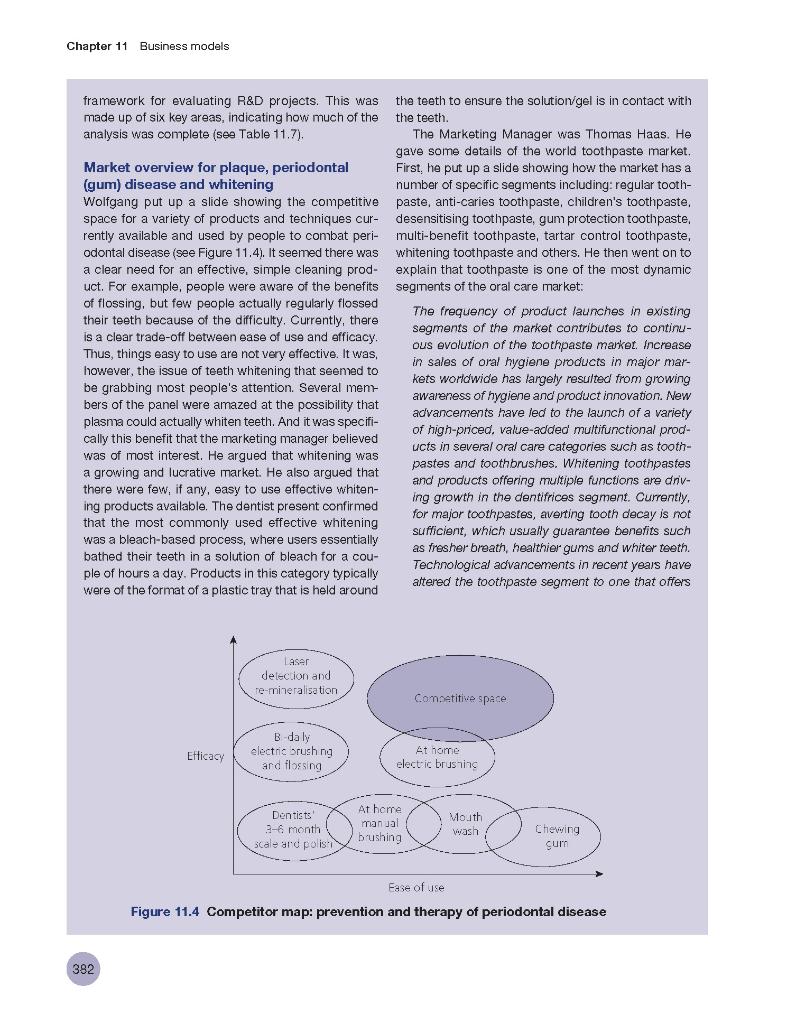
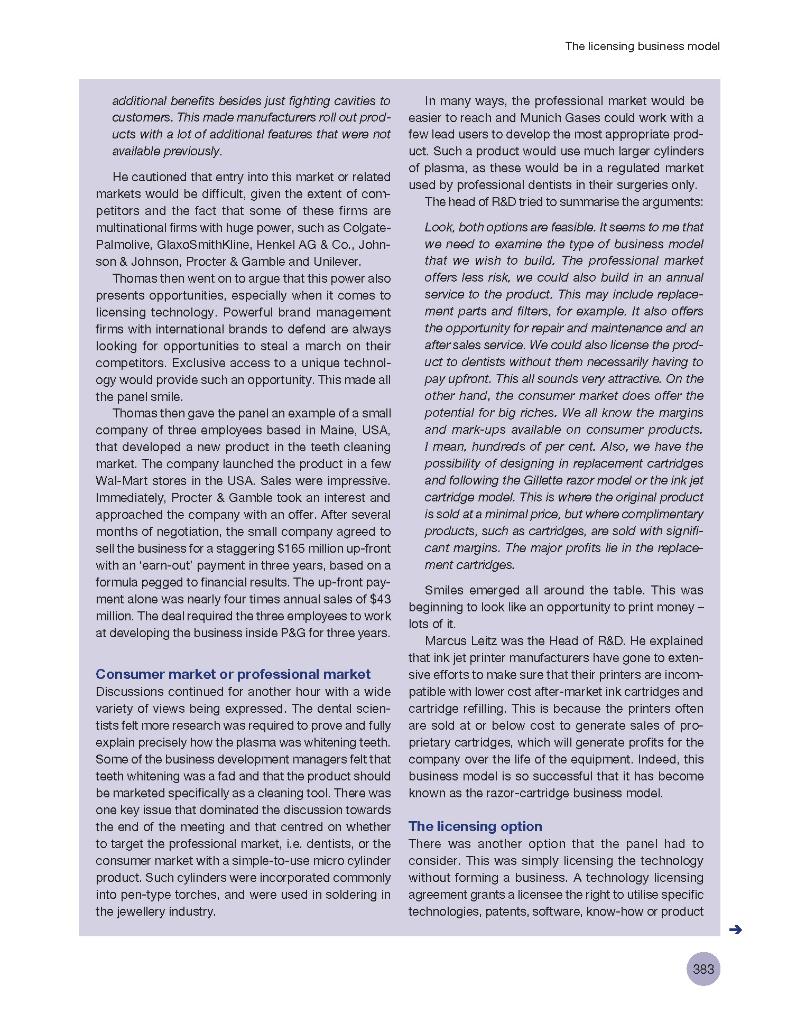
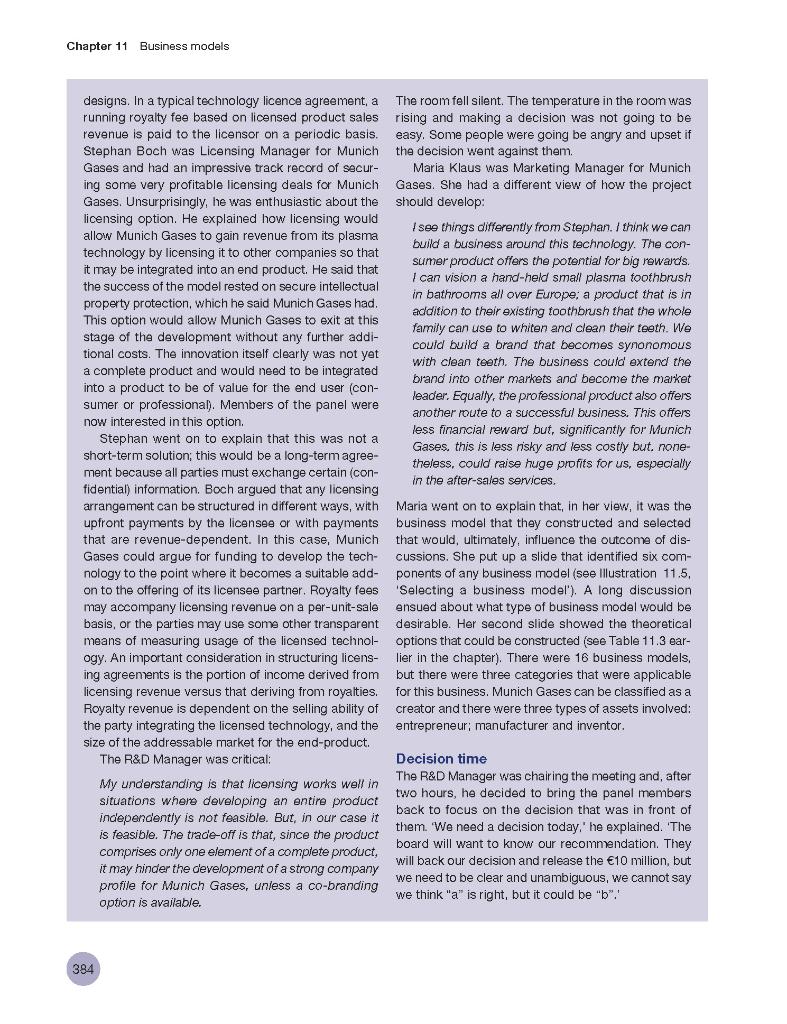
The licensing business model Illustration 11.5 Selecting a business model 1 Value proposition - a description of the cus- support, etc.i, the cost structure, and target tomer problem, the product that addresses the profit margins. problern, and the value of the product. from 5 Position in value network - identification of the customer's perspective. competitors, partners and any network effects 2 Market segment - the group of customers to that can be utilised to deliver more value to target, sornetimes the potential of an innova- the customer. tion is unlocked only when a different market 6 Competitive strategy - how the company will segment is targeted. attempt to develop a sustainable competitive 3 Value chain structure - the firm's position and advantage, for example, by means of a cost, activities in the value chain and how the firm differentiation, or niche strategy. will capture part of the value that it creates in the chain. Sossc: Chesbrough, II, and Resenbloom, R.S. (2002) The cole of 4 Revenue generation and margins - how rev- the business model in capturing value from innovation evid from Xerox Corporation's technology spin off companies enue is generated isales, leasing, subscription, Industrat and Corporafe Change, vol, 11, no, 3,529-55. Case study Developing a new product for the teeth whitening market Nestled alongside the Olympic Park in the heart of A portfolio of R\&D projects Munich's industrial district, to the north of the city, sits Munich Gases employs almost 48,000 employees Munich Gases: a German industrial gas company with working in more than 100 countries worldwide. In a long history of supplying gases and liquids to firms the 2009 financial year, it achieved sales of 11.211 across Europe. Its product range is dominated by liq- billion. The strategy of the group is geared towards uid oxygen, which it supplies to health-care markets 'sustainable earnings-based growth and focuses on and carbon dioxide, which it supplies to the drinks the expansion of its international business with new and beverages industry. With a market capitalisation forward-looking products and services'. Munich of 10 billion, Munich Gases is one of the industry Gases offers a wide range of compressed and liqueleaders. It also has a proud history of successful R\&D, fied gases as well as chemicals and it is, therefore, which has helped to maintain its dominant position an important and reliable partner for a huge variety of over the past 80 years. This case study tells the story industries. Its products are used, for example, in the of how Munich Gases uncovered a multi-billion dollar energy sector, in steel production, chemical processmarket opportunity for whitening teeth and explored ing, environmental protection and welding: as well as how best to exploit it. in food processing. glass production and electronics. It is also investing in the expansion of its fast-growing unoovered and read it, they were so intrigued by the health care business, i.e. medical gases, and it is patent and its possibilities that they quickly estaba leading global player in the development of envi- lished a tearn of researchers to explore whether the ronmentally friendly hydrogen technology. It has an ideacould be a viable business opportunity. The team annual Ris budget of 100 million. Recently, it faced was given 12 months and a budget of 1 million. the decision of whether to invest 10 per cent of this budget in a single project - teeth whitening. Amongst over 100 R\&D projects running within Munich Gases' R&D department was one that was exploring applications for the use of plasma as a cleaning agent. Plasma is the fourth matter. Matter can be solid, liquid, a gas or a fourth type, plasma, which is actually the most common in the universe. Plasma is an ionised gas capable of conducting electricity and absorbing energy from an electrical supply. Manmade plasma is, generally, created in a low-pressure environment. (Lightning and the aurora borealis are naturally occurring examples of plasma.) When a gas absorbs electrical energy, its temperature increases, The plasma teeth cleaning project causing the ions to vibrate laster and 'scrub' a sur- Twelve months had now passed and it was time for face. Plasma has been used for many years to clean the research project to report its findings to a panel surfaces, for example, in semiconductor processing, of senior management. The panel wanted to know plasma cleaning is commonly used to prepare a wafer whether this technology would be of interest to surtace prior to wire bonding. Removing contamina-. Munich Gases. The project had caused much discustion filux) strengthens the hond adhesion, which helps sion amongst the R\&D personnel - some believing extend dovice reliability and longevity. Plasma, there that the company was mad to spend 1 million on a fore, is an effective way to clean without using hazard crazy iclea, and others simply curious as to whether ous solvents. Since 2011, a research team at Munich plasma could, indeed, work. Gases has been exploring the viability of incorporating The project leader Thomas Wolfgang presented plasma for cleaning and whitening teeth. the findings. He explained that, when thinking of Artificial plasmas can be created when energy is plasma, the first thing that comes to mind is temadded to a gas, perhaps using an electrical field or perature. Most people know, and all scientists should a laser. The resulting matter can behave differently know, that high temperatures are required to turn gas when it comes into contact with other particles. Whilst into this state. He finished his introduction by suggestmany artificially created plasmas are extremely hot - ing that the findings after 12 months oonfirmed that for example, the flame on an arc welder - advances it is possible to use plasma to clean teeth. The panel in recent years have allowed the creation of much were fascinated, they all smiled, full of exciterment cooler plasmas. This, in tum, has opened the pos- and anticipation. Wolfgang began to explain some sibility of using them on the human body, where they basic principles about how plasma cleaning uses ion could offer a very precise way of targeting tiny areas. excitation as a cleaning process. He explained that, In this case, the properties of the plasma are harmful when a gas absorbs electrical energy, its temperature to bacteria, without affecting the surrounding tissue. increases, causing the ions to vibrate faster. In an inert This project at Munich Gases was quickly estab- gas, such as argon, the excited ions can bombard a lished, following the uncovering of a patent submit- surface (sandblast') and remove a small amount of ted by the University of Southern California (USC) in material. In the case of an active gas, such as oxy2009, which claimed scientists at the USC had used gen, ion bombardment as well as chemical reactions plasma to sterilise teeth and one of the side effects occur. As a result, organic compounds and residues was a whitening of the teeth. When Munich Gases volatilise and are removed. The licensing business model Wolfgang went on to explain that his teamrecently Wolfgang had to test the product on the nearest subhad created a new plasma laboratory instrument, stitute, which was pigs' teeth. The slides revealed Which uses the matter to destroy bacterial bio-films some dramatic changes in colour following expoon teeth, the main cause of them turning yellow. The sure to the plasma. Discoloured yellow teeth noticemicro-organisms also contribute to bad breath. He ably changed to a shade of white. Wolfgang had to explained that it nay be described as a tiny, plasma explain that white, like any other colour, has hundreds blowtorch that breaks apart the sticky bonds that of different shades, including cream, off-white, ivory, holds plaque to a tooth. However, unlike the hot brilliant white, etc., all of which are natural shades of plasma at the centre of stars and lightning bolts, this teeth that can be found amongst the population of plasma torch is no warmer than room temperature. At human beings. present, his research team had only used the torch to The meeting had to consider whether to invest sterilise a tooth during a root canal but, according to 10 million in this project. Such a decision would, of Wolfgang, they already had some more exciting uses course, be at the expense of other projects not being in mind. He showed the board a short film of some funded. Munich Gases considered a commonly used of the experiments. The laboratory instrument resembled a tiny purple blowtorch, with a pencil-sized jet of plasma coming out of it. Remarkably, it had the ability to annihilate bacteria with outstanding efficiency. In a study, experts show that bacteria tend to come together in a slimy matrix, which boosts their ability to resist attackers. However, the new instrument renders any kind of matrix completely useless to the micro-organisms and destroys them. In one experiment, bacterial colonies grown in the root canal of an extracted human tooth fell prey to the plasma tool so fast that, when the team analysed the surface of the canal using scanning electron microscopes, they found a near pristine surface. Heat sensors placed on the tooth also revealed that its temperature rose by only about five degrees during a ten-minute test fire with the plasma tool. which means that it remains well within tolerable pain limits for humans. Wolfgang explained that there were real and perceived health risks; and these were considerably different. Given that this method was using essentially cold plasma, the risks were minimal. Eut, he acknowledged that the association of heat with plasma is so strong that there may be a negative reaction to the product, based on ignorance or lack of knowledge. Either way, this was a problem that would have to be addressed. It may mean that a part of the marketing communication budget will need to cover education. Wolfgang saved his compelling arguments and convincing slides until last. This was a series of slides of teeth. The teeth were from pigs. As it was not possible to use or even get access to the teeth of humans, framework for evaluating R\&D projects. This was the teeth to ensure the solutiongel is in contact with made up of six key areas, indicating how much of the the teeth. analysis was complete (see Table 11.7). The Marketing Manager was Thomas Haas. He Market overview for plaque, periodontal First, he put up a slide showing how the market has a (gum) disease and whitening number of specific segments including: regular toothWolfgang put up a slide showing the competitive paste, anti-caries toothpaste, children's toothpaste, space for a variety of products and techniques cur- desensitising toothpaste, gum protection toothpaste, rently available and used by people to combat peri- multi-benefit toothpaste, tartar control toothpaste, odontal disease (see Figure 11.4). It seemed there was whitening toothpaste and others. He then went on to a clear need for an effective, simple cleaning prod- explain that toothpaste is one of the most dynamic uct. For example, people were aware of the benefits segments of the oral care market: of flossing, but few people actually regularly flossed The frequency of product launches in existing their teeth because of the difficulty. Currently, there segments of the market contributes to continuis a clear trade-off between ease of use and efficacy. ous evolution of the toothpaste market. increase Thus, things easy to use are not very effective. It was, in sales of oral hygiene products in major marhowever, the issue of teeth whitening that seemed to kets worldwide has largely resulted from growing be grabbing most people's attention. Several mem- awareness of hygiene and product innovation. New bers of the panel were amazed at the possibility that advancements have led to the launch of ariety plasma could actually whiten teeth. And it was specifi- of high-priced. value-added multifunctional prodcally this benefit that the marketing manager believed ucts in several oral care categories such as toothwas of most interest. He argued that whitening was pastes and toothbrushes. Whitening toothpastes a growing and lucrative market. He also argued that and products offering multiple functions are dnivthere were few, if any, easy to use effective whiten- ing growth in the dentifrices segment. Currently, ing products available. The dentist present confirmed for major toothpastes, aventing tooth decay is not that the most commonly used effective whitening sufficient, which usually guarantee benelits such was a bleach-based process, where users essentially as fresher breath, healthier gums and whiter teeth. bathed their teeth in a solution of bleach for a cou- Technological advancements in recent years have ple of hours a day. Products in this category typically were of the format of a plastic tray that is held around aitered the toothpaste segment to one that offers Figure 11.4 Competitor map: prevention and therapy of periodontal disease The licensing business model additional benefits besides just fighting cavities to in many ways, the professional market would be customers. This made manufacturers roll out prod- easier to reach and Munich Gases could work with a ucts with a lot of additional features that were not few lead users to develop the most appropriate prodavailable previously. uct. Such a product would use much larger cylinders He cautioned that entry into this market or related of plasma, as these would be in a regulated market markets would be difficult, given the extent of cont used by professional dentists in their surgeries only. petitors and the fact that some of these firms are The head of R\&D tried to summarise the arguments: multinational firms with huge power, such as Colgate- Look, both options are feasible. It seems to me that Palmolive, GlaxoSmithKline, Henkel AG \& Co., John- we need to examine the type of business model son \& Johnson, Procter \& Gamble and Unilever. that we wish to build. The professional market Thomas then went on to argue that this power also offers less risk, we could also build in an annual presents opportunities, especially when it comes to service to the product. This may include replacelicensing technology. Powerful brand management ment parts and filters, for example. It aiso offers firms with international brands to defend are always the opportunity for repair and maintenance and an looking for opportunities to steal a march on their aftersales service. We could also license the prodcompetitors. Exclusive access to a unique technol- uct to dentists without them necessarily having to ogy would provide such an opportunity. This made all pay upfront. This all sounds very attractive. On the the panel smile. other hand, the consumer market does offer the Thomas then gave the panel an example of a small potential for big riches. We all know the margins company of three employees based in Maine, USA, and mark-ups available on consumer products. that developed a new product in the teeth cleaning 1 mean, hundreds of per cent. Also, we have the market. The company launched the product in a few possibility of designing in replacement cartrioges Wal-Mart stores in the USA. Sales were impressive. and following the Gillette razor model or the ink jet Immediately, Procter \& Gamble took an interest and cartridge model. This is where the original product approached the company with an offer. After several is sold at a minimal phice, but where complimentary months of negotiation, the small company agreed to products, such as cartridges, are sold with signifisell the business for a staggering \$165 million up-front cant margins. The major profits lie in the replace with an 'earn-out' payment in three years, based on a ment cartridges. formula pegged to financial results. The up-front pay- Smiles emerged all around the table. This was ment alone was nearly four times annual sales of $43 beginning to look like an opportunity to print money million. The deal required the three employees to work lots of it. at developing the business inside P\&G for three years. Marcus Leitz was the Head of R\&D. He explained that ink jet printer manufacturers have gone to extenConsumer market or professional market sive efforts to make sure that their printers are incomDiscussions continued for another hour with a wide patible with lower cost after-market ink cartridges and variety of views being expressed. The dental scien- cartridge refilling. This is because the printers often tists felt more research was required to prove and fully are sold at or below cost to generate sales of proexplain precisely how the plasma was whitening teeth. prietary cartridges, which will generate profits for the Some of the business development managers felt that company over the life of the equipment. Indeed, this teeth whitening was a fad and that the product should business model is so successful that it has become be marketed specifically as a cleaning tool. There was known as the razor-cartridge business model. one key issue that dominated the discussion towards the end of the meeting and that centred on whether The licensing option to target the professional market, i.e. dentists, or the There was another option that the panel had to consumer market with a simple-to-use micro cylinder consider. This was simply licensing the technology product. Such cylinders were incorporated commonly without forming a business. A technology licensing into pen-type torches, and were used in soldering in agreement grants a licensee the right to utilise specific the jewellery industry. technologies, patents, software, know-how product designs. In a typical technology licence agreement, a The room fell silent. The temperature in the room was running royalty fee based on licensed product sales rising and making a decision was not going to be revenue is paid to the licensor on a periodic basis. easy. Some people were going be angry and upset if Stephan Boch was Licensing Manager for Munich the decision went against them. Gases and had an impressive track record of secur- Maria Klaus was Marketing Manager for Munich ing some very profitable licensing deals for Munich Gases. She had a different view of how the project Gases. Unsurprisingly, he was enthusiastic about the should develop: licensing option. He explained how licensing would allow Munich Gases to gain revenue from its plasma isee things differently from Stephan. I think we can technology by licensing it to other companies so that build a buriness around this technology. The conit may be integrated into an end product. He said that sumer product offers the potential for big rewards. the success of the model rested on secure intellectual I can vision a hand-held small plasma toothbrush property protection, which he said Munich Gases had. in bathrooms all over Europe; a product that is in This option would allow Munich Gases to exit at this addition to their existing toothbrush that the whole stage of the development without any further addi- family can use to whiten and clean their teeth. We tional costs. The innovation itself clearly was not yet could bulld a brand that becomes synonomous a complete product and would need to be integrated with clean teeth. The business could extend the into a product to be of value for the end user (con- brand into other markets and become the malket sumer or professional). Members of the panel were leader. Equally, the professional product also offers now interested in this option. another route to a successful business. This offers Stephan went on to explain that this was not a less financial reward but, significantly for Munich short-term solution; this would be a long-term agree-_ Gases, this is less risky and less costly but. nonement because all parties must exchange certain (con-__ theless, could raise huge profits for us, especially fidential) information. Boch argued that any licensing arrangement can be structured in different ways, with Maria went on to explain that, in her view, it was the upfront payments by the licensee or with payments business model that they constructed and selected that are revenue-dependent. In this case, Munich that would, ultimately, influence the outcome of disGases could argue for funding to develop the tech- cussions. She put up a slide that identified six comnology to the point where it becomes a suitable add- ponents of any business model (see Illustration 11.5, on to the offering of its licensee partner. Royalty fees 'Selecting a business model'). A long discussion may accompany licensing revenue on a per-unit-sale ensued about what type of business model would be basis, or the parties may use some other transparent desirable. Her second slide showed the theoretical means of measuring usage of the licensed technol- options that could be constructed (see Table 11.3 earogy. An important consideration in structuring licens- lier in the chapter). There were 16 business models, ing agreements is the portion of income derived from but there were three categories that were applicable licensing revenue versus that deriving from royalties. for this business. Munich Gases can be classified as a Royalty revenue is dependent on the selling ability of creator and there were three types of assets involved: the party integrating the licensed technology, and the entrepreneur; manufacturer and inventor. size of the addressable market for the end-product. The R\&D Manager was critical: Decision time My understanding is that licensing works well in The RiD Manager was chairing the meeting and, after situations where developing an entire product two hours, he decided to bring the panel members incependently is not feasible. But, in our case it back to focus on the decision that was in front of is feasible. The trade off is that, since the product them. We need a decision today,' he explained. 'The comprises only one element of a complete product, board will want to know our recomnendation. They it may hinder the cevelopment of a strong company will back our decision and release the 10 million, but profile for Munich Gases, unless a co-branding we need to be clear and unambiguous, we cannot say option is available. we think " a " is right, but it could be " b ".: Yes or no to an investment of 10 million? is available, but this may cost the business in terms And which particular product, market and of losing a position of advantage to a competitor who business model? decides to enter the market. This case raises many questions and not all the information is available to answer them. Nonetheless, Source: Weill, P., Malrone, T.W., D'Urso, V.T., Herman, G. and decisions have to be taken on the best available infor- Woerner, 5. [20us; Do Sorne Business Models Periorm: Beller mation at a given point in time. It is always possible to ol ianagerneal, Massachusells Institule of Techuology, Workry delay the decision until all the information you require Paper No. 226. Questions 1 Should Munich Gases invest 10 million in this new product project? 2 What other factors may yet decide the fate of this project? 3 Which market should Munich Gases select: the consuner product market or professionalbusiness market? 4 Sketch out five different possible business models. Of these, determine which is the most profitable and which is most likely to succeed. 5 How will the powerful toothpaste brand owners react? 6 Should Munich Gases secure an entry into the market with one of Europe's leading multiples (e.g. Lidl. Tesco, Carrefour, Aldii?? 7 Should Munich Gases secure the endcrsement of one of Europe's leading toothpaste brands ie.g. Aquafresh, Signal, Macleans) before entering the narket? 8 How can the firm reassure uneasy consumers about the safety of plasma in their mouths? Chapter summary This chapter showed the importance of developing a clear business model for the enterprise. It is a simple powerful tool to remind entrepreneurs how their ideas will make money. It shows that business models are, fundamentally, linked with technological innovation, yet the business model construct is, essentially, separable from technology. More importantly, developing the right technology is a matter of a business model decision regarding openness and user engagement. The licensing business model is common for technology-based ventures and all aspects of licensing was considered. Discussion questions 1 For start-ups, the need to scale up can be costly; discuss how business model design can help overcome this. 2 Selling a product is great, but generating recurring revenues is better. Discuss the value in developing a 'cell phone monthly subscription' business model. 3 Discuss the problems facing the newspaper industry and the options open to it to make moneyStep by Step Solution
There are 3 Steps involved in it

Get step-by-step solutions from verified subject matter experts
 Study Help