







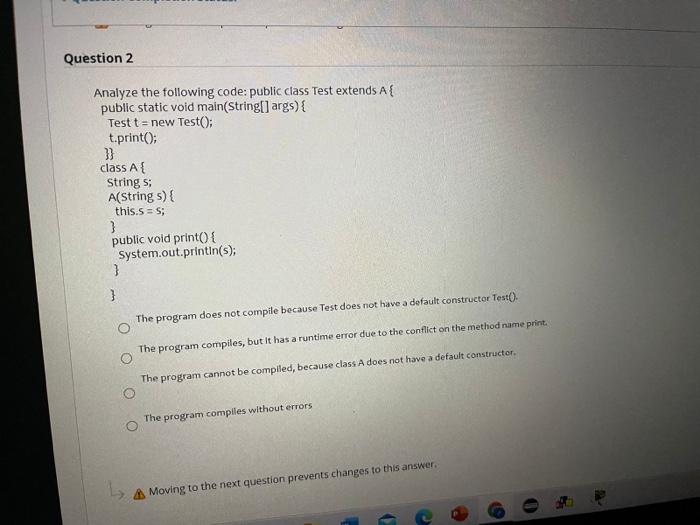
Question: i want the answer for all this multiple choice questions please Analyze the following code: public class Test extends A{ public static void main(String[] args)
![main(String[] args) \{ Test t= new Test () ; t.print(); {3 class](https://dsd5zvtm8ll6.cloudfront.net/si.experts.images/questions/2024/09/66ef89e66144d_43866ef89e6028f9.jpg)




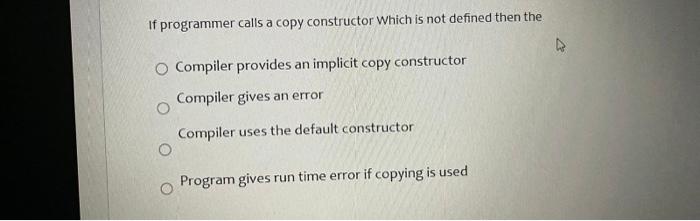

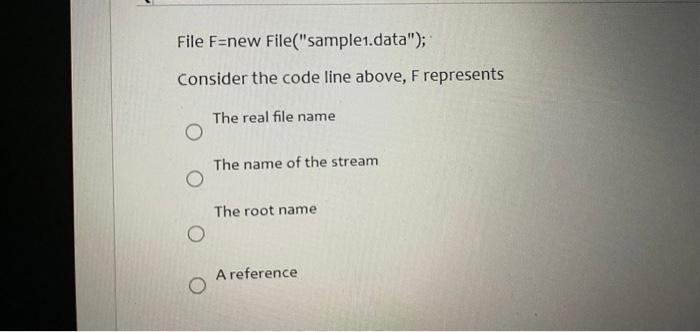
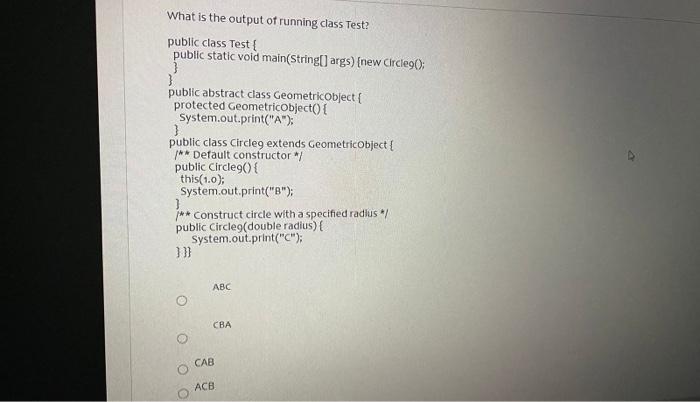
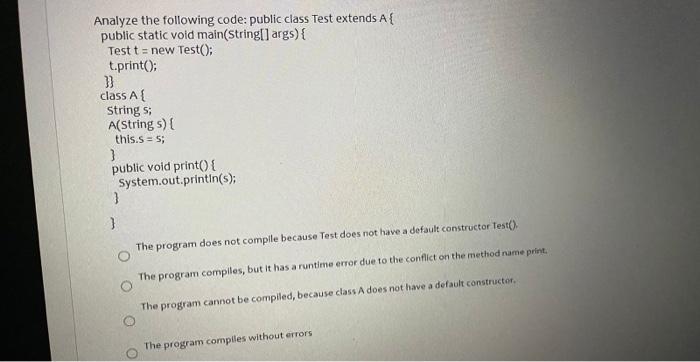
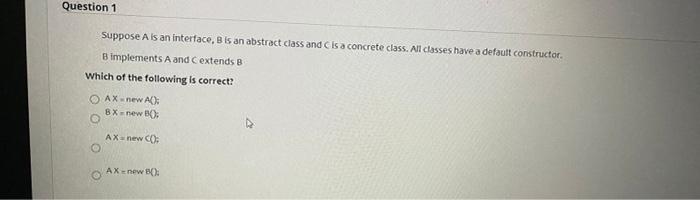
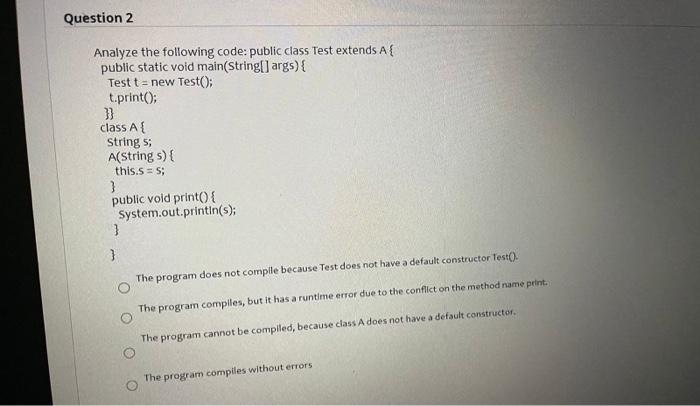
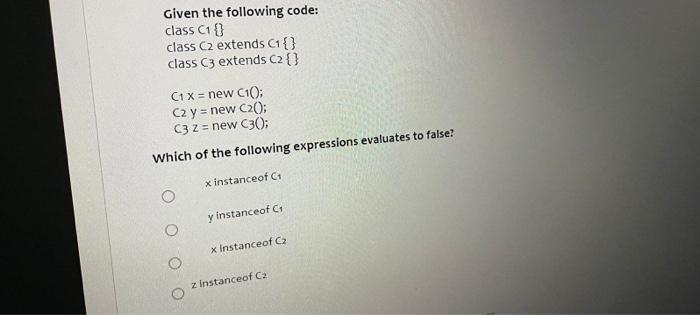
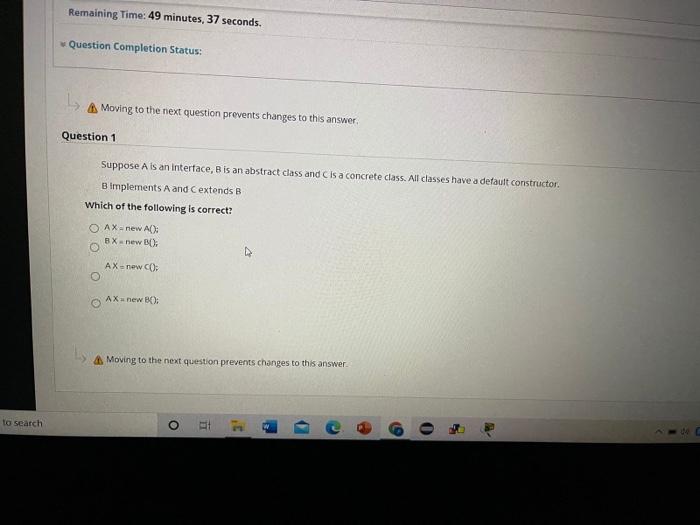
Analyze the following code: public class Test extends A{ public static void main(String[] args) \{ Test t= new Test () ; t.print(); {3 class A{ String 5 ; A( String 5){ this.s = 5 ; \} public void print( ){ System.out.printin(s); \} 3 The program does not compile because Test does not have a default constructor Test(). The program compiles, but it has a runtime error due to the conflict on the method name print. The program cannot be complled, because class A does not have a default constructer. The program complles without errors Moving to the next question prevents changes to this answer. Suppose A is an interface, B is an abstract class and C is a concrete class. All classes have a default constructor. B implements A and C extends B Which of the following is correct? AX=newA(); BX= new B(); AX=newC(); AX= new BC); 4. Moving to the next question prevents changes to this answer- Moving to the next question prevents changes to this answer. stion 17 In Object-oriented programming Encapsulation means in general Attributes are private and methods are private Attributes are private and methods are public Attributes are public and methods are public Attributes are public and methods are private Moving to the next question prevents changes to this answer. An IndexOutOfBoundsException is thrown if you access an element in an array outside the bounds of the array. True False An IndexOutOfBoundsException is thrown if you access an element in an array outside the bounds of the array. True False In java program a file has two names True False RuntimeException. Error and their subclasses are known as checked exceptions. All other exceptions are known as unchecked exceptions. True False If programmer calls a copy constructor Which is not defined then the Compiler provides an implicit copy constructor Compiler gives an error Compiler uses the default constructor Program gives run time error if copying is used The Java interface is used to share common behavior (only method headers) among the instances of different classes. True False File F= new File("sample1.data"); Consider the code line above, F represents The real file name The name of the stream The root name A reference What is the output of running class Test? public class Test \{ public static void main(String[] args) \{new (ircleg(); 3 public abstract class Geometricobject \{ protected Geometricobject() \{ System.out.print("A"); \} public class Circleg extends Geometricobject\{ I Default constructor / public CirclegO this (1.0); System.out.print("B"); ] \$** construct circle with a specified radlus * public Circleg(double radius) System.out.print(" C); ]\}\} ABC CBA CAB ACB Analyze the following code: public class test extends A \{ public static void main(String[] args) \{ Test t= new Test () ; t.print(); \}] class A{ String 5 ; A( String 5){ this.s =5; 3 public void print() \{ System.out.printin(5); 3 \} The program does not compile because Test does not have a default constructor Test(). The program complies, but it has a runtime error due to the conflict on the method name print. The program cannot be compled, because class A does not have a default constructor. The program complles without errors Suppose A is an interface, B is an abstract class and C is a concrete class. All classes have a default constructor. B implements A and C extends B Which of the following is correct? AX-newA();BXnewBOAX=newCO; Ax-new(7) Analyze the following code: public class Test extends A \{ public static void main(String[] args) \{ Test t= new Test(); t.print(); 3} class A{ String 5 ; A( String s){ this.s =5; \} public void print() \{ System.out.printin(s); \} 3 The program does not complle because Test does not have a default constructor lest(). The program compiles, but it has a runtime error due to the conflict on the method name print. The program cannot be complled, because class A does not have a defaut constructor. The program compiles without ertors Given the following code: classC1{}classC2extendsC1{}classC3extendsC2{}C1x=newC1O)C2y=newC2C)C3Z=newC3O) Which of the following expressions evaluates to false? x instance of Cl y instanceof C1 x instance of C2 z instance of C2
Step by Step Solution
There are 3 Steps involved in it

Get step-by-step solutions from verified subject matter experts
 Study Help