Question: Identify three types of pressure that resulted from changes taking place in the education sector and explain how they affected HEC Montreal. Why is the
- Identify three types of pressure that resulted from changes taking place in the education sector and explain how they affected HEC Montreal.
- Why is the CRM project of strategic importance to HEC Montreal? In order to respond to this question, make sure to include the answer to the following questions:
- What makes a project strategic?
- What three key benefits can HEC Montreal hope to achieve hope to achieve with the implementation of CRM?
- Does it make sense for a project of such strategic importance to have been delayed for so long?
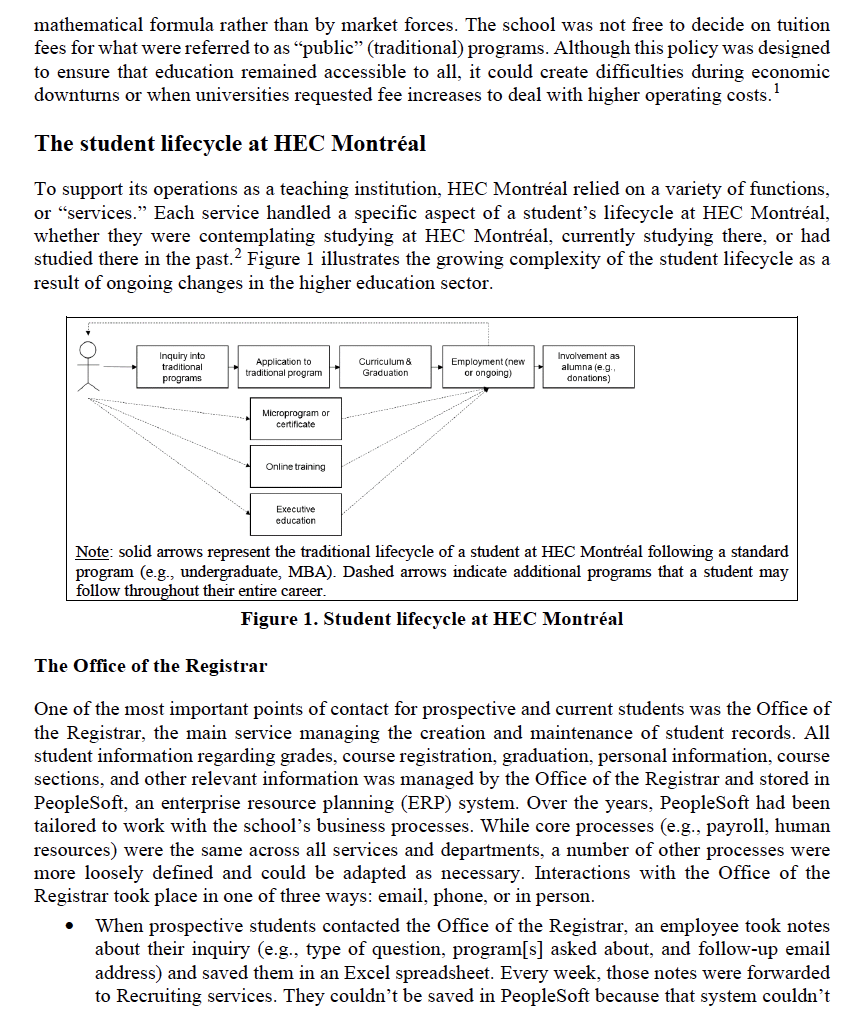
A changing market in the higher education sector Since the early 2010s, the higher education sector had felt growing pressure to keep up with changing labour market trends and learner expectations: A more precarious economic outlook in many Western countries had created a more fragile labour market, where the loyalty of employers and employees was declining. Professionals had to navigate a complex labour market, where the skills they acquired as undergraduates might not last them their entire career. They were thus expected to update their skills as they simultaneously balanced their work and family lives. Globalization had increased the mobility of workers and students, leading to a surge in the number of business schools as well as a strong increase in exchange programs and international admissions, especially at business schools. 6 . Distance learning, originally offered by traditional institutions to a minority of students registered in specific programs, was being reinvented with the emergence of online learning platforms. Massive open online courses MOOCs allowed learners to complement their skill set by taking courses for free or for a nominal fee to earn a certificate of completion." a Students expected digital technologies to play an important role in their relationship with their schools. Although emails were still widely used, a growing number of students maintained ties with other people and organizations using social media and other digital channels that enabled more direct dialogue between participants. Within this changing environment, higher education institutions had to devise new ways to build and maintain strong relationships with prospective, current, and past students. To that end, many were looking at best practices and technologies adopted by traditional organizations facing similar challenges with their customer base. HEC Montral in 2012: A French-speaking business school in a changing environment Founded in 1907, HEC Montral (Hautes tudes Commerciales, or Higher Commercial Studies) was the largest French-speaking business school in North America. It was located in the heart of Montreal (population: 1.7 million in 2014), the largest city in the province of Quebec, Canada. The school adhered to five core values: rigour, relevance, boldness, respect, and commitment, and its mission stated that: HEC Montral is a French-language institution solidly rooted in its community and open to the world. It is an international-calibre university business school that contributes to our society's prosperity by providing leadership in all its spheres of activity, i.e., teaching at all levels, research and serving the community. While affiliated with a parent institution, Universit de Montral, HEC Montral enjoyed a high degree of autonomy in terms of its strategy and operations. In 1996, the growing school inaugurated a second building, and in 2012, it launched an ambitious financing campaign to help fund the construction of a third building in downtown Montreal. An in-depth look at key facts and figures showcasing the diversity that characterized HEC Montral is found in Exhibit 2. Funding in Quebec's higher education sector The Ministre de l'ducation et de l'Enseignement Suprieur du Qubec (Quebec's Ministry of Education) was responsible for funding institutions of higher education, including HEC Montral. The maximum number of students that a school could register was based on its physical footprint (i.e., number and size of classrooms). As with other Quebec universities, the fees charged by HEC Montral for standard programs (e.g., bachelor's, master's) were established by a mandated mathematical formula rather than by market forces. The school was not free to decide on tuition fees for what were referred to as "public" (traditional) programs. Although this policy was designed to ensure that education remained accessible to all, it could create difficulties during economic downturns or when universities requested fee increases to deal with higher operating costs. The student lifecycle at HEC Montral To support its operations as a teaching institution, HEC Montral relied on a variety of functions, or services. Each service handled a specific aspect of a student's lifecycle at HEC Montral, whether they were contemplating studying at HEC Montral, currently studying there, or had studied there in the past.? Figure 1 illustrates the growing complexity of the student lifecycle as a result of ongoing changes in the higher education sector. Inquiry into traditional programs Application to traditional program Curriculum & Graduation Employment(new or ongoing) Involvement as alumna (e.g. donations) Microprogram or certificate Online training Executive education Note: solid arrows represent the traditional lifecycle of a student at HEC Montral following a standard program (e.g., undergraduate, MBA). Dashed arrows indicate additional programs that a student may follow throughout their entire career. Figure 1. Student lifecycle at HEC Montral The Office of the Registrar One of the most important points of contact for prospective and current students was the Office of the Registrar, the main service managing the creation and maintenance of student records. All student information regarding grades, course registration, graduation, personal information, course sections, and other relevant information was managed by the Office of the Registrar and stored in PeopleSoft, an enterprise resource planning (ERP) system. Over the years, PeopleSoft had been tailored to work with the school's business processes. While core processes (e.g., payroll, human resources) were the same across all services and departments, a number of other processes were nore loosely defined and could be adapted as necessary. Interactions with the Office of the Registrar took place in one of three ways: email, phone, or in person. When prospective students contacted the Office of the Registrar, an employee took notes about their inquiry (e.g., type of question, program[s] asked about, and follow-up email address) and saved them in an Excel spreadsheet. Every week, those notes were forwarded to Recruiting services. They couldn't be saved in PeopleSoft because that system couldn't store data about students who didn't yet have an HEC Montral student ID. After searching the school's website, prospective students often contacted the Office of the Registrar to request information they could not find online. Students interested in graduate studies sometimes contacted professors directly to inquire about research interests, available funding, and other specific issues. Following those interactions, professors might advise prospective students to apply to a program, but the Office of the Registrar was not informed of those discussions. Unlike prospective students, current and returning students already had an HEC Montral student ID. Upon request (e.g., a student wished to register for a restricted class, change a billing address, or credit a course), staff at the Office of the Registrar could log into PeopleSoft to perform the required actions on the student's behalf. In such instances, however, there would be no record of the student's request once it had been handled. . Although this process worked fine for students, it could create challenges for Recruiting services. The Excel spreadsheet might contain errors (e.g., mistyped email addresses). The spreadsheets didn't always follow a standard format, making it difficult to import information in bulk for analysis purposes. Finally, not everyone at the Office of the Registrar had the skills to use Excel effectively. The usefulness of the notes could thus vary. Recruiting services Headed by Michel Lemay, Recruiting services had several objectives, all of which focused on enticing the best students to register for HEC Montral programs. The services' primary mission was to follow up on inquiries received by the Office of the Registrar. Based on notes taken by its staff, employees contacted prospective students, asking them whether they had all the information they needed to make a decision and promoting HEC Montral as their best option. In this way, they sought to engage with candidates to nurture relationships that would convince them to become HEC Montral students. These efforts could take time to produce results, however. It was not uncommon for prospective MBA students to contact HEC Montral two or three years before they finally applied to the program. Recruiting services, therefore, had to keep its contact lists to ensure that regular follow-ups were done to maintain the school's relationship with prospective students. Another important component of the services' mission was to attend education fairs around the world to promote the school and answer questions from international students in person. In this case, prospective students provided their contact information on paper, and staff members later input the data into Excel spreadsheets similar to those used by the Office of the Registrar. Although education fairs could yield positive results in terms of establishing relationships with prospective students in some markets (e.g., China, India), the school's budget for attending them was limited. Given the fierce competition among institutions of higher education, deciding which fairs to attend was an ongoing challenge. Recruiting services was also in charge of maintaining the school's online presence. This involved launching recruitment campaigns via email or on social networks (e.g., LinkedIn), understanding how people landed on HEC Montral's website and how they searched for information once they were there, and holding webinars where prospective students could watch interactive presentations of the school and its programs and ask questions in real time. Here again, decisions had to be made about how best to use HEC Montral's limited recruiting budget to ensure the best students would apply. So far, efforts to coordinate those initiatives had proved unsatisfactory. As mentioned, the data collected by human agents (e.g., staff at the Office of the Registrar) was not always accurate. At education fairs, information was also taken down on paper before being entered into a spreadsheet, creating further opportunities for error. Finally, the selection and management of recruitment channels was often based on habit and intuition rather than hard evidence. The school might hold an open house at the same time as its parent institution, Universit de Montral, for example, without questioning whether the day and time of the open house was suitable for the school's clientele. Finally, Recruiting services gathered no data on students who didn't end up registering. There was no way to know why some people decided not to attend HEC Montral, but that information could have proven invaluable to efforts to attract those lost students (e.g., by adapting course schedules in some programs). Overall, the fragmentation of those interactions created silos across the student lifecycle at HEC, making it impossible to generate a comprehensive overview of the process. Student services Student services was in charge of ensuring that new students felt at home. It helped students gain access to financial help, housing services, and psychological support as needed. It also helped students connect with student associations, facilitated exchanges with other schools, and facilitated the integration of international students and locals with the HEC Montral community. In line with the breadth of their mission, staff in the various subunits composing Student services relied on different tools to perform their duties. Although most of those tools included Excel spreadsheets, no single tool had been configured to centralize data and fulfill all existing needs. In addition, most of the forms and information managed by Student services were in hard copy form and kept in paper files. The information gathered by Student services was isolated within the subunit where it was collected and did not cross into PeopleSoft, nor was it shared with other services. This made it impossible for the twenty-some employees working for Student services to access a complete profile of any student to follow up on any special accommodations they might need with other subunits or other services. Alumni services Like Recruiting services, which stayed in close touch with prospective students until they had made a decision, Alumni services was responsible for establishing and maintaining contact with students after they graduated. Among other activities, Alumni services organized networking events to help graduates in their job search or to reconnect with classmates. In 2013, the service entered a transition period, with personnel changes (including a new director) and a new strategic direction. Rather than seeking to re-establish contact with alumni that had graduated years ago, the service now focused on creating ties with graduates as soon as possible. They hoped this more proactive approach would make it easier to maintain this contact over time. One of the challenges facing Alumni services was keeping contact information current. In an ideal world, they could have sent targeted communications to alumni groups based on factors such as geographic location, graduation year, or completed programs or degrees. HEC Montral's recent opening to the international community had made this more difficult, however. Graduates career paths had become much more convoluted, and the mobility of the modern workforce made it more difficult to keep track of them. Both snail mail and email addresses changed frequently. Although every new student at HEC Montral was given a permanent HEC Montral email address, it was not uncommon for students to stop using that address after they graduated. As a result, Alumni services couldn't be sure their communications were reaching their target audiences. To help keep alumni's contact information up to date, staff used Blackbaud Raiser's Edge NXT, a cloud-based fundraising and donor management software solution. A folder was created for each graduate to store their contact information, their current position, their year of graduation, and the Alumni services events they had attended. Alumni registered for those events via the school's website, and there was no integration between those events and Raiser's Edge. A part-time employee was thus tasked with entering the data from event registrations into Raiser's Edge. This data was supplemented with business cards collected during the events. HEC Montral Foundation The HEC Montral Foundation was created to "engage donors and raise funds to support the School's initiatives [...] and to contribute to the development of the next generation of world- class business professionals who will play an active role in cultivating social and economic prosperity in Quebec and in further strengthening the province's visibility and reputation worldwide.l Funds were collected from three main sources: organizations, alumni, and current students, who contributed $10 per semester as part of their tuition fee. The Foundation had a strong reputation for integrity and, in 2014, it earned certification in governance and good management practices for charitable organizations from the Bureau de normalisation du Qubec, Quebec's central body for standardization and certification. Most funds collected by the Foundation were allocated to one of three types of projects: research and teaching, student bursaries, and a special fund dedicated to maintaining the school's physical infrastructure, including buildings, classrooms, and equipment. The Foundation employed fifteen full-time employees to manage personal donations, corporate donations, and telemarketing operations to engage with prospective donors. When an individual or an organization committed to donating money to the Foundation, their contact information was also stored in Raiser's Edge. Telemarketing operations required an additional piece of software to manage call operations. Donations could be made using credit cards over the phone or online, as well as through a secure website. The Foundation periodically organized events to thank donors for their gifts and explain how their donations contributed to the school. Beyond the traditional student lifecycle Although standard education programs accounted for the lion's share of the school's operations, students also engaged with HEC Montral in other important ways. These included special education programs as well as EDUlib, the school's online learning platform. Special education programs at HEC Montral Although most programs offered by the school were governed by Quebec's funding policy, HEC Montral also offered private programs that were not subject to this policy. This gave the school more freedom with regard to the number and structure of special programs as well as tuition fees. In 2013, HEC Montral offered two such programs. The Executive MBA The Executive MBA (EMBA) targeted executives looking to acquire specialized skill sets in a dedicated environment fostering both learning and networking opportunities with fellow students. The EMBA program was highly exclusive, and each cohort had at most fifty students. For these reasons, the EMBA program relied heavily on a personalized approach to communications between the school and those students. For example, EMBA applications were not shared with the rest of the school. Rather, they were evaluated by a small committee composed of staff working in the EMBA office. Similarly, contact information and other student-related data were maintained exclusively by the EMBA staff and were not shared with the rest of the school. For the previous ten years, the EMBA program had relied primarily on its staff's interpersonal skills to build and maintain relationships with professionals. They were the ones who often convinced executives of the benefits of pursuing an EMBA. For Michel Filion, EMBA's recruitment director, this personalized approach fit with the program's exclusivity, although it meant that recruitment costs could be higher than for other programs. This situation was not without risks, moreover, since it relied heavily on the work of a few individuals. Information related to the recruitment process for the EMBA program was managed primarily by a single person who used their own information storage tools, including an address book on their phone. For the EMBA staff, this was one way they sought to maintain control over their data and ensure the trust placed in HEC Montral by executives was not violated. Indeed, the staff worried that having this information centralized and potentially shared with other services could betray that trust if busy executives were contacted for non-vital reasons, for example. Executive education The other type of private program offered by HEC Montral was executive education. The Executive education office offered a variety of programs geared toward professionals. These included training sessions that could last anywhere from half a day to several days and that focused on acquiring knowledge on a specific topic (e.g., artificial intelligence). Executive education was also offered as a customized product where the school designed a training program to meet the needs of a specific organization. In the early 2010s, the Executive education office was the only unit at HEC Montral using a customer relationship management (CRM) system tailored to its needs. This solution was perceived as very limited in terms of features and accessibility, however, in spite of its relatively narrow scope. At that time, the office was also undergoing a series of significant changes, including the revamping of its branding, a name change, and the retirement of several key employees. Online learning with EDUlib Launched in 2012, EDUlib was HEC Montral's response to the growing popularity of MOOC platforms such as Coursera and edX. It aimed to be the first to offer a large selection of courses in French to meet the demand in European and Northern African countries, for example. In 2014, a partnership was created between Universit de Montral, Polytechnique Montral, and HEC Montral. In just a few short years, EDUlib grew to offer about thirty courses at six Canadian institutions. For HEC Montral, EDUlib contributed to two important objectives. First, it increased the school's outreach in parts of the world where it would otherwise be absent. Second, it offered a way to showcase the quality of the school's programs to prospective students. Given the multitude of services and employees involved in ongoing interactions with prospective, current, and past students, HEC Montral's ability to build a complete profile from the time students first made inquiries to the time they graduated was limited. Every service had access to certain pieces of the puzzle and had a partial view of a student's lifecycle, but there was no way to compile that data to create a comprehensive profile. Building long-term relationships with students As mentioned above, competition in the higher education sector had become increasingly fierce. Gathering information about students had become critical and could impact significant decisions. Getting to know candidates before the school even accepted them could help it lock in students before they were snatched up by competitors. Likewise, information collected from students taking online courses with EDUlib could help the school promote targeted programs more likely to lead to applications to HEC Montral. Although HEC Montral was able to manage student records through its enterprise resource planning (ERP) systems, operations related to the ability to build and maintain strong relationships with prospective, current, and graduate students proved challenging. The school could not paint a comprehensive picture of students from the moment they showed interest in HEC Montral to the moment they graduated. The data required to build this picture was either missing or scattered across the school's various services based on their interactions with students. Preliminary inquiries to department heads by prospective graduate students were typically made via email. While a convenient form of communication, this made it difficult to evaluate the total number of candidates who had shown interest in studying at HEC Montral compared to the number who actually ended up applying for graduate programs. As information was deemed to be the key to addressing the challenges faced by HEC Montral, a task force was struck in 2009 to evaluate the feasibility and potential benefits of acquiring a customer relationship management (CRM) system. Once fully implemented, this system would consolidate data about prospective, current, and past students, enabling services to gain a comprehensive understanding of students and provide what is known as a "360-degree customer view. For HEC Montral, this would mean getting a clearer picture of who applied to the school's various









 Study Help