







Question: In Example 3-5 we obtained the electric field intensity around an infinitely long line charge of a uniform charge density in a very simple
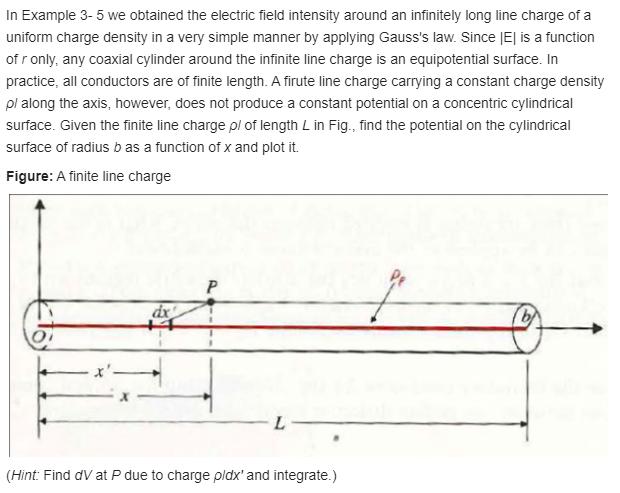
In Example 3-5 we obtained the electric field intensity around an infinitely long line charge of a uniform charge density in a very simple manner by applying Gauss's law. Since JEJ is a function of r only, any coaxial cylinder around the infinite line charge is an equipotential surface. In practice, all conductors are of finite length. A firute line charge carrying a constant charge density pl along the axis, however, does not produce a constant potential on a concentric cylindrical surface. Given the finite line charge pl of length L in Fig., find the potential on the cylindrical surface of radius b as a function of x and plot it. Figure: A finite line charge (Hnt: Find dV at P due to charge pldx' and integrate.)
Step by Step Solution
3.36 Rating (146 Votes )
There are 3 Steps involved in it
To solve this problem we need to find the electric potential V at point P on the cylindrical surface ... View full answer

Get step-by-step solutions from verified subject matter experts
 Study Help