







Question: Inis assignment uses autograding. We rely on the random number generator generating the same random sequence. Same as in Assignment 2 . This time, we
Inis assignment uses autograding. We rely on the random number generator generating the same random sequence. Same as in Assignment This time, we will be using the random.choices function as follows.This will give the following output.Note that we obtain intendent actions and unintended actions here. Make sure that you understand the output and that you can reproduce it on your machine before proceeding. Note that we use anaconda python to obtain the above result.
Problem : An MDP Episode points
In this part of the assignment, we are going to play an episode in an MDP by following a given policy. Consider the first test case of problem available in the file testcasespprob
po
The first part of this file specifies an MDP S is the start state with four available actions N is an ordinary state with the same four available actions and are states where the only available action is exit and the reward are and respectively. The reward for action in other states is # is a wall.
Actions are not deterministic in this environment. In this case with noise we are successfully acting of the time and of the time we will act perpendicular to the intended direction with equal probability, ie for each unintended direction. If the agent attempts to move into a wall, the agent will stay in the same position. Note that this MDP is identical to the example that we covered extensively in our class.
The second part of this file specifies the policy to be executed.
As usual, your first task is to implement the parsing of this grid MDP in the function readgridmdpproblempfilepath of the file
parse.py You may use any appropriate data structure.
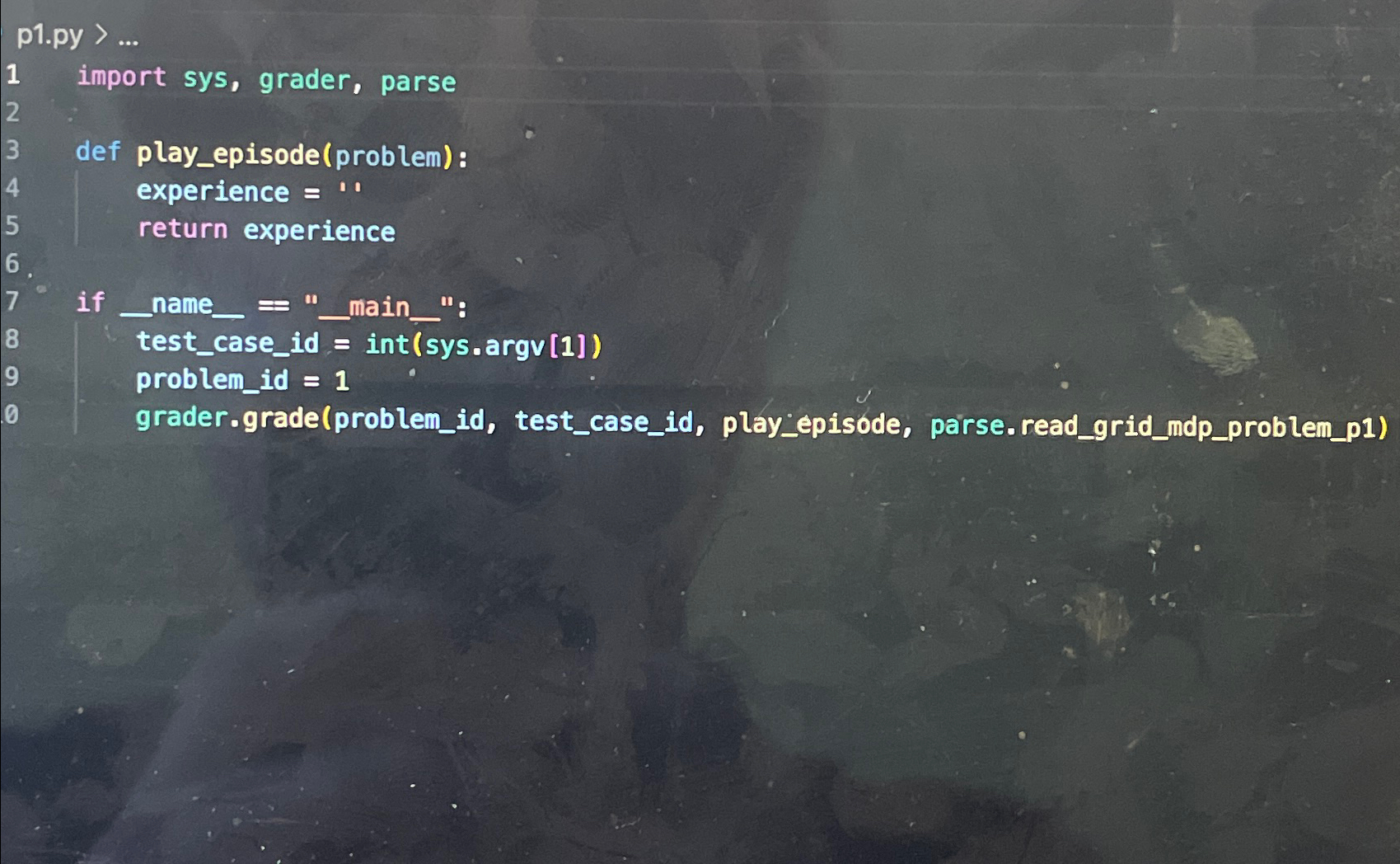
Next, you should implement running the episode in the function playepisodeproblem in the file
ppy
Below is the expected output. Note that we always use exactly characters for the output of a single grid and that the last line does not contain a new line.
Taking action: W intended:
Reward recelved:
New state:
Cunulative rewrd sn:
Taking action: intended:
Reward received:
New state:
Cunulativ rewbar a rd sn:
Taking action: Intended:
Reward recelved:
New state:
Cumulativ rewbar a rd sn:
Taking action: Intended:
Reward recelved:
New state:
Cumulativ rewbar a rd sn:
Taking action: intended:
Reward received:
New state:
Cumulative rewbar a rd sn:
Taking action: E intended: E
Reward recelved:
New state:
Cumulativ rewbar a rd sm:
Taking action: E intended: E
Reward received:
New state:
Cumulativ rewbar a rd sn:
Taking action: E intended: E
Reward recelved:
New state:
Cumulative rewrd sm:
Taking action: exit Intended; exit
Reward received:
Nw state:
s
Cumulativ rewbar a rd sm:
As you can see, in this question we don't use any discount factor. We will introduce that in the next question. You can also try some of the other test cases such as testcasespprob.With a correct implementation, you should be able to pass all test cases.
parse.py
parse.py readgridmdpproblemp
def readgridmdpproblempfilepath:
#Your p code here
problem
return problem
def readgridmdpproblempfilepath:
#Your p code here.
problem
return problem
def readgridmdpproblempfilepath:
#Your p code here
problem
return problem
Step by Step Solution
There are 3 Steps involved in it
1 Expert Approved Answer
Step: 1 Unlock

Question Has Been Solved by an Expert!
Get step-by-step solutions from verified subject matter experts
Step: 2 Unlock
Step: 3 Unlock
 Study Help