







Question: Introduction Describe the use-case, scenario, business challenge, application solution, and other relevant information. Provide the reader with a concise yet effective overview of the
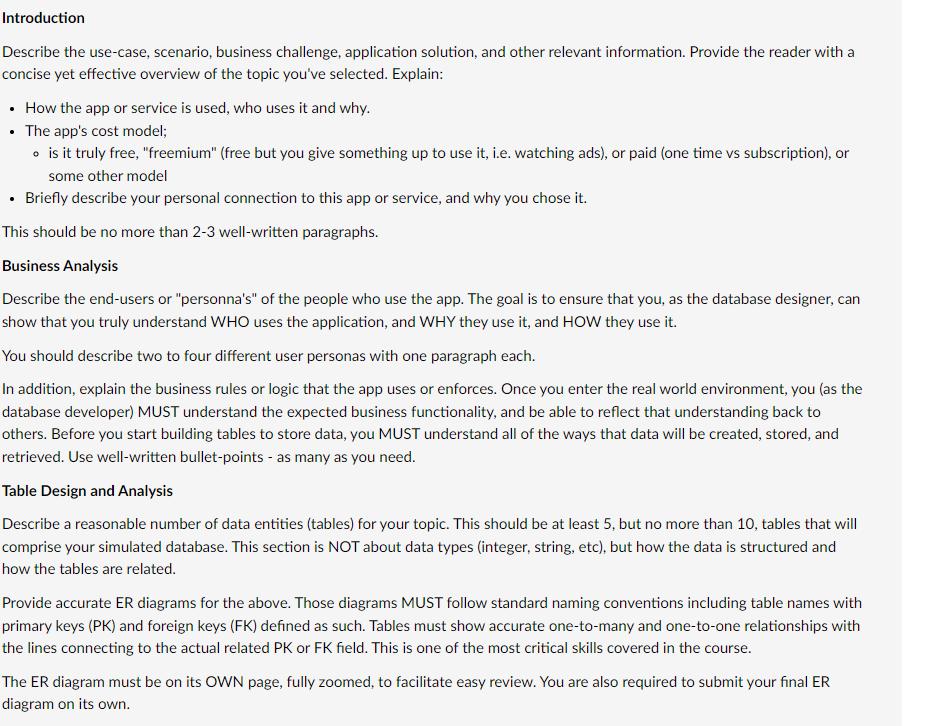
Introduction Describe the use-case, scenario, business challenge, application solution, and other relevant information. Provide the reader with a concise yet effective overview of the topic you've selected. Explain: How the app or service is used, who uses it and why. The app's cost model; is it truly free, "freemium" (free but you give something up to use it, i.e. watching ads), or paid (one time vs subscription), or some other model Briefly describe your personal connection to this app or service, and why you chose it. This should be no more than 2-3 well-written paragraphs. Business Analysis Describe the end-users or "personna's" of the people who use the app. The goal is to ensure that you, as the database designer, can show that you truly understand WHO uses the application, and WHY they use it, and HOW they use it. You should describe two to four different user personas with one paragraph each. In addition, explain the business rules or logic that the app uses or enforces. Once you enter the real world environment, you (as the database developer) MUST understand the expected business functionality, and be able to reflect that understanding back to others. Before you start building tables to store data, you MUST understand all of the ways that data will be created, stored, and retrieved. Use well-written bullet-points - as many as you need. Table Design and Analysis Describe a reasonable number of data entities (tables) for your topic. This should be at least 5, but no more than 10, tables that will comprise your simulated database. This section is NOT about data types (integer, string, etc), but how the data is structured and how the tables are related. Provide accurate ER diagrams for the above. Those diagrams MUST follow standard naming conventions including table names with primary keys (PK) and foreign keys (FK) defined as such. Tables must show accurate one-to-many and one-to-one relationships with the lines connecting to the actual related PK or FK field. This is one of the most critical skills covered in the course. The ER diagram must be on its OWN page, fully zoomed, to facilitate easy review. You are also required to submit your final ER diagram on its own.
Step by Step Solution
3.49 Rating (156 Votes )
There are 3 Steps involved in it
Introduction The selected app is a social media platform called ConnectHub ConnectHub is a usercentric platform designed for connecting people with similar interests and facilitating meaningful intera... View full answer

Get step-by-step solutions from verified subject matter experts
 Study Help