







Question: Is the braking speed different when individuals drive while intoxicated or while talking on a cell phone? This study takes place on a car
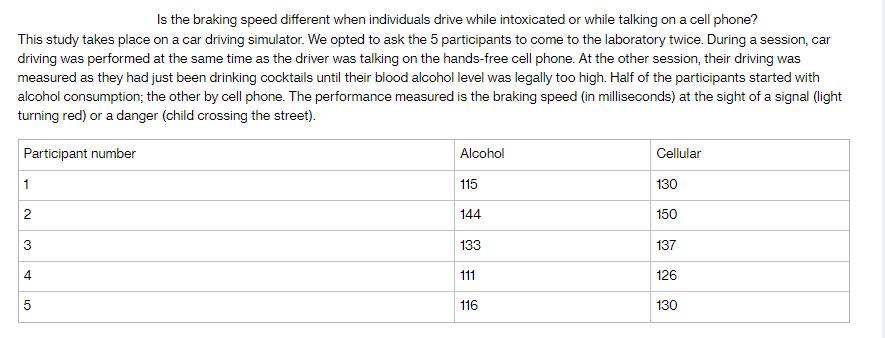
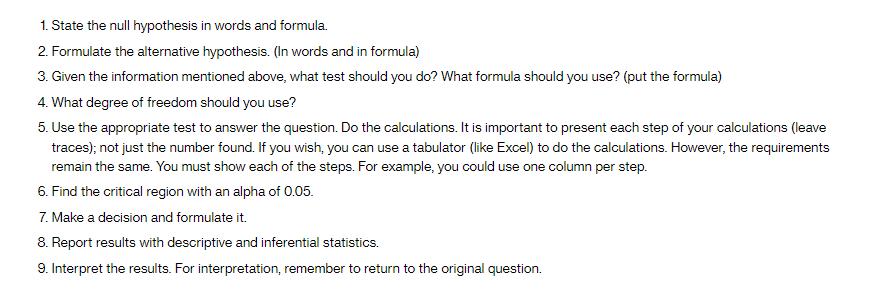
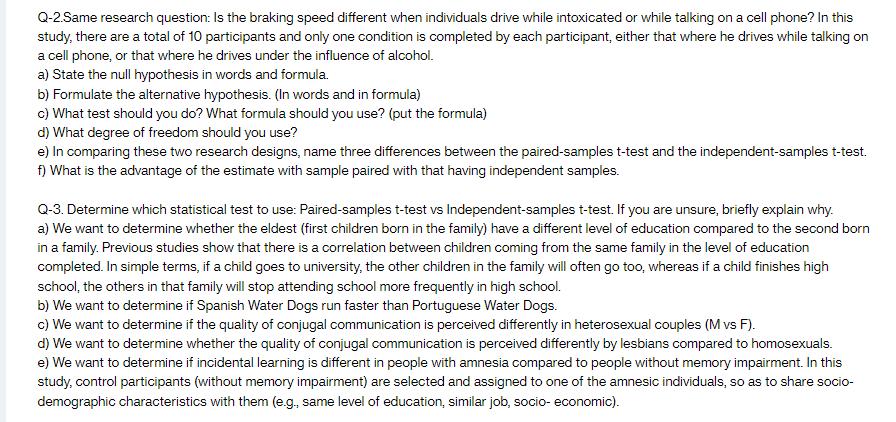

Is the braking speed different when individuals drive while intoxicated or while talking on a cell phone? This study takes place on a car driving simulator. We opted to ask the 5 participants to come to the laboratory twice. During a session, car driving was performed at the same time as the driver was talking on the hands-free cell phone. At the other session, their driving was measured as they had just been drinking cocktails until their blood alcohol level was legally too high. Half of the participants started with alcohol consumption; the other by cell phone. The performance measured is the braking speed (in milliseconds) at the sight of a signal (light turning red) or a danger (child crossing the street). Participant number 1 2 3 4 5 Alcohol 115 144 133 111 116 Cellular 130 150 137 126 130 1. State the null hypothesis in words and formula. 2. Formulate the alternative hypothesis. (In words and in formula) 3. Given the information mentioned above, what test should you do? What formula should you use? (put the formula) 4. What degree of freedom should you use? 5. Use the appropriate test to answer the question. Do the calculations. It is important to present each step of your calculations (leave traces); not just the number found. If you wish, you can use a tabulator (like Excel) to do the calculations. However, the requirements remain the same. You must show each of the steps. For example, you could use one column per step. 6. Find the critical region with an alpha of 0.05. 7. Make a decision and formulate it. 8.Report results with descriptive and inferential statistics. 9. Interpret the results. For interpretation, remember to return to the original question. Q-2 Same research question: Is the braking speed different when individuals drive while intoxicated or while talking on a cell phone? In this study, there are a total of 10 participants and only one condition is completed by each participant, either that where he drives while talking on a cell phone, or that where he drives under the influence of alcohol. a) State the null hypothesis in words and formula. b) Formulate the alternative hypothesis. (In words and in formula) c) What test should you do? What formula should you use? (put the formula) d) What degree of freedom should you use? e) In comparing these two research designs, name three differences between the paired-samples t-test and the independent-samples t-test. f) What is the advantage of the estimate with sample paired with that having independent samples. Q-3. Determine which statistical test to use: Paired-samples t-test vs Independent-samples t-test. If you are unsure, briefly explain why. a) We want to determine whether the eldest (first children born in the family) have a different level of education compared to the second born in a family. Previous studies show that there is a correlation between children coming from the same family in the level of education completed. In simple terms, if a child goes to university, the other children in the family will often go too, whereas if a child finishes high school, the others in that family will stop attending school more frequently in high school. b) We want to determine if Spanish Water Dogs run faster than Portuguese Water Dogs. c) We want to determine if the quality of conjugal communication is perceived differently in heterosexual couples (M vs F). d) We want to determine whether the quality of conjugal communication is perceived differently by lesbians compared to homosexuals. e) We want to determine if incidental learning is different in people with amnesia compared to people without memory impairment. In this study, control participants (without memory impairment) are selected and assigned to one of the amnesic individuals, so as to share socio- demographic characteristics with them (e.g., same level of education, similar job, socio- economic). Q-4. When should you calculate the weighted average of two variances? Explain, the purpose of a weighted average. That is, why in some cases do we calculate the weighted average of two variances?
Step by Step Solution
There are 3 Steps involved in it
Answer One commonly used method for comparing two groups like this is the ttest Here are the steps to perform the analysis Hypotheses Null Hypothesis ... View full answer

Get step-by-step solutions from verified subject matter experts
 Study Help