







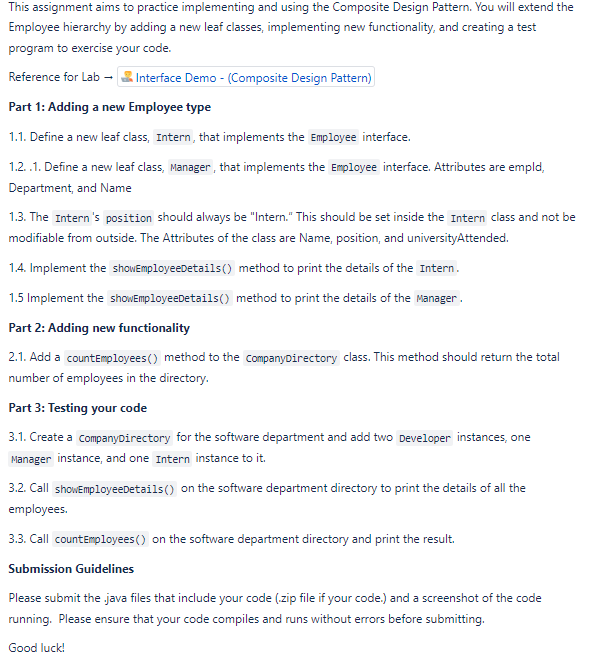
Question: java In this code: Employee is the Component. Developer is the Leaf. CompanyDirectory is the Composite. We can add more specific types of employees (
java
In this code:
Employee is the Component.
Developer is the Leaf.
CompanyDirectory is the Composite.
We can add more specific types of employees like Manager, Engineer, etc. that would also implement the Employee interface. Similarly, we can create different types of directories like DepartmentDirectory, TeamDirectory, etc. that would inherit from CompanyDirectory.
Code:
package CompositePatternDemo;
Component
interface Employee
void showEmployeeDetails;
The Employee interface defines a common operation, showEmployeeDetails which is to be implemented by all objects in the composition. All employees, whether they are a simple developer or a composite directory, will have this operation.
package CompositePatternDemo;
import java.util.ArrayList;
import java.util.List;
Composite
class CompanyDirectory implements Employee
private List employeeList new ArrayList;
@Override
public void showEmployeeDetails
for Employee emp : employeeList
emp.showEmployeeDetails;
public void addEmployeeEmployee emp
employeeList.addemp;
public void removeEmployeeEmployee emp
employeeList.removeemp;
The CompanyDirectory class is a composite node it can contain both leaf nodes like Developer and other composite nodes like other CompanyDirectory instances It implements the Employee interface, and manages child Employee objects both leaves and composites in the employeeList.
It also provides an implementation of showEmployeeDetails which simply delegates the operation to all its children. When called on a CompanyDirectory, this method will print the details of all employees in the directory.
package CompositePatternDemo;
Leaf
class Developer implements Employee
private String name;
private long empId;
private String position;
public Developerlong empId, String name, String position
this.empId empId;
this.name name;
this.position position;
@Override
public void showEmployeeDetails
System.out.printlnDeveloper ID: empId Name: name Position: position;
The Developer class is a leaf node it can't have any children. It's one of the basic building blocks of our composition. This class implements the Employee interface and provides its own implementation of showEmployeeDetails method.
Driver:
package CompositePatternDemo;
public class CompositeDriver
public static void mainString args
Employee dev new Developer "Fred Flintstone", "Pro Developer";
Employee dev new Developer "Bart Simpson", "Developer";
CompanyDirectory engDirectory new CompanyDirectory;
engDirectory.addEmployeedev;
engDirectory.addEmployeedev;
engDirectory.showEmployeeDetails;
In our driver code, we first create two Developer instances, dev and dev We then create a CompanyDirectory instance, engDirectory, and add dev and dev to it Finally, we call showEmployeeDetails on engDirectory thanks to the composite pattern, this prints the details of all employees in the directory, regardless of how many there are or how they're structured.
Step by Step Solution
There are 3 Steps involved in it
1 Expert Approved Answer
Step: 1 Unlock

Question Has Been Solved by an Expert!
Get step-by-step solutions from verified subject matter experts
Step: 2 Unlock
Step: 3 Unlock
 Study Help