







Question: Justify whether the following relations are reflexive, symmetric, transitive, or antisymmetric. Also, determine if they are equivalence relations or partial order relations. (20 pts)
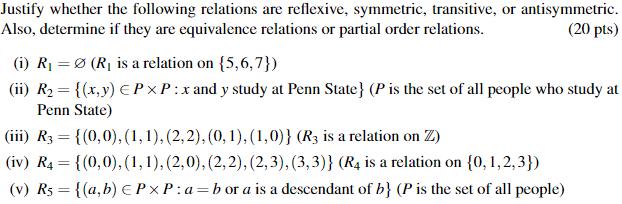
Justify whether the following relations are reflexive, symmetric, transitive, or antisymmetric. Also, determine if they are equivalence relations or partial order relations. (20 pts) (1) R = (R is a relation on {5,6,7}) (ii) R = {(x,y) = PxP:x and y study at Penn State) (P is the set of all people who study at Penn State) (iii) R3 = {(0,0), (1, 1), (2,2), (0, 1), (1,0)} (R3 is a relation on Z) (iv) R4 = {(0,0), (1, 1), (2,0), (2, 2), (2,3), (3,3)} (R4 is a relation on {0, 1,2,3}) (v) R5 = {(a,b) = PxP: a b or a is a descendant of b} (P is the set of all people)
Step by Step Solution
There are 3 Steps involved in it
i R R is a relation on 567 Reflexive A relation R is reflexive if a a is in R for every element a in the set In this case R contains the pairs 5 5 6 6 and 7 7 so it is reflexiveSymmetric A relation R ... View full answer

Get step-by-step solutions from verified subject matter experts
 Study Help