


Question: LESSON 8.3.2 - SOLVING FOR ALL ROOTS OF A POLYNOMIAL The roots of a polynomial are the values that make the function equal to zero.
LESSON 8.3.2 - SOLVING FOR ALL ROOTS OF A
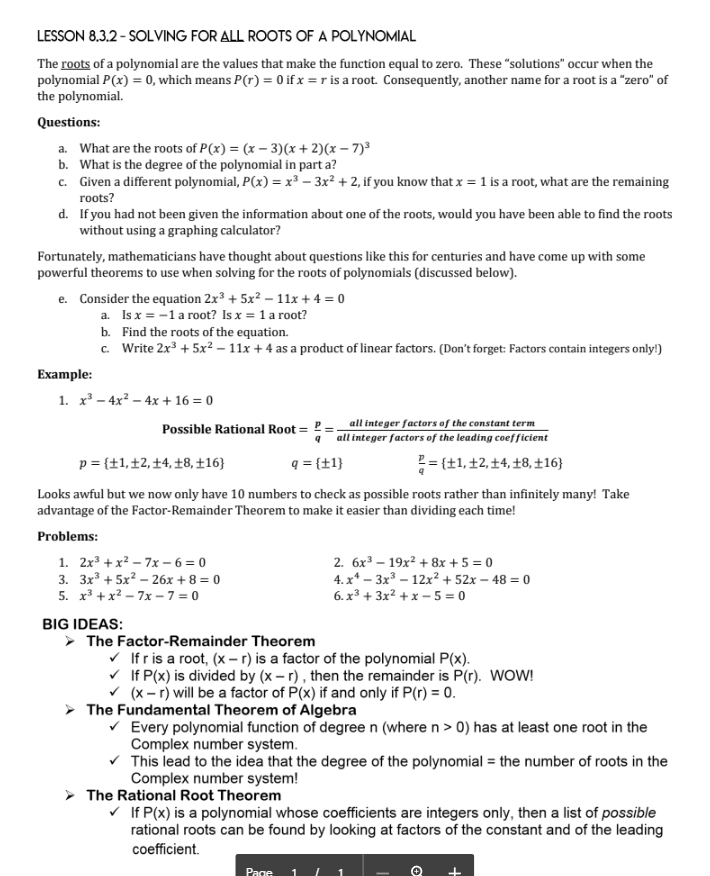
LESSON 8.3.2 - SOLVING FOR ALL ROOTS OF A POLYNOMIAL The roots of a polynomial are the values that make the function equal to zero. These "solutions" occur when the polynomial P(x) = 0, which means P(r) = 0 if x = r is a root. Consequently, another name for a root is a "zero" of the polynomial. Questions: a. What are the roots of P(x) = (x - 3)(x + 2)(x - 7)3 b. What is the degree of the polynomial in part a? c. Given a different polynomial, P(x) = x3 - 3x2 + 2, if you know that x = 1 is a root, what are the remaining roots? d. If you had not been given the information about one of the roots, would you have been able to find the roots without using a graphing calculator? Fortunately, mathematicians have thought about questions like this for centuries and have come up with some powerful theorems to use when solving for the roots of polynomials (discussed below). e. Consider the equation 2x3 + 5x2 - 11x +4 = 0 a. Is x = -1 a root? Is x = 1 a root? b. Find the roots of the equation. c. Write 2x3 + 5x2 - 11x + 4 as a product of linear factors. (Don't forget: Factors contain integers only!) Example: 1. x3 - 4x2 - 4x + 16 = 0 Possible Rational Root = =. all integer factors of the constant term all integer factors of the leading coefficient p = {+1, 12, 14, 18, +16} q = {+1} 2= {+1, +2, 14, 18,+16} Looks awful but we now only have 10 numbers to check as possible roots rather than infinitely many! Take advantage of the Factor-Remainder Theorem to make it easier than dividing each time! Problems: 1. 2x3 + x2 - 7x -6=0 2. 6x3 - 19x2 + 8x + 5 =0 3. 3x3 + 5x2 - 26x + 8 = 0 4. x4 - 3x3 - 12x2 + 52x - 48 = 0 5. x3+ x2- 7x - 7 =0 6.x3+ 3x2 +x -5=0 BIG IDEAS: The Factor-Remainder Theorem If r is a root, (x - r) is a factor of the polynomial P(x). If P(x) is divided by (x - r) , then the remainder is P(r). WOW! (x - r) will be a factor of P(x) if and only if P(r) = 0. > The Fundamental Theorem of Algebra Every polynomial function of degree n (where n > 0) has at least one root in the Complex number system. This lead to the idea that the degree of the polynomial = the number of roots in the Complex number system! The Rational Root Theorem If P(x) is a polynomial whose coefficients are integers only, then a list of possible rational roots can be found by looking at factors of the constant and of the leading coefficient

Step by Step Solution

There are 3 Steps involved in it

1 Expert Approved Answer
Step: 1 Unlock blur-text-image
Question Has Been Solved by an Expert!

Get step-by-step solutions from verified subject matter experts

Step: 2 Unlock
Step: 3 Unlock

Students Have Also Explored These Related Mathematics Questions!