Question: Lets now consider VTB (Vermont Teddy Bear) from the standpoint of the 5 forces model (see pp. 24-28) in terms of its competitive position in
Lets now consider VTB (Vermont Teddy Bear) from the standpoint of the 5 forces model (see pp. 24-28) in terms of its competitive position in the gift delivery service industry sector. (I wonder what is the SIC or NAICS code is for this sector?)
Please choose one of the following questions to answer:
- As of the time of the case does VTB have a lot of competitors?
- Do its customers have a lot of options for finding alternate sources for its products/services?
- Are there substitute products that can fulfill the customers need?
- Is it easy for a new company to enter this business to compete with VTB?
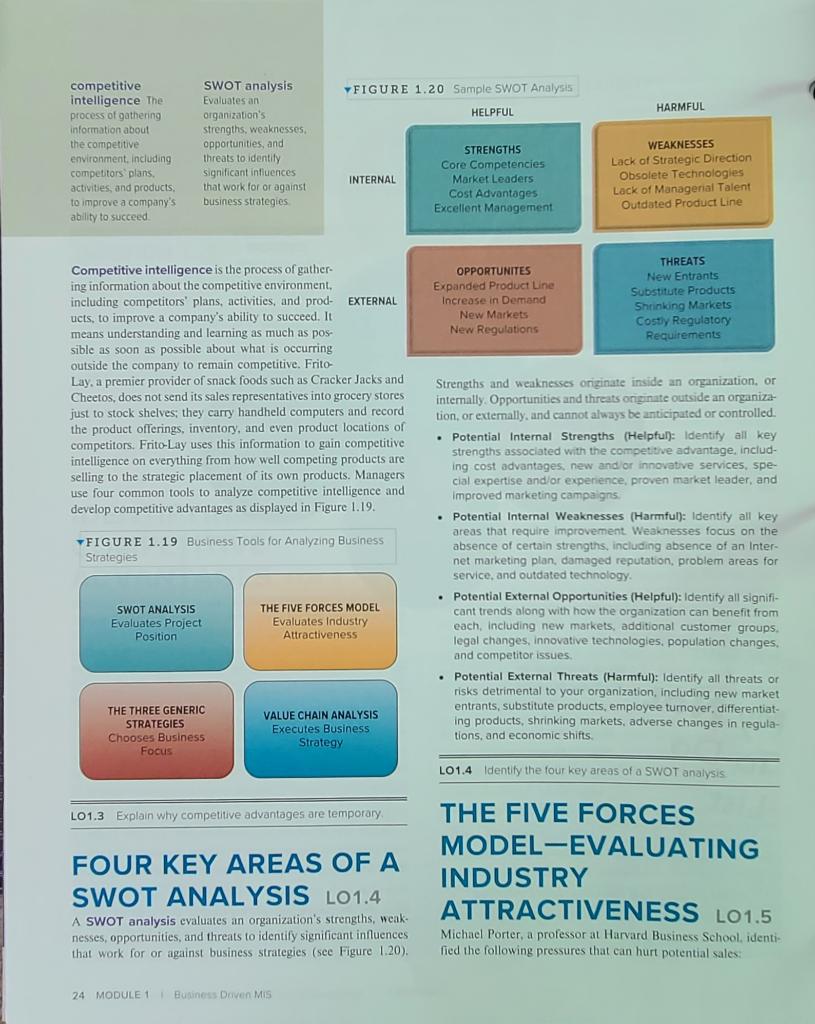
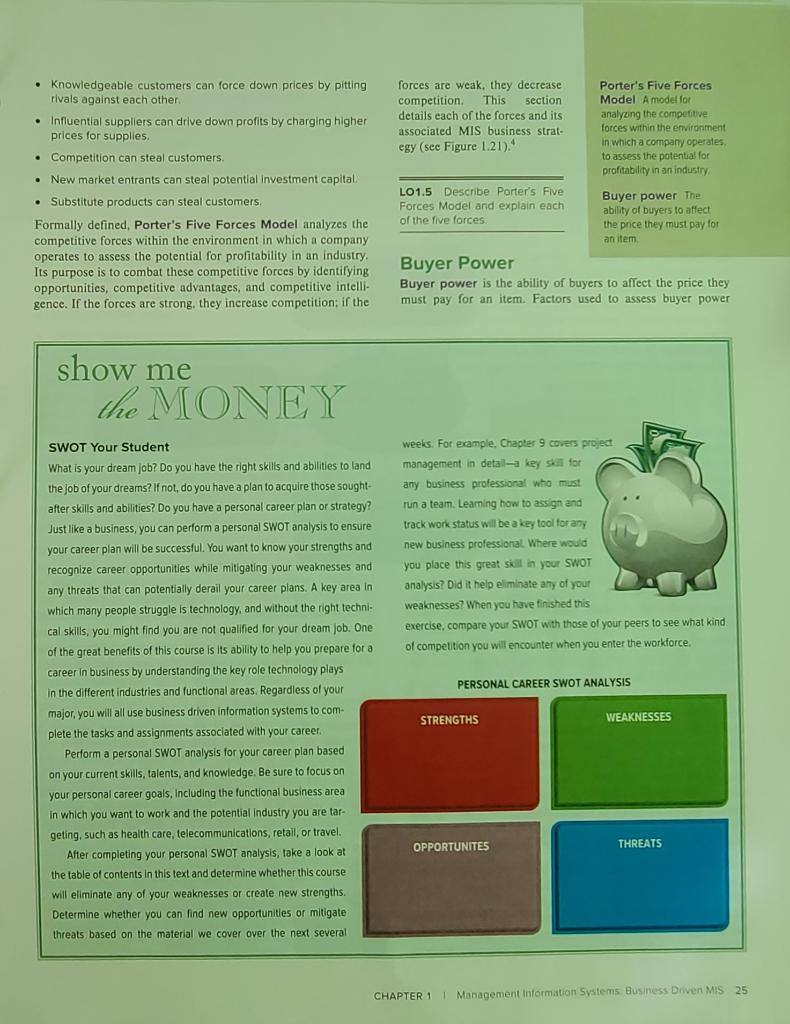
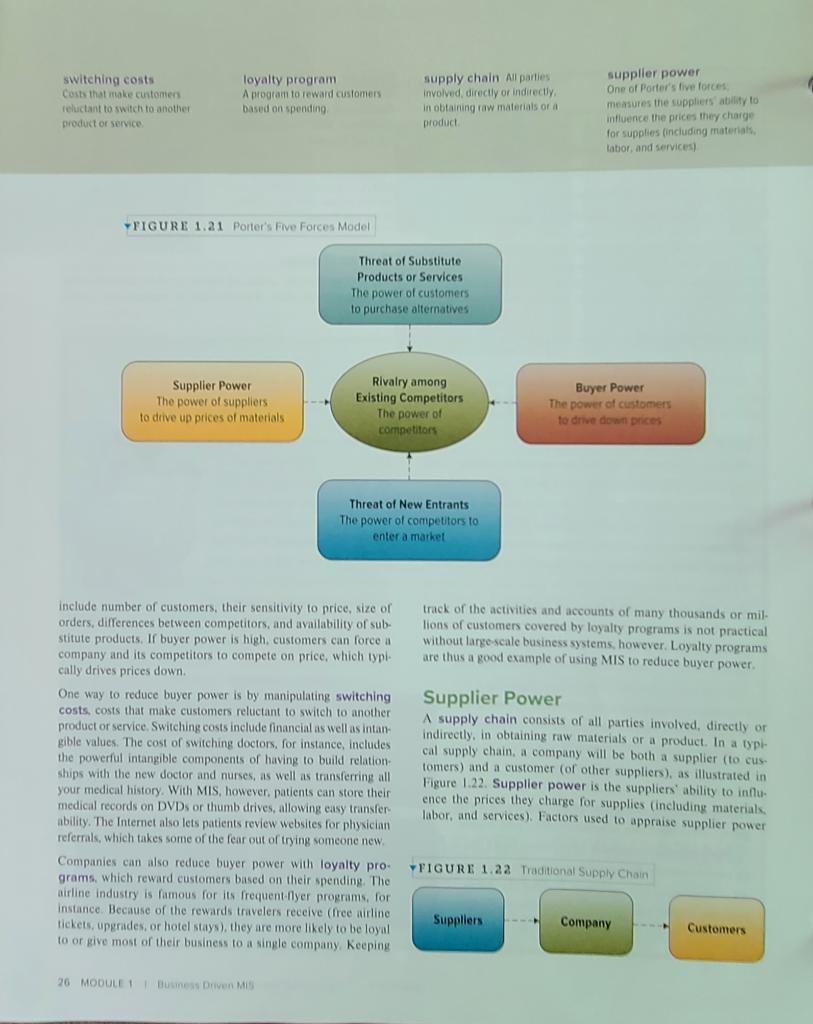
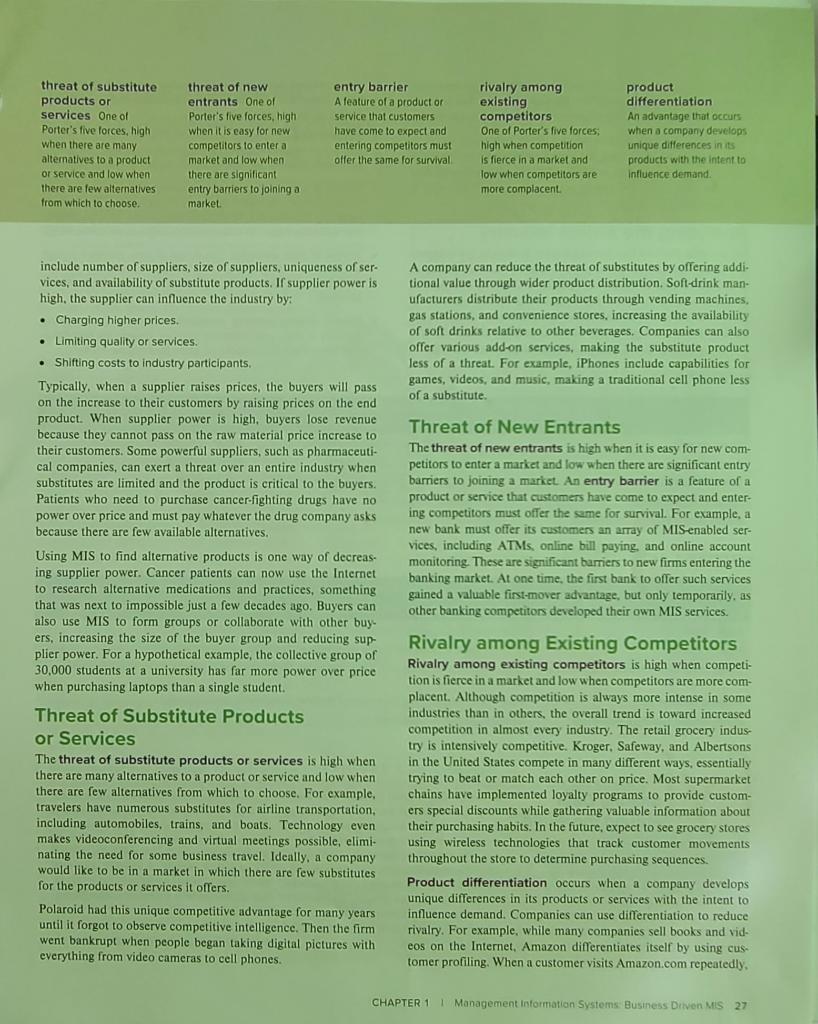
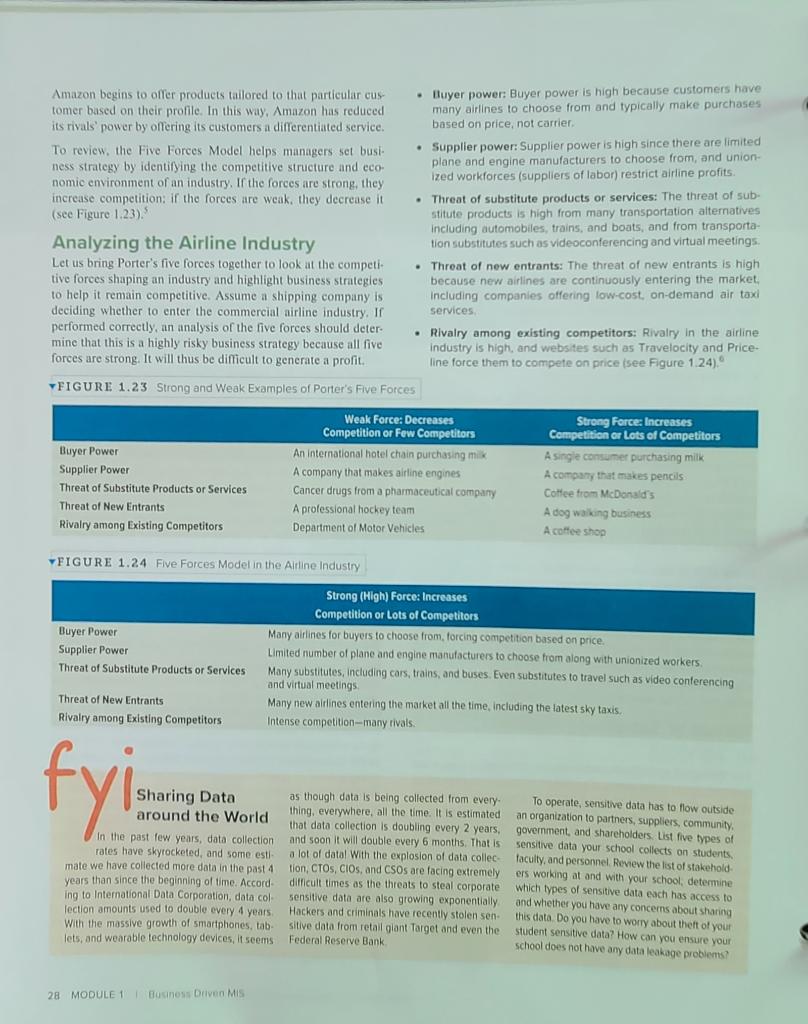
FIGURE 1.20 Sample SWOT Analysis HELPFUL HARMFUL competitive intelligence The process of gathering information about the competitive environment, including competitors plans activities, and products, to improve a company's ability to succeed SWOT analysis Evaluates an organization's strengths, weaknesses opportunities, and threats to identity Significant influences that work for or against business strategies INTERNAL STRENGTHS Core Competencies Market Leaders Cost Advantages Excellent Management WEAKNESSES Lack of Strategic Direction Obsolete Technologies Lack of Managerial Talent Outdated Product Line OPPORTUNITES Expanded Product Line Increase in Demand New Markets New Regulations THREATS New Entrants Substitute Products Shrinking Markets Costy Regulatory Requirements ucts, to Competitive intelligence is the process of gather ing information about the competitive environment, including competitors' plans, activities, and prod- EXTERNAL CES improve a company's ability to succeed. It means understanding and learning as much as pos- sible as soon as soon as possible about what is occurring outside the company to remain competitive. Frio Lay, a premier provider of snack foods such as Cracker Jacks and Cheetos, does not send its sales representatives into grocery stores just to stock shelves, they carry handheld computers and record the product offerings, inventory, and even product locations of competitors. Frito-Lay uses this information to gain competitive intelligence on everything from how well competing products are selling to the strategic placement of its own products. Managers use four common tools to analyze competitive intelligence and develop competitive advantages as displayed in Figure 1.19. FIGURE 1.19 Business Tools for Analyzing Business Strategies Strengths and weaknesses originate inside an organization or internally. Opportunities and threats originate outside an organiza- tion, or externally, and cannot always be anticipated or controlled. Potential Internal Strengths (Helpful): Identify all key strengths associated with the competitive advantage, includ- ing cost advantages, new and/or innovative services, spe- cial expertise and/or experience, proven market leader, and Improved marketing campaigns Potential Internal Weaknesses (Harmful): Identify all key areas that require improvement Weaknesses focus on the absence of certain strengths, including absence of an Inter- net marketing plan, damaged reputation, problem areas for service, and outdated technology Potential External Opportunities (Helpful): Identity all signifi- cant trends along with how the organization can benefit from each, including new markets, additional customer groups, legal changes, innovative technologies, population changes, and competitor issues Potential External Threats (Harmful): Identify all threats or risks detrimental to your organization, including new market entrants, substitute products, employee turnover, differentiat- ing products, shrinking markets, adverse changes in regula- tions, and economic shifts SWOT ANALYSIS Evaluates Project Position THE FIVE FORCES MODEL Evaluates Industry Attractiveness THE THREE GENERIC STRATEGIES Chooses Business Focus VALUE CHAIN ANALYSIS Executes Business Strategy LO1.4 Identify the four key areas of a SWOT analysis LO1.3 Explain why competitive advantages are temporary FOUR KEY AREAS OF A SWOT ANALYSIS L01.4 A SWOT analysis evaluates an organization's strengths, weak- nesses, opportunities, and threats to identify significant influences that work for or against business strategies (see Figure 1.20). THE FIVE FORCES MODEL-EVALUATING INDUSTRY ATTRACTIVENESS LO1.5 Michael Porter, a professor at Harvard Business School identi fied the following pressures that can hurt potential sales: 24 MODULE 1 Business Deven MS Knowledgeable customers can force down prices by pitting rivals against each other. Influential suppliers can drive down profits by charging higher prices for supplies Competition can steal customers. New market entrants can steal potential investment capital Substitute products can steal customers. Formally defined, Porter's Five Forces Model analyzes the competitive forces within the environment in which a company operates to assess the potential for profitability in an industry, Its purpose is to combat these competitive forces by identifying opportunities, competitive advantages, and competitive intelli- gence. If the forces are strong, they increase competition: if the forces are weak, they decrease Porter's Five Forces competition. This section Model A model for details each of the forces and its analyzing the competitive associated MIS business strat- forces within the environment egy (see Figure 1.21). in which a company operates to assess the potential for profitability in an industry LO1.5 Describe Porter's Five Buyer power The Forces Model and explain each ability of buyers to affect of the five forces the price they must pay for an item Buyer Power Buyer power is the ability of buyers to affect the price they must pay for an item. Factors used to assess buyer power show me the MONEY weeks. For example, Chapter 9 covers project management in detail-a key sal any business professional who must run a team. Learning how to assign and track work status will be a key tool for any new business professional Where would you place this great still in your SWOT analysis? Did it help eliminate any of your weaknesses? When you have finished this exercise, compare your SWOT with those of your peers to see what kind of competition you will encounter when you enter the workforce SWOT Your Student What is your dream job? Do you have the right skills and abilities to land the job of your dreams? If not, do you have a plan to acquire those sought- after skills and abilities? Do you have a personal career plan or strategy? Just like a business, you can perform a personal SWOT analysis to ensure your career plan will be successful. You want to know your strengths and recognize career opportunitles while mitigating your weaknesses and any threats that can potentially derail your career plans. A key area in which many people struggle is technology, and without the right techni: cal skills, you might find you are not qualified for your dream job. One of the great benefits of this course is its ability to help you prepare for a career in business by understanding the key role technology plays in the different industries and functional areas. Regardless of your major, you will all use business driven information systems to com- plete the tasks and assignments associated with your career. Perform a personal SWOT analysis for your career plan based on your current skills, talents, and knowledge. Be sure to focus on your personal career goals, including the functional business area in which you want to work and the potential Industry you are tar- geting, such health care, telecommunications, retail, or travel. After completing your personal SWOT analysis, take a look at the table in this text and determine whether this course will eliminate any of your weaknesses or create new strengths. Determine whether you can find new opportunities or mitigate threats based on the material we cover over the next several PERSONAL CAREER SWOT ANALYSIS STRENGTHS WEAKNESSES OPPORTUNITES THREATS CHAPTER 1 T Management Information Systems Business Driven MIS 25 switching costs Costs that make cutomers reluctant to switch to another product or service loyalty program A program to reward customers based on spending supply chain All parties involved, directly or indirectly in obtaining raw materials or a product supplier power One of Porter's live forces measures the suppliers ability to influence the prices they charge for supplies (including materials, Labor, and services) FIGURE 1.21 Porter's Five Forces Model Threat of Substitute Products or Services The power of customers to purchase alternatives Supplier Power The power of suppliers to drive up prices of materials Rivalry among Existing Competitors The power of competitors Buyer Power The power of customers to drive down prices Threat of New Entrants The power of competitors to enter a market track of the activities and accounts of many thousands or mil. lions of customers covered by loyalty programs is not practical without large-scale business systems, however. Loyalty programs are thus a good example of using MIS to reduce buyer power include number of customers, their sensitivity to price, size of orders, differences between competitors, and availability of sub- stitute products. If buyer power is high, customers can force company and its competitors to compete on price, which typi cally drives prices down. One way to reduce buyer power is by manipulating switching costs, costs that make customers reluctant to switch to another product or service. Switching costs include financial as well as intan gible values. The cost of switching doctors, for instance, includes the powerful intangible components of having to build relation ships with the new doctor and nurses, as well transferring all your medical history. With Mis, however, patients can store their medical records on DVDs or thumb drives, allowing easy transfer ability. The Internet also lets patients review websites for physician referrals, which takes some of the fear out of trying someone new Companies can also reduce buyer power with loyalty pro grams, which reward customers based on their spending The airline industry is famous for its frequentlyer programs, for instance. Because of the rewards travelers receive (free airline tickets, upgrades, or hotel stays), they are more likely to be loyal to or give most of their business to a single company Keeping Supplier Power A supply chain consists of all parties involved. directly or indirectly, in obtaining raw materials or a product. In a typi- cal supply chain, a company will be both a supplier (to cus tomers) and a customer (or other suppliers), as illustrated in Figure 1.22. Supplier power is the suppliers' ability to influ ence the prices they charge for supplies (including materials. labor, and services). Factors used to appraise supplier power FIGURE 1.22 Traditional Supply Chain Suppliers --- Company Customers 26 MODULET Bus Driven MS threat of substitute products or services One of Porter's five forces, high when there are many alternatives to a product or service and low when there are few alternatives from which to choose. threat of new entrants One of Porter's five forces, high when it is easy for new competitors to enter a market and low when there are significant entry barriers to joining a market entry barrier A feature of a productor service that customers have come to expect and entering competitors must offer the same for survival rivalry among existing competitors One of Porter's five forces; high when competition is fierce in a market and low when competitors are more complacent product differentiation An advantage that occurs when a company develops unique differences in its products with the intent to influence demand A company can reduce the threat of substitutes by offering addi- tional value through wider product distribution. Soft-drink man. ufacturers distribute their products through vending machines. gas stations, and convenience stores, increasing the availability of soft drinks relative to other beverages. Companies can also offer various add-on services, making the substitute product less of a threat. For example, iPhones include capabilities for games, videos, and music, making a traditional cell phone less of a substitute include number of suppliers, size of suppliers, uniqueness of ser- vices, and availability of substitute products. If supplier power is high, the supplier can influence the industry by: Charging higher prices. Limiting quality or services Shifting costs to industry participants, Typically, when a supplier raises prices, the buyers will pass on the increase to their customers by raising prices on the end product. When supplier power is high, buyers lose revenue because they cannot pass on the raw material price increase to their customers. Some powerful suppliers, such as pharmaceuti- cal companies, can exert a threat over an entire industry when substitutes are limited and the product is critical to the buyers. Patients who need to purchase cancer-fighting drugs have no power over price and must pay whatever the drug company asks because there are few available alternatives. Using MIS to find alternative products is one way of decreas- ing supplier power. Cancer patients can now use the Internet to research alternative medications and practices, something that was next to impossible just a few decades ago. Buyers can also use MIS to form groups or collaborate with other buy- ers, increasing the size of the buyer group and reducing sup- plier power. For a hypothetical example, the collective group of 30,000 students at a university has far more power over price when purchasing laptops than a single student. Threat of Substitute Products or Services The threat of substitute products or services is high when there are many alternatives to a product or service and low when there are few alternatives from which to choose. For travelers have numerous substitutes for airline transportation, including automobiles, trains, and boats. Technology even makes videoconferencing and virtual meetings possible, elimi- nating the need for some business travel. Ideally, a company would like to be in a market in which there are few substitutes for the products or services it offers. Polaroid had this unique competitive advantage for many years until it forgot to observe competitive intelligence. Then the firm went bankrupt when people began taking digital pictures with everything from video cameras to cell phones Threat of New Entrants The threat of new entrants is high when it is easy for new com- petitors to enter a market and low when there are significant entry barriers to joining a market An entry barrier is a feature of a product or service that customers have come to expect and enter- ing competitors must offer the same for survival. For example, a new bank must offer its customers an array of MIS-enabled ser- vices, including ATMs, online bill paying, and online account monitoring. These are significant barriers to new firms entering the banking market. At one time, the first bank to offer such services gained a valuable first-mover advantage, but only temporarily, as other banking competitors developed their own MIS services. Rivalry among Existing Competitors Rivalry among existing competitors is high when competi- tion is fierce in a market and low when competitors are more com- placent. Although competition is always more intense in some industries than in others, the overall trend is toward increased competition in in almost every industry. The retail grocery indus- try . intensively competitive. Kroger, Safeway, and Albertsons in the United States compete in many different ways, essentially to beat or match each other on Most other on price. supermarket chains have implemented loyalty programs to provide custom- ers special discounts while gathering valuable information about their purchasing habits. In the future, expect to see grocery stores using wireless technologies that track customer movements throughout the store to determine purchasing sequences. Product differentiation occurs when a company develops unique differences in its products or services with the intent to influence demand. Companies can use differentiation to reduce rivalry. For example, while many companies sell books and vid- eos on the Internet, Amazon differentiates itself by using cus- tomer profiling. When a customer visits Amazon.com repeatedly, example, CHAPTER 1 Management Information Systems Business Driven MS 27 Amazon begins to offer products tailored to that particular cus Buyer power: Buyer power is high because customers have tomer based on their profile. In this way, Amazon has reduced many airlines to choose from and typically make purchases its rivals power by offering its customers a differentiated service. based on price, not carrier To review, the Five Forces Model helps managers set busi- Supplier power: Supplier power is high since there are limited ness strategy by identifying the competitive structure and eco plane and engine manufacturers to choose from, and union- nomic environment of an industry. If the forces are strong, they ized workforces (suppliers of labor) restrict airline profits increase competition: if the forces are weak, they decrease it Threat of substitute products or services: The threat of sub- (see Figure 1.23). stitute products is high from many transportation alternatives including automobiles, trains, and boats, and from transporta- Analyzing the Airline Industry tion substitutes such as videoconferencing and virtual meetings Let us bring Porter's five forces together to look at the competi Threat of new entrants: The threat of new entrants is high tive forces shaping an industry and highlight business Strategies because new airlines are continuously entering the market. help it remain competitive. Assume a shipping company is including companies offering low-cost, on-demand air taxi deciding whether to enter the commercial airline industry. If services performed correctly, an analysis of the five forces should deter- mine that this is a highly risky business strategy because all five Rivalry among existing competitors: Rivalry in the airline Industry is high and websites such as Travelocity and Price. forces are strong. It will thus be difficult to generate a profil line force them to compete on price (see Figure 1.24). FIGURE 1.23 Strong and Weak Examples of Porter's Five Forces Buyer Power Supplier Power Threat of Substitute Products Services Threat of New Entrants Rivalry among Existing Competitors Weak Force: Decreases Competition or Few Competitors An International hotel chain purchasing milik A company that makes airline engines Cancer drugs from a pharmaceutical company A professional hockey team Department of Motor Vehicles Strong Force: Increases Competition or Lots of Competitors A single consumer purchasing milk A company that makes pencils Coree from McDonald's Adog walking business A coffee shop FIGURE 1.24 Five Forces Model in the Airline Industry Buyer Power Supplier Power Threat of Substitute Products or services Strong (High) Force: Increases Competition or Lots of Competitors Many airlines for buyers to choose from, forcing competition based on price Limited number of plane and engine manufacturers to choose from along with unionized workers. Many substitutes, including cars, trains and buses. Even substitutes to travel such as video conferencing and virtual meetings Many new airlines entering the market all the time, including the latest sky taxis. Intense competition-many rivals. Threat of New Entrants Rivalry among Existing Competitors fyi as though data is being collected from every To operate, sensitive data has to flow outside Sharing Data thing, everywhere, all the time. It is estimated an organization partners, suppliers, community around the World that data collection is doubling every 2 years, government, and shareholders List five types of In the past few years, data collection and soon it will double every 6 months. That is sensitive data your school collects on students rates have skyrocketed, and some esti a lot of datal With the explosion of data collec faculty, and personnel Review the list of stakehold mate we have collected more data in the past 4 tion, CTOs, CIOs, and CSOs are facing extremelyers working at and with your school, determine years than since the beginning of time. Accord difficult times as the threats to steal corporate which types of sensitive data each has access to ing to International Data Corporation, data col sensitive data are also growing exponentially and whether you have any concerns about sharing lection amounts used to double every 4 years Hackers and criminals have recently stolen sen this data. Do you have to worry about theft of your with the massive growth of smartphones, tab. sitive data from retail giant Target and even the student sensitive data? How can you ensure your lets, and wearable technology devices, it seems Federal Reserve Bank school does not have any data leakage problems! 28 MODULE 1 Business Driven MIS









 Study Help