







Question: LSAT Prep 101 section 4 - PMC K Evaluating Your Chil... Fragments and Run... APA Title Page 7th E... | Free APA Citation G... G
LSAT Prep 101 section 4
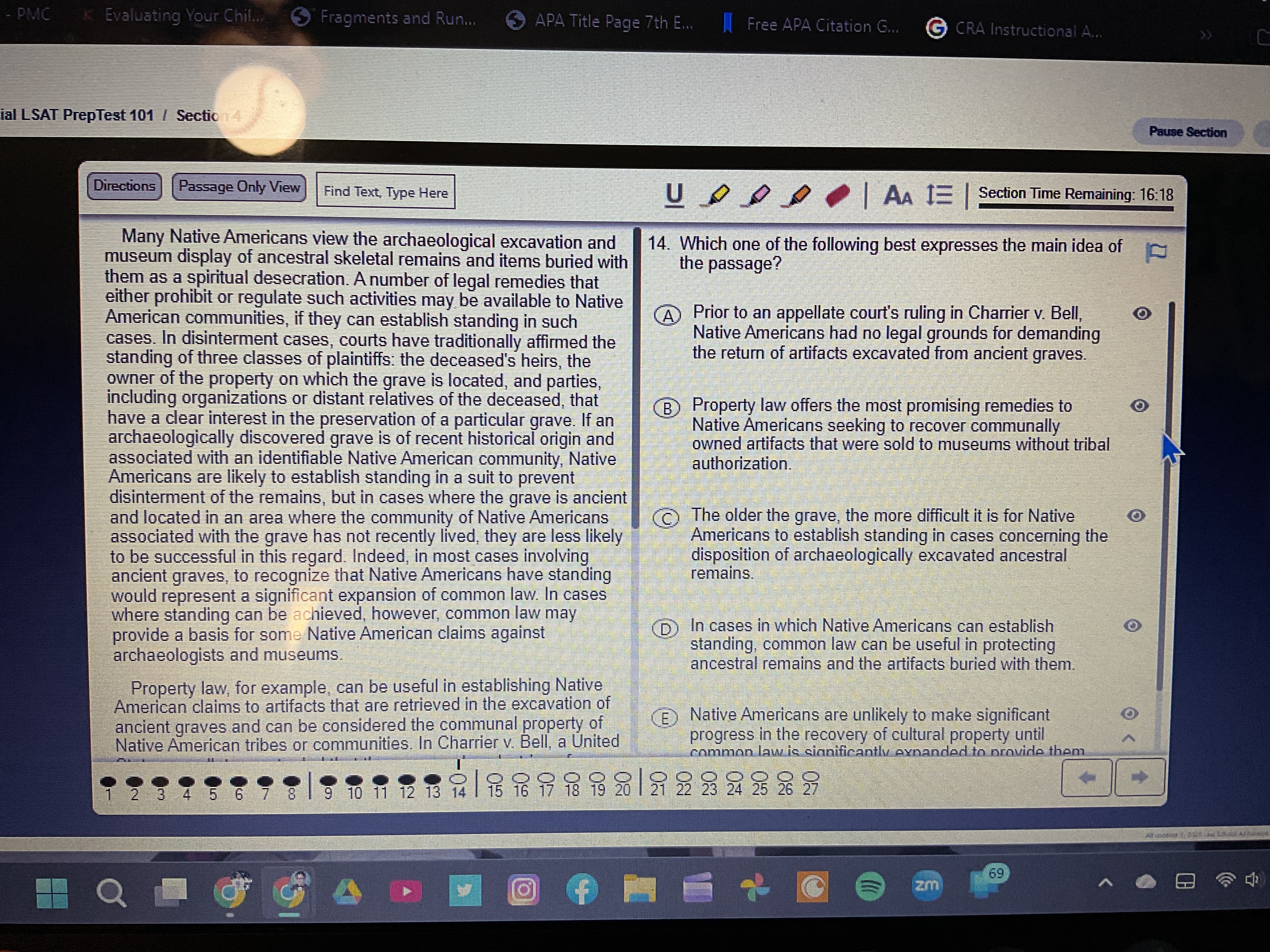 - PMC K Evaluating Your Chil... Fragments and Run... APA Title Page 7th E... | Free APA Citation G... G CRA Instructional A... ial LSAT PrepTest 101 / Section4 Pause Section Directions Passage Only View Find Text, Type Here U DDD AA = Section Time Remaining: 16:18 Many Native Americans view the archaeological excavation and museum display of ancestral skeletal remains and items buried with 14. Which one of the following best expresses the main idea of the passage? hem as a spiritual desecration. A number of legal remedies that either prohibit or regulate such activities may be available to Native American communities, if they can establish standing in such Prior to an appellate court's ruling in Charrier v. Bell, O cases. In disinterment cases, courts have traditionally affirmed the Native Americans had no legal grounds for demanding standing of three classes of plaintiffs: the deceased's heirs, the the return of artifacts excavated from ancient graves. owner of the property on which the grave is located, and parties, including organizations or distant relatives of the deceased, that B Property law offers the most promising remedies to have a clear interest in the preservation of a particular grave. If an Native Americans seeking to recover communally archaeologically discovered grave is of recent historical origin and owned artifacts that were sold to museums without tribal associated with an identifiable Native American community, Native authorization. Americans are likely to establish standing in a suit to prevent disinterment of the remains, but in cases where the grave is ancient and located in an area where the community of Native Americans The older the grave, the more difficult it is for Native O associated with the grave has not recently lived, they are less likely Americans to establish standing in cases concerning the to be successful in this regard. Indeed, in most cases involving disposition of archaeologically excavated ancestral ancient graves, to recognize that Native Americans have standing remains. would represent a significant expansion of common law. In cases where standing can be achieved, however, common law may provide a basis for some Native American claims against D In cases in which Native Americans can establish O archaeologists and museums. standing, common law can be useful in protecting ancestral remains and the artifacts buried with them. Property law, for example, can be useful in establishing Native American claims to artifacts that are retrieved in the excavation of ancient graves and can be considered the communal property of Native Americans are unlikely to make significant O progress in the recovery of cultural property until
 Step by Step Solution
There are 3 Steps involved in it
1 Expert Approved Answer
Step: 1 Unlock

Question Has Been Solved by an Expert!
Get step-by-step solutions from verified subject matter experts
Step: 2 Unlock
Step: 3 Unlock
 Study Help