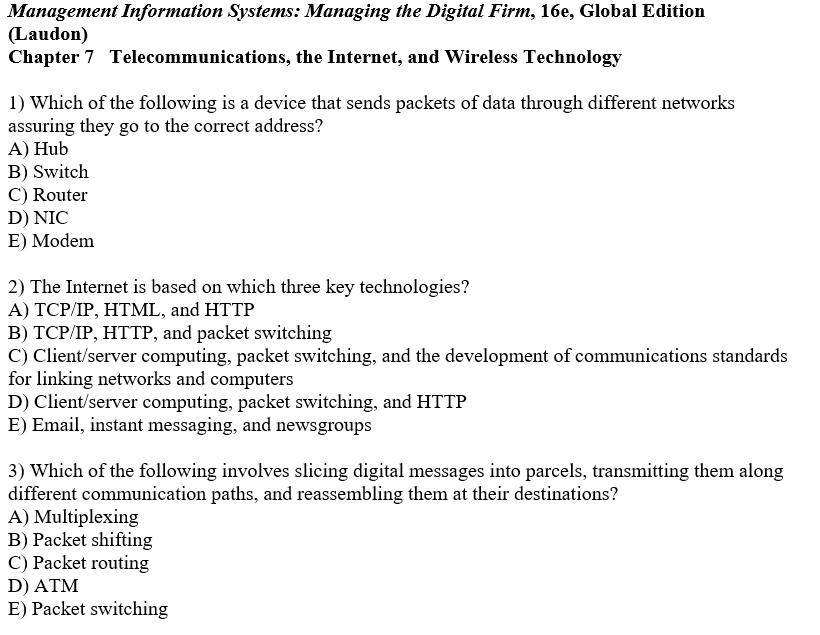
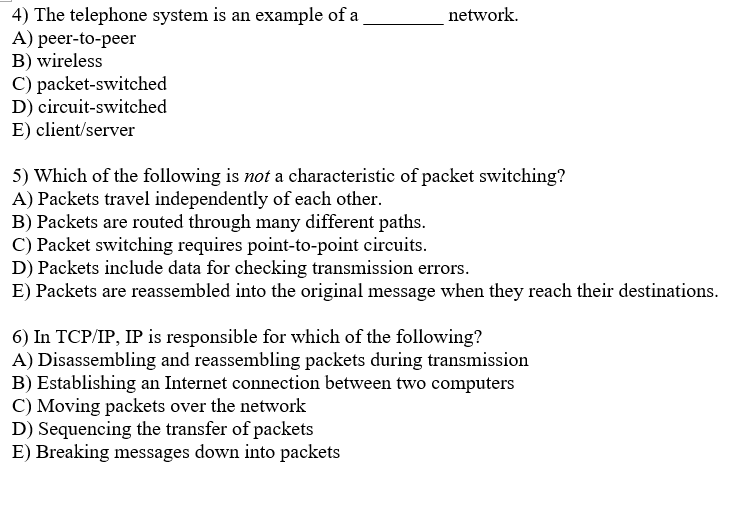
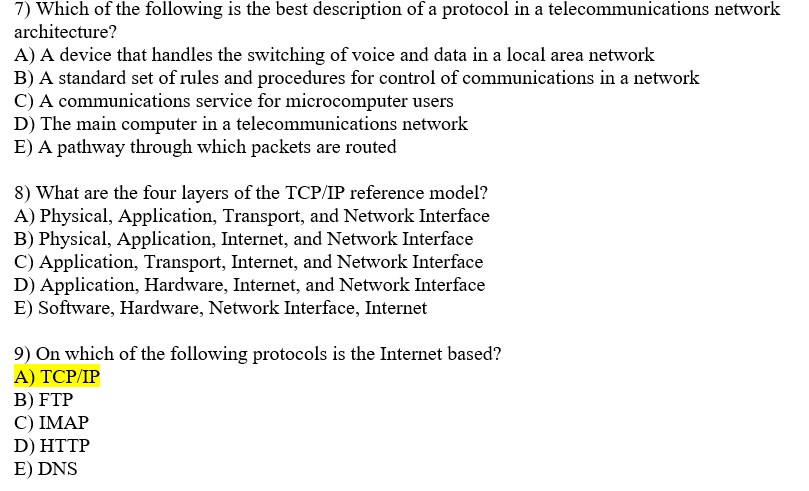
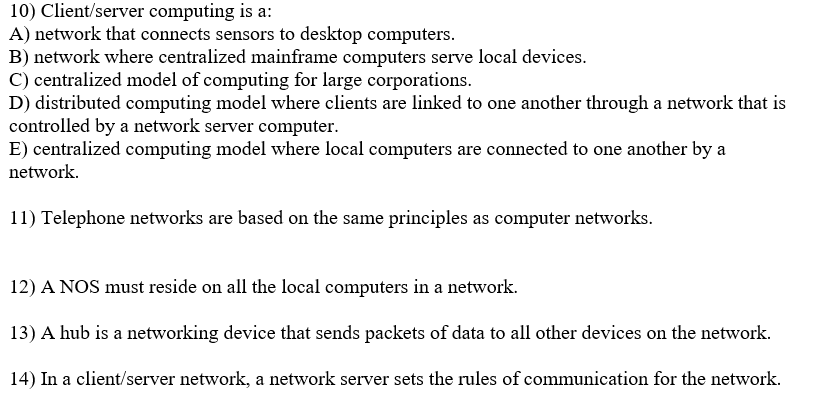
Management Information Systems: Managing the Digital Firm, 16e, Global Edition (Laudon) Chapter 7 Telecommunications, the Internet, and Wireless Technology 1) Which of the following is a device that sends packets of data through different networks assuring they go to the correct address? A) Hub B) Switch C) Router D) NIC E) Modem 2) The Internet is based on which three key technologies? A) TCP/IP, HTML, and HTTP B) TCP/IP, HTTP, and packet switching C) Client/server computing, packet switching, and the development of communications standards for linking networks and computers D) Client/server computing, packet switching, and HTTP E) Email, instant messaging, and newsgroups 3) Which of the following involves slicing digital messages into parcels, transmitting them along different communication paths, and reassembling them at their destinations? A) Multiplexing B) Packet shifting C) Packet routing D) ATM E) Packet switching network. 4) The telephone system is an example of a A) peer-to-peer B) wireless C) packet-switched D) circuit-switched E) client/server 5) Which of the following is not a characteristic of packet switching? A) Packets travel independently of each other. B) Packets are routed through many different paths. C) Packet switching requires point-to-point circuits. D) Packets include data for checking transmission errors. E) Packets are reassembled into the original message when they reach their destinations. 6) In TCP/IP, IP is responsible for which of the following? A) Disassembling and reassembling packets during transmission B) Establishing an Internet connection between two computers C) Moving packets over the network D) Sequencing the transfer of packets E) Breaking messages down into packets 7) Which of the following is the best description of a protocol in a telecommunications network architecture? A) A device that handles the switching of voice and data in a local area network B) A standard set of rules and procedures for control of communications in a network C) A communications service for microcomputer users D) The main computer in a telecommunications network E) A pathway through which packets are routed 8) What are the four layers of the TCP/IP reference model? A) Physical, Application, Transport, and Network Interface B) Physical, Application, Internet, and Network Interface C) Application, Transport, Internet, and Network Interface D) Application, Hardware, Internet, and Network Interface E) Software, Hardware, Network Interface, Internet 9) On which of the following protocols is the Internet based? A) TCP/IP B) FTP C) IMAP D) HTTP E) DNS 10) Client/server computing is a: A) network that connects sensors to desktop computers. B) network where centralized mainframe computers serve local devices. C) centralized model of computing for large corporations. D) distributed computing model where clients are linked to one another through a network that is controlled by a network server computer. E) centralized computing model where local computers are connected to one another by a network. 11) Telephone networks are based on the same principles as computer networks. 12) A NOS must reside on all the local computers in a network. 13) A hub is a networking device that sends packets of data to all other devices on the network. 14) In a client/server network, a network server sets the rules of communication for the network. 15) A computer network consists of at least two computers. 16) Client/server computing has largely replaced centralized mainframe computing. 17) Computer networks that use packet switching are less efficient than telephone networks that use circuit switching. 18) Two computers using TCP/IP can communicate even if they are based on different hardware and software platforms. 19) In a large company today, you will often find an infrastructure that includes hundreds of small LANs linked to each other as well as to corporate-wide networks. 20) TCP/IP was developed during the early 1970s to support efforts to help scientists transmit data among different types of computers over long distances




