







Question: Mary has a trit j = {0,1,2} and, based on j, sends a one-qubit state a|0>+B|1> to John. John applies some n-qubit unitary U
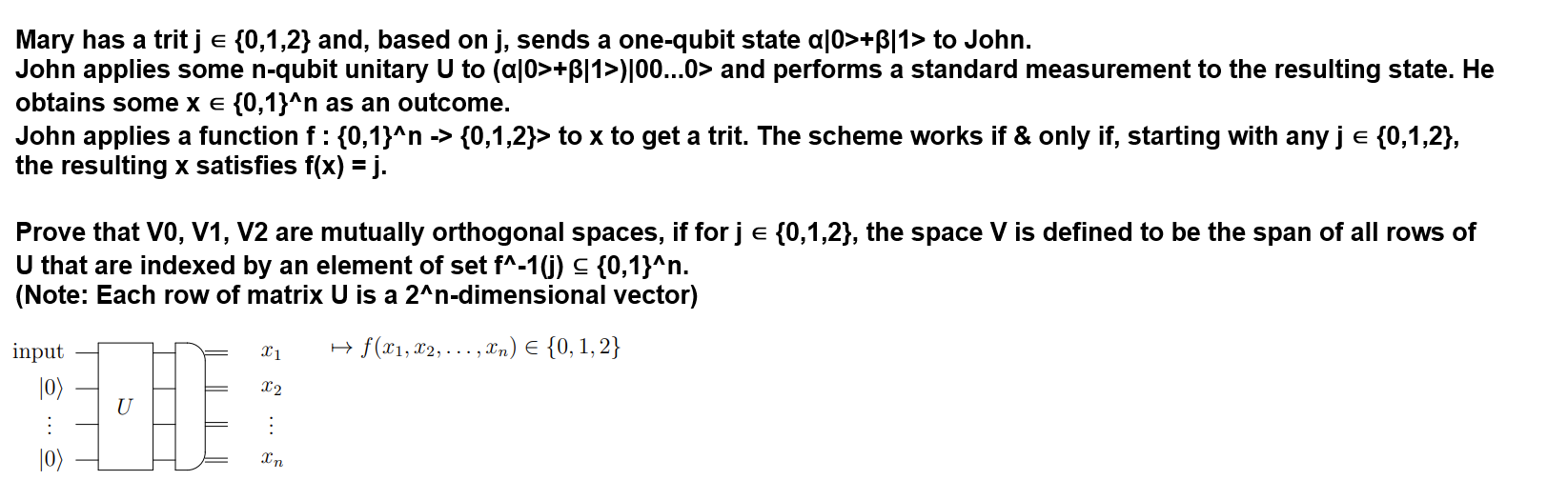
Mary has a trit j = {0,1,2} and, based on j, sends a one-qubit state a|0>+B|1> to John. John applies some n-qubit unitary U to (a|0>+|1>)|00...0> and performs a standard measurement to the resulting state. He obtains some x = {0,1}^n as an outcome. John applies a function f : {0,1}^n -> {0,1,2}> to x to get a trit. The scheme works if & only if, starting with any j = {0,1,2}, the resulting x satisfies f(x) = j. Prove that V0, V1, V2 are mutually orthogonal spaces, if for j = {0,1,2}, the space V is defined to be the span of all rows of U that are indexed by an element of set f^-1(j) {0,1}^n. (Note: Each row of matrix U is a 2^n-dimensional vector) input |0) |0) DE U X1 f(x1,x2,...,xn) = {0, 1, 2} E X2 Xn
Step by Step Solution
3.52 Rating (149 Votes )
There are 3 Steps involved in it
The image contains a problem statement within the realm of quantum information theory specifically about the transmission of a trit using a quantum sy... View full answer

Get step-by-step solutions from verified subject matter experts
 Study Help