







Question: need help building this with the following parameters. work: anderson windows. own a home. buy a used car. married with a family of 4 The
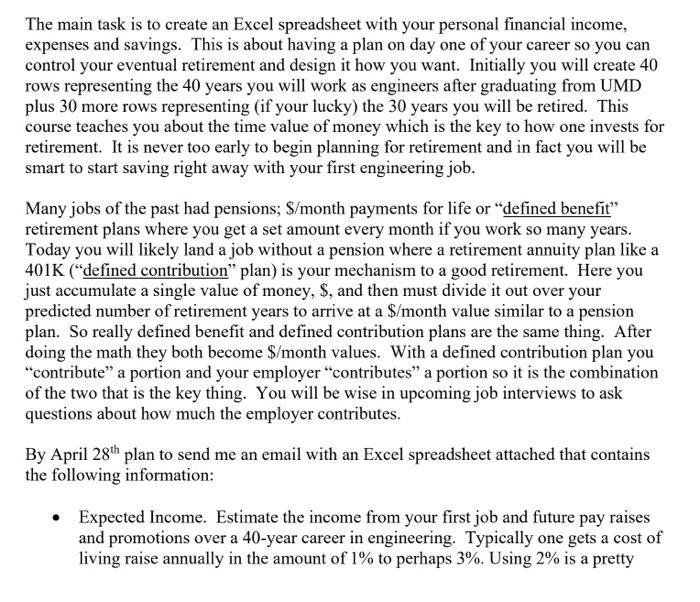

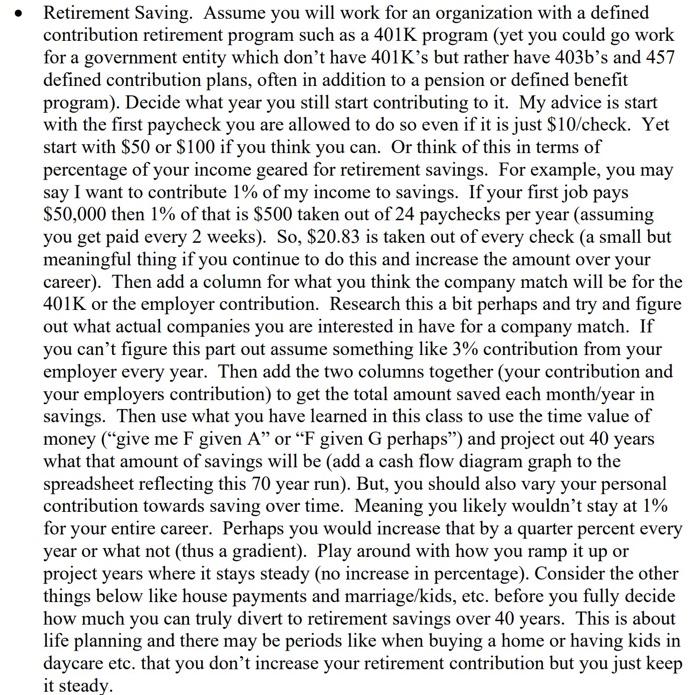
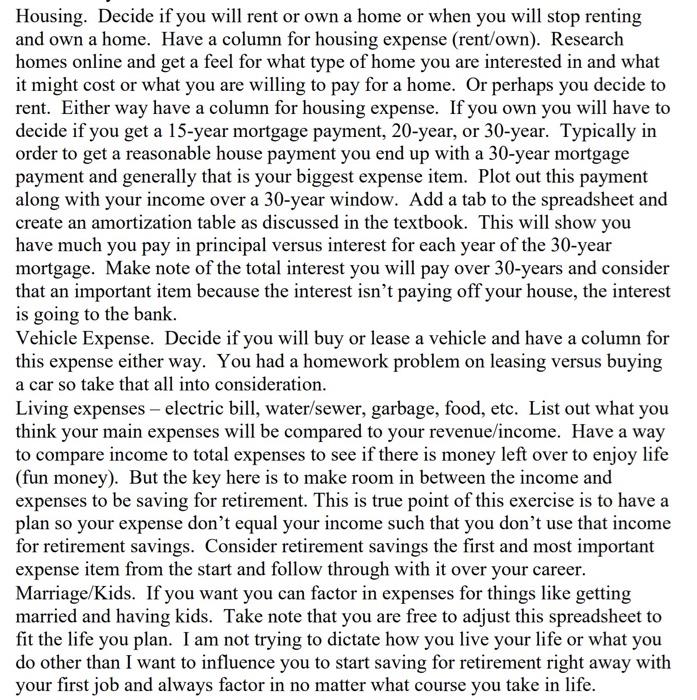
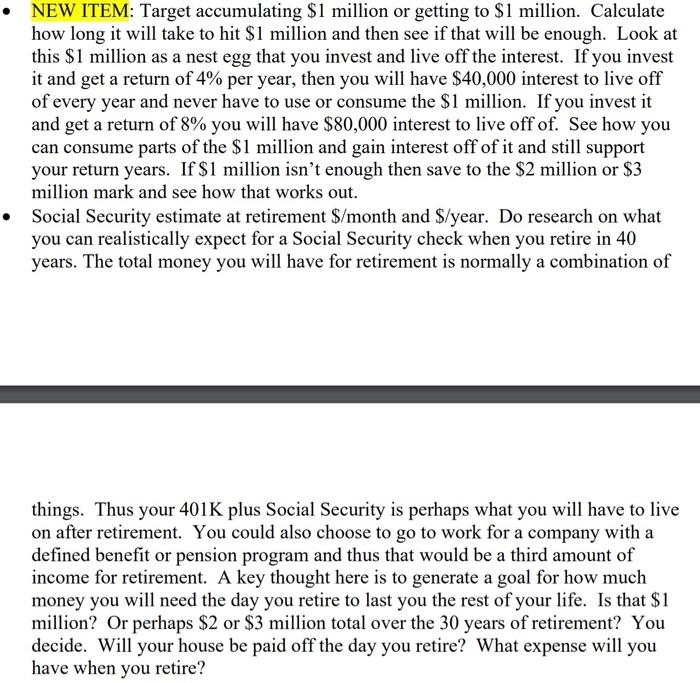
The main task is to create an Excel spreadsheet with your personal financial income, expenses and savings. This is about having a plan on day one of your career so you can control your eventual retirement and design it how you want. Initially you will create 40 rows representing the 40 years you will work as engineers after graduating from UMD plus 30 more rows representing (if your lucky) the 30 years you will be retired. This course teaches you about the time value of money which is the key to how one invests for retirement. It is never too early to begin planning for retirement and in fact you will be smart to start saving right away with your first engineering job. Many jobs of the past had pensions; $/month payments for life or defined benefit" retirement plans where you get a set amount every month if you work so many years. Today you will likely land a job without a pension where a retirement annuity plan like a 401K ("defined contribution" plan) is your mechanism to a good retirement. Here you just accumulate a single value of money, $, and then must divide it out over your predicted number of retirement years to arrive at a $/month value similar to a pension plan. So really defined benefit and defined contribution plans are the same thing. After doing the math they both become $/month values. With a defined contribution plan you "contribute" a portion and your employer "contributes" a portion so it is the combination of the two that is the key thing. You will be wise in upcoming job interviews to ask questions about how much the employer contributes. By April 28th plan to send me an email with an Excel spreadsheet attached that contains the following information: Expected Income. Estimate the income from your first job and future pay raises and promotions over a 40-year career in engineering. Typically one gets a cost of living raise annually in the amount of 1% to perhaps 3%. Using 2% is a pretty safe bet but this is just an estimate. Larger raises could occur over your career with promotions that could lead to maybe a 5% to 10% raise. Try to figure out what your starting salary might be for your first job and then estimate how that might realistically grow over 40 years and have the spreadsheet reflect that growth in income over the years. Retirement Saving. Assume you will work for an organization with a defined contribution retirement program such as a 401K program (yet you could go work for a government entity which don't have 401K's but rather have 403b's and 457 defined contribution plans, often in addition to a pension or defined benefit program). Decide what year you still start contributing to it. My advice is start with the first paycheck you are allowed to do so even if it is just $10/check. Yet start with $50 or $100 if you think you can. Or think of this in terms of percentage of your income geared for retirement savings. For example, you may say I want to contribute 1% of my income to savings. If your first job pays $50,000 then 1% of that is $500 taken out of 24 paychecks per year (assuming you get paid every 2 weeks). So, $20.83 is taken out of every check (a small but meaningful thing if you continue to do this and increase the amount over your career). Then add a column for what you think the company match will be for the 401K or the employer contribution. Research this a bit perhaps and try and figure out what actual companies you are interested in have for a company match. If you can't figure this part out assume something like 3% contribution from your employer every year. Then add the two columns together (your contribution and your employers contribution) to get the total amount saved each month/year in savings. Then use what you have learned in this class to use the time value of money ("give me F given A" or "F given G perhaps") and project out 40 years what that amount of savings will be (add a cash flow diagram graph to the spreadsheet reflecting this 70 year run). But, you should also vary your personal contribution towards saving over time. Meaning you likely wouldn't stay at 1% for your entire career. Perhaps you would increase that by a quarter percent every year or what not (thus a gradient). Play around with how you ramp it up or project years where it stays steady (no increase in percentage). Consider the other things below like house payments and marriage/kids, etc. before you fully decide how much you can truly divert to retirement savings over 40 years. This is about life planning and there may be periods like when buying a home or having kids in daycare etc. that you don't increase your retirement contribution but you just keep it steady. Housing. Decide if you will rent or own a home or when you will stop renting and own a home. Have a column for housing expense (rent/own). Research homes online and get a feel for what type of home you are interested in and what it might cost or what you are willing to pay for a home. Or perhaps you decide to rent. Either way have a column for housing expense. If you own you will have to decide if you get a 15-year mortgage payment, 20-year, or 30-year. Typically in order to get a reasonable house payment you end up with a 30-year mortgage payment and generally that is your biggest expense item. Plot out this payment along with your income over a 30-year window. Add a tab to the spreadsheet and create an amortization table as discussed in the textbook. This will show you have much you pay in principal versus interest for each year of the 30-year mortgage. Make note of the total interest you will pay over 30-years and consider that an important item because the interest isn't paying off your house, the interest is going to the bank. Vehicle Expense. Decide if you will buy or lease a vehicle and have a column for this expense either way. You had a homework problem on leasing versus buying a car so take that all into consideration. Living expenses - electric bill, water/sewer, garbage, food, etc. List out what you think your main expenses will be compared to your revenue/income. Have a way to compare income to total expenses to see if there is money left over to enjoy life (fun money). But the key here is to make room in between the income and expenses to be saving for retirement. This is true point of this exercise is to have a plan so your expense don't equal your income such that you don't use that income for retirement savings. Consider retirement savings the first and most important expense item from the start and follow through with it over your career. Marriage/Kids. If you want you can factor in expenses for things like getting married and having kids. Take note that you are free to adjust this spreadsheet to fit the life you plan. I am not trying to dictate how you live your life or what you do other than I want to influence you to start saving for retirement right away with your first job and always factor in no matter what course you take in life. NEW ITEM: Target accumulating $1 million or getting to $1 million. Calculate how long it will take to hit $1 million and then see if that will be enough. Look at this $1 million as a nest egg that you invest and live off the interest. If you invest it and get a return of 4% per year, then you will have $40,000 interest to live off of every year and never have to use or consume the $1 million. If you invest it and get a return of 8% you will have $80,000 interest to live off of. See how you can consume parts of the $1 million and gain interest off of it and still support your return years. If $1 million isn't enough then save to the $2 million or $3 million mark and see how that works out. Social Security estimate at retirement $/month and $/year. Do research on what you can realistically expect for a Social Security check when you retire in 40 years. The total money you will have for retirement is normally a combination of things. Thus your 401K plus Social Security is perhaps what you will have to live on after retirement. You could also choose to go to work for a company with a defined benefit or pension program and thus that would be a third amount of income for retirement. A key thought here is to generate a goal for how much money you will need the day you retire to last you the rest of your life. Is that $1 million? Or perhaps $2 or $3 million total over the 30 years of retirement? You decide. Will your house be paid off the day you retire? What expense will you have when you retire? Overall you are attempting here to see what your income will look life during the 40 years of working and then what kind of money you will have for the next 30 years after you retire. Will you have enough to live comfortably for 30 years? What will you need to live for 30 years if you are funding your retirement? All good things to consider at your stage of the game. Have fun with this and discuss it with your classmates, friends, parents, etc. to get other perspectives and thoughts to incorporate into this and then keep this spreadsheet and adjust it over they years. But do yourself a favor and save an original version of this spreadsheet with a date on it and then don't edit it. Go back in 10, 20, 30 years and see how things have changed or stayed the same has your life evolves and takes twists and turns. Any further questions, come see me. The main task is to create an Excel spreadsheet with your personal financial income, expenses and savings. This is about having a plan on day one of your career so you can control your eventual retirement and design it how you want. Initially you will create 40 rows representing the 40 years you will work as engineers after graduating from UMD plus 30 more rows representing (if your lucky) the 30 years you will be retired. This course teaches you about the time value of money which is the key to how one invests for retirement. It is never too early to begin planning for retirement and in fact you will be smart to start saving right away with your first engineering job. Many jobs of the past had pensions; $/month payments for life or defined benefit" retirement plans where you get a set amount every month if you work so many years. Today you will likely land a job without a pension where a retirement annuity plan like a 401K ("defined contribution" plan) is your mechanism to a good retirement. Here you just accumulate a single value of money, $, and then must divide it out over your predicted number of retirement years to arrive at a $/month value similar to a pension plan. So really defined benefit and defined contribution plans are the same thing. After doing the math they both become $/month values. With a defined contribution plan you "contribute" a portion and your employer "contributes" a portion so it is the combination of the two that is the key thing. You will be wise in upcoming job interviews to ask questions about how much the employer contributes. By April 28th plan to send me an email with an Excel spreadsheet attached that contains the following information: Expected Income. Estimate the income from your first job and future pay raises and promotions over a 40-year career in engineering. Typically one gets a cost of living raise annually in the amount of 1% to perhaps 3%. Using 2% is a pretty safe bet but this is just an estimate. Larger raises could occur over your career with promotions that could lead to maybe a 5% to 10% raise. Try to figure out what your starting salary might be for your first job and then estimate how that might realistically grow over 40 years and have the spreadsheet reflect that growth in income over the years. Retirement Saving. Assume you will work for an organization with a defined contribution retirement program such as a 401K program (yet you could go work for a government entity which don't have 401K's but rather have 403b's and 457 defined contribution plans, often in addition to a pension or defined benefit program). Decide what year you still start contributing to it. My advice is start with the first paycheck you are allowed to do so even if it is just $10/check. Yet start with $50 or $100 if you think you can. Or think of this in terms of percentage of your income geared for retirement savings. For example, you may say I want to contribute 1% of my income to savings. If your first job pays $50,000 then 1% of that is $500 taken out of 24 paychecks per year (assuming you get paid every 2 weeks). So, $20.83 is taken out of every check (a small but meaningful thing if you continue to do this and increase the amount over your career). Then add a column for what you think the company match will be for the 401K or the employer contribution. Research this a bit perhaps and try and figure out what actual companies you are interested in have for a company match. If you can't figure this part out assume something like 3% contribution from your employer every year. Then add the two columns together (your contribution and your employers contribution) to get the total amount saved each month/year in savings. Then use what you have learned in this class to use the time value of money ("give me F given A" or "F given G perhaps") and project out 40 years what that amount of savings will be (add a cash flow diagram graph to the spreadsheet reflecting this 70 year run). But, you should also vary your personal contribution towards saving over time. Meaning you likely wouldn't stay at 1% for your entire career. Perhaps you would increase that by a quarter percent every year or what not (thus a gradient). Play around with how you ramp it up or project years where it stays steady (no increase in percentage). Consider the other things below like house payments and marriage/kids, etc. before you fully decide how much you can truly divert to retirement savings over 40 years. This is about life planning and there may be periods like when buying a home or having kids in daycare etc. that you don't increase your retirement contribution but you just keep it steady. Housing. Decide if you will rent or own a home or when you will stop renting and own a home. Have a column for housing expense (rent/own). Research homes online and get a feel for what type of home you are interested in and what it might cost or what you are willing to pay for a home. Or perhaps you decide to rent. Either way have a column for housing expense. If you own you will have to decide if you get a 15-year mortgage payment, 20-year, or 30-year. Typically in order to get a reasonable house payment you end up with a 30-year mortgage payment and generally that is your biggest expense item. Plot out this payment along with your income over a 30-year window. Add a tab to the spreadsheet and create an amortization table as discussed in the textbook. This will show you have much you pay in principal versus interest for each year of the 30-year mortgage. Make note of the total interest you will pay over 30-years and consider that an important item because the interest isn't paying off your house, the interest is going to the bank. Vehicle Expense. Decide if you will buy or lease a vehicle and have a column for this expense either way. You had a homework problem on leasing versus buying a car so take that all into consideration. Living expenses - electric bill, water/sewer, garbage, food, etc. List out what you think your main expenses will be compared to your revenue/income. Have a way to compare income to total expenses to see if there is money left over to enjoy life (fun money). But the key here is to make room in between the income and expenses to be saving for retirement. This is true point of this exercise is to have a plan so your expense don't equal your income such that you don't use that income for retirement savings. Consider retirement savings the first and most important expense item from the start and follow through with it over your career. Marriage/Kids. If you want you can factor in expenses for things like getting married and having kids. Take note that you are free to adjust this spreadsheet to fit the life you plan. I am not trying to dictate how you live your life or what you do other than I want to influence you to start saving for retirement right away with your first job and always factor in no matter what course you take in life. NEW ITEM: Target accumulating $1 million or getting to $1 million. Calculate how long it will take to hit $1 million and then see if that will be enough. Look at this $1 million as a nest egg that you invest and live off the interest. If you invest it and get a return of 4% per year, then you will have $40,000 interest to live off of every year and never have to use or consume the $1 million. If you invest it and get a return of 8% you will have $80,000 interest to live off of. See how you can consume parts of the $1 million and gain interest off of it and still support your return years. If $1 million isn't enough then save to the $2 million or $3 million mark and see how that works out. Social Security estimate at retirement $/month and $/year. Do research on what you can realistically expect for a Social Security check when you retire in 40 years. The total money you will have for retirement is normally a combination of things. Thus your 401K plus Social Security is perhaps what you will have to live on after retirement. You could also choose to go to work for a company with a defined benefit or pension program and thus that would be a third amount of income for retirement. A key thought here is to generate a goal for how much money you will need the day you retire to last you the rest of your life. Is that $1 million? Or perhaps $2 or $3 million total over the 30 years of retirement? You decide. Will your house be paid off the day you retire? What expense will you have when you retire? Overall you are attempting here to see what your income will look life during the 40 years of working and then what kind of money you will have for the next 30 years after you retire. Will you have enough to live comfortably for 30 years? What will you need to live for 30 years if you are funding your retirement? All good things to consider at your stage of the game. Have fun with this and discuss it with your classmates, friends, parents, etc. to get other perspectives and thoughts to incorporate into this and then keep this spreadsheet and adjust it over they years. But do yourself a favor and save an original version of this spreadsheet with a date on it and then don't edit it. Go back in 10, 20, 30 years and see how things have changed or stayed the same has your life evolves and takes twists and turns. Any further questions, come see me
Step by Step Solution
There are 3 Steps involved in it

Get step-by-step solutions from verified subject matter experts
 Study Help