



Question: Objective The purpose of this assignment is to illustrate how the .FILL pseudo-op performs the task of translating textual decimal numbers (such as the string
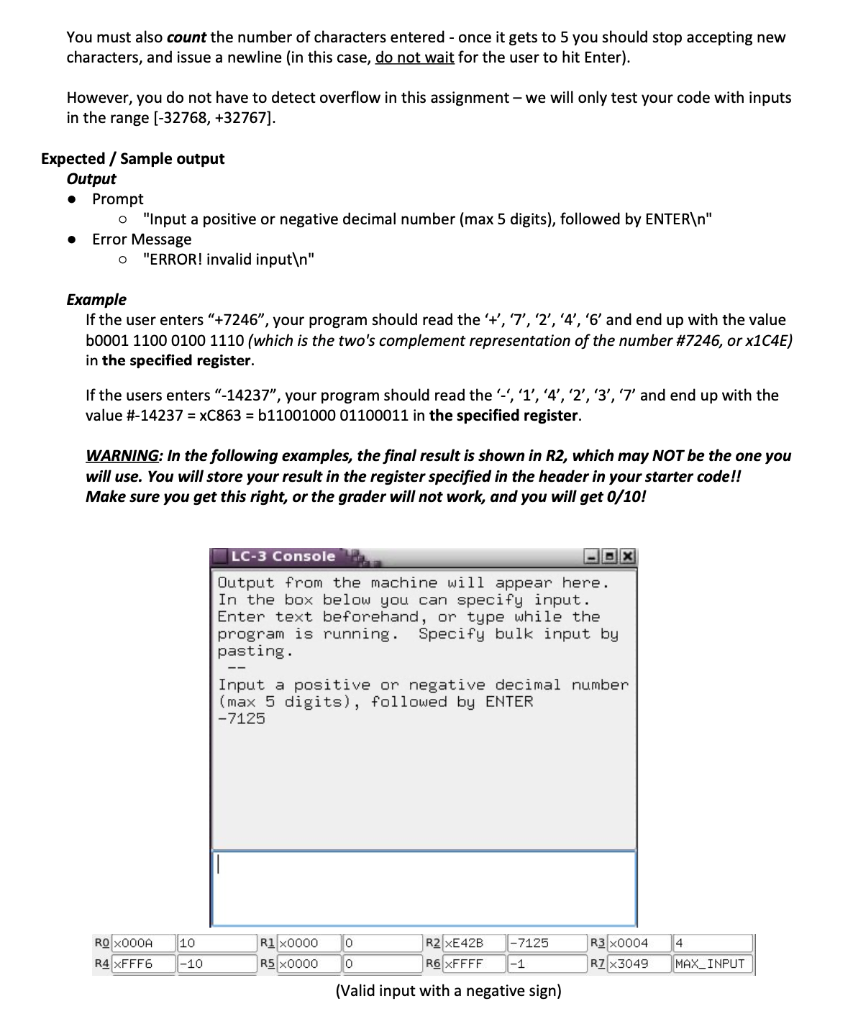
Objective The purpose of this assignment is to illustrate how the .FILL pseudo-op performs the task of translating textual decimal numbers (such as the string "+5392") into actual numbers (i.e. five thousand three hundred and ninety two, represented of course as a 16-bit two's complement binary value). High Level Description Prompt the user to enter a signed multi-digit decimal number (max 5 digits) from the keyboard. Convert the string of decimal numeric digits into the corresponding 16-bit two's complement number, stored in Rx (i.e. one of the 8 registers: you will be told which register at the start of the provided starter code). The range of acceptable values is (-32768, +32767]; the absence of a sign means the number is positive - i.e. the first character entered by the user may be '+','', or a numeric digit - and nothing else. Your Tasks Your program can be broken down into the following tasks: 1. Read in the initial character. If it is a '-, make the final result negative by setting a "flag" (so if the "negative" flag is set, take the 2's complement of Rx at the end). If it is '+' it can be ignored; If it is a numeric digit, then the number is not negative, and the input is just the first numeric digit of the number. In all three cases, you can then proceed to accept any remaining digits (see item 2.) If the initial character is a newline, the program can just terminate without any output. Any other initial character must be treated as an error (see below). 2. Convert the string of numeric digits input by the user into the binary number they represent (see examples below). To do this, you can follow this algorithm: Initialize Rx (and any other registers as needed) to 0 - DO NOT do this by LD'ing 0 from memory! There is a much simpler & faster way - remember the "TIP" in your lab 1 notes! Convert each digit from ascii code to binary number as it is typed in, and add it to Rx; as each subsequent digit is entered, multiply Rx by #10, and repeat (go back to lab 1 & assn 1 to recall how to multiply!) Stop when you detect the newline character (' ' = XOA), or when you reach 5 input digits: o For example, if the user types '2', then Rx will contain #2 = b0000 0000 0000 0010 If the user then types '3', making the string now read 23, then Rx will contain 2 x #10 + 3 = #23 = b0000 0000 0001 0111 If the user then types '4', making the string read 234, then Rx will contain #23 x #10 + 4 = #234 = b0000 0000 1110 1010 o You must also perform input character validation with this assignment - i.e. reject any non-numeric input character. That is, if the user enters "+23g, on detecting the non-numeric 'g', your program should output an error, discard all input, and start over with the initial prompt (see sample output). You must also count the number of characters entered - once it gets to 5 you should stop accepting new characters, and issue a newline (in this case, do not wait for the user to hit Enter). However, you do not have to detect overflow in this assignment - we will only test your code with inputs in the range (-32768, +32767). Expected / Sample output Output Prompt "Input a positive or negative decimal number (max 5 digits), followed by ENTER " Error Message "ERROR! invalid input " O o Example If the user enters "+7246", your program should read the '+','7', '2','4, '6' and end up with the value b0001 1100 0100 1110 (which is the two's complement representation of the number #7246, or x1C4E) in the specified register. If the users enters "-14237", your program should read the '-,'1', '4', '2', '3', '7' and end up with the value #-14237 = xC863 = b11001000 01100011 in the specified register. WARNING: In the following examples, the final result is shown in R2, which may NOT be the one you will use. You will store your result in the register specified in the header in your starter code!! Make sure you get this right, or the grader will not work, and you will get 0/10! LC-3 Console DOX Output from the machine will appear here. In the box below you can specify input. Enter text beforehand, or type while the program is running. Specify bulk input by pasting Input a positive or negative decimal number (max 5 digits), followed by ENTER -7125 -- ROXOOOA R4 XFFF6 10 -10 R1 X0000 R5 X0000 0 R2 XE42B - 7125 0 R6 XFFFF -1 (Valid input with a negative sign) R3 X0004 RZ X3049 MAX_INPUT Objective The purpose of this assignment is to illustrate how the .FILL pseudo-op performs the task of translating textual decimal numbers (such as the string "+5392") into actual numbers (i.e. five thousand three hundred and ninety two, represented of course as a 16-bit two's complement binary value). High Level Description Prompt the user to enter a signed multi-digit decimal number (max 5 digits) from the keyboard. Convert the string of decimal numeric digits into the corresponding 16-bit two's complement number, stored in Rx (i.e. one of the 8 registers: you will be told which register at the start of the provided starter code). The range of acceptable values is (-32768, +32767]; the absence of a sign means the number is positive - i.e. the first character entered by the user may be '+','', or a numeric digit - and nothing else. Your Tasks Your program can be broken down into the following tasks: 1. Read in the initial character. If it is a '-, make the final result negative by setting a "flag" (so if the "negative" flag is set, take the 2's complement of Rx at the end). If it is '+' it can be ignored; If it is a numeric digit, then the number is not negative, and the input is just the first numeric digit of the number. In all three cases, you can then proceed to accept any remaining digits (see item 2.) If the initial character is a newline, the program can just terminate without any output. Any other initial character must be treated as an error (see below). 2. Convert the string of numeric digits input by the user into the binary number they represent (see examples below). To do this, you can follow this algorithm: Initialize Rx (and any other registers as needed) to 0 - DO NOT do this by LD'ing 0 from memory! There is a much simpler & faster way - remember the "TIP" in your lab 1 notes! Convert each digit from ascii code to binary number as it is typed in, and add it to Rx; as each subsequent digit is entered, multiply Rx by #10, and repeat (go back to lab 1 & assn 1 to recall how to multiply!) Stop when you detect the newline character (' ' = XOA), or when you reach 5 input digits: o For example, if the user types '2', then Rx will contain #2 = b0000 0000 0000 0010 If the user then types '3', making the string now read 23, then Rx will contain 2 x #10 + 3 = #23 = b0000 0000 0001 0111 If the user then types '4', making the string read 234, then Rx will contain #23 x #10 + 4 = #234 = b0000 0000 1110 1010 o You must also perform input character validation with this assignment - i.e. reject any non-numeric input character. That is, if the user enters "+23g, on detecting the non-numeric 'g', your program should output an error, discard all input, and start over with the initial prompt (see sample output). You must also count the number of characters entered - once it gets to 5 you should stop accepting new characters, and issue a newline (in this case, do not wait for the user to hit Enter). However, you do not have to detect overflow in this assignment - we will only test your code with inputs in the range (-32768, +32767). Expected / Sample output Output Prompt "Input a positive or negative decimal number (max 5 digits), followed by ENTER " Error Message "ERROR! invalid input " O o Example If the user enters "+7246", your program should read the '+','7', '2','4, '6' and end up with the value b0001 1100 0100 1110 (which is the two's complement representation of the number #7246, or x1C4E) in the specified register. If the users enters "-14237", your program should read the '-,'1', '4', '2', '3', '7' and end up with the value #-14237 = xC863 = b11001000 01100011 in the specified register. WARNING: In the following examples, the final result is shown in R2, which may NOT be the one you will use. You will store your result in the register specified in the header in your starter code!! Make sure you get this right, or the grader will not work, and you will get 0/10! LC-3 Console DOX Output from the machine will appear here. In the box below you can specify input. Enter text beforehand, or type while the program is running. Specify bulk input by pasting Input a positive or negative decimal number (max 5 digits), followed by ENTER -7125 -- ROXOOOA R4 XFFF6 10 -10 R1 X0000 R5 X0000 0 R2 XE42B - 7125 0 R6 XFFFF -1 (Valid input with a negative sign) R3 X0004 RZ X3049 MAX_INPUT
Step by Step Solution
There are 3 Steps involved in it

Get step-by-step solutions from verified subject matter experts